
智慧高速

Search documents
“四变八”成雅高速扩容启动 预计通行能力将提升约50%
Si Chuan Ri Bao· 2025-09-29 00:34
Core Points - The Chengya Expressway expansion project has officially entered the construction phase, marking a significant infrastructure development in Sichuan Province as part of the national "14th Five-Year Plan" [2] - The project involves a total estimated investment of nearly 30 billion yuan, with a planned completion date in 2029 [2] - The expansion will increase the expressway's capacity by approximately 50% by widening the lanes from a dual six-lane and four-lane configuration to a dual eight-lane configuration [3] Group 1: Project Overview - The Chengya Expressway, originally opened in 2000, will be expanded to approximately 159 kilometers, including a new Lu Mountain branch line of 24.367 kilometers [2] - The main line will undergo significant upgrades, including the reconstruction of 20 interchanges and the addition of 4 new interchanges [2] - The new Lu Mountain branch will reduce travel time between Lu County and Mingshan District from 1 hour to 20 minutes, addressing the lack of direct expressway connections [2] Group 2: Technological and Operational Enhancements - The expansion will incorporate smart highway features, enhancing operational management through digital and intelligent systems, including dynamic lane control and emergency response measures [3] - The project aims to create a safer, more convenient, and comfortable expressway experience for travelers, integrating tourism and transportation [3] Group 3: Construction Strategy - The construction will focus on minimizing traffic disruption by implementing design and traffic organization strategies, such as single-side widening and phased construction [4] - The project will ensure that the existing road base remains stable while integrating new construction, addressing potential settlement issues through advanced engineering techniques [4] - All construction units have commenced work on various segments of the project, with simultaneous development of supporting infrastructure to ensure effective logistics and support [5]

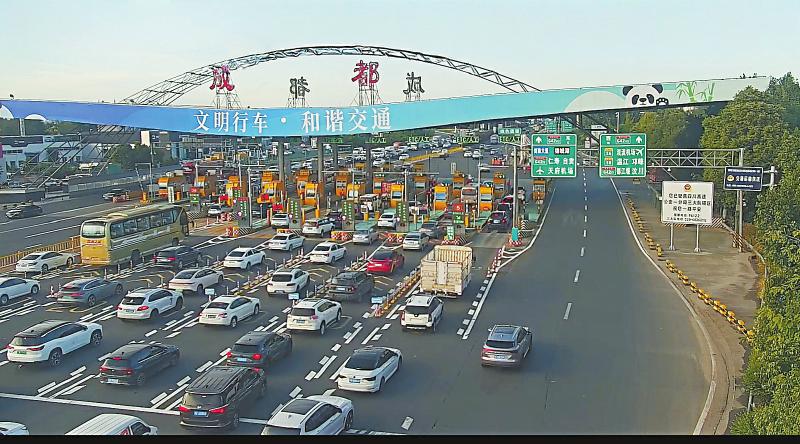
拓维信息与安徽交控信息达成战略合作
Xin Lang Cai Jing· 2025-09-03 11:18
Group 1 - Anhui Jiaokong Information Industry Co., Ltd. has officially reached a strategic cooperation with Tuo Wei Information System Co., Ltd. and Hunan Kaihong Zhigu Digital Industry Development Co., Ltd. [1] - The three parties will explore new cooperation models in the field of smart highways, focusing on domestic software and hardware technologies such as Kunpeng, Ascend AI, and open-source HarmonyOS [1] - This collaboration aims to inject strong new momentum into the digital transformation of the transportation industry [1]

中日韩高速每公里收费对比:日本1.1元,韩国0.42元,中国多少钱
Sou Hu Cai Jing· 2025-08-27 22:31
Core Insights - The article discusses the differences in highway toll pricing and infrastructure management among China, Japan, and South Korea, highlighting China's competitive advantage in terms of cost and efficiency. Pricing Comparison - Japan's highway toll is approximately 1.1 yuan per kilometer, making it the most expensive among the three countries, with a legislative toll period extending to 2115, effectively creating a "permanent toll" situation [4] - South Korea charges about 0.42 yuan per kilometer, less than one-third of Japan's rate, with a clear toll period of 20 to 30 years, after which highways become free [7] - China's highway toll is around 0.4 yuan per kilometer, slightly cheaper than South Korea, with a total length exceeding 160,000 kilometers, making it the longest in the world [10] Infrastructure Management - Japan's high costs are attributed to geographical challenges, such as mountains and earthquakes, leading to expensive construction and maintenance [3] - South Korea benefits from a unified management system under a single road corporation, allowing for efficient planning and cost distribution [7] - China's highway construction has been standardized since 2004, leading to significant cost savings through bulk material purchases and efficient project execution, such as the rapid completion of the Hong Kong-Zhuhai-Macao Bridge [11][10] Technological Innovations - South Korea is implementing innovative solutions like solar-powered highway barriers and electric vehicle charging stations, which may reduce reliance on toll fees in the future [9] - China is advancing towards smart highways, including features for autonomous driving, enhancing convenience for users [12]

浙江沪杭甬(00576)发布中期业绩 股东应占溢利27.87亿元 同比增长4%
智通财经网· 2025-08-22 14:19
Core Viewpoint - Zhejiang Huhangyou (00576) reported a 3.8% increase in revenue for the six months ending June 30, 2025, compared to the same period in 2024, reaching RMB 8.685 billion, with a net profit attributable to shareholders of RMB 2.787 billion, reflecting a 4.0% year-on-year growth [1][2] Group 1: Financial Performance - The company's basic earnings per share increased by 4.0% to RMB 0.4651, while diluted earnings per share rose by 5.6% to RMB 0.4651 [1] - The group achieved a steady financial performance amidst a complex environment, demonstrating resilience and strategic focus [1] Group 2: Operational Enhancements - The company implemented measures such as hard shoulder opening and smart upgrades to improve road network efficiency, resulting in reduced congestion and shorter toll station closure times [1] - Enhanced planning and organization of roadwork, along with optimized construction schedules, contributed to ongoing upgrades in road maintenance [2] Group 3: Strategic Investments - The company is advancing major investment and acquisition projects, including the construction of the Yongjin Expressway and the successful bid for the second phase of the Yongzhou Expressway [2] - A 51% stake acquisition in the Gui San Expressway, a key route connecting the Sichuan-Chongqing and Guangdong-Hong Kong-Macau regions, further strengthens the company's regional strategic layout [2] Group 4: Green and Innovative Initiatives - The company is accelerating the integration of AI technologies and conducting research on advanced technologies such as drone inspections to enhance smart highway operations [2] - The successful operation of a new energy heavy truck charging station at the Yongjin Expressway service area marks a significant step in establishing a demonstration transport route for electric container trucks [2] - The company is also expanding its renewable energy projects, including the successful grid connection of distributed photovoltaic power generation on the Yongzhou Expressway [2]
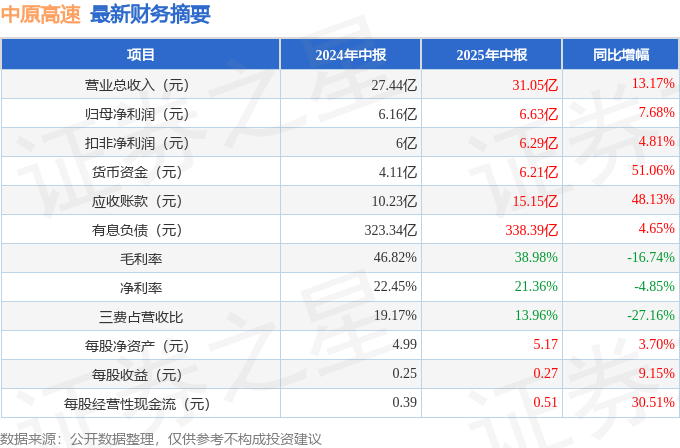
中原高速2025年中报简析:营收净利润同比双双增长,应收账款上升
Zheng Quan Zhi Xing· 2025-08-09 22:25
Core Viewpoint - Zhongyuan Expressway (600020) reported a solid performance in its 2025 mid-year financial results, with total revenue and net profit showing year-on-year growth, although there was a decline in quarterly net profit [1] Financial Performance - Total revenue for the first half of 2025 reached 3.105 billion yuan, a year-on-year increase of 13.17% compared to 2.744 billion yuan in 2024 [1] - Net profit attributable to shareholders was 663 million yuan, up 7.68% from 616 million yuan in the previous year [1] - The second quarter saw total revenue of 1.806 billion yuan, a 9.5% increase year-on-year, but net profit decreased by 7.39% to 307 million yuan [1] - The gross margin was 38.98%, down 16.74% year-on-year, while the net margin was 21.36%, a decrease of 4.85% [1] Key Financial Metrics - Accounts receivable increased significantly by 48.13% year-on-year, reaching 1.515 billion yuan [1] - Cash and cash equivalents rose by 51.06% to 621 million yuan [1] - The total expenses (selling, administrative, and financial) amounted to 434 million yuan, representing 13.96% of revenue, a decrease of 27.16% [1] - Earnings per share increased by 9.15% to 0.27 yuan, while operating cash flow per share rose by 30.51% to 0.51 yuan [1] Business Model and Investment Insights - The company's return on invested capital (ROIC) was 3.77%, indicating historically weak capital returns, with a median ROIC of 5.15% over the past decade [3] - The business model relies heavily on capital expenditures, necessitating careful evaluation of capital projects and their financial viability [3] - Analysts expect the company's performance in 2025 to reach 1 billion yuan, with an average earnings per share forecast of 0.45 yuan [3] Debt and Cash Flow Management - The company has a debt-to-asset ratio of 63.83%, with interest-bearing liabilities totaling 33.839 billion yuan, which is 15.32 times the average operating cash flow over the past three years [3] - The company plans to optimize its debt structure and improve repayment capabilities through various financing channels, including bank loans and bond issuance [5]

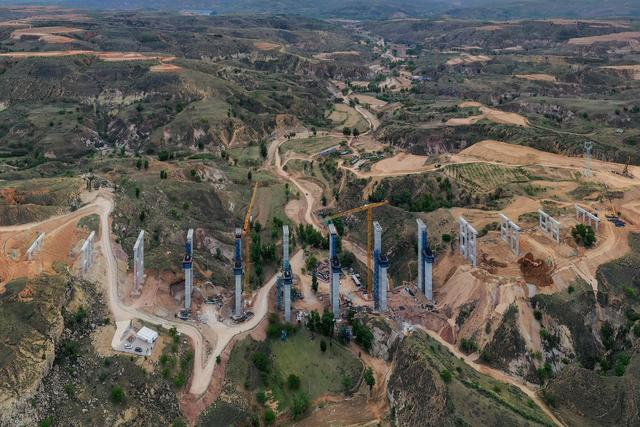
道路更智慧 通行更顺畅
Liao Ning Ri Bao· 2025-07-12 01:23
Core Viewpoint - The reconstruction and expansion of the Jingha Expressway's Shenshan section aims to enhance traffic flow and safety, incorporating advanced technologies and new traffic management strategies to accommodate increased vehicle volume and improve operational efficiency [1][2][3]. Group 1: Infrastructure Expansion - The Shenshan section of the Jingha Expressway will add four lanes, resulting in a total of ten lanes for two-way traffic, significantly improving traffic flow [4][5]. - The project is expected to complete earlier than planned, with the Beijing direction anticipated to open by late July and full dual-direction operation by the end of September [1]. Group 2: Smart Technology Integration - The Shenshan section features a comprehensive smart highway system, including 32 platforms and 84 algorithms for real-time monitoring of traffic and environmental conditions, utilizing AI for video analysis and weather monitoring [3]. - Drones have been deployed along the highway to enhance surveillance and emergency response capabilities, with 27 drone nests installed for automated patrols [2]. Group 3: Traffic Management Innovations - New traffic management features include the introduction of a left-side hard shoulder for emergency stops and a tidal lane system to optimize traffic flow between passenger and freight vehicles [4][5]. - The tidal lane will dynamically adjust based on traffic conditions, allowing for flexible use of lanes depending on the volume of passenger and freight traffic [5]. Group 4: Safety Enhancements - The reconstruction includes new M-type guardrails designed to improve safety by reducing the risk of vehicle crossover and minimizing injury during accidents [6]. - Additional safety features such as mileage markers and warning signs have been implemented to assist drivers in accurately identifying their location and preparing for lane changes [6][7].
六个行动·微故事丨道路通,发展更快了!
Nei Meng Gu Ri Bao· 2025-06-04 15:30
Core Viewpoint - The construction of key transportation projects in Inner Mongolia, such as the S26 Nalong Expressway and Provincial Road 220, is expected to significantly enhance regional connectivity, promote economic development, and improve living standards for local residents [1][4][10]. Group 1: Project Details - Provincial Road 220, spanning 125.755 kilometers, is crucial for connecting the Xilin Gol League and Chifeng City, facilitating the flow of people and goods, and supporting local industries like agriculture and tourism [1][5]. - The S26 Nalong Expressway, with a total investment of 7 billion yuan, is a major project aimed at improving coal transportation efficiency between Inner Mongolia and Shanxi [2][10]. - The construction of both roads is part of a broader initiative to enhance transportation infrastructure in Inner Mongolia, with plans to invest 48 billion yuan in 72 major projects by 2025 [10]. Group 2: Construction Techniques and Innovations - Innovative construction methods, such as "segmented prefabrication and multi-point synchronous transportation," are being employed to address challenges posed by complex terrain in the S26 Nalong Expressway project [2][6]. - The use of green and low-carbon technologies, including the incorporation of industrial waste into concrete, is being prioritized to enhance sustainability and reduce carbon emissions during construction [6][10]. - The construction teams are overcoming geological challenges through various techniques, ensuring the stability and safety of the roadbed and structures [5][6]. Group 3: Economic and Social Impact - The completion of these roads is anticipated to create more job opportunities and increase income for residents along the routes, thereby contributing to local economic growth [1][4]. - The development of transportation infrastructure is expected to facilitate tourism by improving access to scenic areas, thus integrating tourism resources and enhancing overall economic benefits [5][6]. - The ongoing construction efforts reflect a commitment to high-quality development in Inner Mongolia, with a focus on improving living conditions and economic prospects for local communities [6][10].
中威电子(300270) - 300270中威电子投资者关系管理信息20250514
2025-05-14 09:12
Group 1: Core Technology Advantages - The company's core technology advantages are reflected in five key areas: deep accumulation in video technology, intelligent algorithms and big data analysis capabilities, IoT perception and system integration advantages, smart hardware and scenario-based solutions, and integrated services and market expansion capabilities [1]. Group 2: Financial Performance - In 2024, the company has not yet turned a profit, but the operating situation has improved, with a reduction in the loss margin compared to the previous year. Revenue has increased, and the gross profit margin has improved [2]. - The gross profit margin for 2024 is 26.39%, slightly up from 23.67% in 2023, primarily due to accelerated technological iterations in the video surveillance field and competitive pricing strategies [4]. Group 3: Cost Reduction and Efficiency Improvement - The company has implemented cost reduction measures such as procurement negotiations and inventory management, which have effectively lowered procurement costs and inventory backlog [2]. - The deployment of the PMS project management platform has optimized resource allocation and reduced delay risks through real-time monitoring [2]. Group 4: Research and Development Investment - In 2024, the company invested 20.0273 million yuan in R&D, accounting for 10.97% of total revenue. The focus will be on integrating products with digital technologies in smart highways and upgrading solutions for smart parks [4]. - Despite a 31.22% year-on-year decrease in R&D expenses, the company has optimized processes to lower marginal costs and concentrated resources on high-potential areas, ensuring no negative impact on innovation [5]. Group 5: Future Growth and Profit Distribution - Future profit growth points are expected to come from deepening core business, expanding into emerging fields, and innovating business models while improving operational efficiency and cash flow [5]. - The company will not distribute profits for 2024 due to negative retained earnings, but has a three-year shareholder dividend plan in place [4].
