智能手机高端化

Search documents
全球智能手机市场“量缓价升” AI手机与折叠屏机型迎来新增长机会
Zheng Quan Ri Bao Wang· 2025-08-07 12:59
Core Insights - The global smartphone market revenue reached a record high of over $100 billion in Q2 2025, marking a 10% year-on-year growth, while the shipment volume only grew by 3% [1] - The average selling price (ASP) of smartphones also hit a new high, increasing by 7% to nearly $350, indicating a trend of "volume slowing, price rising" driven by strong demand in the high-end market [1][2] - Major brands like Apple, Samsung, Xiaomi, OPPO, and vivo all reported year-on-year revenue growth in Q2 2025, with Apple leading the market with a 43% share and a 13% increase in revenue [2] Market Dynamics - High-end device demand is particularly strong in developed markets, supported by expanded financing options, trade-in programs, and aggressive promotional activities that lower the entry barrier for consumers [1][2] - OPPO achieved a 14% increase in average selling price, the highest among the top five brands, despite a decline in shipment volume, thanks to the success of its high-end models [2] - Vivo's revenue grew by 4% and shipment volume by 5%, driven by expansion in markets like India, the Middle East, Africa, and Latin America, while also increasing its share in Europe [2] Industry Trends - The smartphone industry is undergoing a structural adjustment where revenue growth outpaces shipment growth, indicating a shift towards enhancing product value and user experience as the market approaches saturation [2][3] - The trend of value growth replacing quantity growth is expected to become the new normal in the smartphone industry, with a focus on innovation in hardware, software, and AI ecosystems [3] - Future growth opportunities are anticipated from emerging trends such as generative AI smartphones and foldable devices, which are expected to significantly impact the global smartphone market [3]

小米手机欧洲份额超苹果,全球出货受印度拖累
Guan Cha Zhe Wang· 2025-08-07 09:38
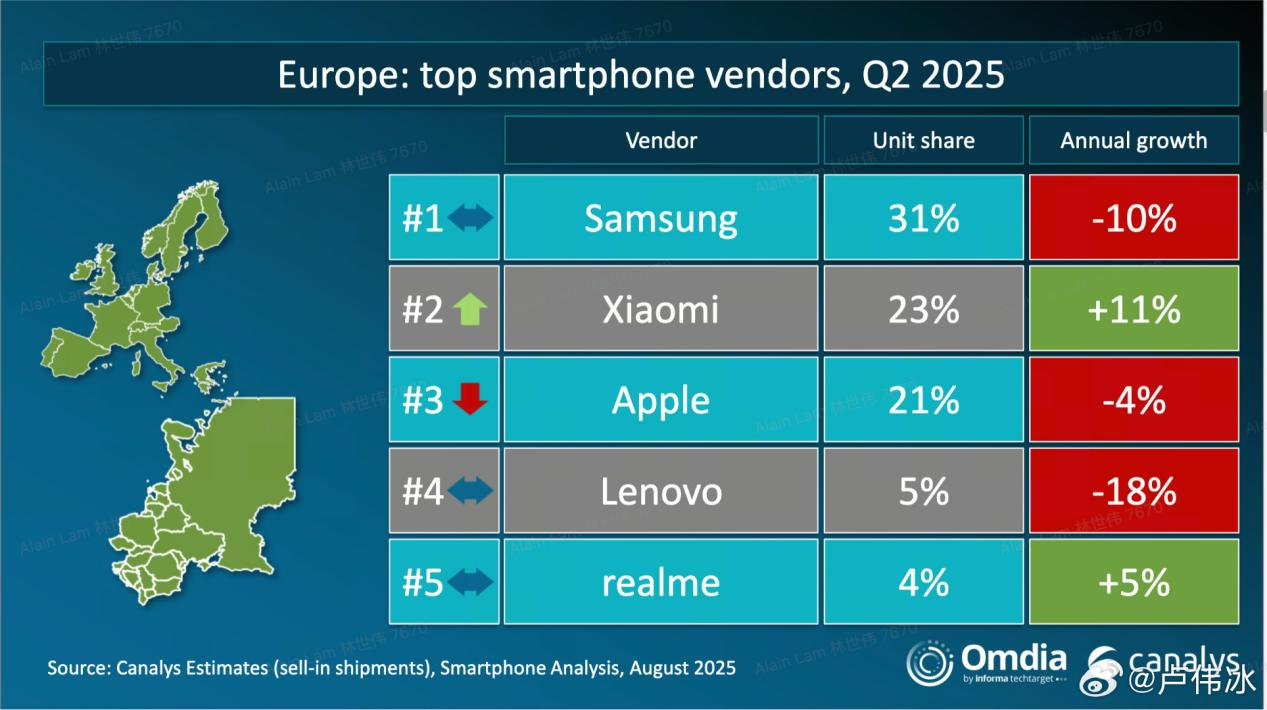
Group 1 - Xiaomi's smartphone market share in Europe ranked second in Q2 2025, with a focus on high-end strategy for future growth [1] - In Q2 2025, Xiaomi held a 23% market share in Europe, showing an 11% annual growth, while Samsung led with 31% but experienced a -10% annual growth [2] - Globally, smartphone shipments slightly declined to 288.9 million units in Q2 2025, with Xiaomi maintaining stable shipments of 42.4 million units and a 15% market share [3] Group 2 - Xiaomi's smartphone shipments in India dropped by 25% year-on-year, impacting overall performance [4][5] - Despite achieving a historical high of 15% global market share, Xiaomi's gross margin declined, with total revenue for Q2 2025 estimated at 112.6 billion RMB, slightly below market expectations [5] - In the electric vehicle sector, Xiaomi is expected to deliver 82,000 units in Q2 2025, with an average selling price of 242,000 RMB and an improved gross margin of 25% [6] Group 3 - Due to revised forecasts for smartphone gross margins, analysts have lowered Xiaomi's earnings per share estimates for 2025 to 2027 by 2% to 7%, and reduced the target price from 78 HKD to 72 HKD while maintaining a "buy" rating [7]

Counterpoint Research:2025年Q1中东和非洲智能手机出货量同比增长7%
智通财经网· 2025-05-29 03:17
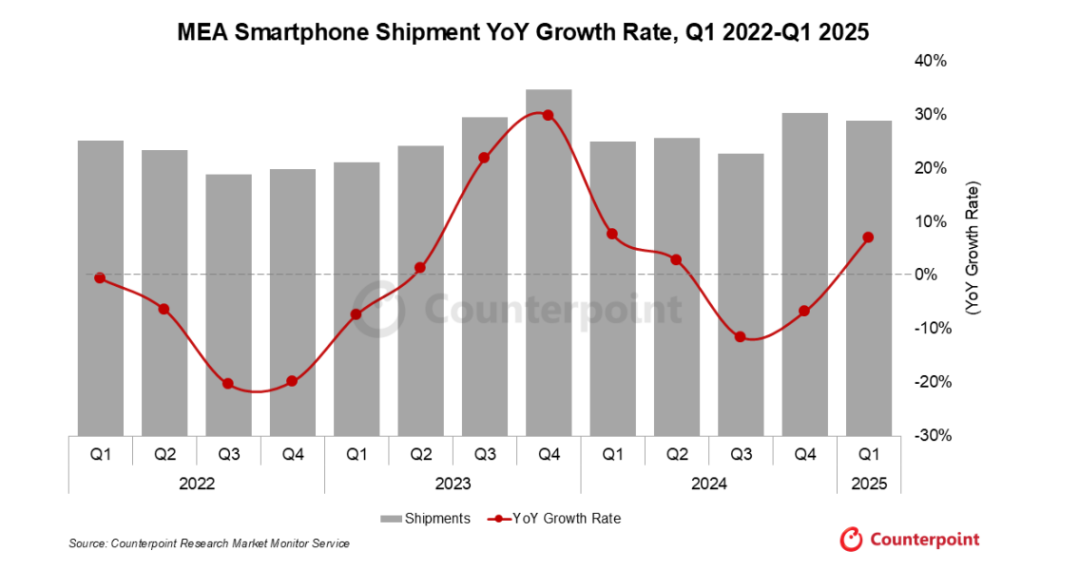
Core Insights - The smartphone shipment volume in the Middle East and Africa is expected to grow by 7% year-on-year in Q1 2025, marking the first positive growth after two consecutive quarters of decline [1] - Strong demand during Ramadan and Easter, expanded device supply, and moderate inflation have driven consumer spending in the region [1] Market Dynamics - The smartphone market in the Middle East and Africa is entering an adjustment phase in 2024, with brands focusing on clearing old inventory and reducing new product launches, leading to a decrease in active brands [6] - Despite the adjustment, the market is expected to see a strong recovery in early 2025 due to improved supply and the release of pent-up demand, particularly for budget models under $100 [6] - High-end smartphones priced above $800 continue to show robust growth, indicating a persistent trend towards premiumization [6] 5G Adoption - The 5G adoption rate in the region has slightly increased, reaching a market share of 33% in Q1 2025, with brands like Samsung, Xiaomi, and HONOR leading the growth in the $400 to $499 price segment [6] - The reduction in 5G component costs and significant investments from African operators, along with government digitalization efforts, have contributed to the proliferation of 4G and 5G infrastructure [6] Display Technology - The penetration rate of OLED displays reached 42% in Q1 2025, driven by consumer demand for vibrant colors, better contrast, and energy efficiency [7] - Smartphones with screens larger than 6.5 inches are increasingly popular, as users prefer high-resolution displays for enhanced viewing experiences [7] Brand Performance - Samsung maintained its market leadership with a 15% year-on-year increase in shipments, streamlining its product offerings from 103 to 76 models to focus on higher quality [12] - Transsion holds a 32% market share in the region, up from 29% last year, with TECNO achieving a 31% growth rate due to strong promotions in the mid-range market [12] - Xiaomi's shipments decreased by 2%, but its LTE smartphones saw a 27% year-on-year growth, primarily in the low-end market [13] - Apple experienced a 4% increase in shipments, with its market share rising to 6%, driven by the strong performance of the new iPhone 16e in price-sensitive markets [13]

安卓厂商集体兼容苹果,能抢走多少iPhone用户?
虎嗅APP· 2025-05-07 10:58
Core Viewpoint - Android manufacturers are increasingly integrating with Apple's ecosystem to attract iPhone users, as the smartphone market growth slows down and they seek new opportunities for expansion [7][8]. Group 1: Android Manufacturers' Strategies - Vivo launched the X200 Ultra and X200s, which allow deep integration with Apple's ecosystem, enabling data transfer and notification sharing between Vivo and iPhone devices [4][6]. - Other Android brands like OPPO and Xiaomi have also introduced features for file transfer and remote control with Apple devices, indicating a collective move towards compatibility with Apple's ecosystem [6][15]. - The strategy of compatibility is seen as a necessity for Android manufacturers to capture new users, particularly from Apple's loyal customer base [7][8]. Group 2: Market Share and Performance - According to IDC, in 2024, Apple's market share in China is projected to be 15.6%, ranking third, while it holds a dominant 60% share in the premium market segment priced above $800 [9]. - The market share data for 2024 shows Vivo at 17.2%, Huawei at 16.6%, and Apple at 15.6%, with Apple experiencing a decline of 5.4% year-over-year [11]. - Xiaomi's smartphone shipments have shown significant growth, with a 39.9% increase in Q1 2025 compared to Q1 2024, indicating a successful strategy in attracting users from Apple [19][20]. Group 3: Challenges in High-End Market - Despite efforts to attract Apple users, Android manufacturers face challenges in converting them to high-end products, as many users still prefer mid-range options [27][28]. - The high-end smartphone market has seen a shift, with Huawei gaining market share at the expense of Apple, while other Android brands have not significantly increased their presence in this segment [24][27]. - The integration with Apple's ecosystem has not yet translated into substantial gains in the high-end market for brands like OPPO, Vivo, and Xiaomi [24][27].
智能手机重启高端局,移动SoC动摇棋盘
远川研究所· 2025-04-15 12:28
超出预期的还在于高端化趋势的进一步确认。根据IDC报告,当前旗舰手机售价普遍提升,尤其在头部品牌 集中度极高的中国市场,预测2025年高端机型(600美元以上价位)份额将历史性扩大至30.9%[2]。 这背后两大推动力不可忽视:一方面是生成式AI带来的手机功能质变,激活消费者的换机热情;另一方面 是移动游戏进入精品化竞争,拉动玩家对高性能手机的需求。 两大趋势都仰赖一颗核心硬件——移动SoC,将其推向了高端化的新博弈。 掀开增长的天花板 2019年以后,智能手机换机周期不断拉长,出货量增长的天花板肉眼可见,如何提高单机利润率,成为手 机品牌涌向高端化赛道的内驱力。 过去主流的高端化打法是在零部件上做加法,通过增加摄像头数量、折叠屏等提升单机价值量,激发消费 意愿,但效益逐渐见顶。直到生成式AI带来了变革。 生成式AI从根本上重塑了人机交互方式,手机功能从被动地使用进化至主动地提供服务,颠覆了软硬件设 计的底层逻辑,带来焕然一新的用户体验,比如端对端的任务交付、通过对话提供的情绪价值,成为消费 者下单新手机的理由。 去年年中,调研机构IDC预测,全球智能手机出货量将在这一年结束两年下滑、提升4%,这个数字在两个 ...
中国智能手机市场: 2024 年高端化趋势持续增强
Counterpoint Research· 2025-03-05 09:45
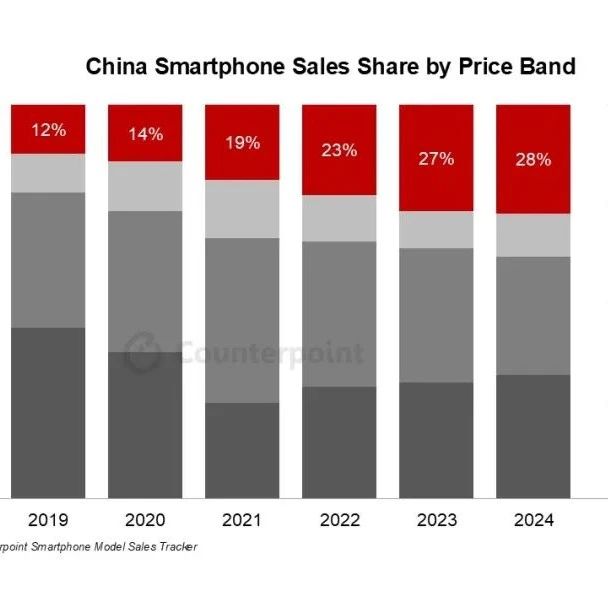
Core Insights - The high-end smartphone market in China (priced at $600 and above) is projected to reach a sales share of 28% in 2024, a significant increase from 11% in 2018, indicating a clear trend towards premium devices in the Chinese smartphone market [1][2][4]. Group 1: Market Trends - The trend towards high-end smartphones has accelerated since 2017, particularly following the U.S. ban on Huawei, which has further propelled this shift [1][2]. - Huawei has emerged as a key driver of this trend, with its market share in the high-end segment increasing to 29%, the highest among Chinese smartphone brands [2][4]. - Other Chinese brands have also intensified their focus on the high-end market, with their overall market share in this segment rising from 5% in 2020 to 15% in 2024 [2][5]. Group 2: Competitive Landscape - Apple and Huawei continue to dominate the high-end smartphone market, together accounting for 83% of total sales in this segment in 2024 [4]. - Huawei's recovery, following the return of its 5G Kirin chips, has led to a market share increase from 20% in 2023 to 29% in 2024, with a remarkable 37% overall sales growth and a 52% increase in the high-end market [4][5]. - Other major Chinese brands, such as Xiaomi and Vivo, have seen approximately 50% year-on-year growth in the high-end market, although they still face challenges in establishing a significant presence [5]. Group 3: Future Outlook - The trend towards high-end smartphones in China is expected to continue, with local brands solidifying their dominance in the $400-$600 price range, increasing their market share from 89% in 2023 to 91% in 2024 [5]. - As competition intensifies, smartphone manufacturers will need to focus on product innovation, localization, and brand differentiation to stand out in this rapidly evolving market [5].