杠杆牛

Search documents
5万家机构在融资,难道杠杆牛又来了?
Sou Hu Cai Jing· 2025-08-15 08:14
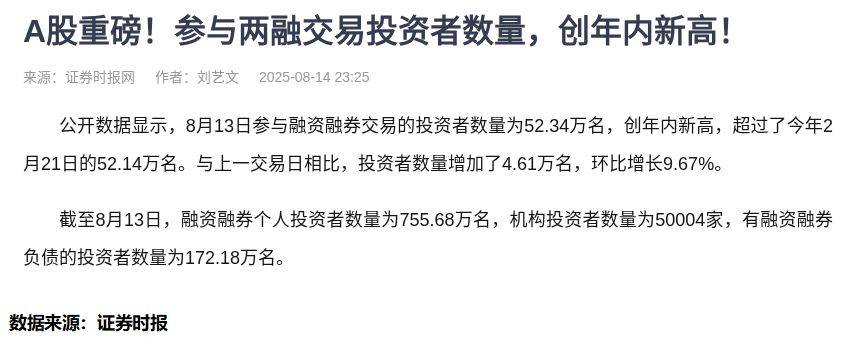
Group 1 - The core viewpoint of the article suggests that the recent adjustment in the A-share market is timely, highlighting the disparity in behavior between institutional investors and retail investors during market fluctuations [1] - The article notes that the current margin trading activity has reached a new high for the year, with over 520,000 investors actively participating, reminiscent of the "leveraged bull market" ten years ago, but with a more stable leverage ratio compared to 2015 [1][3] - Regulatory measures have increased the margin requirement to 80%, which is seen as a protective measure for retail investors, indicating that sometimes policy restrictions can serve as a safeguard [5] Group 2 - The article discusses two psychological syndromes observed in bull markets: "fear of heights," where investors miss opportunities during corrections, and "impulse syndrome," where investors become overly excited at market peaks [6][10] - It emphasizes the importance of understanding institutional trading behaviors, suggesting that stocks with active institutional participation are more likely to present genuine investment opportunities [8][10] - The article concludes that the current market dynamics differ significantly from past experiences, urging investors to focus on data-driven analysis rather than superficial market movements to keep pace with market trends [13]

“A股慢牛说”开始风靡
吴晓波频道· 2025-08-14 01:10
Core Viewpoint - The article discusses the emergence of a "slow bull" market in A-shares, contrasting it with previous rapid bull markets and highlighting the importance of understanding the current market dynamics for investment strategies [2][5][42]. Group 1: Characteristics of the "Slow Bull" Market - The current A-share market is showing signs of a "slow bull" similar to the U.S. market, characterized by steady growth rather than rapid spikes [6][10]. - Key elements of a "slow bull" include strong economic fundamentals, high dividends, and loose market liquidity, which are evident in the current A-share environment [7][8][11]. Group 2: Economic Fundamentals - As of mid-2025, China's GDP growth rate reached 5.3%, exceeding the initial target of 5%, with a notable 9.08% year-on-year revenue growth and a 16.87% increase in net profit among A-share companies [11][12]. - The trend of increasing dividends is also present, with A-share companies distributing 2.4 trillion yuan in dividends in 2024, a 9% increase year-on-year [13]. Group 3: Market Liquidity - The liquidity in the A-share market is being bolstered by institutional and individual investors, with significant policy support aimed at increasing long-term capital inflow [14][16]. - A notable increase in new A-share accounts, reaching 1.9636 million in July 2025, indicates growing retail investor participation [16]. Group 4: Impact of Real Estate Market - The decline of major real estate companies, such as China Evergrande, is shifting capital flows from real estate to the stock market, enhancing the attractiveness of A-shares [20][21]. - The overall sales of the top 100 real estate companies fell by 13.3% year-on-year in the first seven months of 2025, indicating a weakening real estate sector [20]. Group 5: Policy Support and Investor Confidence - Regulatory measures, including interest rate cuts and reduced IPO activity, have been implemented to support the A-share market, fostering investor confidence [28][30]. - The tightening of IPO policies has been perceived positively by investors, contributing to a sense of security in the market [32][34]. Group 6: Market Sentiment and Future Outlook - Despite the positive indicators, a significant portion of capital remains cautious, with 63.8% of residents still favoring savings over investments [37]. - Analysts generally agree on the existence of a "slow bull" market, with differing opinions on the pace and main drivers of growth, particularly in technology and manufacturing sectors [42][44].

A股融资余额破2万亿 创近10年新高
Zhong Guo Jing Ying Bao· 2025-08-12 04:15
Group 1 - The core viewpoint of the articles highlights that the A-share financing balance has officially surpassed 2 trillion yuan, reaching a nearly 10-year high as of August 11, 2023 [1][2] - The last time the A-share financing balance exceeded 2 trillion yuan was on May 20, 2015, during a "fast bull" market when the Shanghai Composite Index was approaching the 4500-point mark [1] - The previous surge in financing balance from 1 trillion yuan to 2 trillion yuan occurred within 100 trading days, coinciding with a rapid rise in the Shanghai Composite Index [1] Group 2 - The current increase in A-share financing balance to over 2 trillion yuan has been characterized by a longer period of "energy accumulation," indicating a more stable leverage level compared to previous years [2] - Following the peak in 2015, the financing balance dropped to around 700 billion yuan, with a subsequent rise to over 1.7 trillion yuan in 2021 before declining again [2] - As of August 11, 2023, the financing balance accounts for 2.29% of the A-share circulating market value, significantly lower than the historical peak of 4.72% [2]
如果牛市来到,红利类资产是否会有收益大幅跑输的风险?
雪球· 2025-07-15 08:30
Core Viewpoint - The article discusses the performance of dividend assets compared to growth assets in different market phases, highlighting the potential risks of dividend assets under certain market conditions, particularly during bull markets [4][26]. Market Phases Analysis - From 2014 to present, dividend assets have shown low volatility and steady growth, while growth assets like the ChiNext have experienced more dramatic fluctuations [6]. - In the early bull market phase (2014-2015), the dividend index rose by 177%, but growth stocks outperformed with a 194% increase in the ChiNext index [8]. - During the 2015 stock market crash, the dividend index fell by 44%, similar to the declines in the CSI 300 and ChiNext indices [11]. - In the structural bull market phase (2016-2017), the dividend index increased by 44%, matching the CSI 300, while the ChiNext index only rose by 6% [14]. - In the bear market of 2018, the dividend index decreased by 25%, but it had the smallest decline compared to other indices [17]. - From 2019 to 2021, the dividend index only increased by 24%, significantly lagging behind the ChiNext's 170% rise [19]. - During the adjustment period (2021-2022), the dividend index fell by 4%, outperforming the CSI 300 and ChiNext indices [21]. - In the current oscillation phase (2022-2024), the dividend index has risen by 4%, while other indices have declined [23]. - Looking ahead to the potential explosive phase starting in Q4 2024, the dividend index is expected to lag behind growth styles due to a lack of valuation elasticity [25]. Investment Strategy Insights - The article concludes that while dividend assets may underperform in bull markets driven by risk appetite, they can perform well in structural bull markets where both valuation and earnings recover [26]. - Historical market trends indicate that a balanced asset allocation is essential for navigating different market environments and achieving sustainable returns [27].