
生态环境分区管控

Search documents
创意图解:建设美丽中国,如何推动全面绿色转型?
Xin Lang Cai Jing· 2026-01-22 13:01
Group 1 - The article discusses the significant progress in ecological restoration in China, highlighting that by the end of November 2026, 21 counties in the Taklamakan Desert region have achieved an additional afforestation area of 8.3822 million acres [1] - It emphasizes the implementation of major ecological protection and restoration projects, which enhance the diversity, stability, and sustainability of the ecosystem [1] - The article outlines the promotion of a green production and lifestyle, integrating ecological concepts into economic and social development across various sectors [1] Group 2 - Specific measures include the establishment of ecological environment zoning management systems, which have been implemented in over 40,000 areas [1] - The article mentions the commitment to adjust industrial structures, pollution control, and ecological protection as part of the "14th Five-Year Plan" to build a beautiful China that coexists harmoniously with nature [1] - It highlights the importance of the concept that "lucid waters and lush mountains are invaluable assets" in guiding various industries and regions towards sustainable development [1]


中国工程院院士王金南:如何理解以制度协同改革引领排污许可优化?
Xin Lang Cai Jing· 2026-01-19 01:26
Core Viewpoint - The article emphasizes the importance of reforming the three core systems of ecological environment zoning control, environmental impact assessment (EIA), and pollutant discharge permits to enhance ecological governance modernization and support high-quality development [1][13]. Summary by Sections System Positioning - Ecological environment zoning control provides the "bottom line" and "framework" for various development activities, serving as a foundational system for ecological management and ensuring the construction of a beautiful China [2][14]. - EIA acts as the main system for source prevention, controlling environmental access for planning and projects, and requires reform to reduce burdens on grassroots while maintaining strict access controls [2][14]. - Pollutant discharge permits are the core system for regulating fixed pollution sources, connecting source control with end-of-pipe governance, and enabling precise lifecycle management of pollution sources [2][14]. System Interconnection - The three systems are interconnected, forming a logical loop of "spatial control—access control—emission regulation," with each system aiming to improve environmental quality through precise management [3][15]. - Zoning control focuses on spatial dimensions, EIA on decision-making dimensions, and pollutant discharge permits on emission dimensions, each addressing different aspects of environmental management [3][15]. Implementation Sequence - Zoning control is foundational and precedes other management, EIA occurs during planning and project decision-making, and pollutant discharge permits are implemented during the operational phase of projects [4][16]. Reform Significance - Reforming ecological environment zoning control is crucial for enhancing the synergy among the three systems, improving their scientific and operational effectiveness, and providing a basis for optimizing EIA and pollutant discharge permit systems [5][17]. Key Reform Directions for Pollutant Discharge Permits - The vision for pollutant discharge permits is to establish a comprehensive, scientifically sound, and efficient "one-permit" regulatory system for fixed pollution sources, transitioning from broad to precise control [8][20]. - Key reform tasks include comprehensive coverage of all pollutants, effective interlinking with zoning control and EIA, full lifecycle management, promoting quality standards, and clarifying corporate responsibilities [8][20]. Implementation Pathways - Establish a permit emission volume determination system based on environmental quality goals, enhancing precision and adaptability to local conditions [21]. - Promote interlinked management across environmental systems, ensuring cohesive regulatory frameworks and processes [21]. - Advance "one-permit" management to integrate pollution and carbon emissions control, utilizing a unified information management platform for comprehensive reporting and management [10][22].
如何理解以制度协同改革引领排污许可优化?——专访中国工程院院士王金南
Zhong Guo Huan Jing Bao· 2026-01-13 01:24
Core Viewpoint - The article emphasizes the importance of reforming the three core systems of ecological environment zoning control, environmental impact assessment (EIA), and pollutant discharge permits to enhance ecological governance and support high-quality development [1][5]. Summary by Sections Ecological Environment Zoning Control - Ecological environment zoning control provides the "bottom line" and "framework" for various development activities, serving as a foundational system for ecological management [2]. - It is essential for ensuring the construction of a beautiful China, with ecological protection red lines, environmental quality bottom lines, and resource utilization upper lines as key components [2][3]. Environmental Impact Assessment (EIA) - EIA acts as a primary system for source prevention, crucial for controlling environmental access for planning and projects [2]. - The EIA system has developed over 40 years but faces challenges that require reform to reduce burdens on local levels while maintaining strict access controls [2][3]. Pollutant Discharge Permits - Pollutant discharge permits are the core system for regulating fixed pollution sources, linking source control with end-of-pipe treatment [2][3]. - The permits are essential for precise lifecycle management of fixed pollution sources [2]. Interconnections Among the Three Systems - The three systems are interconnected, forming a logical closed loop of "spatial control—access control—emission regulation" [3]. - Each system focuses on improving environmental quality through precise management, supporting the overall ecological environment system [3]. Distinctions Among the Systems - Different control dimensions: zoning control focuses on spatial dimensions, EIA on decision-making, and discharge permits on emission dimensions [3][4]. - Different target objects: zoning control covers all spatial units, EIA focuses on specific projects, and discharge permits target fixed pollution sources [3][4]. Reforming Ecological Environment Zoning Control - Zoning control is seen as a basis for the synergy of the three systems, requiring reforms to enhance its scientific and operational effectiveness [5]. - Key areas for reform include strengthening multi-factor collaborative management, supporting precise standard formulation, and improving the institutional guarantee system [5][6][7]. Future Directions for Pollutant Discharge Permits - The vision for pollutant discharge permits is to establish a comprehensive, scientifically sound, and efficient regulatory system [8]. - Core reform tasks include full-factor coverage, integrated management, full-cycle control, quality standards, and reinforcing corporate responsibility [8][9][10]. Implementation Pathways for Optimizing Discharge Permits - Establishing a permit emission volume determination system based on environmental quality goals is crucial [9]. - Promoting interlinked management across zoning control, EIA, and discharge permits is necessary for effective governance [9]. - Implementing a "one certificate" management approach for coordinated pollution and carbon reduction is essential [10].
长三角区域生态环境分区管控有何特点?如何借鉴?
Zhong Guo Huan Jing Bao· 2026-01-05 00:30
Core Viewpoint - The article discusses the advancements and challenges in ecological environment zoning and control in the Yangtze River Delta region, emphasizing the need for coordinated management and innovative practices to enhance ecological protection and sustainable development [1][4]. Achievements - The Yangtze River Delta region has established a collaborative platform for ecological and green development, creating an ecological environment access list and exploring unified ecological control systems for key cross-border water bodies [2]. - Shanghai has optimized environmental impact assessments for projects that meet ecological management requirements, promoting the orderly retreat of traditional industries and the concentration of high-end services [2]. - Jiangsu has significantly increased the number of control units per unit area, developing differentiated ecological environment access lists and embedding zoning control into the entire chain of project assessments and regulatory processes [2]. - Zhejiang has achieved full coverage of ecological environment zoning control plans at provincial, municipal, and county levels, incorporating new factors such as groundwater and carbon sink capacity into control objectives [3]. - Anhui has innovatively established a four-level control list system that reflects regional characteristics and requirements, enhancing the specificity and applicability of environmental management [3]. Existing Issues - There is a need to improve the diversified and refined management capabilities for ecological environment zoning control, as current assessments of new pollutants and biodiversity are insufficient [4]. - The lack of strong coordination policies for cross-border ecological environment zoning control has led to inconsistencies in management goals and ecological protection measures across different jurisdictions [5]. - The application scenarios and models for zoning control results are limited, with insufficient integration into other departmental planning and policies [6]. Recommendations - Strengthen overall coordination across various fields to achieve refined management, integrating new environmental factors into a comprehensive technical standard system for ecological environment zoning control [7]. - Enhance regional coordination to optimize development layouts, focusing on prominent ecological issues and developing integrated zoning control strategies [8]. - Innovate application scenarios by establishing cross-departmental coordination mechanisms and expanding the use of zoning control results in urban planning and industrial development [8].
苏州生态环境分区管控经验入选省级典型案例
Su Zhou Ri Bao· 2025-12-15 00:16
当城市轨道交通网络不断延伸,如何让这条"城市动脉"与自然生态和谐共生?近日,苏州生态环境 分区管控在轨道交通规划中的创新应用经验,入选省级典型案例,并在全省推广。 2023年,苏州市启动城市轨道交通第四期建设规划,涵盖4条线路、总长约130公里,设车辆基地和 主变电所。如何让轨道交通网络既满足城市发展需求,又守护苏州的绿水青山?规划团队将生态考量置 于最前沿,通过生态环境分区管控综合服务平台,规划线路与场站选址被逐一比对分析。在此过程中, 一处原计划的车辆基地选址被发现占用优先保护单元阳澄湖重要湿地。经多轮研讨,这处选址最终被调 整优化,完整避开了生态敏感区域。"这一调整虽然增加了大量前期工作,却守住了宝贵的生态底 线。"市生态环境局相关人员说。 在太湖沿岸的规划段,生态保护要求更为精细严格。根据分区管控规定,位于太湖一级保护区内的 车辆基地被建议不设置危险废物暂存间,同时对污水处理设施提出了更高的防渗标准。"规划确保了太 湖及线路沿线涉及其他水体的水质和生态环境质量。"规划团队以车辆基地污水处理站、洗车库等设施 区污水长期泄漏下渗、危废品库废油污染物意外事故发生瞬时泄漏下渗为重点,分析与空间布局约束、 污染 ...
把中国式现代化底色擦得更亮 ——加快经济社会发展全面绿色转型,建设美丽中国
Ren Min Ri Bao· 2025-12-11 22:03
Core Viewpoint - Green development is a prominent feature of Chinese-style modernization, emphasizing the importance of ecological environment protection and a comprehensive green transformation of economic and social development [2][4]. Group 1: Green Transformation Initiatives - The 14th Five-Year Plan emphasizes accelerating the comprehensive green transformation of economic and social development, with a focus on building a beautiful China [2]. - The central economic work conference has prioritized "dual carbon" goals, promoting a comprehensive green transformation as a key task for the upcoming year [2]. - The ecological environment department highlights that achieving carbon peak and carbon neutrality is a strategic decision made by the central government, requiring a planned and step-by-step implementation of carbon peak actions [3]. Group 2: Energy System and Carbon Market - The construction of a new energy system is underway, with projects like the hydrogen-electric coupling demonstration in Ningbo, which has already consumed over 8.6 million kilowatt-hours of clean energy [3]. - The national carbon market has expanded to include industries such as steel, cement, and aluminum, covering over 60% of national CO2 emissions [5]. - The carbon market aims to stimulate internal motivation for carbon reduction, promoting a low-carbon development awareness across society [5]. Group 3: Energy Consumption and Efficiency - By the end of the 14th Five-Year Plan, the majority of new electricity demand will be met by new clean energy generation, with a significant reduction in coal consumption [4]. - Jiangsu's Nanjing Steel Group has implemented a smart energy management platform, achieving energy savings of over 80 million yuan in 2024 and a 4.7% reduction in energy consumption per ton of steel [7]. Group 4: Green Production and Lifestyle - The establishment of a green manufacturing system is progressing, with over 6,430 national green factories contributing to more than 20% of production value [9]. - The adoption of green lifestyles is increasing, with over 90% of urban residential communities implementing waste sorting and over 60% of consumers opting for new energy vehicles [10]. Group 5: Pollution Prevention and Ecosystem Optimization - Continuous efforts are being made to combat pollution and optimize ecosystems, with a focus on integrated protection of natural resources [12]. - The construction of a natural protection area system is advancing, with the implementation of the National Park Law marking a new phase in ecological protection [13]. Group 6: Large-scale Afforestation and Green Initiatives - Large-scale afforestation efforts have been initiated, with significant progress in ecological construction in regions like Inner Mongolia, achieving an 80% governance rate of desertified land [14]. - The 14th Five-Year Plan period is critical for accelerating the green transformation of economic and social development, with a commitment to achieving carbon peak goals [14].
给子孙后代,划好生态家底
Xin Hua Wang· 2025-11-26 02:42
Core Viewpoint - The implementation of ecological environment zoning and control is a significant decision by the central government to reform and improve the ecological civilization system, aiming to promote high-quality development through high-level protection [6]. Group 1: Current Development Status - As of now, over 19,000 priority protection units, 18,000 key control units, and 6,000 general control units have been designated, covering 54.4%, 14.1%, and 31.5% of the land area respectively, establishing a comprehensive control system that clarifies what each unit can and cannot do [7]. Group 2: Key Tasks - The first task is to improve control plans and strengthen the institutional framework, ensuring dynamic coordination between economic and social development plans and land spatial planning, with annual optimizations and five-year adjustments [8]. - The second task focuses on enhancing policy coordination to improve the effectiveness of zoning and control systems, implementing differentiated protection and restoration strategies in key ecological areas [9]. - The third task emphasizes the application of results to promote green transformation in economic and social development, integrating ecological considerations into various sectors such as industry, urban construction, and transportation [10]. - The fourth task is to enhance foundational support capabilities and strict supervision and assessment, establishing specialized teams and enforcing regulations in areas with significant ecological issues [11][12].
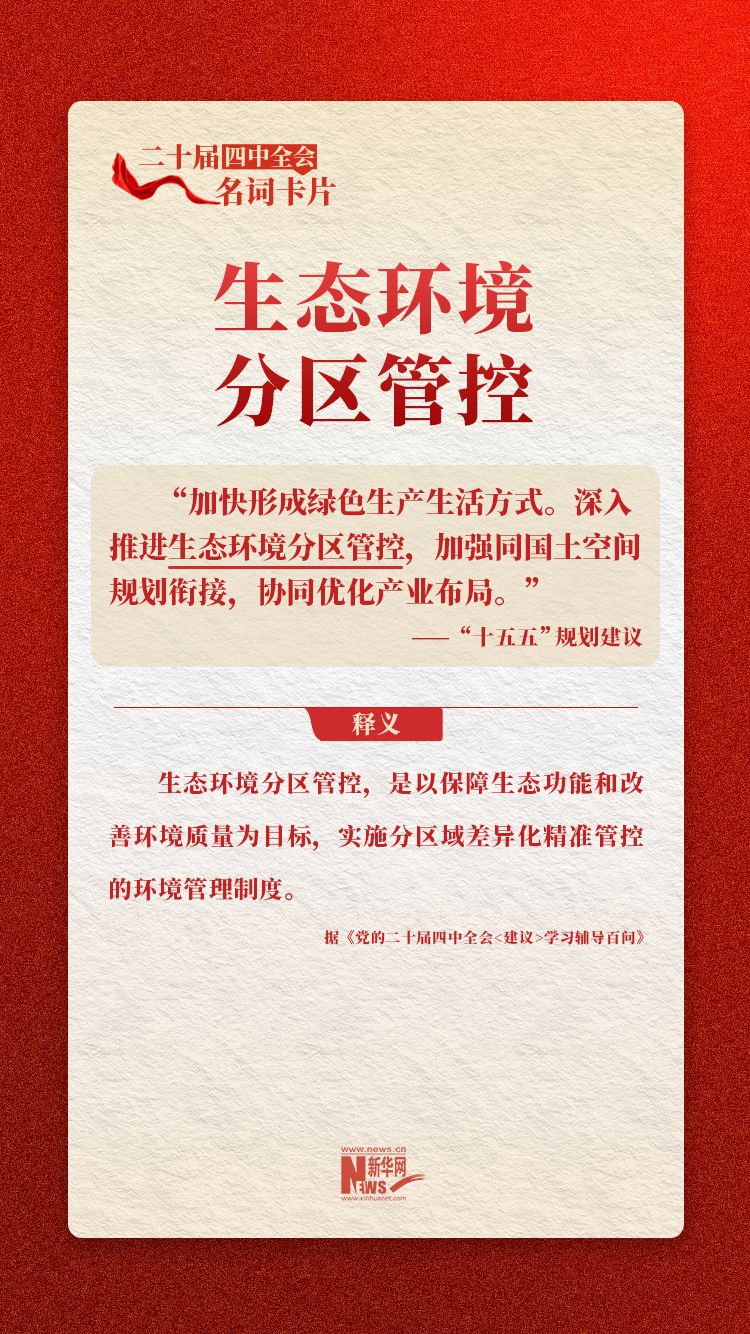
二十届四中全会名词卡片:生态环境分区管控
Xin Hua Wang· 2025-11-25 14:09
Core Viewpoint - The implementation of ecological environment zoning and control is a significant decision by the central government to reform and improve the ecological civilization system, promoting high-quality development and solidifying the ecological foundation for modernization in China [7]. Group 1: Current Development Status - As of now, over 19,000 priority protection units, 18,000 key control units, and 6,000 general control units have been designated, covering 54.4%, 14.1%, and 31.5% of the land area respectively, establishing a comprehensive control system that clarifies what each unit can and cannot do [8]. Group 2: Key Tasks - The first task is to improve control plans and strengthen the institutional framework, ensuring dynamic coordination between economic and social development plans and land spatial planning, while enhancing information sharing and decision-making capabilities [9]. - The second task focuses on enhancing policy coordination to improve the effectiveness of zoning and control systems, implementing differentiated protection strategies in key ecological areas, and gradually incorporating additional environmental factors into the zoning system [10]. - The third task emphasizes the application of results to promote green transformation in economic and social development, guiding industries towards low-carbon development and optimizing management of priority protection units [11]. - The fourth task is to enhance foundational support capabilities and strict supervision, establishing a specialized team for ecological environment zoning and control, and incorporating the implementation status into performance assessments [12].
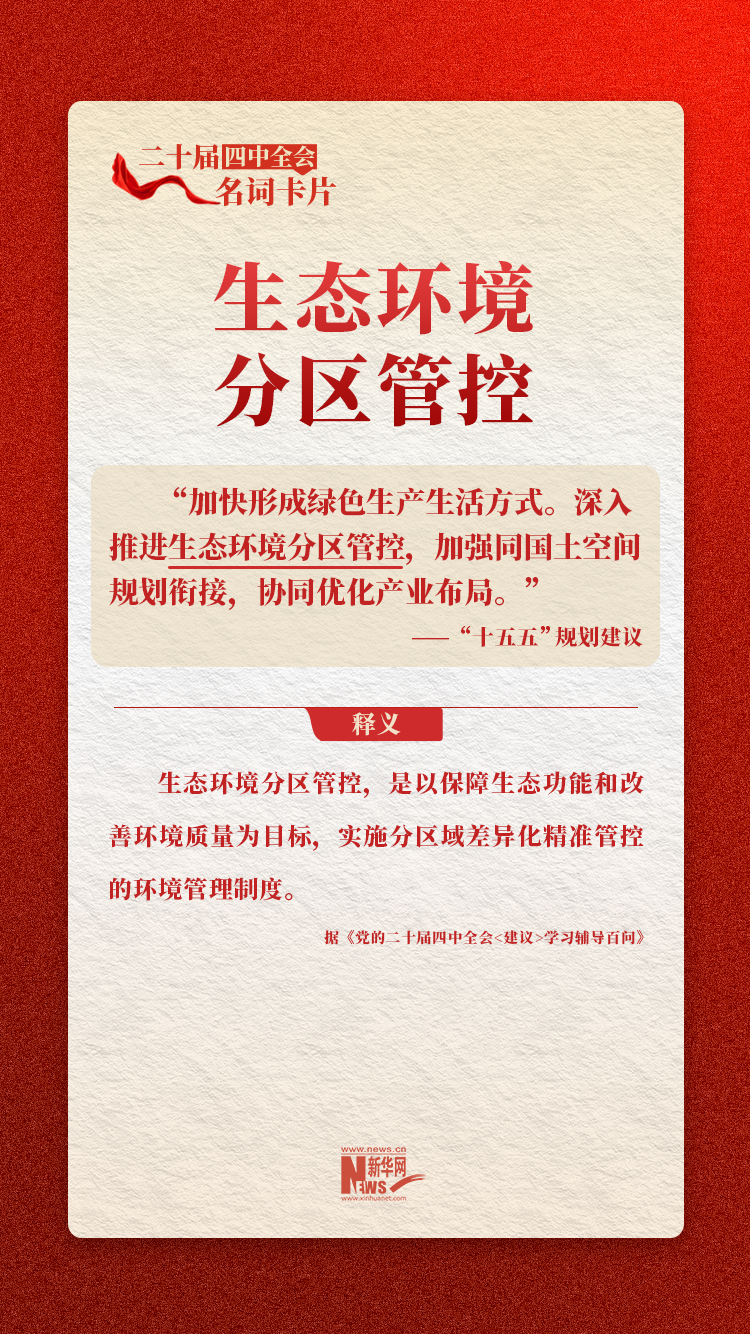
加快经济社会发展全面绿色转型(学习贯彻党的二十届四中全会精神)
Ren Min Ri Bao· 2025-11-18 23:09
Core Viewpoint - The 20th Central Committee of the Communist Party of China has approved the "Suggestions on Formulating the 15th Five-Year Plan for National Economic and Social Development," emphasizing the importance of accelerating the comprehensive green transformation of economic and social development during the 15th Five-Year Plan period, reflecting the strong will and determination of the Party leadership to prioritize ecological and green development [1][2]. Group 1: Significance of Green Transformation - Accelerating the comprehensive green transformation is essential for promoting high-quality development, as green development is a key characteristic of high-quality growth [3]. - The green transformation is a fundamental strategy to address ecological and environmental issues, aiming to reduce pollution and carbon emissions from the source [4]. - It is also a strategic move to shape new advantages in international cooperation and competition, as global trends are increasingly favoring green and low-carbon development [5]. Group 2: Current Situation and Challenges - The 15th Five-Year Plan period is critical for achieving carbon peak goals, with both historical opportunities and significant challenges ahead [6]. - Domestically, while there have been notable advancements in green transformation, structural issues such as reliance on coal and high emissions remain [7]. - Internationally, competition in the green low-carbon sector is intensifying, with various countries vying for leadership in green technologies and climate governance [8]. Group 3: Key Tasks for Green Transformation - Establishing a new energy system is crucial, as the energy sector accounts for over 85% of national carbon emissions, necessitating a shift towards clean and efficient energy sources [10]. - Implementing a dual control system for carbon emissions is essential, focusing on local, industrial, and enterprise-level management to ensure accountability [11]. - Advancing ecological environment zoning and control measures will help create a spatial framework for high-quality green development [12]. - Enhancing resource management and promoting a circular economy are vital for improving resource efficiency and reducing consumption [13]. - Developing supportive policies for green low-carbon development is necessary to internalize external costs and foster a conducive environment for sustainable practices [14]. - Strengthening international cooperation in green transformation is important for leveraging external opportunities and addressing global environmental challenges [15]. Group 4: Goals and Future Directions - The establishment of a green production and lifestyle is a key goal for the 15th Five-Year Plan, guiding the direction for comprehensive green transformation [16].
“十五五”时期,四川生态环境保护工作如何发力?
Zhong Guo Huan Jing Bao· 2025-10-28 00:20
Core Points - The "15th Five-Year Plan" period is crucial for Sichuan Province to achieve socialist modernization and advance the construction of a beautiful China, emphasizing ecological protection and high-quality development [1] Group 1: Carbon Neutrality and Emission Control - Sichuan aims to achieve carbon peak goals by transitioning to dual control of carbon emissions and intensity, establishing a comprehensive evaluation system for carbon neutrality [2] - The province will expand the carbon trading market and innovate regional carbon management mechanisms to promote low-carbon development [2] - Key areas will focus on collaborative innovation in pollution reduction and carbon reduction, ensuring completion of national carbon peak pilot tasks [2] Group 2: Green Economic Transformation - The province will optimize spatial structure through ecological environment zoning and enhance management of environmental factors [3] - Sichuan will adjust its industrial structure by promoting green upgrades and developing strategic emerging industries [3] - Energy structure will be optimized by promoting clean energy and implementing the "Electric Sichuan" initiative [3] Group 3: Pollution Prevention and Control - Comprehensive air quality management will be strengthened, focusing on the control of NOX and VOCs emissions [4] - Water environment governance will be enhanced through integrated management of water resources and ecosystems [5] - Soil safety will be prioritized with strict management of agricultural land and pollution remediation [5] Group 4: Ecosystem Protection and Restoration - Sichuan will establish a robust ecological safety framework and enhance the protection of critical ecosystems [6] - Biodiversity protection efforts will be intensified, focusing on rare and endangered species [6] - Regulatory measures for ecological protection will be reinforced, ensuring compliance with ecological red lines [6] Group 5: Major Projects and Reforms - The province will plan significant projects with national and regional impacts, including ecological protection and environmental quality improvement initiatives [7] - Reforms will focus on ecological damage compensation and resource environment rights trading [7] - Major policies will address critical ecological and environmental issues, enhancing management and compensation mechanisms [7]