
碳化硅半导体

Search documents
【明日主题前瞻】全球首例!我国介入式脑机接口成功实现人体患肢运动功能修复
Xin Lang Cai Jing· 2025-06-23 11:59
Group 1: Brain-Computer Interface (BCI) Development - The world's first invasive brain-computer interface successfully restored motor function in a paralyzed patient in China, led by a team from Nankai University and local hospitals [1] - The BCI technology is expected to experience explosive growth in the next 3 to 5 years, driven by policy support and technological breakthroughs, with both invasive and non-invasive product developments progressing [2] - Companies like Rongtai Health and Aoyi Technology are collaborating to advance brain-machine integration technology and its applications in smart health [2] Group 2: Cross-Border Payment Innovations - The launch of the Cross-Border Payment System marks a significant innovation, allowing real-time cross-border remittances between mainland China and Hong Kong [3] - This system is expected to enhance the efficiency of cross-border payments and expand the offshore business scale of the renminbi, providing new profit growth points for banks [3] - Companies like Xiaogongshangcheng and Lakala are actively investing in cross-border payment services, with Lakala reporting a 76% increase in cross-border merchant scale and an 85% increase in transaction volume year-on-year [3] Group 3: Carbon Fiber Material Expansion - Carbon fiber materials are increasingly being used in various industries, with a projected demand of 11,700 tons in the electric vertical takeoff and landing aircraft sector by 2030, creating a new market worth over 10 billion [4] - The price of T300-grade carbon fiber has dropped by 70% to around 60,000 yuan per ton, facilitating its use in more industries [4] - The carbon fiber market in China is expected to reach approximately 17.14 billion yuan in 2024, with an 8.16% year-on-year production growth and a 119.9% increase in exports [4] Group 4: Solid-State Battery Advancements - Solid-state batteries are entering a critical development phase, with expectations for widespread application in low-altitude economy, robotics, and new energy vehicles [6] - The global shipment of solid-state batteries is projected to reach 614.1 GWh by 2030, with a market size exceeding 250 billion yuan [6] - Companies like XianDao Intelligent and Ningde Times are making significant advancements in solid-state battery production equipment and technology [7] Group 5: Semiconductor Material Innovations - The launch of a silicon carbide semiconductor production project highlights the growing importance of wide bandgap semiconductors, which offer superior performance compared to traditional silicon-based semiconductors [8] - The silicon carbide market is expected to grow rapidly, driven by demand from AI data centers, AR glasses, and other emerging applications [8] - Companies like TianYue Advanced and XinLian Integrated are expanding their production capabilities in silicon carbide substrates, targeting various high-tech applications [9] Group 6: Cobalt Supply and Market Dynamics - The Democratic Republic of the Congo has extended its temporary ban on cobalt exports, which could impact global cobalt supply by over 100,000 metric tons [10] - The global cobalt production is projected to reach 288,000 metric tons in 2024, with the DRC accounting for approximately 220,000 metric tons, representing a 25% year-on-year increase [10] - Companies like Hanrui Cobalt and Luoyang Molybdenum are significantly increasing their cobalt production, with Hanrui ranking among the top three in global market share [11]
黄金类ETF,集体回调;国内最大碳化硅半导体基地投产;集中上市!增量资金来了→
新华网财经· 2025-05-30 00:34
Market Overview - On May 29, the Xinchuang ETF rose by 6.41%, leading the ETF market, while several fintech and Hong Kong innovative drug-related ETFs increased by over 4% [1][8] - Gold-related ETFs collectively retreated, with the top ten declines in the ETF market being these products [1][8] - New funds continue to flow into the market, with 23 ETFs launched in May and 9 more set to debut, injecting incremental capital into the market [1][8] Macro News - The Central Committee and State Council issued opinions to enhance the market-oriented allocation of resource and environmental factors, aiming for a well-established carbon emission rights and water rights trading system by 2027 [3] - From January to April, large-scale light industry enterprises achieved revenue of 7.35 trillion yuan, a year-on-year increase of 4.9%, and profits of 419.06 billion yuan, up 3.8% [3] - The Ministry of Finance plans to issue 710 billion yuan of 30-year fixed-rate bonds, with a coupon rate of 1.88% [3] Industry Developments - The first batch of silicon carbide wafers from the Changfei Advanced Wuhan base has officially been put into production, marking it as the largest silicon carbide semiconductor base in China, expected to contribute 30% of the domestic silicon carbide wafer capacity [10] - The base, with a total investment exceeding 20 billion yuan, aims to produce 360,000 six-inch silicon carbide wafers annually, meeting the manufacturing needs of 1.44 million electric vehicles [10] Company News - Honor's CEO announced at the launch of the Honor 400 series that the company has completed its restructuring and is preparing for an IPO, having engaged various intermediaries for the process [9][12] - Nvidia reported a revenue of 44.1 billion USD for Q1 of the 2026 fiscal year, a 12% increase quarter-on-quarter and a 69% increase year-on-year, although net profit decreased by 15% quarter-on-quarter [12] - A new hydrogen energy investment fund initiated by Sinopec has been registered, with an initial scale of 5 billion yuan, focusing on the entire hydrogen energy industry chain [10]


SiC营收规模居中国公司第三,基本半导体冲击港交所IPO
Ju Chao Zi Xun· 2025-05-28 05:40
Core Viewpoint - Basic Semiconductor has officially submitted its listing application to the Hong Kong Stock Exchange, positioning itself as a leading player in China's third-generation semiconductor power device industry, focusing on the research, manufacturing, and sales of silicon carbide power devices [2] Company Overview - Basic Semiconductor is the only company in China that integrates silicon carbide chip design, wafer manufacturing, module packaging, and gate driver design and testing capabilities [2] - The company has established a comprehensive product portfolio, including silicon carbide discrete devices, automotive-grade and industrial-grade silicon carbide power modules, and power semiconductor gate drivers [2][5] Market Position - According to Frost & Sullivan, Basic Semiconductor ranks seventh globally and sixth in China in the silicon carbide power module market by revenue for 2024, and third among Chinese companies [2] - The company has achieved significant sales growth, with revenue increasing from RMB 116.9 million in 2022 to RMB 220.6 million in 2023, and projected to reach RMB 299 million in 2024 [7] Product Applications - Basic Semiconductor's solutions serve various industries, including electric vehicles, renewable energy systems, energy storage systems, industrial control, data centers, and rail transportation [2] - The company has delivered over 90,000 units of its products for electric vehicle applications as of December 31, 2024, with sales of silicon carbide power modules increasing from over 500 units in 2022 to over 30,000 units in 2023, and further to over 61,000 units in 2024 [7] Technological Advancements - Basic Semiconductor holds 163 patents and has submitted 122 patent applications, with core product performance reaching international benchmark levels [5] - The company has established a research and development center in collaboration with Tsinghua University and has been recognized as a collaborative innovation center for third-generation semiconductors [5] Business Model - Basic Semiconductor operates under an IDM (Integrated Device Manufacturer) model, covering the entire value chain from silicon carbide chip design to wafer production and module packaging, with all processes achieving mass production [6] - The company plans to expand its packaging capacity in Shenzhen and Zhongshan, aiming to achieve significant supply chain and cost advantages [6]
昔日碳化硅巨头,如今破产在即
Hu Xiu· 2025-05-21 06:58
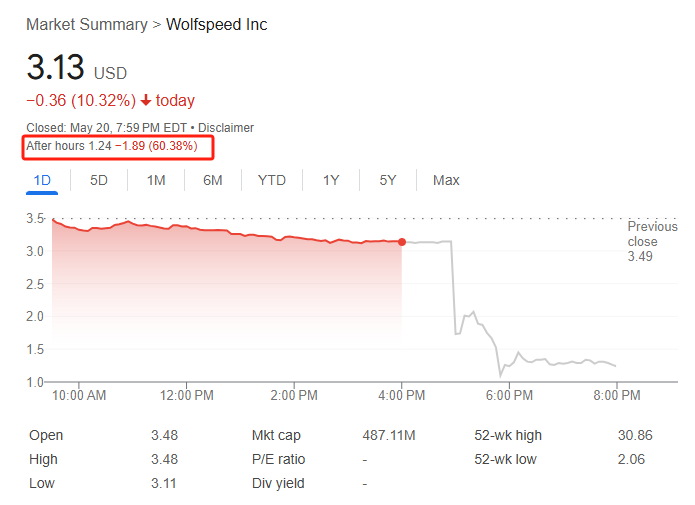
Core Viewpoint - Wolfspeed, a semiconductor supplier, is preparing to file for bankruptcy protection due to a debt crisis, leading to a stock price drop of over 60% and record short option trading activity [1][3]. Company Overview - Wolfspeed was once a leading player in the silicon carbide (SiC) market, known for having the world's first 8-inch SiC wafer factory [4]. - Originally a division of Cree, Wolfspeed focused on third-generation compound semiconductors, initially commercializing technology for the LED market [5]. - In 2017, Cree strategically shifted its focus to the Wolfspeed division, which was officially renamed in October 2021 to concentrate on the development and innovation of third-generation compound semiconductors [6]. Market Dynamics - The demand for silicon carbide semiconductors has been significantly driven by the electric vehicle (EV) sector, which accounts for over 60% of the current SiC demand [6]. - However, recent slowdowns in the EV market in Europe and the U.S. have led to delays in orders for automotive-grade semiconductors, impacting Wolfspeed's business [7]. Financial Performance - Wolfspeed has expressed concerns about its ongoing viability, predicting annual revenue to fall below expectations, with a forecast of $850 million for 2026, significantly lower than analysts' expectations of $958.7 million [1]. - The company has faced severe financial challenges, including a 90% drop in stock price since its peak during the pandemic, leading to layoffs and factory closures [7]. Management Issues - Investment firm Jana Partners has criticized Wolfspeed's management for missteps in capital allocation, execution, and strategy, contributing to the company's ongoing operational difficulties and stock price decline [8].
突传利空!刚刚,暴跌超66%!
券商中国· 2025-05-21 02:03
Core Viewpoint - Wolfspeed, a leading American chip manufacturer, is preparing to file for bankruptcy due to significant debt issues, leading to a drastic drop in its stock price by over 66% [1][3][4]. Group 1: Financial Performance and Market Position - Wolfspeed's projected revenue for the fiscal year 2026 is $850 million, which is below analysts' expectations of $958.7 million [5]. - The company has faced a decline in demand from the industrial and automotive markets, exacerbated by economic uncertainties and tariff policies [4]. - The stock price has plummeted by over 90% since its peak during the pandemic [10]. Group 2: Management and Strategic Decisions - Analysts attribute the company's operational issues to missteps in capital allocation, execution, and strategy by the management team [1][10]. - The company has undergone significant leadership changes, including the dismissal of its CEO and plans to lay off 30% of its senior leadership team [6][10]. - JanaPartners, a prominent investor, has completely exited its position in Wolfspeed, selling nearly 5 million shares in the first quarter of this year [6]. Group 3: Industry Context and Future Outlook - Wolfspeed was once a leader in the silicon carbide market, particularly in the electric vehicle sector, which accounts for over 60% of silicon carbide demand [7][10]. - The anticipated growth in the electric vehicle market has not materialized as expected, leading to delays in semiconductor orders from automotive manufacturers [10]. - The company is seeking Chapter 11 bankruptcy protection to renegotiate its debts, which is expected to gain support from most creditors [4].

碳化硅企业跻身世界一流 南沙集成电路产业园已发展成全国最具规模、最完整的第三代半导体产业链
Shen Zhen Shang Bao· 2025-05-18 22:57
Core Viewpoint - The rapid growth of the silicon carbide (SiC) semiconductor industry is driven by the booming electric vehicle (EV) market, with significant advancements in domestic production and application of SiC materials [2][3]. Industry Overview - The global semiconductor market is projected to grow by 19% in 2024, reaching $628 billion, with a notable shift towards third-generation semiconductor materials like SiC [2]. - The total market size for third-generation semiconductor power electronics is expected to reach 17.6 billion yuan in 2024, marking a 14.8% increase from 2023, with the EV and transportation sector accounting for 68% of this market [2]. Market Dynamics - The penetration rate of SiC modules in passenger vehicles is nearly 15%, with all major automakers incorporating SiC motor controller projects in new models [2]. - The domestic SiC power market for EVs is estimated to be around 12 billion yuan in 2024, with a growth rate of 19.2%, and is projected to expand to 30 billion yuan by 2029, indicating a compound annual growth rate of approximately 20% over the next five years [2]. Competitive Landscape - Leading domestic companies in the SiC substrate segment have entered the global top tier, while two domestic firms rank among the top ten in the SiC power electronics device segment [2]. - The company Xinju Neng has achieved a market share that ranks fourth globally in SiC automotive-grade modules, with over 450,000 units installed to date [4]. Regional Development - The Nansha Integrated Circuit Industrial Park in Guangzhou has become a hub for the third-generation semiconductor industry, fostering collaboration among upstream and downstream companies to accelerate domestic production capabilities [5]. - Guangdong province is actively working to establish itself as a significant player in the semiconductor industry, addressing the "chip shortage" in the EV sector by developing a complete third-generation semiconductor supply chain [5].