
磁约束核聚变

Search documents
中国“人造太阳”实验,有新突破!
新华网财经· 2026-01-02 05:12
Core Viewpoint - The research team from the Hefei Institutes of Physical Science has confirmed the existence of a density-free zone in the EAST (Experimental Advanced Superconducting Tokamak), providing significant physical evidence for high-density operation in magnetic confinement nuclear fusion devices [1][5]. Group 1: Research Findings - The EAST device utilizes magnetic confinement to achieve controlled nuclear fusion, with plasma density being a critical parameter that directly affects fusion reaction rates [4]. - Previous research indicated a density limit where plasma would rupture and escape magnetic confinement, releasing significant energy and impacting device safety [4]. - The team developed a theory model called Plasma-Wall Self-Organization (PWSO), identifying the role of boundary impurities in triggering radiation instability that leads to the density limit [5]. Group 2: Experimental Methods and Results - By utilizing a fully metallic wall environment in EAST, the researchers employed methods such as electron cyclotron resonance heating and pre-filling gas to reduce boundary impurity sputtering, effectively delaying the onset of the density limit and plasma rupture [5]. - The physical conditions of the target plate were adjusted to reduce tungsten impurity sputtering, allowing plasma to surpass the density limit and enter a new density-free zone [5]. - The experimental results closely matched the predictions of the PWSO theory, marking the first confirmation of the existence of a tokamak density-free zone [5].


中国“人造太阳”实验又有新突破
第一财经· 2026-01-02 04:55
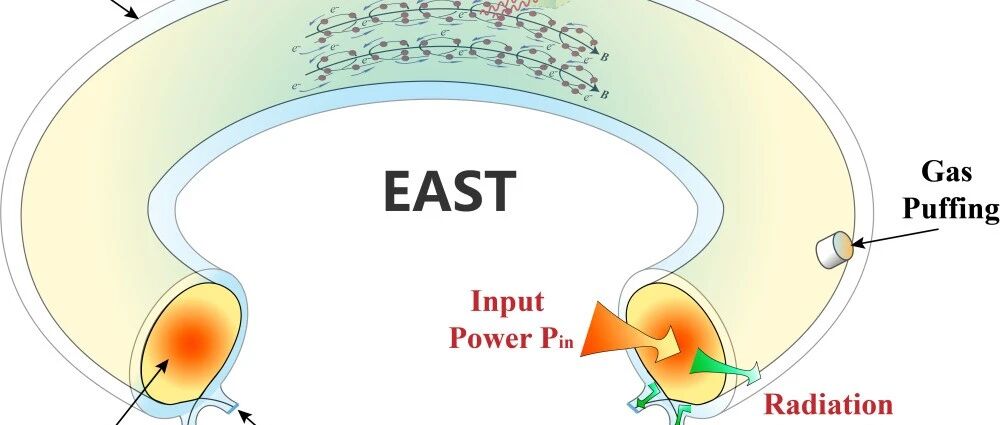
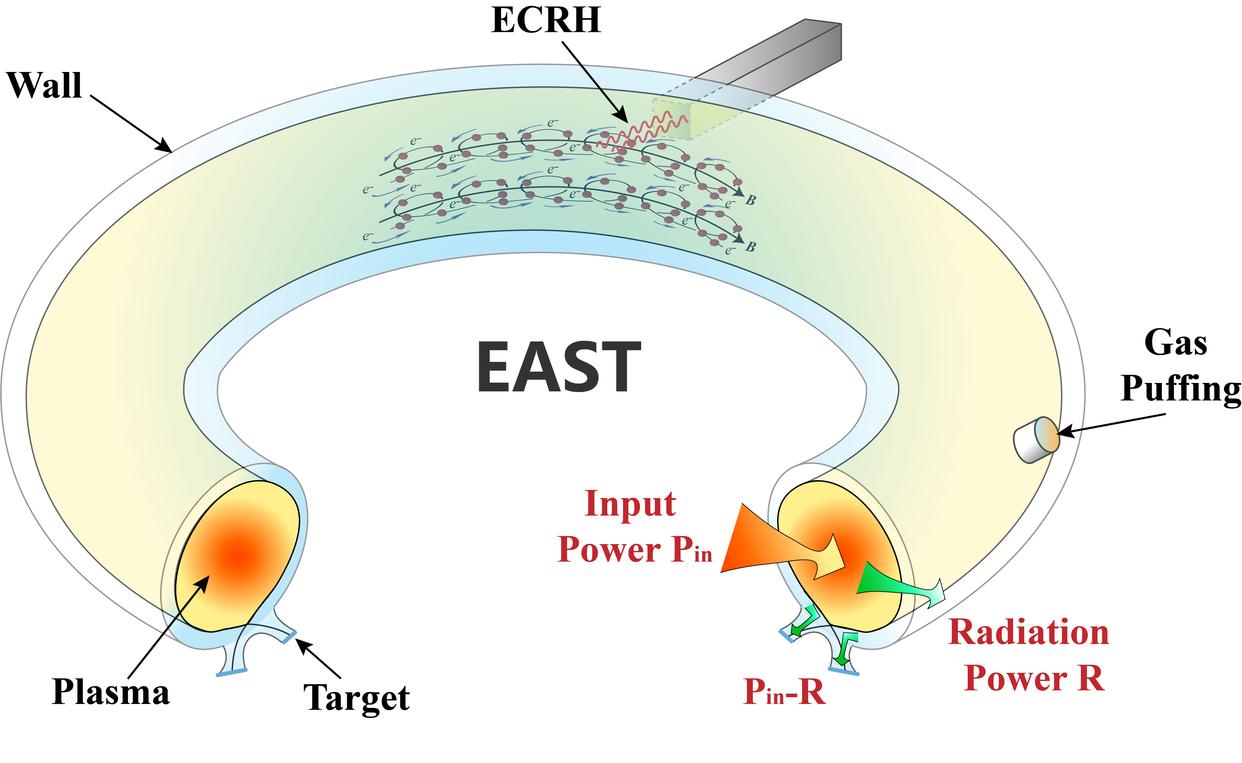
2026.01. 02 本文字数:928,阅读时长大约1.5分钟 来源 | 新华社 封图 | 科研团队提供 EAST实验结果与PWSO理论预测相互印证。(科研团队提供) 此次,我国科研团队发展了边界等离子体与壁相互作用自组织(PWSO)理论模型,发现边界杂质 引起的辐射不稳定性在密度极限触发中的关键作用,揭示了密度极限的触发机理。依托EAST全金 属壁运行环境,科研人员利用电子回旋共振加热和预充气协同启动等方法降低边界杂质溅射,主动 延迟了密度极限和等离子体破裂的发生。通过调控靶板的物理条件,降低了靶板钨杂质主导的物理 溅射,控制等离子体突破了密度极限,引导等离子体进入新的密度自由区。实验结果与PWSO理论 预测高度吻合,首次证实了托卡马克密度自由区的存在。这一创新性工作为理解密度极限提供了重 要线索,并为托卡马克高密度运行提供了重要的物理依据。 这项工作由中国科学院合肥物质科学研究院等离子体物理研究所、华中科技大学、法国艾克斯-马 赛大学等单位协作完成,受到了国家磁约束聚变专项的支持。 微信编辑 | 苏小 1月2日,中国科学院合肥物质科学研究院等离子体物理研究所科研团队宣布,有"人造太阳"之称 的全超导托卡 ...
中国“人造太阳”实验,有新突破!
Xin Lang Cai Jing· 2026-01-02 04:03
原标题:中国"人造太阳"实验找到突破密度极限的方法 这项工作由中国科学院合肥物质科学研究院等离子体物理研究所、华中科技大学、法国艾克斯-马赛大 学等单位协作完成,受到了国家磁约束聚变专项的支持。 来源:新华社 此次,我国科研团队发展了边界等离子体与壁相互作用自组织(PWSO)理论模型,发现边界杂质引起 的辐射不稳定性在密度极限触发中的关键作用,揭示了密度极限的触发机理。依托EAST全金属壁运行 环境,科研人员利用电子回旋共振加热和预充气协同启动等方法降低边界杂质溅射,主动延迟了密度极 限和等离子体破裂的发生。通过调控靶板的物理条件,降低了靶板钨杂质主导的物理溅射,控制等离子 体突破了密度极限,引导等离子体进入新的密度自由区。实验结果与PWSO理论预测高度吻合,首次证 实了托卡马克密度自由区的存在。这一创新性工作为理解密度极限提供了重要线索,并为托卡马克高密 度运行提供了重要的物理依据。 1月2日,中国科学院合肥物质科学研究院等离子体物理研究所科研团队宣布,有"人造太阳"之称的全超 导托卡马克核聚变实验装置(EAST)实验证实托卡马克密度自由区的存在,找到突破密度极限的方 法,为磁约束核聚变装置高密度运行提供了 ...
中国“人造太阳”实验,有新突破!
券商中国· 2026-01-02 03:51
原标题:中国"人造太阳"实验找到突破密度极限的方法 1月2日,中国科学院合肥物质科学研究院等离子体物理研究所科研团队宣布,有"人造太阳"之称的全超导托卡 马克核聚变实验装置(EAST)实验证实托卡马克密度自由区的存在,找到突破密度极限的方法,为磁约束核 聚变装置高密度运行提供了重要的物理依据。相关研究成果发表在国际学术期刊《科学进展》上。 托卡马克装置是一种利用磁约束来实现受控核聚变的环形装置,犹如一个螺旋形"磁跑道",锁住高温等离子 体,达到核聚变目的。等离子体密度是托卡马克性能的关键参数之一,直接影响聚变反应速率。过去,科研人 员发现,等离子体密度存在一个极限,一旦达到极限,等离子体就会破裂并逃脱磁场约束,巨大能量释放到装 置内壁,影响装置安全运行。国际聚变界通过长期研究发现,触发密度极限的物理过程发生于等离子体和装置 内壁的边界区域,但对其中的物理机制并不十分清楚。 此次,我国科研团队发展了边界等离子体与壁相互作用自组织(PWSO)理论模型,发现边界杂质引起的辐射 不稳定性在密度极限触发中的关键作用,揭示了密度极限的触发机理。依托EAST全金属壁运行环境,科研人 员利用电子回旋共振加热和预充气协同启动等 ...

中国“人造太阳”实验 有新突破!
Shang Hai Zheng Quan Bao· 2026-01-02 03:14
中国"人造太阳"实验找到突破密度极限的方法 此次,我国科研团队发展了边界等离子体与壁相互作用自组织(PWSO)理论模型,发现边界杂质引起 的辐射不稳定性在密度极限触发中的关键作用,揭示了密度极限的触发机理。依托EAST全金属壁运行 环境,科研人员利用电子回旋共振加热和预充气协同启动等方法降低边界杂质溅射,主动延迟了密度极 限和等离子体破裂的发生。通过调控靶板的物理条件,降低了靶板钨杂质主导的物理溅射,控制等离子 体突破了密度极限,引导等离子体进入新的密度自由区。实验结果与PWSO理论预测高度吻合,首次证 实了托卡马克密度自由区的存在。这一创新性工作为理解密度极限提供了重要线索,并为托卡马克高密 度运行提供了重要的物理依据。 这项工作由中国科学院合肥物质科学研究院等离子体物理研究所、华中科技大学、法国艾克斯-马赛大 学等单位协作完成,受到了国家磁约束聚变专项的支持。 来源:新华社、参考消息 (文章来源:上海证券报) 1月2日,中国科学院合肥物质科学研究院等离子体物理研究所科研团队宣布,有"人造太阳"之称的全超 导托卡马克核聚变实验装置(EAST)实验证实托卡马克密度自由区的存在,找到突破密度极限的方 法,为磁约 ...
中国“人造太阳”实验,取得重要突破!
中国能源报· 2026-01-02 02:06
来源 :新华社 End 欢迎分享给你的朋友! 出品 | 中国能源报(c ne ne rgy) 责编丨李慧颖 此次,我国科研团队发展了边界等离子体与壁相互作用自组织(PWSO)理论模型,发现边界杂质引起的辐射不稳定性在密度极限触 发中的关键作用,揭示了密度极限的触发机理。依托EAST全金属壁运行环境,科研人员利用电子回旋共振加热和预充气协同启动等方 法降低边界杂质溅射,主动延迟了密度极限和等离子体破裂的发生。通过调控靶板的物理条件,降低了靶板钨杂质主导的物理溅射, 控制等离子体突破了密度极限,引导等离子体进入新的密度自由区。实验结果与PWSO理论预测高度吻合,首次证实了托卡马克密度 自由区的存在。这一创新性工作为理解密度极限提供了重要线索,并为托卡马克高密度运行提供了重要的物理依据。 这项工作由中国科学院合肥物质科学研究院等离子体物理研究所、华中科技大学、法国艾克斯-马赛大学等单位协作完成,受到了国家 磁约束聚变专项的支持。 中国"人造太阳"实验找到突破密度极限的方法。 1月2日,中国科学院合肥物质科学研究院等离子体物理研究所科研团队宣布,有"人造太阳"之称的全超导托卡马克核聚变实验装置 (EAST)实验证实托 ...

财经早报:1月2日
Xin Hua Cai Jing· 2026-01-02 01:52
Group 1 - In 2025, the sales of products related to the trade-in program will exceed 2.6 trillion yuan, benefiting over 360 million people [1] - The trade-in program includes over 11.5 million cars, 129 million home appliances, 9.1 million digital products, 12 million home renovation items, and 12.5 million electric bicycles [1] - The Chinese Ministry of Commerce expressed strong opposition to the EU's carbon border adjustment mechanism, stating it imposes unfair trade restrictions on Chinese products [1] Group 2 - In 2025, China's carbon market is expected to operate smoothly, with an increase in market vitality and expanded support for voluntary greenhouse gas reduction trading [1] - The China Council for the Promotion of International Trade organized 407 outbound delegations in 2025, focusing on practical cooperation in trade and investment with Belt and Road countries [1] - The total box office revenue for Chinese films in 2025 is projected to be 51.83 billion yuan, with a year-on-year growth of 21.95% [1] Group 3 - The Jilin Province's total electricity consumption reached 101.2 billion kilowatt-hours in 2025, marking a significant milestone [1] - The number of outbound and inbound travelers through the Hong Kong-Zhuhai-Macao Bridge exceeded 31.34 million and 6.8 million vehicles, respectively, in 2025, both setting historical records [1] - The Spanish stock market index Ibex saw a nearly 50% increase in 2025, marking the largest rise since 1993 [1] Group 4 - Elon Musk announced that his brain-machine interface company, Neuralink, will begin mass production of brain-machine interface devices in 2026, focusing on streamlined and automated surgical processes [2]
中国“人造太阳”实验传新进展
财联社· 2026-01-02 01:29
Core Viewpoint - The research team from the Hefei Institutes of Physical Science has confirmed the existence of a density-free zone in the EAST (Experimental Advanced Superconducting Tokamak), providing significant physical evidence for high-density operation in magnetic confinement nuclear fusion devices [1][5]. Group 1: Research Findings - The tokamak device utilizes magnetic confinement to achieve controlled nuclear fusion, with plasma density being a critical parameter that directly affects fusion reaction rates [2][3]. - Previous research indicated a density limit for plasma, beyond which the plasma would break and escape magnetic confinement, releasing significant energy and impacting the device's safe operation [2][3]. - The team developed a boundary plasma-wall interaction self-organization (PWSO) theoretical model, identifying the key role of radiation instability caused by boundary impurities in triggering the density limit [5]. Group 2: Experimental Methods and Results - By utilizing a fully metallic wall environment in EAST, researchers employed methods such as electron cyclotron resonance heating and pre-filling gas to reduce boundary impurity sputtering, effectively delaying the onset of the density limit and plasma disruption [5]. - The physical conditions of the target plate were adjusted to reduce tungsten impurity-induced sputtering, allowing the plasma to surpass the density limit and enter a new density-free zone [5]. - The experimental results were found to be highly consistent with the PWSO theoretical predictions, marking the first confirmation of the existence of a tokamak density-free zone [5].

中国“人造太阳”实验找到突破密度极限的方法
Xin Hua She· 2026-01-02 00:09
Core Insights - The research team from the Hefei Institute of Physical Science, Chinese Academy of Sciences, confirmed the existence of a density-free zone in the EAST (Experimental Advanced Superconducting Tokamak) nuclear fusion device, providing significant physical evidence for high-density operation in magnetic confinement fusion devices [1][6] Group 1: Tokamak Device and Density Limit - The Tokamak device utilizes magnetic confinement to achieve controlled nuclear fusion, with plasma density being a critical parameter that directly affects fusion reaction rates [3] - Previous research indicated a density limit where plasma would break and escape magnetic confinement, releasing significant energy and impacting device safety [3] Group 2: Research Findings and Theoretical Models - The research team developed a boundary plasma-wall interaction self-organization (PWSO) theoretical model, identifying the key role of radiation instability caused by boundary impurities in triggering the density limit [5][6] - By utilizing a fully metallic wall environment in EAST, researchers employed methods such as electron cyclotron resonance heating and pre-filling to reduce boundary impurity sputtering, actively delaying the onset of the density limit and plasma disruption [6] Group 3: Experimental Validation and Collaboration - The experimental results aligned closely with PWSO theoretical predictions, marking the first confirmation of the existence of a Tokamak density-free zone [6] - This innovative work was a collaborative effort involving the Hefei Institute of Physical Science, Huazhong University of Science and Technology, and Aix-Marseille University, supported by the National Magnetic Confinement Fusion Program [6]
可控核聚变专题报告:可控核聚变系列报告(一):未来能源的奇点
HUAXI Securities· 2025-12-19 08:41
Group 1 - Controlled nuclear fusion is considered a future ideal energy source due to its high energy output compared to nuclear fission, with 1 gram of deuterium-tritium fusion fuel releasing energy equivalent to 11.2 tons of standard coal, which is about four times that of 1 gram of uranium-235 fission [12][13] - The deuterium-tritium reaction is the mainstream application in nuclear fusion, offering advantages such as feasible fuel acquisition, high technical feasibility, and significant energy gain, making it the most viable path for achieving net energy gain and commercial power generation [18][19] - Magnetic confinement is recognized as the most promising method for achieving large-scale controlled nuclear fusion, with superconducting technology being key to future device miniaturization and cost reduction [1][25] Group 2 - The global demand for electricity is increasing, driven by data centers, which currently consume about 415 TWh and are expected to double to approximately 945 TWh by 2030, making controlled nuclear fusion an ideal energy solution [2][3] - The progress in controlled nuclear fusion has shifted from "can it ignite" to "can it operate long-term, stably, and economically," with significant advancements in devices like EAST and ITER laying the groundwork for commercial viability [2][3] - Major domestic projects in China, such as EAST and BEST, are expected to see capital expenditures exceeding 92 billion yuan over the next five years, benefiting local companies involved in the supply chain [4][6] Group 3 - The manufacturing value of midstream equipment in the tokamak devices is significant, with over 50% of the value chain attributed to midstream equipment, including key components like vacuum chambers and superconducting magnets [3][6] - Domestic companies are expected to benefit from the nuclear fusion sector, with investments in upstream materials and midstream equipment manufacturing, including companies like Western Superconducting, Antai Technology, and China Nuclear Power [6][4] - The capital expenditure in China's controlled nuclear fusion sector is projected to maintain around 92 billion yuan from 2026 to 2030, with annual investments exceeding 10 billion yuan [6][4]