
碳市场

Search documents
海螺水泥(600585):底部业绩稳定,分红率小幅提升
GF SECURITIES· 2026-03-31 11:49
Investment Rating - The investment rating for the company is "Buy-A/Buy-H" with a current price of 23.42 CNY and a reasonable value of 30.16 CNY for A-shares and 30.09 HKD for H-shares [4]. Core Views - The company reported a net profit attributable to shareholders of 8.1 billion CNY in 2025, representing a year-on-year increase of 5.4%. The net profit for Q4 was 1.81 billion CNY, down 27.6% year-on-year and 6.6% quarter-on-quarter [8][9]. - The company benefits from a decline in coal prices, leading to a slight increase in profitability for cement, while aggregate and concrete gross profits decreased by 2.4% [10]. - Capital expenditures are expected to decrease, with a cash dividend of 4.486 billion CNY in 2025, reflecting a slight increase in the dividend payout ratio to 55% [13]. - The company is projected to have a net profit of 9.1 billion CNY in 2026, with corresponding P/E ratios of 13.5, 11.0, and 9.5 for 2026, 2027, and 2028 respectively [14]. Summary by Sections Financial Performance - Revenue for 2025 was 82.532 billion CNY, with a growth rate of -9.3%. EBITDA was 17.534 billion CNY, and net profit attributable to shareholders was 8.113 billion CNY, with a growth rate of 5.4% [2][18]. - The company’s earnings per share (EPS) for 2025 was 1.53 CNY, with a projected increase to 1.71 CNY in 2026 [18]. Business Segments - Cement and clinker sales volume in 2025 was 265 million tons, down 1.13% year-on-year, with an average price of 230 CNY per ton, a decrease of 16 CNY year-on-year [10]. - Aggregate revenue was 4.2 billion CNY, down 10% year-on-year, while concrete revenue increased by 20% to 3.2 billion CNY, with a gross profit margin of 12.4% [10]. Capital Expenditure and Dividends - Capital expenditure for 2025 was 11 billion CNY, with a planned increase to 11.8 billion CNY in 2026, significantly lower than the levels from 2021 to 2024 [13]. - The company’s cash dividend for 2025 was 4.486 billion CNY, with a payout ratio of 55%, indicating a slight increase from the previous year [13]. Profitability Outlook - The company is expected to maintain a net profit of approximately 30 CNY per ton in 2024-2025, with a potential improvement in profitability in 2026 due to supply-side adjustments [13][14].
欧盟碳市场行情简报(2026年第53期)-20260327
Guo Tai Jun An Qi Huo· 2026-03-27 06:28
1. Report Industry Investment Rating - Not provided in the given content 2. Core View of the Report - The EU carbon market is affected by increased supply expectations, causing EUA to turn down. The EUA futures settlement price decreased by 0.67% to 70.74 euros/ton, with a trading volume of 36,200 lots (an increase of 0.65) [1]. 3. Summary by Relevant Catalog Market Quotes - **Primary Market**: The auction price and bid - cover ratio are not available [1]. - **Secondary Market**: The EUA futures settlement price is 70.74 euros/ton, down 0.67%, and the trading volume is 36,200 lots (an increase of 0.65) [1]. Strategy - The signal strength is 0 (0 means empty position, ±1 means slightly long/short, ±2 means long/short) [1]. Logic - **Positive Factors**: Germany hopes to significantly reduce its dependence on fossil fuel imports and narrow the climate gap [1]. - **Negative Factors**: (1) The latest CoT report shows that investment funds' net long positions decreased by 6.24 million tons; (2) The EU plans to announce measures next week to keep EUAs that would otherwise be cancelled in the market to suppress a sharp rise in carbon prices [2]. Other Information - The cease - fire clues have reduced the risk premium, and the TTF price has declined but remains at a high level [3]. Market Data Charts - **EUA Auction Information**: Data on EUA auction volume, price, CBAM certificate price, auction revenue, and bid - cover ratio from March 24 - 25, 2026 are presented [3]. - **EUA Auction Price and Bid - Cover Ratio Seasonal Charts**: Show the seasonal trends of EUA auction prices and bid - cover ratios from 2022 - 2026 [3]. - **EUA Futures and Spot Market Information**: Include data on futures and spot settlement prices, trading volumes, and their changes from March 24 - 25, 2026, as well as information on container shipping carbon costs [3]. - **EUA Futures and Spot Prices and Basis Chart**: Displays the relationship between EUA futures and spot prices and their basis [3]. - **December Contract Position Seasonal Chart**: Shows the seasonal positions of December contracts from 2023 - 2027 [3].
【申万宏源策略】周度研究成果(20260316 - 20260322)
申万宏源研究· 2026-03-23 01:06
Group 1: Market Overview - The current market is experiencing significant pressure, with a potential peak in stress levels observed. This is attributed to a decline in funds supporting the "first phase of the rally," leading to a contraction in industry ETFs and a reduction in pension fund allocations to avoid net value losses [7][8]. - The A-share market is in a "two-phase rally" undergoing a consolidation phase, with expectations of a rebound following a period of overselling. The market is likely to remain in a range-bound state, with leading sectors potentially rotating [7][8]. - Short-term investment opportunities are focused on sectors like CPO and energy storage, which are expected to benefit from energy diversification and supply resilience trends. The second phase of the rally is anticipated to include AI industry chains and price increase cycles [8][11]. Group 2: Industry Comparisons - Geopolitical tensions are driving up prices for commodities such as oil, coal, and agricultural products, while concerns about stagflation in overseas economies are rising. The Federal Reserve's hawkish stance has increased the likelihood of no interest rate cuts in 2026, leading to a significant drop in metal and lithium battery futures prices [11][12]. - Despite a continued decline in real estate construction starts, expectations of supply clearance have led to a rebound in prices for cement and glass [11][12]. - Retail sales in January-February showed a year-on-year increase of 2.8%, surpassing expectations, with growth in manufacturing, infrastructure investment, and power generation [11][12]. Group 3: Asset Allocation Strategies - The latest global quantitative asset allocation model suggests an overweight position in gold, A-shares, and resource-based emerging markets, while maintaining standard allocations in US stocks, crude oil, and industrial metals [19][20]. - The strategy emphasizes the importance of "inflation assets," with a continued positive outlook on commodities, energy, precious metals, and industrial metals, while also considering potential rebound opportunities in agricultural products [19][20]. - Caution is advised regarding fixed income investments, particularly long-duration bonds, in light of rising inflation and expectations of wide credit spreads, suggesting a shift towards medium to short-duration credit bonds [19][20]. Group 4: Thematic Investments - The approval of the first invasive brain-computer interface marks a significant advancement in the industry, indicating a notable increase in sector attractiveness [16][18]. - Developments in quantum technology and bio-manufacturing are gaining attention, with significant breakthroughs in energy efficiency and practical applications [16][18]. - China's commitment to the "Triple Nuclear Declaration" and advancements in hydrogen energy and nuclear fusion are expected to drive future investment opportunities in these sectors [16][18].


【申万宏源策略】从“双反”到碳关税:贸易壁垒倒逼我国碳市场加速破局——2026年春季ESG投资策略
申万宏源证券上海北京西路营业部· 2026-03-20 02:46
Core Viewpoint - The article discusses the impact of trade barriers, particularly "double anti" measures and carbon tariffs, on accelerating the development of China's carbon market, emphasizing the importance of ESG (Environmental, Social, and Governance) investment strategies for 2026 [2] Group 1: Trade Barriers and Carbon Market - The introduction of trade barriers is forcing China to enhance its carbon market, which is seen as a necessary response to global environmental standards [2] - The "double anti" measures, which include anti-dumping and anti-subsidy investigations, are highlighted as significant factors influencing China's trade dynamics and carbon market evolution [2] - The article suggests that carbon tariffs could become a critical tool for countries to protect their domestic industries while promoting environmental sustainability [2] Group 2: ESG Investment Strategies - The article outlines that ESG investment strategies will play a crucial role in shaping the future of investments in China, particularly in light of increasing regulatory pressures and market demands for sustainability [2] - It emphasizes the need for companies to align their operations with ESG principles to attract investment and remain competitive in the global market [2] - The potential for growth in the ESG investment sector is underscored, with projections indicating significant increases in capital flows towards sustainable investments by 2026 [2]

十五五规划全文解读-环境目标-产业转型-碳市场机遇与挑战
2026-03-12 09:08
Summary of Key Points from the Conference Call Industry or Company Involved - The discussion revolves around China's "14th Five-Year Plan" and its transition to the "15th Five-Year Plan," focusing on carbon intensity targets, carbon market reforms, and the broader implications for various industries, particularly energy-intensive sectors like coal, steel, cement, and aluminum [1][2][3][4][5]. Core Points and Arguments 1. **Carbon Intensity Target**: The "15th Five-Year Plan" sets a carbon intensity reduction target of 17%, slightly lower than the previous 18% target, but with greater difficulty due to expected GDP growth slowing to 4.5%-5% [1][2]. 2. **Transition from Energy Consumption Control to Carbon Emission Control**: The shift aims to encourage renewable energy consumption and alleviate rigid constraints on economic development imposed by traditional energy consumption metrics [3][4]. 3. **Carbon Policy Framework**: A comprehensive carbon policy system is being established, including local carbon budget management starting in 2026, with a focus on high-energy-consuming industries [4][5]. 4. **Industry Inclusion in Carbon Market**: By 2027, major industries such as thermal power, steel, cement, and electrolytic aluminum will be fully integrated into the carbon market, with expected emissions reductions of 300-400 million tons [1][4][8]. 5. **Investment in Renewable Energy**: Anticipated investments in renewable energy are projected to reach 13 trillion yuan by 2025, contributing over 10% to GDP, with a focus on new power systems and low-carbon technologies [1][5][6]. 6. **Energy Structure Changes**: Oil consumption is expected to peak around 2025-2026, while coal aims to peak by 2027, with significant growth in wind and solar installations anticipated [1][6][8]. 7. **Challenges in Implementation**: Key challenges include aligning central and local government responsibilities, managing coal consumption, and promoting new industrial technologies amid rising costs [10][11]. Other Important but Possibly Overlooked Content 1. **International Relations and Climate Goals**: The dual carbon strategy is seen as a means to enhance China's international standing and competitiveness, particularly in the context of global climate change discussions [6][10]. 2. **Regional Disparities in Emission Reduction Pressure**: Economic provinces like Zhejiang and Guangdong face significant reduction pressures, while energy-rich provinces like Shaanxi may have a different set of challenges due to their existing reduction foundations [16]. 3. **Carbon Market Development**: The carbon market is expected to evolve with the introduction of institutional investors and the development of carbon financial derivatives to enhance liquidity and market efficiency [12][13]. 4. **Long-term Vision for 2035**: The "15th Five-Year Plan" lays the groundwork for achieving broader greenhouse gas reduction goals by 2035, expanding the scope of emissions control beyond CO2 to include other greenhouse gases [5][11]. This summary encapsulates the critical insights and implications discussed in the conference call, highlighting the strategic direction of China's carbon policies and their impact on various industries and regional economies.
欧盟碳市场行情简报(2026年第40期)-20260310
Guo Tai Jun An Qi Huo· 2026-03-10 07:16
Group 1: Report Industry Investment Rating - Not provided Group 2: Core Viewpoints - EUA is running stably for now after the EU officially approved the 2040 emission reduction target [1] - The signal strength of the strategy is 0 (0 means empty position, ±1 means bullish/bearish, ±2 means long/short) [1] - The bullish factor is that the EU officially approved the 2040 emission reduction target, aiming to reduce by 90% compared to the 1990 level and allowing up to about 5% of emissions reduction through international carbon credits [1] - There is no new bearish factor [1] Group 3: Summary by Related Catalogs Latest Market Conditions - In the primary market, the auction price is 69.66 euros/ton (0.97%), and the bid - cover ratio is 2.5 [1] - In the secondary market, the EUA futures settlement price is 70.57 euros/ton (0.31%), and the trading volume is 36,700 lots (-0.17) [1] Strategy - Signal strength: 0 (0 for empty position, ±1 for bullish/bearish, ±2 for long/short) [1] Core Logic - Bullish: EU officially approved 2040 emission reduction target, reducing by 90% compared to 1990 level and allowing up to about 5% reduction via international carbon credits [1] - Bearish: No new bearish factors [1] - Other: European auto lobby groups seek further concessions on EU emission standards due to limited progress in carbon dioxide data; the International Energy Agency warned that if the crisis caused by US - Israel's strike on Iran persists, Europe and Asia will compete for scarce LNG supplies [1]

环保行业深度跟踪:两会明确碳减排要求,原油涨价提振生柴赛道
GF SECURITIES· 2026-03-08 13:17
Investment Rating - The report maintains an "Buy" rating for the environmental protection industry [2] Core Insights - The government work report for 2026 emphasizes the need for a 17% reduction in carbon emissions per unit of GDP and a 3.8% reduction in total carbon emissions, marking a shift towards dual control of carbon emissions [12][14] - The report highlights the increasing demand for green energy and biofuels, particularly biodiesel, driven by rising oil prices and geopolitical tensions [5][21] - The report suggests focusing on companies involved in the recycling and green energy sectors, such as biofuels and green methanol, as potential investment opportunities [5][13] Summary by Sections Government Work Report - The 2026 government work report sets higher targets for carbon emissions reduction and introduces a national low-carbon transition fund to support hydrogen and green fuel development [12][15] - The report indicates that 2026 will be the first year of formal carbon assessments for local governments [12][14] Biodiesel Market - The average export price of UCO (Used Cooking Oil) in 2025 was 7,742 CNY/ton, a year-on-year increase of 21.6% [21] - UCO export volume for 2025 was 2.7558 million tons, with a 6.6% decrease compared to the previous year [21] - The report notes that the price of UCO has been on an upward trend, reaching 8,125.54 CNY/ton by December 2025 [21] Carbon Market and Policies - The report tracks developments in the carbon market, noting a recent trading volume of 56.05 million tons and a closing price of 81.85 CNY/ton [36][39] - It highlights the establishment of a comprehensive recycling system for retired solar panels, aiming for a cumulative utilization of 250,000 tons by 2027 [34] Key Companies to Watch - The report recommends monitoring companies such as Langkun Technology, Shanhai Environment, and Huanxin Co., which are positioned to benefit from the growing demand for biofuels and recycling [5][33]




欧盟碳市场行情简报(2026年第37期)-20260305
Guo Tai Jun An Qi Huo· 2026-03-05 08:17
Report Industry Investment Rating - Not provided Core Viewpoints - The conflict in Iran has doubled the TTF price, and the gas - coal conversion has pushed the EUA price up slightly [1] - Italy plans to "strip" the ETS cost from the electricity price formation mechanism, which may weaken the EUA price signal and hinder the green transition [1] Summary by Related Catalogs Market Conditions - **Primary Market**: The EUA auction price is 68.77 euros/ton (0.51%), and the bid - cover ratio is 1.46 [1] - **Secondary Market**: The EUA futures settlement price is 73.33 euros/ton (3.91%), with a trading volume of 58,600 lots (0.18) [1] - **Auction Details**: On March 3, 2026, the EUA auction price was 68.77 euros/ton, the CBAM certificate price was 69.58 euros/ton, the auction volume was 2.7125 million tons, the bid - cover ratio was 1.46, and the auction revenue was 186.54 million euros [3] - **Futures and Spot**: On March 3, 2026, the futures settlement price was 73.33 euros/ton (3.91% increase), the futures trading volume was 58,600 lots (0.18 increase), the spot settlement price was 71.91 euros/ton (3.89% increase), and the spot trading volume was 4,077 lots (- 883 decrease) [4] Strategy - Signal strength: 0 (0 means empty position, ±1 means slightly long/short, ±2 means long/short) - There are no new positive factors, and the negative factor is Italy's plan to "strip" ETS cost from the electricity price formation mechanism [1]
复旦碳价指数:2026年3月CEA与CCER价格指数走势分化
Cai Fu Zai Xian· 2026-02-28 03:31
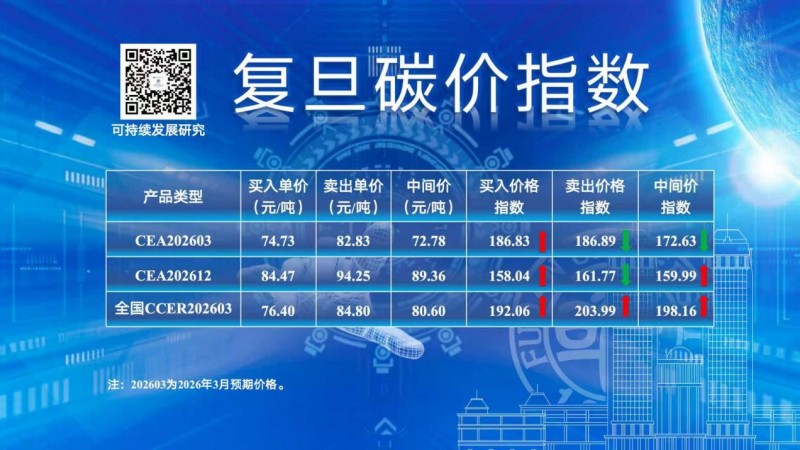
Core Insights - The Fudan University Sustainable Development Research Center released the carbon price indices for March 2026, including the national carbon emission allowance (CEA) price index, the national CCER price index, and the Chinese Green Electricity Certificate (GEC) price index [1] CEA and CCER Price Indices - The expected buy price for the national carbon emission allowance (CEA) in March 2026 is 74.73 CNY/ton, with a sell price of 82.83 CNY/ton, and a midpoint price of 72.78 CNY/ton. The buy price index increased by 3.12%, while the sell price index decreased by 1.03%, and the midpoint price index fell by 6.80% [2][3] - For December 2026, the expected buy price for CEA is 84.47 CNY/ton, with a sell price of 94.25 CNY/ton, and a midpoint price of 89.36 CNY/ton. The buy price index is 158.04, and the sell price index is 161.77, with a midpoint price index of 159.99 [2][3] - The expected buy price for the national certified voluntary emission reduction (CCER) in March 2026 is 76.40 CNY/ton, with a sell price of 84.80 CNY/ton, and a midpoint price of 80.60 CNY/ton. The buy price index rose by 6.41%, the sell price index increased by 1.19%, and the midpoint price index grew by 3.60% [2][3] GEC Price Indices - The expected prices for the three types of domestic green certificates (GEC) for 2025 production are as follows: centralized project price is 7.32 CNY/certificate (index 133.09), distributed project price is 7.15 CNY/certificate (index 145.07), and biomass power generation price is 6.85 CNY/certificate (index 132.75) [4][5] - The price trends for the three types of green certificates show divergence, with the distributed project certificates continuing to rise by 1.4%, while centralized and biomass project certificates experienced a decline [4] Carbon Market Overview - In February, the national carbon market exhibited a stable price with reduced trading volume. The average closing price for CEA was 79.57 CNY/ton, up approximately 2.33% from January's average of 77.76 CNY/ton. The market showed high-level fluctuations, with prices ranging between 76 and 81 CNY/ton [6] - The average daily trading volume for carbon allowances in February was 24.57 million tons, a significant decrease of about 55% compared to January's 54.68 million tons. Despite the overall reduction in trading volume, there were days with higher trading volumes, indicating ongoing adjustments by companies [6] Global Carbon Market Trends - The global carbon market in February showed a general decline in trading volumes, with the EU carbon market experiencing a 37.15% increase in daily trading volume, while the UK and Korea markets saw declines of 25.74% and 3.65%, respectively [7] - Price trends varied across carbon markets, with the EU market's price dropping from 96.66 USD/ton to 82.25 USD/ton (a cumulative decrease of 14.91%), while the Korean market saw an increase from 8.47 USD/ton to 8.89 USD/ton (a cumulative increase of 4.98%) [8]
全国碳市场行情简报(2026年第30期)-20260225
Guo Tai Jun An Qi Huo· 2026-02-25 12:34
Report Information - Report Title: National Carbon Market Market Briefing (Issue 30, 2026) [1] - Release Date: February 24, 2026 [3] Investment Rating - Not provided Core View - After the holiday, on the first trading day, a small volume pushed up the carbon price. The price increased significantly, but the trading volume was extremely low, indicating a thin - volume fluctuation [4][6] Market Conditions CEA - The listed volume was 10,000 tons, and the bulk volume was 0 tons. The listed transaction average price was 81.00 yuan/ton [4] - For different years' CEA: - The closing prices of CEA19 - 20, CEA21, CEA22, CEA23, CEA24, and CEA25 were 74.00 yuan/ton, 74.52 yuan/ton, 76.39 yuan/ton, 81.00 yuan/ton, 81.00 yuan/ton, and 81.00 yuan/ton respectively. The year - on - year increase of CEA25 was 2.92% [8] - The total trading volume of CEA25 was 10,000 tons, and the listed agreement trading volume was 10,000 tons. The total turnover was 810,000 yuan [8][9] CCER - The listed agreement trading volume was 0.00 tons, and the trading average price was 89.00 yuan/ton, with a year - on - year increase of 4.09% [4] - The trading volume was 0.09 tons, and the turnover was 0.00 yuan, with a premium rate of 9.88% [9] Strategy - Signal strength: 0 (0 means short - position, ±1 means bullish/bearish, ±2 means long/short) [4] Risk Factors - The CCER supply increment exceeded expectations; the power generation industry quota gap was lower than expected; the competent department issued policies clarifying an ambitious future emission reduction path [7]