
科技创新与产业创新融合发展

Search documents
新晋“双万”城市,又拿下一个“增速冠军”
Mei Ri Jing Ji Xin Wen· 2025-10-26 04:27
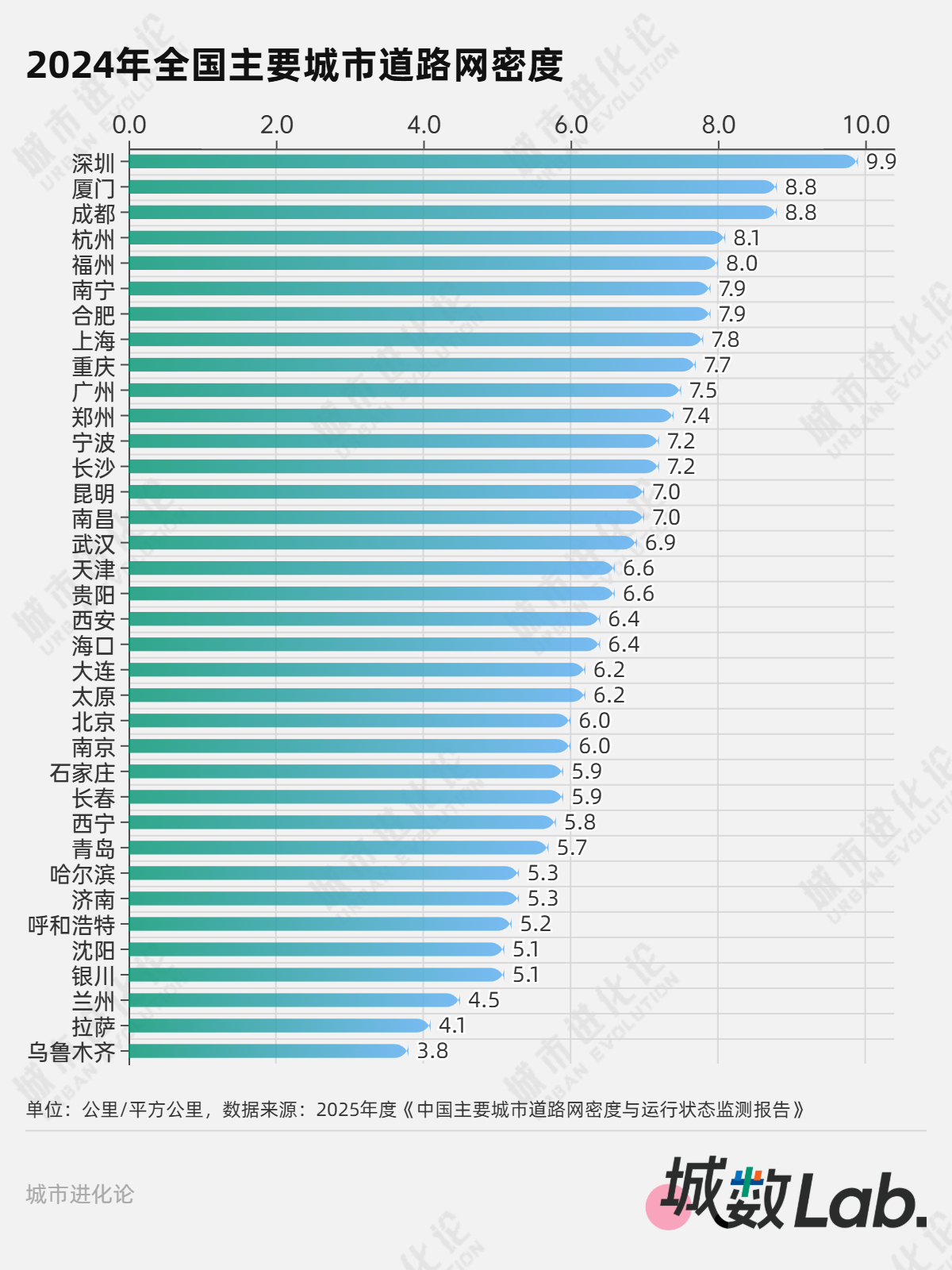
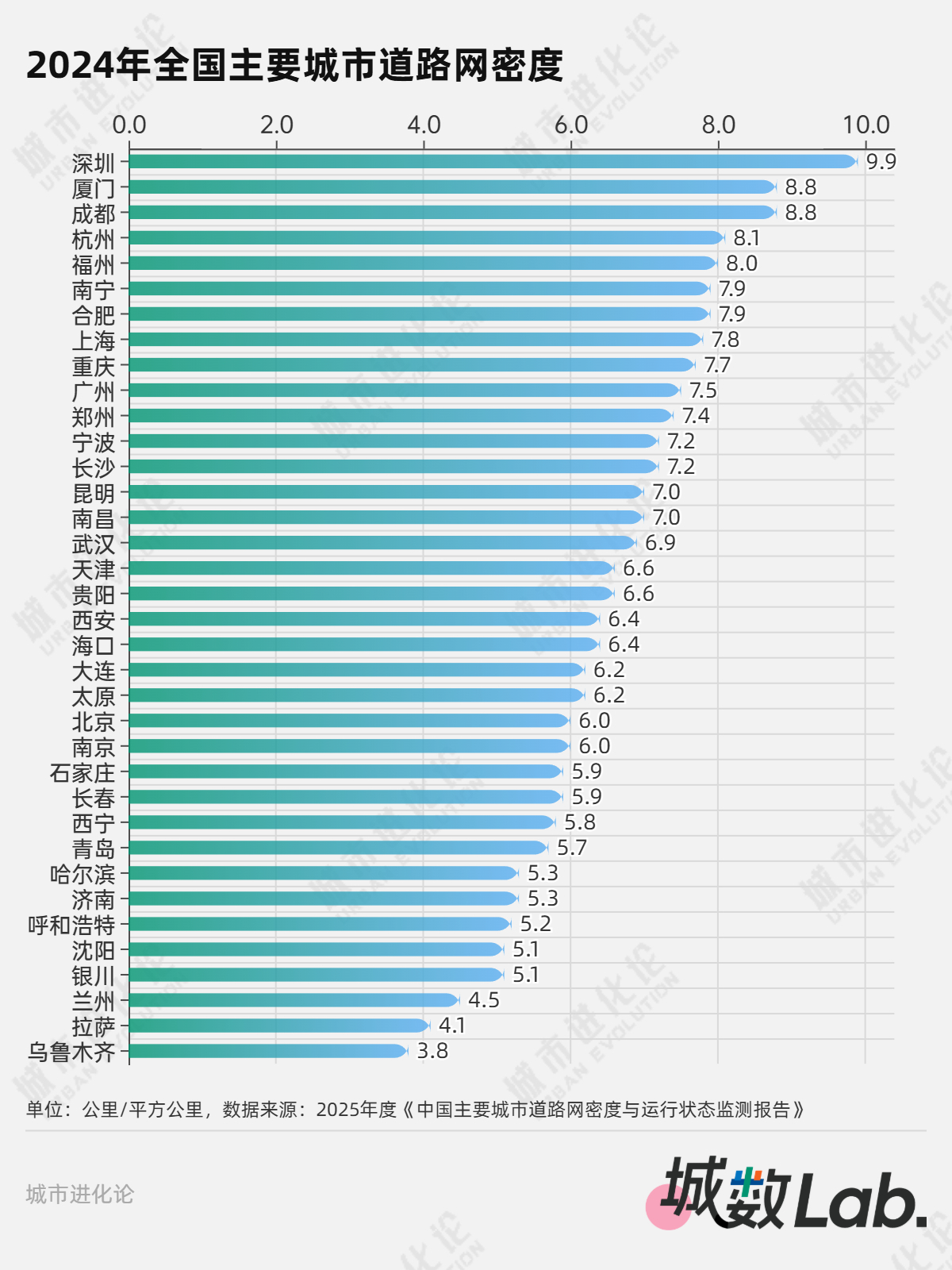
Core Insights - The article discusses the importance of road network density as an indicator of urban vitality and health, with a target set by the Chinese government to achieve an average road network density of 8 km/km in urban built-up areas by 2023 [1][3]. Group 1: Road Network Density - As of 2024, the average road network density across 36 major cities in China is 6.6 km/km, with only Shenzhen, Xiamen, Chengdu, Hangzhou, and Fuzhou meeting the 8 km/km standard [1]. - In 2024, cities with the highest growth in road network density include Hangzhou, Hefei, Shanghai, and Wuhan, each increasing by 0.3 km/km, while Zhengzhou, Changsha, Nanjing, and Changchun increased by 0.2 km/km [3]. - Hefei has emerged as the "growth champion" over five years, with its road network density rising from 7.0 km/km to 7.9 km/km, a cumulative increase of approximately 15.2% [6]. Group 2: Urban Vitality and Traffic Conditions - There is a linear relationship between road network density and urban vitality; higher density areas tend to attract more people and logistics, enhancing urban activity [9]. - Hefei's continuous push for technological and industrial innovation has led to a sustained increase in urban development momentum, with its resident population surpassing 10 million in 2024, making it the 18th city in China to reach this milestone [9]. - In 2024, seven cities are classified as severely congested, with average peak speeds below 18 km/h, including newly added Shenzhen and Harbin, indicating increasing traffic pressure in major cities [13].

城数Lab. | 新晋“双万”城市,又拿下一个“增速冠军”
Mei Ri Jing Ji Xin Wen· 2025-10-26 04:23
Core Insights - The article discusses the importance of road network density as an indicator of urban vitality and health, highlighting recent government goals to increase this metric in Chinese cities [1][3]. Group 1: Road Network Density Goals - In 2016, the Chinese government set a target for urban road network density to reach an average of 8 km/km² by 2020, which was reiterated in a 2023 announcement [1]. - As of 2024, the average road network density across 36 major cities in China is 6.6 km/km², with only a few cities like Shenzhen, Xiamen, Chengdu, Hangzhou, and Fuzhou meeting the 8 km/km² standard [1]. Group 2: City Performance in Road Network Density - In 2024, cities such as Hangzhou, Hefei, Shanghai, and Wuhan saw an increase of 0.3 km/km² in road network density, while Zhengzhou, Changsha, Nanjing, and Changchun increased by 0.2 km/km² [3]. - Hefei has emerged as the "growth champion" over five years, with its road network density rising from 7.0 km/km² to 7.9 km/km², a cumulative growth of approximately 15.2% [6]. Group 3: Relationship Between Road Network Density and Urban Vitality - Zhao Yixin, a senior engineer, noted a linear relationship between road network density and urban vitality, indicating that higher density facilitates better traffic flow and attracts more people and logistics [9]. - Hefei's continuous push for technological and industrial innovation has led to a significant increase in urban vitality, with its population surpassing 10 million in 2024, making it the 18th city in China to reach this milestone [9]. Group 4: Traffic Congestion Issues - In 2024, the number of severely congested cities (with peak average speeds below 18 km/h) increased to seven, including newly added Shenzhen and Harbin, alongside major cities like Beijing and Shanghai [15]. - The article also highlights that cities like Harbin and Urumqi are facing challenges due to increased travel demand from a booming tourism market, which adds pressure to urban transportation systems [17].
“三服务”助推民营经济高质量发展
Xin Hua Ri Bao· 2025-10-09 02:13
Group 1 - The core viewpoint emphasizes the importance of comprehensive service for enterprises, which is seen as a superior investment guide compared to traditional promotional methods [1] - The Zhulian Street in Nantong Economic and Technological Development Zone focuses on a full-cycle service approach to support the development of the private economy, including short-term service projects, medium-term policy support, and long-term environmental optimization [1] - The establishment of a new industrial park with approximately 8000 acres of land is prioritized to support project landing and production, which is crucial for the high-quality development of the private economy [1] Group 2 - The implementation of enterprise-friendly policies is highlighted as a key driver for high-quality development in the private economy, with a focus on effectively communicating these policies to businesses [2] - A team of 99 "chief service personnel" has been deployed to connect with 187 enterprises, ensuring that policies are accurately matched to the needs of businesses, transforming the approach from "enterprises seeking policies" to "policies seeking enterprises" [2] - The promotion of technology and industry innovation is emphasized, with 9 technology transformation projects guided for application this year, amounting to a total investment of approximately 240 million [2] Group 3 - A good business environment is essential for both enterprises and their employees, with a focus on providing supportive services to alleviate concerns for workers [3] - The service centers at the street and community levels are continuously optimizing their service offerings, evolving from version 1.0 to 3.0 to better meet the diverse needs of enterprise employees [3] - Initiatives such as extended service hours, appointment services, and home visits are introduced to address the challenges faced by employees in managing their personal affairs [3]
促进科技创新和产业创新融合发展
Jing Ji Ri Bao· 2025-09-23 22:10
Group 1 - The core viewpoint emphasizes the importance of integrating technological innovation and industrial innovation to seize competitive advantages and foster new development momentum [1] - Jiangsu Province's Yancheng City is leveraging the rapid growth of green energy to enhance traditional industries and support emerging industries, providing a practical example of deep integration between technological and industrial innovation [1] - Yancheng has initiated a series of activities focused on technological innovation, demonstrating a clear understanding among decision-makers that innovation is crucial for the city's future [1] Group 2 - Companies are identified as the main drivers of technological and industrial innovation integration, and there is a need to address the lack of collaboration between academia and industry [2] - The article highlights the importance of building infrastructure that facilitates the conversion of technological achievements into practical productivity, ensuring a smooth transition from laboratory to production [2] - Establishing a coordinated mechanism across departments and regions is essential to break down information silos and resource barriers, thereby enhancing the innovation ecosystem [3]
国务院国资委:国资央企将努力在更深层次融入国家技术转移体系
Xin Hua Cai Jing· 2025-09-17 06:56
Core Viewpoint - The State-owned Assets Supervision and Administration Commission (SASAC) emphasizes the integration of technological innovation and industrial innovation as a priority since the 14th Five-Year Plan, focusing on enhancing the role of central enterprises in technology innovation and addressing bottlenecks in the industrial chain [1][2][3] Group 1: Technological Breakthroughs - Central enterprises are focusing on "from 0 to 1" technological breakthroughs to solve critical industrial issues, leveraging both market and technological advantages [1] - Key core technology breakthroughs have been achieved in areas such as new materials and industrial software, effectively addressing industrial shortcomings [1] - Collaboration with universities and research institutions has been initiated to identify and solve scientific problems in production practices [1] Group 2: Results Transformation - The focus is on "from 1 to 100" results transformation, building bridges from technology to products to enhance market access for scientific achievements [2] - The establishment of 134 pilot verification platforms and 291 service projects aims to improve the efficiency of results transformation across various enterprises [2] - Formation of 23 innovation alliances facilitates collaborative efforts in research and development, sharing risks and benefits to promote the application of research outcomes [2] Group 3: Industrialization - The emphasis on "from 100 to N" industrialization involves providing high-value application scenarios and creating a "green channel" for the procurement of innovative products [3] - Over the past three years, 785 technological achievements have been industrialized in more than 6,000 enterprises, with a total contract value exceeding 200 billion [3] - Collaboration with various innovation entities has led to the establishment of 33 national industrial alliances, promoting iterative upgrades of independent innovations through large-scale applications [3] Future Directions - SASAC plans to deepen integration into the national technology transfer system, enhancing the role of central enterprises in the entire chain from supply to application of technological achievements [3]
济南高新区:力争今年新认定市级以上高能级创新平台不少于15家
Qi Lu Wan Bao Wang· 2025-09-04 03:52
Core Viewpoint - The Jinan High-tech Zone is focusing on integrating technological innovation with industrial development, aiming to establish itself as a regional innovation hub by 2025 [3]. Group 1: Innovation and Entrepreneurship - The High-tech Zone is committed to supporting innovation and entrepreneurship by promoting the deep integration of innovation chains, industrial chains, financial chains, and talent chains [3]. - Plans are in place to establish at least 15 high-level innovation platforms recognized at the municipal level or above by 2025 [3]. - The zone is enhancing service functions in parks like Qilu Software Park and Innovation Service Center, providing one-stop services for enterprises [3]. Group 2: Technology Commercialization - The High-tech Zone is focusing on the industrialization of technological innovations, particularly in cutting-edge fields such as new-generation information technology, pharmaceutical health, and quantum information [3]. - Three concept verification centers are being established to strengthen feasibility assessments and prototype development for early-stage technologies [3]. - Eight pilot demonstration bases for technology transfer are being set up in four key areas: new-generation information technology, biomedicine, high-end equipment, and new energy materials [3]. - A full-chain mechanism for technology transfer is being established, covering concept verification, pilot incubation, and industrialization [3].
许昆林在江苏自贸试验区南京片区调研时强调
Nan Jing Ri Bao· 2025-08-30 01:58
Group 1 - The provincial government emphasizes the importance of implementing the recently approved open innovation development plan for the biopharmaceutical industry in Jiangsu, aiming to enhance the province's global competitiveness in this sector [1][2][3] - The focus is on integrating technological and industrial innovation, leveraging policy advantages to boost the entire biopharmaceutical value chain, including research, manufacturing, distribution, and usage [1][2] - The government encourages collaboration between enterprises, universities, and clinical institutions to drive new drug development and technology transfer, aiming for significant breakthroughs in the industry [2][3] Group 2 - Jiangsu's biopharmaceutical industry is identified as a key area for growth, with the government aiming to create a competitive and attractive innovation ecosystem [2][3] - The implementation of the open authorization plan is expected to facilitate cross-border flows of talent, capital, and data, enhancing the province's ability to attract global resources [2] - The government calls for coordinated efforts among departments and localities to ensure the effective execution of the plan, aiming to generate replicable and scalable success stories in the biopharmaceutical sector [3]
知产”是金,“卷价格”不如“拼专利
Xin Hua Ri Bao· 2025-08-13 22:59
Core Viewpoint - The discussion emphasizes the importance of intellectual property (IP) protection as a driver of innovation and a facilitator for the development of new productive forces in Jiangsu Province [1][2]. Group 1: Intellectual Property Statistics - As of June this year, Jiangsu Province has 671,900 valid invention patents, with an invention patent ownership rate of 78.81 per 10,000 people, maintaining the top position in the country for nine consecutive years [2]. - In the first half of the year, the patent authorization rate for enterprises in Jiangsu accounted for 89.82% of the total authorization, exceeding the national average by 15.42 percentage points [2]. - The province's "1650" modern industrial system saw 34,300 invention patents authorized in the first half of the year, ranking third nationally, with high-end textiles, semiconductors, and high-end equipment leading the way [2]. Group 2: Role of Intellectual Property in Innovation - Intellectual property serves as a "shield" to incentivize innovation and a "navigator" to promote it, providing both institutional and technical support for the development of new productive forces [2][3]. - The patent system allows for a temporary monopoly (typically 20 years) to ensure innovators can recoup their costs, as seen in the pharmaceutical industry where the average cost of developing a new drug exceeds $1 billion [3]. - Utilizing patent literature can shorten research cycles by 60% and save 40% of research funding, highlighting its role in guiding innovation [3]. Group 3: Technology Transfer and Financial Leverage - Intellectual property acts as a bridge for the transformation of scientific achievements into marketable products and as a lever for attracting investment [4]. - The Jiangsu Provincial Intellectual Property Office has initiated actions to revitalize patents held by universities and research institutions, focusing on the needs of technology-based SMEs [4]. - The establishment of a comprehensive financial ecosystem for intellectual property aims to facilitate financing through IP pledges and enhance the value of intangible assets [4]. Group 4: Addressing Competitive Challenges - The shift from price competition to patent competition in strategic emerging industries is a growing concern, prompting the provincial IP office to enhance monitoring and training for startups [5][6]. - Encouraging the formation of IP alliances and patent pools can reduce costs and promote high-quality development in industries facing excessive competition [6]. Group 5: Rapid Protection System - Jiangsu has established a "1+13+N" rapid collaborative protection system for intellectual property, significantly reducing the time for patent authorization and dispute resolution [7]. - The average authorization period for invention patents has been reduced from 22 months to 3 months, and for utility model patents from 12 months to 6 months [7]. Group 6: International Intellectual Property Protection - With over 7,000 companies holding international patents, Jiangsu is enhancing its overseas IP protection capabilities through various initiatives [8]. - The provincial IP office is addressing challenges in IP enforcement, such as evidence collection and high costs, by improving collaborative protection efficiency [8]. Group 7: Ongoing Challenges and Initiatives - Despite advancements, challenges remain in the IP protection system, prompting the launch of the "Ten Actions for Enhancing IP Protection" to create a fair and efficient environment for innovation [9].
全国人大代表尹花:推动科技创新和产业创新融合发展
Xin Hua Wang· 2025-08-12 05:59
Core Viewpoint - The article emphasizes the need for strengthening the role of enterprises in innovation, accelerating the collaboration between industry, technology, and market to promote high-quality development in the sector [1] Group 1: Innovation and Development - Enterprises should focus on high-quality supply to lead and create demand, integrating technological and industrial innovation for development [1] - There is a growing consumer demand for quality, personalization, and scenario-based consumption, necessitating continuous improvement in product quality, variety, and supply [1] Group 2: Industry Collaboration - The article suggests enhancing the deep integration of production, education, and research led by enterprises, particularly in the food sector, by establishing high-level technological innovation platforms [1] - A proposed model for innovation involves enterprises setting challenges, collaborating with educational institutions to solve them, and receiving government support [1] Group 3: Competitive Advantage - The focus should be on improving the entire industry chain's competitive advantage by addressing key technological challenges in the field of food biotechnology manufacturing [1] - The article highlights the importance of leveraging the National Key Laboratory of Beer Fermentation Engineering to enhance supply quality and stimulate consumer activity [1]

儋州工业园:打造对接大湾区的“科创门户”
Hai Nan Ri Bao· 2025-08-08 01:16
Core Points - The Danzhou Industrial Park has successfully launched the first domestically produced computer equipped with Huawei's Kunpeng processor, marking a significant milestone in the collaboration between Shenzhen and Danzhou [1] - The production line has an annual capacity of 80,000 units, including domestic terminal computers and servers, showcasing a strong partnership between Donghua Software Co., Ltd. and Huawei Technologies Co., Ltd. [1] - The Danzhou Industrial Park is evolving into a model for integrating technological innovation and industrial development, driven by the collaboration with Shenzhen [1][2] Group 1 - The Danzhou Industrial Park was previously underdeveloped, with only 27 companies, 18 of which were inactive before 2020, highlighting the transformation since the establishment of a joint venture with Shenzhen Port Group [2] - Since 2020, major Shenzhen enterprises have established operations in Danzhou, including the Donghua Pengxiao Industrial Park project, which focuses on high-tech industries [2][3] - The Danzhou government and Shenzhen enterprises have created a comprehensive cooperation system involving government agencies, industry associations, state-owned platforms, think tanks, and businesses [2] Group 2 - The second Hainan (Danzhou) Agricultural Products Supply and Marketing Conference facilitated a signing amount of 2.36 billion yuan, enhancing the export channels for Danzhou's agricultural products [3] - The Danzhou Industrial Park has attracted new investments, such as a 500 million yuan international food industry park project by Guoquan Group, which aims to leverage the region's port advantages and favorable policies [4][5] - The Danzhou Industrial Park is implementing a one-stop service model to streamline business operations, significantly reducing the barriers for new enterprises [5] Group 3 - The Danzhou Science and Technology Innovation Center project is under construction, utilizing advanced technologies like 3D modeling and BIM to enhance project management [6] - This center aims to integrate Shenzhen's innovative resources and focus on sectors such as digital economy, food processing, biotechnology, and new materials [6][7] - The center will serve as a hub for technology exchange between Danzhou and Shenzhen, providing differentiated services for startups at various development stages [7]
