知识产权

Search documents
起诉小米汽车的“老头乐”企业致歉
新华网财经· 2026-03-28 02:13
Group 1 - The core viewpoint of the article is that Yanlu New Energy has acknowledged its infringement on Xiaomi's design patents and has ceased using the related components, expressing regret for any confusion caused to Xiaomi [2][3] - Yanlu New Energy has withdrawn its request for patent invalidation on March 25, 2026, and will publicly announce this information through the National Intellectual Property Administration [2] - The company has gained a deeper understanding of intellectual property laws and appreciates Xiaomi's support throughout the process [3] Group 2 - Yanlu New Energy, a small company with only 20 employees, initiated a patent invalidation request against Xiaomi's three design patents, which are critical features of Xiaomi's main products, SU7 and YU7 [7][8] - The three patents in question include the rear bumper, front bumper, and front headlight, with specific application numbers provided [9] - Yanlu New Energy is primarily engaged in the research, manufacturing, sales, and after-sales service of new energy vehicles, with its main product being the "Yunlei" electric tricycle [10]



独家专访最高法院副院长陶凯元:涉人工智能知识产权裁判规则需要不断探索
21世纪经济报道· 2026-03-03 12:54
Core Viewpoint - The article discusses the increasing intellectual property disputes related to artificial intelligence (AI) as AI models evolve and expand their applications, highlighting the need for a balance between AI industry development and copyright protection [1][10]. Group 1: Intellectual Property Disputes - The release of AI models like Seedance 2.0 in early 2026 has brought copyright issues regarding training data sources into public focus, with ongoing debates in the film industry about whether AI recreations of classic movies constitute infringement [1]. - Major AI companies such as Anthropic, Meta, OpenAI, and Google are involved in copyright lawsuits, with plaintiffs including news media, book authors, and film production giants [1]. - The Supreme People's Court of China is actively drafting judicial policy documents related to AI and data property rights to provide clearer judicial boundaries for new technology applications [1][11]. Group 2: Judicial Challenges and Responses - The Vice President of the Supreme People's Court, Tao Kaiyuan, acknowledges the challenges posed by generative AI to copyright law, emphasizing the need for a nuanced approach to adjudication rather than a simple application of existing laws [10]. - The court is focusing on three main legal issues: whether AI-generated content can be recognized as a work under copyright law, whether training AI models with others' works infringes copyright, and how to assign liability when AI-generated content infringes on copyrights [10][11]. Group 3: Fair Competition and Market Regulation - The article highlights the importance of fair competition as a fundamental principle of market economy, with the Supreme People's Court taking steps to regulate "involutionary" competition practices, particularly in the platform economy and new energy vehicles [4][5]. - The court has published 51 typical cases related to anti-monopoly and unfair competition, covering new technologies and industries, to promote fair competition [5]. Group 4: Enhancing Intellectual Property Protection - The court is committed to improving the efficiency of intellectual property trials, ensuring timely remedies and adequate compensation for rights holders, and preventing situations where winning a lawsuit does not translate into market success [12][14]. - Measures include the use of provisional remedies like injunctions and preliminary judgments to provide timely relief to rights holders, as well as a focus on punitive damages for severe infringement cases [12][13].

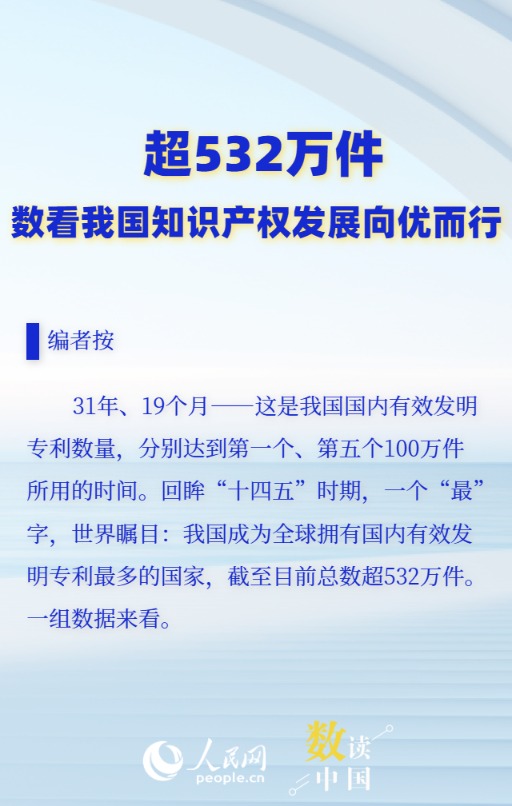
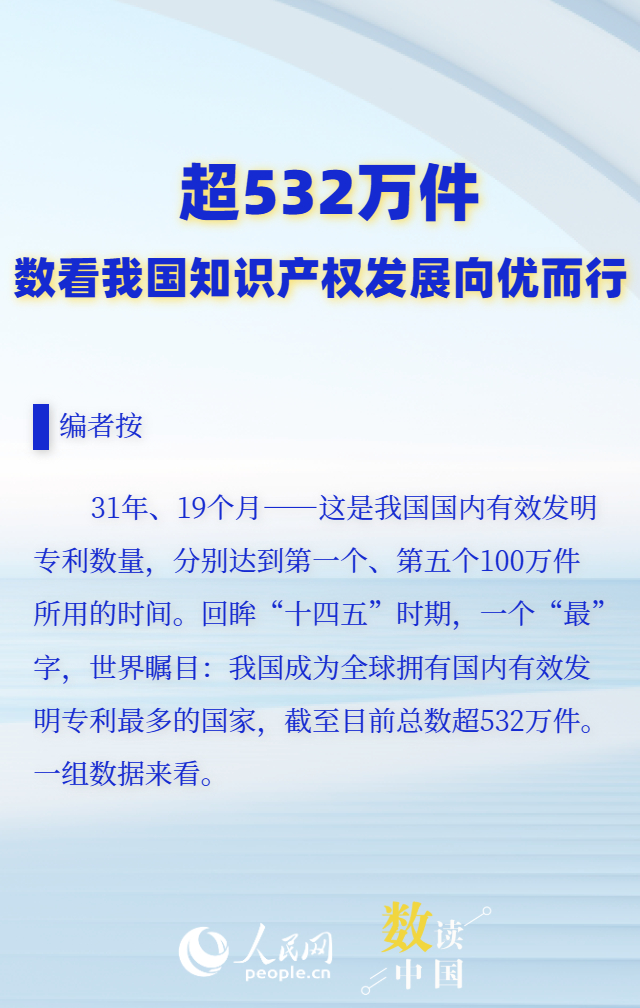
数读中国 超532万件!数看我国知识产权发展向优而行
Ren Min Wang· 2026-02-28 01:40
Core Viewpoint - China has become the country with the highest number of valid domestic invention patents globally, exceeding 5.32 million patents, significantly surpassing the goals set for the 14th Five-Year Plan [2][3]. Group 1: Patent Growth and Achievements - The number of valid domestic invention patents in China has surpassed 5.32 million, making it the global leader in this category [3]. - During the 14th Five-Year Plan period, the number of valid domestic invention patents has successively broken the milestones of 4 million and 5 million, exceeding the planned targets [3]. - The time taken to reach the first 1 million patents was 31 years, while the subsequent milestones were achieved in significantly shorter periods: 4 years for the second million, 2 years for the third, 18 months for the fourth, and approximately 19 months for the fifth [5][6]. Group 2: International Patent Applications and Technology - China has ranked first globally in PCT (Patent Cooperation Treaty) international patent applications for six consecutive years, with a high-value invention patent ownership rate of 16 per 10,000 people [4]. - The transaction volume of technology contracts involving patents has exceeded 1 trillion yuan annually [4]. - By the end of 2025, the number of valid domestic invention patents in strategic emerging industries is expected to reach 1.534 million [4]. Group 3: Intellectual Property Cooperation and Services - China has established intellectual property cooperation relationships with over 80 countries and regions, with a patent examination fast track (PPH) covering 86 countries [9]. - There are 519 national-level intellectual property public service institutions, achieving full provincial coverage, and 129 national-level intellectual property protection centers and rapid response centers have been established [11]. - By 2025, the overseas intellectual property dispute response guidance platform is expected to reach 116, having guided over 4,200 disputes and helping companies recover nearly 41 billion yuan in losses [11]. Group 4: Patent Examination Efficiency - The average examination cycle for invention patents has been reduced to 15 months, while the trademark registration average examination cycle remains stable at 4 months, both achieving the fastest levels under similar examination systems [14]. - The accuracy rate for invention patent examination has improved to 95.6%, and the trademark examination pass rate exceeds 97% [14]. Group 5: Patent Utilization and Economic Impact - Through special actions for patent transformation and utilization, over 134.9 million existing patents have been reviewed, with 145.8 million patent transfer and licensing records completed, connecting with 450,000 enterprises [15]. - The industrialization rate of invention patents for Chinese enterprises has increased from 44.9% in 2020 to 54% by 2025 [15]. - The value added by patent-intensive industries as a percentage of GDP has risen from 11.97% in 2020 to 13.38% in 2024 [17].
超532万件!数看我国知识产权发展向优而行
Ren Min Ri Bao· 2026-02-28 01:15
Core Insights - China has become the country with the highest number of valid domestic invention patents, exceeding 5.32 million as of now, achieving significant milestones during the 14th Five-Year Plan period [2][4]. Group 1: Patent Growth - The time taken to reach the first 1 million valid domestic invention patents was 31 years, while the subsequent milestones were achieved much faster: the second million in 4 years, the third in 2 years, the fourth in 18 months, and the fifth in approximately 19 months [6][7]. - The number of valid domestic invention patents surpassed 4 million and 5 million during the 14th Five-Year Plan, exceeding the planned targets [4]. Group 2: International Standing - China has ranked first globally in PCT (Patent Cooperation Treaty) international patent applications for six consecutive years, with a high-value invention patent ownership rate of 16 per 10,000 people [5]. - The country holds 60% of the world's artificial intelligence patents and approximately two-thirds of global robot-related patents [8]. Group 3: Economic Impact - The annual transaction volume of technology contracts involving patents exceeds 1 trillion yuan [5]. - The contribution of patent-intensive industries to China's GDP increased from 11.97% in 2020 to an expected 13.38% by 2024 [22]. Group 4: Knowledge Property Services - There are 519 national-level intellectual property public service institutions, achieving full provincial coverage [12]. - A total of 129 national-level intellectual property protection centers and rapid response centers have been established, with guidance provided for over 4,200 overseas intellectual property disputes, helping recover nearly 41 billion yuan in losses [13]. Group 5: Innovation and Talent Development - The average examination cycle for invention patents has been reduced to 15 months, and the accuracy rate for patent examination has improved to 95.6% [19]. - The number of intellectual property professionals has surpassed 1 million, and the industrialization rate of enterprise invention patents has increased from 44.9% in 2020 to 54% by 2025 [20].
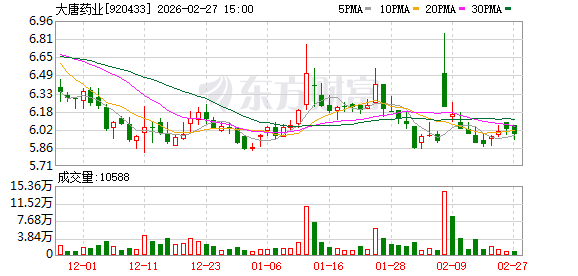
大唐药业:关于取得发明专利证书的公告
Zheng Quan Ri Bao· 2026-02-27 13:10
Core Viewpoint - Datang Pharmaceutical has recently received an invention patent certificate issued by the National Intellectual Property Administration [2] Group 1 - The company announced the receipt of the patent certificate on February 27 [2]
532万件专利,意味着什么?(人民日报)
Ren Min Ri Bao· 2026-02-27 03:19
Group 1 - The core point of the article highlights that China has become the country with the most valid invention patents globally, surpassing 5.32 million patents as of now, achieving this milestone in a significantly shorter time compared to previous benchmarks [1][3] Group 2 - The increase in patent numbers reflects a continuous optimization of the innovation ecosystem, with 519 national-level intellectual property public service institutions established across the country, achieving provincial-level coverage [2] - The collaboration among application, agency, and examination sectors is driving innovation from mere quantity accumulation to qualitative leaps [2] Group 3 - The value of innovation is tied to high-quality development, with 70% of high-value invention patents expected to come from strategic emerging industries by the end of 2025 [3] - Protecting intellectual property is equated with protecting innovation, as the 5.32 million patents serve as a link between innovation and the market, injecting strong momentum into the development of new productive forces [3] - Looking ahead to the 15th Five-Year Plan, the path for the development of intellectual property with Chinese characteristics is gradually unfolding [3]
我国发明专利申请量连续多年全球居首(人民日报)
Ren Min Ri Bao· 2026-02-27 03:19
Core Insights - China has become the first country to surpass 5 million valid invention patents, with a total of 5.32 million patents as of now, indicating a strong growth in intellectual property [2] - The country holds 60% of global artificial intelligence patents and approximately two-thirds of robot-related patents, showcasing its dominance in these emerging technologies [2] - The average examination period for invention patents in China has been reduced to 15 months, the fastest level internationally under similar examination systems, reflecting improved efficiency in patent protection [3] Patent Growth and Impact - During the 14th Five-Year Plan period, the number of valid invention patents in China has been steadily increasing, with a target of reaching 2.29 million high-value invention patents by the end of 2025, 70% of which will belong to strategic emerging industries [2] - The number of invention patent applications has ranked first globally for several consecutive years, reinforcing China's status as a patent powerhouse [2] - The financial sector has issued over 900 billion yuan in loans backed by intellectual property, indicating a significant increase in the practical application of high-value patents [3] Intellectual Property Protection - The social satisfaction rate regarding intellectual property protection has been improving year by year, reflecting growing confidence in China's intellectual property system among foreign enterprises [3] - As of January 2026, the number of valid invention patents held by foreign applicants in China has exceeded 922,000, demonstrating the increasing engagement of foreign companies in the Chinese market [3] - The shift from a knowledge property power to a knowledge property strong nation is marked by a deepening respect for knowledge and encouragement of innovation within society [3]
532万件专利,意味着什么?
Ren Min Ri Bao· 2026-02-25 22:15
Core Insights - China has become the country with the highest number of valid invention patents, exceeding 5.32 million as of now, marking a significant milestone in its innovation journey [1][3] Group 1: Patent Growth - The time taken to reach the first and fifth million valid invention patents in China was 31 years and 19 months respectively, indicating a rapid acceleration in patent accumulation [1] - The increase in patent numbers reflects a continuous optimization of the innovation ecosystem rather than mere numerical growth [2] Group 2: Innovation and Quality Development - High-value invention patents are increasingly coming from strategic emerging industries, with projections indicating that 70% will originate from these sectors by the end of 2025 [3] - Protecting intellectual property is essential for fostering innovation, as evidenced by the role of 5.32 million patents in linking innovation to market applications [3] Group 3: Future Outlook - The development path of China's intellectual property is expected to continue evolving positively, with a focus on quality and new heights in innovation during the "15th Five-Year Plan" [4]
中国移动取得文件管理方法专利
Sou Hu Cai Jing· 2026-02-25 04:40
Group 1 - The State Intellectual Property Office of China has granted a patent titled "Document Management Method, Device, and Computer Program Product" to China Mobile Communications Group Terminal Co., Ltd. and China Mobile Communications Group Co., Ltd., with the announcement number CN118802895B and an application date of March 2024 [1] - China Mobile Communications Group Terminal Co., Ltd. was established in 2004 and is based in Beijing, primarily engaged in the manufacturing of computers, communications, and other electronic devices, with a registered capital of 6.2 billion RMB [1] - The company has made investments in 5 enterprises, participated in 5,000 bidding projects, holds 170 trademark registrations, 665 patents, and has 6 administrative licenses [1] Group 2 - China Mobile Communications Group Co., Ltd. was established in 1999 and is also based in Beijing, focusing on telecommunications, broadcasting, television, and satellite transmission services, with a registered capital of 30 billion RMB [1] - This company has invested in 55 enterprises, participated in 5,000 bidding projects, holds 2,205 trademark registrations, 5,000 patents, and has 50 administrative licenses [1]

Anthropic一条推文,引发了全球AI圈同仇敌忾的群嘲。
数字生命卡兹克· 2026-02-25 02:38
Core Viewpoint - The article discusses the controversy surrounding three Chinese AI companies—DeepSeek, Moonshot, and MiniMax—accused of conducting "industrial-scale distillation attacks" on Anthropic's Claude model, raising significant national security concerns [3][4]. Group 1: Distillation and Its Implications - Distillation is a common AI training technique where a larger model (teacher) is used to train a smaller model (student), allowing the smaller model to learn from the larger one without needing to replicate its entire complexity [11][12]. - The article highlights that while distillation is a normal practice, the legality of how training data is obtained is crucial, especially when it involves using outputs from other companies' models [13]. - Anthropic claims that the Chinese companies created 24,000 fake accounts to extract Claude's outputs, which they argue violates their service terms [13][16]. Group 2: Legal and Ethical Concerns - Anthropic faced a lawsuit for using over 7 million copyrighted books from piracy sites like LibGen and PiLiMi to train Claude, leading to a historic $1.5 billion settlement [14][16]. - The court ruled that using legally purchased books for AI training is fair use, while using pirated books constitutes infringement, highlighting the importance of legal data acquisition methods [17]. - The article points out the double standards in the industry, where Anthropic criticizes others for data extraction while having engaged in similar practices [19]. Group 3: Broader Implications of AI and Copyright - The article raises philosophical questions about the nature of "theft" in the context of AI, suggesting that traditional notions of theft do not apply to data, as copying does not deplete the original [25][26]. - It discusses the historical context of copyright issues, noting that technological advancements have consistently sparked debates about intellectual property rights [30][31]. - The emergence of AI challenges existing frameworks of creativity and ownership, as AI can learn from and generate new content based on existing works [35][36]. Group 4: Future Considerations - The article emphasizes the need for a nuanced discussion on AI and copyright, moving beyond binary views of "theft" to consider the complexities involved [44][45]. - It warns against the monopolization of AI training capabilities by a few companies, particularly in the U.S., and the implications this has for global equity in AI development [47][48].