
美元微笑曲线

Search documents
“特朗普2.0”百日美元或创1973年以来最差纪录!高盛:真正冲击5月中旬爆发,美元将进入长期结构性贬值
Mei Ri Jing Ji Xin Wen· 2025-04-28 08:00
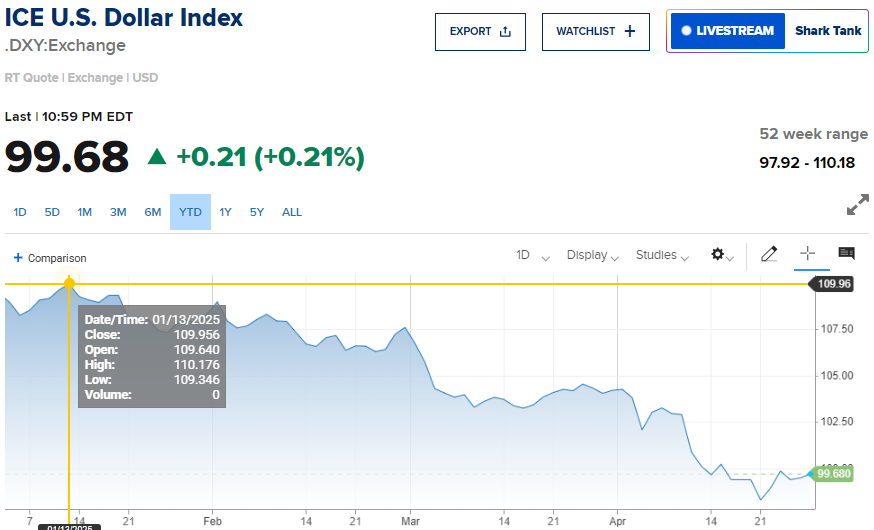
Core Viewpoint - The US dollar index has declined nearly 9% since Trump's return to the White House, potentially marking the worst performance in the first 100 days of a presidency since 1973, with Goldman Sachs warning of a long-term structural depreciation of the dollar [1][2][3]. Group 1: Economic Indicators - Goldman Sachs reports that while current "hard data" in the US remains strong, the negative impacts of tariff policies on the economy may not become apparent until mid-May or early June [1][3]. - The dollar index was reported at 99.68 points, having briefly fallen below 98, marking a three-year low [2]. Group 2: Investor Sentiment - Non-US investors currently hold $22 trillion in US assets, with half of that in unhedged stocks, indicating that a reduction in US exposure could lead to significant dollar depreciation [2][9]. - Shah emphasizes that the dollar's weakness is likely to be structural, as it serves as a natural adjustment mechanism to tariffs and economic uncertainties [3][5]. Group 3: Long-term Trends - Shah notes that the influx of private capital into US assets, which has historically supported a strong dollar, may be reversing, leading to a potential decline in demand for US assets [5][15]. - The dollar's actual value is currently above its historical average, suggesting a potential depreciation of 25% to 30% if non-US investors reduce their exposure [9]. Group 4: Policy Uncertainty - High levels of policy uncertainty and low consumer and business confidence contribute to market risk aversion, with Goldman Sachs estimating a 45% probability of a US recession in the next 12 months [16][19]. - Despite recent tariff pauses, many tariffs remain in place, and significant reductions are unlikely, which could prolong economic challenges [16][19].


哪些资产可以帮助投资者避险?
伍治坚证据主义· 2025-04-11 02:57
当市场中的避险情绪上升,比如当美国总统特朗普忽然宣布对全球大部分国家征收关税时,股市整体都会下跌,绝大部分股票都会受其影响而被抛售。哪怕 一个公司的业绩和进出口贸易无关,其价格也会被大盘带动而下跌回撤。在这个时候,有些投资者会觉得他需要一些"避险资产",或者"投资保险",来保 护他的投资组合,维持他的理智,帮助他在价格暴跌时不至于被迫出售那些长期看好的股票。 那么问题来了:哪些资产可以帮助投资者达到"保险"的功能呢? 第一个选项是 政府国债 。 这里的国债,主要指那些信用评级比较高的发达国家政府国债,比如美国、英国、澳大利亚、德国等。由于发行这些国债的国家政府信用评级比较高,市场 对他们比较信任,几乎不用担心他们像阿根廷政府那样违约,因此这些国家的政府国债是很多投资机构最青睐的"保险资产"之一。 前摩根士丹利策略师 Stephen Jen 曾提出过一个金融理论,叫做 美元微笑曲线 ,来解释美元在不同经济环境下为何能表现强势的现象。在全球风险上 升、经济衰退或金融市场动荡时,投资者寻求 " 避险资产 " 。美元因其全球储备货币地位以及美国国债市场的深度和流动性,被认为是最安全的资产。此 时,资本流入美国,美元升 ...
哪些资产可以帮助投资者避险?
伍治坚证据主义· 2025-04-11 02:57
Core Viewpoint - The article discusses the importance of safe-haven assets during times of market volatility, highlighting government bonds, gold, and the US dollar as key options for investors seeking to protect their portfolios from downturns [1][2][6]. Group 1: Government Bonds - Government bonds, particularly from high-credit-rated developed countries like the US, UK, Australia, and Germany, are favored as safe-haven assets due to their reliability and low default risk [2][3]. - In economic downturns, central banks typically lower interest rates, which increases bond prices and provides investors with a protective function [2][3]. - The current yield on US 10-year government bonds is approximately 4.3%, offering decent returns while maintaining their role as a safe asset during market turmoil [3]. Group 2: Gold - Gold is highlighted as another significant safe-haven asset, especially during crises, as it is perceived to resist inflation due to its finite supply [4][5]. - Over the past year, gold prices have increased by around 50%, indicating its appeal during uncertain times [5]. - However, gold's price volatility poses risks, as it can spike during crises but may also decline sharply once the crisis subsides, necessitating careful timing by investors [5]. Group 3: US Dollar - The US dollar is recognized as a classic safe-haven asset, benefiting from its status as the global reserve currency and the depth of the US Treasury market [6][7]. - The "dollar smile" theory explains that the dollar appreciates during both economic downturns and periods of strong US economic performance, making it a reliable asset in various conditions [6][7]. - Concerns about the dollar's status as a safe-haven asset arise from geopolitical tensions and potential shifts in global economic dynamics, which could undermine its reserve currency status [7]. Group 4: Diversification Strategy - The article emphasizes that no single asset can guarantee protection against losses, advocating for a diversified investment approach to mitigate risks and achieve smoother returns [8]. - Investors are encouraged to maintain a long-term perspective and avoid being overly influenced by short-term market fluctuations [9].
华泰证券-3月FOMC点评:_有限”鸽派的美联储
HTSC· 2025-03-20 07:26
Investment Rating - The report maintains a neutral investment rating for the industry, indicating that the industry is expected to perform in line with the benchmark [35]. Core Insights - The Federal Reserve's March FOMC meeting kept the federal funds rate target range at 4.25% to 4.5%, aligning with market expectations. The statement noted increased uncertainty in the economic outlook, with short-term inflation risks rising and employment risks declining [2][3]. - The Fed plans to reduce the scale of quantitative tightening (QT) starting in April, with a monthly reduction cap for Treasury securities set to $5 billion, down from $25 billion, while maintaining a $35 billion cap for agency bonds and mortgage-backed securities [2][8]. - Economic growth forecasts have been downgraded, with GDP growth expectations for 2025 and 2026 revised down to 1.7% and 1.8%, respectively, while unemployment rate expectations for 2025 have been raised to 4.4% [3][10]. Summary by Sections FOMC Meeting Insights - The FOMC meeting highlighted a cautious approach to monetary policy, with officials indicating a need for data-driven decisions due to heightened economic uncertainty [2][3]. - The dot plot revealed a narrowing of opinions regarding the number of rate cuts expected in 2025, with a total of two cuts anticipated, but with increased divergence on the magnitude of those cuts [3]. Market Reactions - Following the FOMC announcement, U.S. Treasury yields fell, and stock markets rebounded, with the S&P 500 rising by 1.08% and the Nasdaq by 1.41% [9][12]. - The market is pricing in a 66% chance of a rate cut in 2025, reflecting an increase in expectations following the FOMC meeting [9]. Future Policy Outlook - The report suggests that the U.S. economy may face a "stagflation-like" environment, complicating the Fed's decision-making between employment and inflation control [10]. - The Fed's decision to slow down the balance sheet reduction is seen as a precautionary measure, with potential for further adjustments depending on liquidity conditions [10][11]. Asset Allocation Insights - U.S. Treasuries are viewed as a high-probability investment, but the potential for significant rate cuts may be limited by inflation risks [11]. - The report advises a cautious stance on U.S. equities due to ongoing uncertainties related to tariffs and economic performance, suggesting a diversified asset allocation strategy [12][13].