
美国债务

Search documents
6月30日上期所沪银期货仓单较上一日增加4093千克
Jin Tou Wang· 2025-06-30 07:59
Group 1 - The total silver futures in Shanghai Futures Exchange reached 1,299,756 kilograms, with an increase of 4,093 kilograms compared to the previous day [1] - The main silver futures opened at 8,716 yuan per kilogram, peaked at 8,765 yuan, and dropped to a low of 8,662 yuan, closing at 8,762 yuan, reflecting a daily decline of 0.54% [1] Group 2 - President Donald Trump expressed concerns regarding his "massive and beautiful" spending bill and the unfair auto trade with Japan [2] - Trump indicated uncertainty about passing the spending bill by the target date of July 4, stating that a delay could lead to perceptions of failure [2] - Trump emphasized the need for a person who can lower interest rates to enter the Federal Reserve, especially in light of the upcoming $9 trillion U.S. debt [2] - Trump criticized Japan for not purchasing American cars while the U.S. imports millions of Japanese vehicles, suggesting Japan should import more U.S. oil and other products [2]
鲍威尔:美国债务的规模并没有影响到美联储履行自身职责。
news flash· 2025-06-25 15:24
Core Viewpoint - The scale of U.S. debt has not impacted the Federal Reserve's ability to fulfill its responsibilities [1] Group 1 - The Federal Reserve maintains that its operations and policy implementations remain unaffected by the current debt levels [1]
美国财长贝森特:税收法案是否会增加美国债务尚有待观察。
news flash· 2025-06-11 15:45
Core Viewpoint - The U.S. Treasury Secretary, Janet Yellen, stated that it remains to be seen whether the tax legislation will increase the national debt [1] Group 1 - The discussion around the tax bill's impact on the national debt is ongoing and uncertain [1]
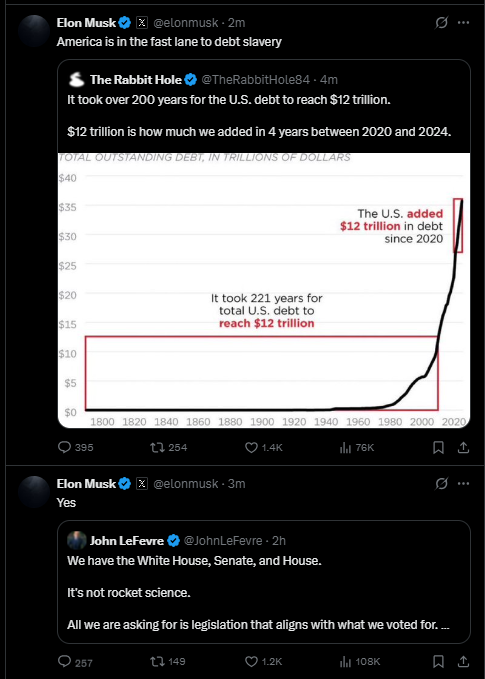
前美国政府效率部(DOGE)“顾问”马斯克转发别人的帖子并评论称,美国正快速堕为债务奴役。该帖子认为,美国债务耗费了200年才达到12万亿美元,但2020-24年就增长了12万亿美元。
news flash· 2025-06-04 17:58
Core Insights - The former U.S. government efficiency advisor, Elon Musk, commented on a post stating that the U.S. is rapidly descending into debt servitude [1] - The post highlighted that it took 200 years for U.S. debt to reach $12 trillion, but this amount increased by another $12 trillion from 2020 to 2024 [1] Summary by Categories - **Debt Growth** - U.S. debt reached $12 trillion over 200 years, but an additional $12 trillion is projected to accumulate between 2020 and 2024 [1] - **Economic Implications** - The rapid increase in debt raises concerns about the economic stability and future financial obligations of the U.S. [1]

中信期货晨报:国内商品期货以下跌为主,三大橡胶期货领跌-20250529
Zhong Xin Qi Huo· 2025-05-29 02:55
1. Report Industry Investment Rating - No industry investment rating information is provided in the report. 2. Core Views of the Report - Maintain the view of more hedging and more volatility overseas, and a structural market in China. Strategically allocate gold and non - US dollar assets [6]. - Overseas, the inflation expectation structure in the US is stable, and the short - term fundamentals remain resilient. The fiscal impact on short - term sentiment is expected to improve in the next 2 - 3 weeks. In July - September, under the "dual uncertainty" of tariffs and fiscal policy, US stocks and bonds are likely to experience significant fluctuations. - In China, the pro - growth policies maintain their stance, and may still focus on making good use of existing resources. The export resilience and the window period of tariff relaxation support the economic growth rate in the second quarter. The bond market still has value for dip - buying after the capital pressure eases. The stock market and commodities return to the fundamental logic, showing a short - term range - bound trend. It is recommended to focus on the low - valuation and policy - driven logic [6]. 3. Summary According to Relevant Catalogs 3.1 Macro Essentials - **Overseas Macro**: Tariff and US debt concerns are the two main lines of market fluctuations in May. The EU requested to extend the tariff negotiation deadline to July 9, which was approved by US President Trump. The US House of Representatives passed a large - scale tax - cut and spending bill on May 22, planning to cut taxes by more than $4 trillion and reduce spending by at least $1.5 trillion in the next 10 years. The 20 - year US Treasury bond auction on May 22 was one of the worst in five years, increasing market concerns about the growth of US debt. US retail sales in April increased slightly by 0.1%, slightly exceeding expectations. The US manufacturing and service PMI in May both performed better than expected [6]. - **Domestic Macro**: The domestic economic data in April showed resilience, and policy expectations were generally stable. On May 20, the China - ASEAN Economic and Trade Ministers' Special Meeting was held online, and the two sides announced the full completion of the negotiation of the China - ASEAN Free Trade Area 3.0. The People's Bank of China authorized the National Inter - bank Funding Center to announce that the 1 - year and over - 5 - year LPRs were both cut by 10BP in May 2025. At the same time, many state - owned banks such as China Construction Bank and Industrial and Commercial Bank of China announced a cut in deposit interest rates, which was the first round of deposit interest rate cuts by state - owned banks this year. In terms of economic data, investment and consumption growth in April slowed down slightly but still showed resilience. In investment, the cumulative year - on - year growth of fixed - asset investment from January to April was 4.0%, with an expected 4.3% and a previous value of 4.2%. In consumption, the year - on - year growth of total retail sales of consumer goods in April was 5.1%, with an expected 5.5% and a previous value of 5.9%; the seasonally adjusted month - on - month growth was 0.24%, with a low growth rate but still showing some growth [6]. - **Asset Views**: Overseas, maintain a view of more volatility for equity assets and be vigilant about market risk preferences. In China, the pro - growth policies maintain their stance. The bond market still has value for dip - buying after the capital pressure eases. The stock market and commodities return to the fundamental logic, showing a short - term range - bound trend [6]. 3.2 View Highlights - **Macro**: Overseas, the stagflation trading cools down, and the long - and short - term allocation ideas diverge. In China, there are moderate reserve requirement ratio cuts and interest rate cuts, and the fiscal end implements the established policies in the short term. Overseas, the inflation expectation structure flattens, the economic growth expectation improves, and the stagflation trading cools down [7]. - **Finance**: Stock index futures are waiting for a change in volume. Stock index options see enhanced hedging transactions. The bond market for treasury bond futures may still be volatile [7]. - **Precious Metals**: The risk preference rises, and precious metals are in short - term adjustment. The short - term adjustment of gold and silver continues due to the better - than - expected progress of Sino - US negotiations [7]. - **Shipping**: The sentiment declines. Pay attention to the sustainability of the increase in the loading rate in June. The focus is on the game between the peak - season expectation and the implementation of price increases for the container shipping route to Europe [7]. - **Black Building Materials**: As the off - season approaches, the molten iron output declines, but the ore price remains relatively firm. The demand for steel continues to weaken, and the futures and spot prices decline. The second - round price cut for coke has started, and coke enterprises have difficulty in shipping. The pressure on coking coal inventory reduction increases, and the market sentiment is low [7]. - **Non - ferrous Metals and New Materials**: The inventory reduction generally slows down, and non - ferrous metals remain range - bound. The copper inventory continues to accumulate, and the copper price fluctuates at a high level. The alumina market is in high - level consolidation due to the undetermined revocation of mining licenses [7]. - **Energy and Chemicals**: Sino - US tariffs have dropped significantly, and energy and chemical products are out of the doldrums. The expectation of oil production increase intensifies the pressure on oil prices. The demand for LPG continues to weaken. The asphalt and high - sulfur fuel oil prices are overestimated and expected to fall [9]. - **Agriculture**: Sino - US negotiations have achieved substantial progress, and the sentiment is favorable for the cotton price rebound. The warehouse receipt game for rubber continues to ferment, and NR leads the commodity market. The raw materials for synthetic rubber remain weak, and the market is in horizontal consolidation [9].
最近卖光美股!82岁吉姆·罗杰斯:我现在坐拥大量现金,策略上和巴菲特完全一样
聪明投资者· 2025-05-28 05:13
Core Viewpoint - Jim Rogers expresses significant concern about the current state of the U.S. stock market, indicating that he has sold all his American stocks, suggesting that the market is nearing the end of a "party" phase [1][2][30]. Summary by Sections On Tariffs and Debt - Rogers believes tariffs are generally harmful and that they ultimately burden consumers, as they are essentially a tax on imports [7][8]. - He notes that China is currently experiencing a slowdown due to the aftermath of a real estate bubble and global trade contractions, but he expects China to remain patient in negotiations regarding tariffs with the U.S. [9][10]. - He expresses concern over the U.S. national debt, emphasizing that the U.S. is the largest debtor nation in history and worries about the implications for future generations [11][12][17][45]. On Economic Conditions and Speculation - Rogers acknowledges that while economic data may appear strong, historical patterns suggest that such conditions often precede downturns, leading to his current worries about market sustainability [21][25][30]. - He highlights a surge in speculative behavior among new investors, which historically has led to negative outcomes [26][28]. On Interest Rates - Rogers predicts that interest rates will rise due to ongoing global inflation, suggesting that rates could exceed 5% in the coming years [36][39]. On Investment Opportunities - Currently, Rogers sees limited attractive investment opportunities globally, although he maintains a positive outlook on China and Uzbekistan [41][42][62]. - He has previously invested in India but currently holds no positions there, indicating a cautious approach to emerging markets [41]. On Personal Investment Strategy - Rogers holds a significant cash position and continues to invest in gold and silver, viewing them as long-term assets for his children [51][52]. - He expresses skepticism about the future of the U.S. dollar, acknowledging its current strength but warning of the unsustainable debt levels that could lead to a decline [56][57]. On Market Sentiment - Rogers advises investors to be extremely cautious in the current market environment, emphasizing the need for prudence amid rising excitement and confidence among market participants [64][70].

投资者对美国债务担忧加剧,金价上涨
news flash· 2025-05-22 01:46
金十数据5月22日讯,现货黄金价格周四上涨,因投资者对美国政府债务增长的担忧加剧,且对20年期 国债拍卖的需求不温不火,突显出对美国资产的兴趣低迷。 投资者对美国债务担忧加剧,金价上涨 ...