芯片战

Search documents
美国对华芯片战失败,上半年我国芯片出口5427亿,欧美不淡定了
Sou Hu Cai Jing· 2025-06-10 04:17
Group 1 - The core point of the article is that China's semiconductor industry has achieved significant growth, with integrated circuit exports reaching 542.7 billion yuan in the first half of 2025, marking a historical high and a 25.6% increase [1][3][12] - The development of China's semiconductor industry has been propelled by national policies since the late 1990s, with the 2014 "National Integrated Circuit Industry Development Promotion Outline" elevating the sector to a strategic level [3][4] - Despite facing U.S. sanctions, China's semiconductor industry has made remarkable progress, particularly in smartphone and public transportation sectors, showcasing the emergence of domestic chips [4][10] Group 2 - U.S. sanctions intended to block China's access to advanced semiconductor technology have inadvertently led to economic repercussions for American high-tech manufacturing [6][8] - Major U.S. semiconductor companies, including Intel, Qualcomm, and NVIDIA, have expressed dissatisfaction with the government's restrictions and have lobbied for easing export limitations to China [8][10] - As China's semiconductor industry continues to rise, the effectiveness of U.S. sanctions is diminishing, prompting the U.S. to consider increasing tariffs on certain Chinese goods [10][12] Group 3 - China's self-reliance in semiconductor technology has been bolstered by years of innovation, allowing domestic manufacturers to replace imports in key areas such as storage chips and 5G communications [10][12] - The article suggests that the U.S. is facing increasing economic challenges and global competition, making it difficult to maintain a prolonged conflict with China in the semiconductor sector [12][13] - The future of U.S.-China cooperation in the semiconductor industry remains uncertain, as China's influence continues to grow and more countries seek economic ties with China [12][13]


临走前,马斯克给特朗普留下几句忠告:中国的实力深不可测!
Sou Hu Cai Jing· 2025-05-27 11:31
Group 1 - Musk emphasizes China's impressive talent pool and capabilities, particularly in the AI sector, predicting that by the end of the year, China's power generation will reach 2.5 times that of the US, potentially increasing to 3 to 4 times [1] - The Chinese power industry has diversified from coal to include hydropower, wind, solar, natural gas, and other renewable sources, aiming to become a world-class green low-carbon energy supplier [3] - By 2035, it is projected that clean energy will account for 95% of installed capacity and over 70% of power generation in China, driven by carbon peak and carbon neutrality goals [3] Group 2 - Musk's comments are seen as a challenge to the prevailing narrative in the US, particularly against Trump's administration, which has been engaged in a trade war with China [4] - The US government has issued warnings against the use of Huawei's AI chips, indicating a strategy to hinder China's AI development and maintain technological dominance [6] - Trump's administration has shown a pattern of aggressive trade policies, which have ultimately resulted in negative consequences for American citizens, highlighting the challenges of decoupling from China [8]

特朗普拒不妥协?美债危机倒逼中美谈判,英伟达CEO暗藏玄机
Sou Hu Cai Jing· 2025-05-06 07:27
Group 1: US-China Negotiations - The US has extended an olive branch to China for negotiations, but China's response indicates a need for sincerity from the US side [2] - The US is facing economic pressures from the ongoing tariff war, with warnings of a recession and declining trust from international allies like Japan [2] - Japan's willingness to negotiate regarding US debt holdings highlights vulnerabilities in the US financial system [2] Group 2: Chip War Dynamics - Trump's chip policy is an escalation of existing restrictions, targeting companies like Nvidia and aiming to pressure China into concessions [4] - China's self-sufficiency in chip production is increasing, with projections of a 30% self-sufficiency rate in 2024 and 45% by 2025 [4] - Historical examples show that US technology restrictions often lead to accelerated advancements in Chinese technology [4][7] Group 3: Nvidia's Position - Nvidia's CEO, Jensen Huang, suggests that US export restrictions could inadvertently strengthen China's competitive edge [6] - The US has a pattern of restricting technologies that China has not yet mastered, but once China achieves breakthroughs, restrictions are lifted [6][7] - Nvidia's revenue from the Chinese market constitutes 40% of its data center business, indicating significant financial risk if China shifts to self-reliance [7] Group 4: Future Considerations - The US-China competition is not a zero-sum game; mutual respect and equality are essential for productive negotiations [9] - The US should focus on fair competition in emerging sectors like renewable energy and artificial intelligence rather than relying on restrictive measures [9]

英伟达“55亿伤痕”背后:芯片战再升级,瑞银急砍目标价
Jin Rong Jie· 2025-04-21 03:09
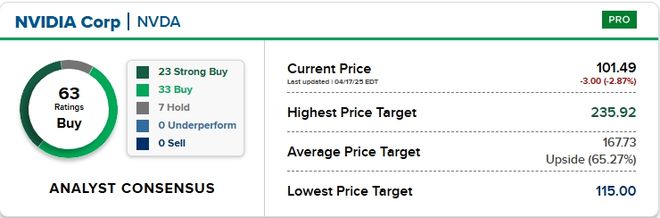
Group 1 - UBS has revised its price target for NVIDIA from $185 to $180 due to U.S. government export restrictions affecting the company's H20 graphics processors, indicating a potential 72% upside from the new target [1] - NVIDIA is expected to incur a $5.5 billion charge related to the export of its H20 GPUs, as the U.S. government has mandated that licenses are required for exports to multiple countries, including China [1] - The semiconductor industry faces systemic risks, with NVIDIA's stock down 22% year-to-date, and the economic recovery being weaker than previous rebounds [1] Group 2 - AMD's price target has been lowered to $155, with the export ban potentially having a more significant impact on AMD compared to NVIDIA [1] - AMD's MI308 product, designed specifically for the Chinese market, now also requires similar export licenses, which may lead to a de facto ban [2] - AMD anticipates up to $800 million in losses related to inventory, purchase commitments, and reserves, with an estimated $1 billion revenue impact due to inventory-related losses [2]