麒麟芯片

Search documents
手机涨价,华为苹果为啥不涨?
36氪· 2026-03-26 10:14
Core Viewpoint - The current price increase in the smartphone industry is a result of a shift from competing on hardware and scale to competing on supply chain, ecosystem, and long-term value [4][67]. Group 1: Price Increase Dynamics - Major brands like Xiaomi, OPPO, vivo, and Honor are signaling price increases for mid-range phones by 300 to 500 yuan and flagship models by 1000 to 2000 yuan [6][7]. - The price of storage chips, particularly DRAM and NAND flash, has surged, with DRAM contract prices increasing by 90% to 95% and NAND flash by 55% to 60% in early 2026 [20]. - The cost of storage chips in a typical mid-range Android phone has risen from approximately 300 yuan to 500-600 yuan, increasing its cost share from 12% to over 20% [20]. Group 2: Factors Behind Price Increases - The demand for storage chips has been drastically altered by the explosive growth of AI servers, which require significantly more memory than standard servers [22][23]. - Major storage manufacturers have redirected over 80% of their advanced production capacity to AI server-specific storage, leading to a severe shortage for mobile devices [24]. - The rising costs of raw materials like copper and aluminum, along with the global AI infrastructure expansion, have further exacerbated the situation [26]. Group 3: Apple and Huawei's Pricing Strategies - Apple has managed to lower the price of the iPhone 17e by 1000 yuan compared to the iPhone 16e, leveraging its massive global procurement scale to negotiate lower prices with suppliers [8][33]. - Apple's self-developed components, such as the C1X baseband, allow it to reduce costs compared to purchasing from third-party suppliers like Qualcomm [36]. - Huawei is not increasing prices due to its self-developed technologies, which help mitigate external cost pressures, and its procurement of domestic components at lower prices [45][49]. Group 4: Market Positioning and Strategy - Huawei aims to enhance its market reputation and user loyalty rather than focusing solely on short-term profits, with a goal of selling 70 million phones in 2026 [50][56]. - Both Apple and Huawei are strategically positioned to maintain or lower prices while other brands are forced to increase them due to weaker supply chain management [57][58]. - The smartphone market is expected to see a significant shift, with lower-end models potentially disappearing or being severely downgraded due to increased component costs [60].



中芯国际:第三大晶圆代工企业,受益本土企业崛起和本地化制造趋势-20260307
Guoxin Securities· 2026-03-07 00:45
Investment Rating - The report maintains an "Outperform" rating for the company [5] Core Insights - The company is the third-largest foundry globally, benefiting from the rise of domestic enterprises and the trend of localized manufacturing [1][11] - The semiconductor industry has long-term growth potential, characterized by cyclical and growth aspects, with global semiconductor sales expected to reach a record high of $791.6 billion in 2025 [2][34] - The company's revenue is projected to grow from $31 billion in 2017 to $93 billion in 2025, with a CAGR of 15% [20] - The company maintains a high capacity utilization rate, expected to reach 95.7% by Q4 2025, driven by the increasing demand from Chinese chip design companies [2][55] Financial Projections - Revenue and net profit forecasts for 2025 are $9.3 billion and $685 million, respectively, with a net profit CAGR of 18% from 2017 to 2025 [4][20] - The company’s gross margin is expected to be 21% in 2025, with over 90% of revenue coming from integrated circuit foundry services [23][29] - The company plans to increase its capital expenditure significantly, reaching $8.1 billion by 2025 to support capacity expansion [56][59] Market Dynamics - The company is positioned to benefit from the increasing number of Chinese chip design firms, which are expected to grow from 1,380 in 2017 to 3,901 by 2025, with a CAGR of 14% [43] - The demand for 12-inch wafers is rising, with their revenue share expected to increase to 77% by 2025, while the share of 8-inch wafers declines to 23% [29][31] - The global semiconductor sales are projected to continue double-digit growth into 2026, indicating a robust market environment [34]

美专家:中美擦枪走火或因三大死结,美国绝不允许中国平起平坐?
Sou Hu Cai Jing· 2026-02-27 03:30
Group 1 - The core issue in US-China relations is the unwillingness of the US to accept China's rise as an equal power, leading to increased risks of conflict [1] - The economic deadlock began in 2018 with the US imposing tariffs on Chinese goods, which did not significantly reduce the trade deficit and disrupted supply chains [3] - In 2019, the technological deadlock intensified as the US restricted exports to Chinese companies like Huawei, prompting China to accelerate its innovation efforts [3] Group 2 - The security deadlock is primarily focused on Taiwan and the South China Sea, with increased military activities raising the risk of miscalculation and conflict [5] - The US's provision of arms to Taiwan is viewed as a provocative action, further complicating the security situation [5] - The US's hegemonic mindset is identified as the root cause of these deadlocks, leading to a fragmented global economy and increasing tensions [7] Group 3 - Experts suggest that the US should adjust its perspective, recognizing that China's success does not equate to US failure, and advocate for dialogue to manage tensions [7] - Effective management of the Taiwan issue and reduced military sales could lead to a more stable global environment [7] - Continued adherence to outdated thinking by the US could exacerbate these deadlocks, threatening global stability [7]
时隔4年,华为在欧洲发布Mate80 Pro
Guan Cha Zhe Wang· 2026-02-27 03:16
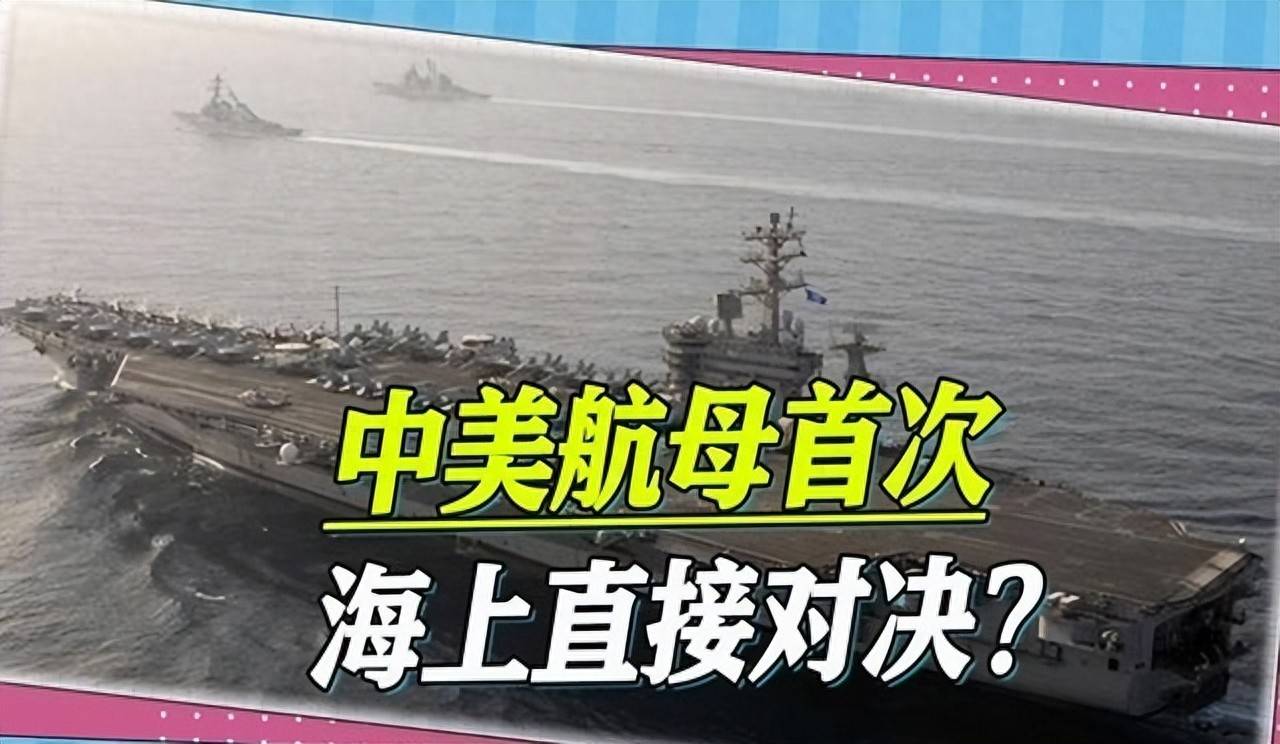
Group 1 - Huawei launched the Mate80 Pro overseas in Madrid, marking its return to the global high-end smartphone market since the Mate50 Pro in 2022 [1][3] - The Mate80 Pro overseas version is expected to feature a Kirin chip and is pre-installed with EMUI 15 based on Android, rather than the previously speculated HarmonyOS [1] - The pricing for the Mate80 Pro overseas version is set at €1299 for the 16+512GB model, which is approximately ¥10,510, higher by ¥3,511 compared to the domestic price [1] Group 2 - Huawei is seen as overcoming U.S. tech sanctions and regaining its position as a leader in the Chinese smartphone market, with projections indicating a market share of 16.4% by 2025, surpassing Apple [3] - The European smartphone market remains highly competitive, with Samsung holding a 35% share, Apple at 27%, and Xiaomi at 16%, collectively dominating nearly 80% of the market [5] - Huawei's wearable products, such as watches and headphones, are less dependent on the operating system ecosystem and may provide growth opportunities in overseas markets, while the smartphone segment still faces challenges until the HarmonyOS ecosystem matures [5]
美国三届政府打了8年才发现:为何中国反而越打越强?
Sou Hu Cai Jing· 2026-02-16 05:53
Group 1 - The US has imposed tariffs on Chinese goods since 2018, starting with steel and aluminum, expanding to $340 billion worth of products at a 25% rate [1] - In response to US tariffs, China implemented retaliatory measures, matching the scale of the tariffs [1] - The US-China trade tensions escalated with the US imposing additional tariffs on $200 billion of Chinese goods, raising the rate from 10% to 25% [1] - The US government has continued to enforce strict export controls on semiconductor technology to China, including the addition of companies to the entity list [1][3] - By 2026, the US shifted focus to requiring allies to pay more military expenses to reduce economic ties with China [3] Group 2 - China's semiconductor self-sufficiency reached 35% by January 2026, indicating progress in domestic production capabilities [3] - Despite US efforts to suppress China's economy, trade deficits have increased, from $375 billion in 2018 to $650 billion in 2020 [3] - Chinese companies have adapted by relocating supply chains to countries like Vietnam and India, and have increased domestic R&D efforts [5] - By 2026, China's manufacturing value added accounted for 35% of the global total, showcasing enhanced resilience in its industrial chain [5] - China's export structure has shifted significantly towards high-tech products, with electric vehicle exports increasing several times [5] Group 3 - The US's strategy has not achieved its intended effects, as China's technological development and export stability have continued to grow [7] - The US faces internal challenges such as manufacturing hollowing out, financialization, political polarization, and increasing wealth disparity [7] - The key issue lies in the US finding a new strategic direction to maintain its global dominance, while China continues to rise through global cooperation and innovation [9]
破防了?美芯价格暴跌90%,美媒直接甩锅,比尔盖茨三年前预言成真
Sou Hu Cai Jing· 2026-02-03 06:34
Core Insights - The global semiconductor market is experiencing a dramatic price drop, with general chip prices plummeting from $90 to around $10, a decline of nearly 90% [2] - Major companies like Micron and Intel are facing significant financial challenges, indicating turmoil within the U.S. semiconductor industry [2] Group 1: Market Dynamics - The price collapse is not merely a market fluctuation but signifies a critical turning point in a prolonged technological competition [5] - The U.S. semiconductor industry, once stable with a clear global structure, is now facing challenges due to geopolitical tensions and export restrictions [5][7] - The U.S. has implemented multiple export control measures against China, aiming to maintain technological dominance, which has inadvertently accelerated China's self-reliance in chip development [7][11] Group 2: China's Response - China's semiconductor industry has rapidly advanced, achieving significant milestones such as 7nm process production by SMIC and the development of domestically produced Kirin chips by Huawei [11] - By the end of 2025, China's self-sufficiency in chips is projected to reach nearly 70%, fundamentally altering the global supply-demand landscape [11] - China is not only meeting its domestic needs but is also beginning to export chips to Southeast Asia and the Middle East, marking a historic shift from being a net importer to a dual-driven export market [13] Group 3: Strategic Miscalculations - The U.S. semiconductor price drop can be traced back to strategic misjudgments regarding China's capabilities and the impact of export controls [13] - Bill Gates' warnings about the consequences of restricting China's access to chip technology have proven prescient, as these actions have catalyzed China's competitive growth [9][11] - The current situation illustrates that China's approach is not to replicate the U.S. monopoly but to create a new ecosystem based on self-sufficiency and open cooperation [13]
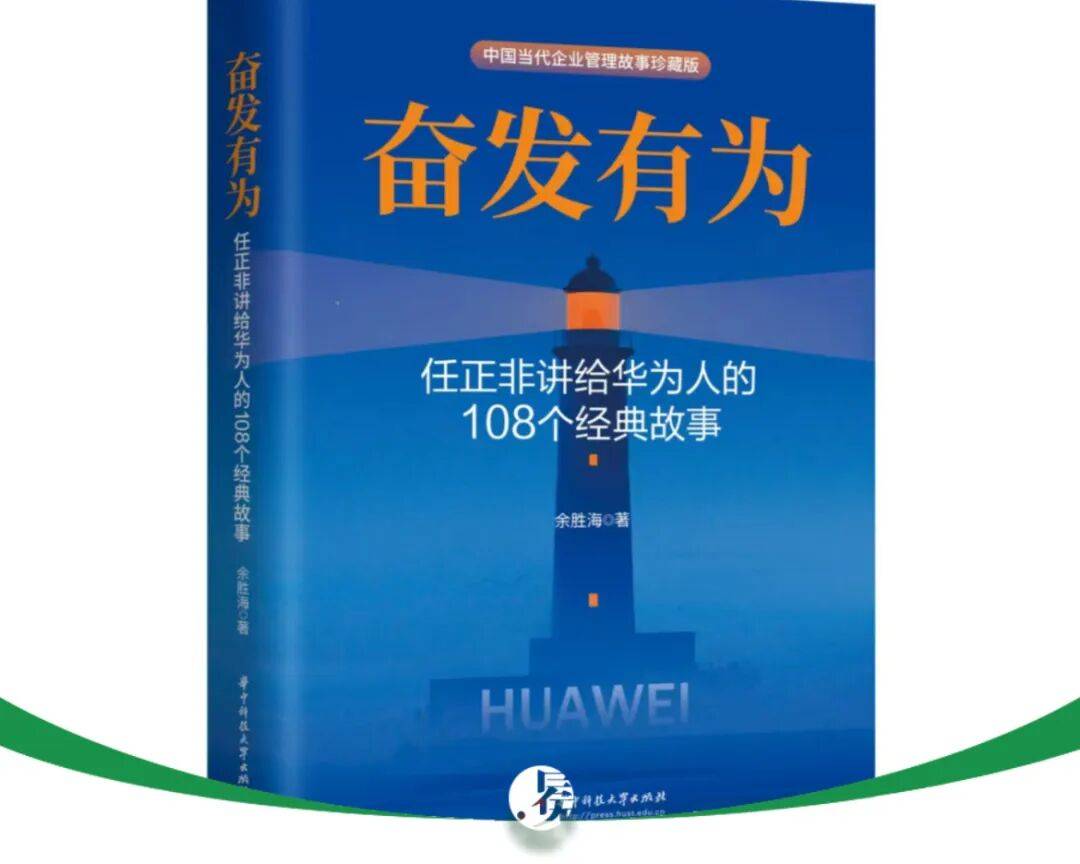
奋斗为炬,铸华为长青之魂——读《奋发有为:任正非讲给华为人的108个经典故事》 || 推荐
Sou Hu Cai Jing· 2026-01-13 09:27
Core Insights - The book "Fighting for Success: 108 Classic Stories from Ren Zhengfei for Huawei Employees" by Yu Shenghai serves as a key to understanding Huawei and offers inspiration for every struggler, emphasizing the importance of being grounded and adhering to one's original intentions in turbulent times [2][7] Group 1: Huawei's Corporate Philosophy - Huawei's rise is marked by a focus on "putting the fighter first" and "being customer-centric," which are fundamental principles that guide the company's operations [2][4] - The culture of Huawei rewards contributors with high salaries and benefits, reinforcing the idea that recognizing and respecting every effort is crucial for building a strong team [4][5] Group 2: Customer-Centric Approach - Huawei engineers go to great lengths to meet customer needs, such as trekking in remote areas to ensure communication for local communities and customizing products for specific regional requirements [5][6] - The company views customers not merely as profit sources but as partners in mutual growth, which has helped Huawei maintain its competitive edge in the market [5][6] Group 3: Strategic Independence - Huawei's decision to remain private and not go public reflects its commitment to long-term research and development over short-term profits, allowing for substantial investments in foundational technologies [6][7] - The company’s resilience is highlighted by its ability to pivot during external technological blockades, transforming previously sidelined projects into key assets, such as the Harmony OS and Kirin chips [6][7] Group 4: Lessons for Other Enterprises - Huawei's journey illustrates the necessity of self-innovation and maintaining control over core technologies, serving as a warning to other Chinese enterprises about the importance of adapting to changing global dynamics [6][7] - The stories within the book convey that success is not accidental but a result of respecting fighters, honoring customer needs, committing to long-term strategies, and pursuing technological independence [7]
美国频繁失态的原因或许是:中国一脚踏入了舒适区,特朗普还没辙
Sou Hu Cai Jing· 2026-01-10 04:46
Group 1 - The U.S. is facing unprecedented challenges as China enters strategic areas previously dominated by the U.S. [1] - The U.S. announced its withdrawal from 66 international organizations, including 31 UN entities, highlighting its unilateralism [3] - U.S. tariffs on Chinese electric vehicles have backfired, with China's exports to the U.S. increasing to 9% and a trade surplus growing by 34.6% year-on-year [4] Group 2 - The U.S. has historically maintained a clear division in global supply chains, controlling high-end manufacturing and key technologies while allowing other countries to develop low-end manufacturing [8] - The balance of power has shifted as China's industrial and technological capabilities have risen, breaking the previous equilibrium [10] - China's "Made in China 2025" initiative has achieved 86% of its goals, directly competing with the U.S. in core industries, particularly in renewable energy [11] Group 3 - Chinese companies like CATL and BYD are leading in battery technology and electric vehicle sales, with China accounting for 68% of global new energy vehicle sales in 2025 [13][14] - China's self-sufficiency in semiconductors has increased from 14% in 2014 to 23% in 2023, with projections of reaching 27% by 2027 [16] - Despite U.S. export controls, major chip companies like Intel and NVIDIA are still reliant on the Chinese market for revenue [17] Group 4 - Germany's automotive industry is resisting U.S. sanctions against China, with BMW investing $15 billion to expand its operations in China [19] - The anticipated anti-China coalition led by the U.S. is faltering due to the economic interdependence of other countries with China [20] - The U.S. strategy of tariffs and sanctions has led to significant losses for American companies reliant on the Chinese market [20] Group 5 - The U.S. is experiencing a decline in global trust, with its reputation and governance indicators dropping in the Global Soft Power Index [24] - Public sentiment in countries like Germany, France, and Spain is increasingly supportive of countermeasures against U.S. imports [26] - The U.S. is caught in a cycle of sanctions and shortages, struggling to adapt to the new global industrial landscape shaped by China's advancements [28] Group 6 - The U.S. fears losing its exceptional status as a dominant global power, which would limit its ability to impose sanctions and manage risks [29] - Global investment trends show that 60% of sovereign funds are planning to increase investments in China, indicating a shift in capital flows [30] - The competition of the future will focus on who can provide more public goods for global development rather than monopolizing core technologies [31][32]

欧盟发布研发榜单:华为以229.4亿欧元成唯一进入前十的中国企业
Xin Lang Cai Jing· 2026-01-07 05:24
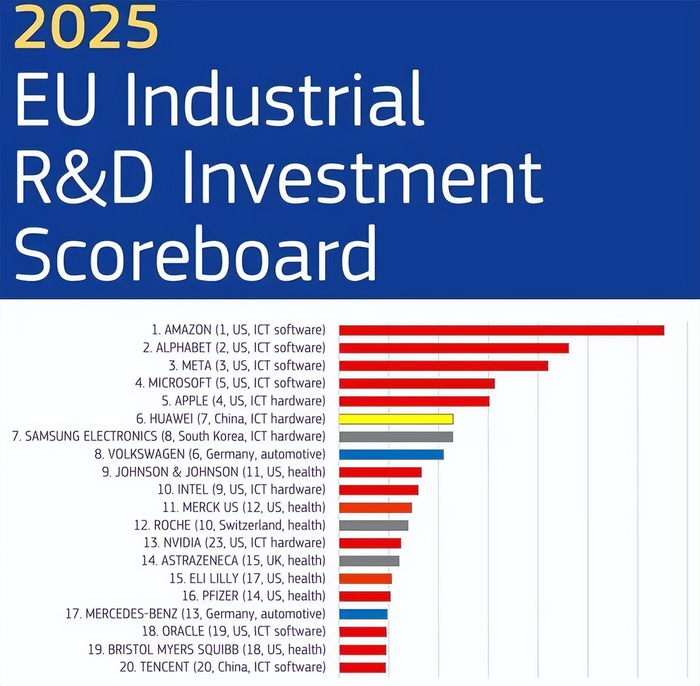
Core Insights - The article highlights the significant position of Huawei in global R&D investment, ranking sixth with an investment of €22.94 billion, showcasing China's shift from "catching up" to "keeping pace" in technology competition [4][12] R&D Investment Overview - The EU's 2025 Global R&D Investment Top 100 list shows that the US has 674 companies, accounting for 47.1% of total R&D investment, while China has 525 companies at 16.1%, and the EU has 318 companies at 16.2% [1] - Huawei's R&D expenses for the first half of 2025 reached ¥96.95 billion, representing 22.7% of its revenue, equating to approximately ¥5.36 billion spent daily, which is significantly higher than competitors like Apple and Xiaomi [5][6] Strategic Focus Areas - Huawei's R&D strategy is not merely about cost but targets critical areas, such as semiconductor technology, with over 7,000 engineers dedicated to developing the Kirin and Ascend chips, aiming to overcome technological barriers [6][9] - The company has established a comprehensive capability loop in three key areas: computing power, quantum technology, and operating systems, moving beyond isolated breakthroughs [7][8][10] Technological Innovations - In computing power, Huawei has innovated through architecture rather than relying on EUV lithography, creating a "supercomputer" with the Atlas960 Super PoD, which supports 15,488 computing cards and achieves a total computing power of 30 EFLOPS [8] - In quantum technology, Huawei focuses on core technology breakthroughs and industry applications, having secured a patent for superconducting quantum chips that significantly reduce qubit interference [9] - The HarmonyOS has evolved from being Android-compatible to redefining standards, with significant R&D investment leading to the release of HarmonyOS 5.0, which enhances task efficiency across devices [10] Implications and Challenges - Huawei's entry into the top ten of global R&D investment is a milestone for Chinese technology, reflecting a deeper transformation in global innovation dynamics [12] - Despite the achievements, the article notes that outside of Huawei, few Chinese companies rank highly in R&D, indicating a need for broader industry growth and support for long-term investment strategies [12]
旗舰手机“芯”格局生变:联发科天玑上位 高通面临份额挤压
Ju Chao Zi Xun· 2026-01-05 08:43
Core Viewpoint - Major Chinese smartphone manufacturers, including Huawei, Xiaomi, OPPO, vivo, and Honor, are planning to adjust their chip strategies between 2026 and 2027 by gradually reducing or even stopping the use of Qualcomm Snapdragon platforms in favor of increasing the adoption of MediaTek Dimensity series processors [1][4]. Group 1: Chip Strategy Transition - Chinese smartphone manufacturers are shifting from reliance on a single supplier to a dual-track parallel chip strategy, driven by risk mitigation and cost control [4]. - Currently, Huawei has largely transitioned to its own Kirin chip solutions, while Xiaomi, OPPO, vivo, and Honor are adopting a "Qualcomm + MediaTek" dual-supplier strategy to effectively disperse supply chain risks [4]. - OPPO's Find X series flagship models are available with both Snapdragon and Dimensity chip versions, allowing market performance and user feedback to guide future product directions [4]. Group 2: Cost Pressures - The direct driver for smartphone manufacturers adjusting their chip strategies is the ongoing rise in costs, particularly the increasing prices of Qualcomm's flagship chips [5]. - The latest Snapdragon 8 Gen 2 chip has a procurement cost of $280, accounting for 25% to 35% of the material costs of high-end smartphones, significantly squeezing overall profit margins [6]. - Storage chip prices are also rising, with industry analysts estimating that the material costs for high-end smartphones could increase by over 40% by 2026 compared to three years ago, while terminal prices may not rise correspondingly [7]. Group 3: MediaTek's Competitive Position - MediaTek's ability to gain favor among manufacturers is primarily due to its significant improvement in technical capabilities, with the Dimensity series now competing directly with Qualcomm's flagship chips in terms of performance and power consumption [8]. - Since the launch of the Dimensity 9000 series, MediaTek's sustained investment in high-end chip development has begun to yield results, with the latest Dimensity 9500 mobile platform receiving market recognition [9]. - OPPO Find X9, Find X9 Pro, and vivo X300, X300 Pro flagship models are now equipped with the Dimensity 9500 platform, indicating that MediaTek chips are no longer exclusive to mid-range models [9]. Group 4: Market Restructuring - The competitive landscape of the smartphone chip market is undergoing structural changes, with MediaTek's increasing market share in the high-end segment redefining the market dynamics [10]. - Industry forecasts suggest that by 2026, MediaTek's share in the global high-end smartphone chip market could rise from less than 20% to over 30%, posing more challenges to Qualcomm's market dominance [11]. - The dual-platform strategy is expected to become a standard configuration for mainstream smartphone manufacturers, allowing for flexible chip platform allocation across different product series and price points, maximizing market coverage while reducing supply chain risks [12]. Group 5: Consumer Impact - For consumers, this shift means a wider range of product choices, with smartphones featuring different chip platforms offering differentiated performance, pricing, and unique features, thereby driving technological innovation across the industry [13]. - As Huawei returns to self-developed chips and other manufacturers seek a balance between price and technology, flagship smartphones will increasingly feature MediaTek Dimensity chips, changing consumer selection criteria [13].