贵金属市场调整

Search documents
白银暴跌刷新46年历史纪录美元信誉度下降以及全球央行购金等长期潜在因素将持续存在。此次回调更像是对之前过度上涨的理性调整。
Sou Hu Cai Jing· 2025-12-30 03:58
Group 1 - The core point of the article highlights a significant drop in silver prices, marking an unprecedented decline in the global precious metals market, with COMEX silver futures plummeting 8.67% to $69.856 per ounce, the lowest level since February 2021, breaking a 46-year record for daily volatility [1][3][4] - The sharp decline in silver prices is attributed to several factors, including a sudden increase in margin requirements by the Chicago Mercantile Exchange (CME) by 13.6%, which raised the cost of leveraged trading and triggered a wave of stop-loss orders and forced liquidations, leading to a domino effect of selling [3][4] - Despite the dramatic drop, silver's current market dynamics differ from the speculative crash of 1980, as silver now has both financial attributes and significant industrial demand, particularly in sectors like photovoltaics, artificial intelligence data centers, and electric vehicles, with demand for silver in photovoltaic systems expected to grow at an annual rate of 40% by 2025 [3][4][6] Group 2 - The silver market was in a bull phase just a week prior to the crash, with prices exceeding $83 per ounce, and a cumulative increase of 185% since the beginning of 2025, significantly outpacing gold's 72% increase during the same period [4][6] - The recent price drop is viewed as a cooling-off period following market exuberance rather than a termination of the upward trend, with expectations that factors such as Federal Reserve policies, global industrial demand recovery, and supply chain structures will continue to impact the precious metals market significantly [6][8] - Investors are advised to avoid leveraging and to manage positions rationally, as the long-term fundamentals for silver price increases remain solid due to ongoing global monetary policy easing and rising industrial demand [6][8]

国泰君安期货:昔日“上涨枭雄”缘何回调?节前贵金属遭遇多重压力
Xin Lang Cai Jing· 2025-12-30 02:53
Core Viewpoint - The precious metals market has experienced a significant pullback, with gold prices dropping over 3% and silver prices falling more than 6%, reversing the previous bullish trend. This rapid adjustment has notably suppressed market bullish sentiment [2][12]. Market Status - As of the latest morning session, the main gold futures contract (2602) has fallen back below the 1000 mark, but showed signs of resistance at previous support levels around 970, indicating that the overall technical structure remains relatively stable [3][12]. - The main silver futures contract (2602) is fluctuating around the 18000 mark, and has not breached short-term support levels near 17609, maintaining a generally strong upward bias [3][12]. Potential Reasons for Recent Adjustments 1. **Margin Policy Adjustments**: The CME Group raised the margin requirements for gold and silver futures on December 29, aiming to address recent market volatility and enhance risk coverage. This has increased trading costs and pressure on positions. Concurrently, the Shanghai Futures Exchange also raised margin ratios and price limits, reinforcing tightening regulatory expectations domestically. This dual pressure has dampened trading enthusiasm and leverage space [5][14]. 2. **Bank of Japan's Rate Hike Signals**: The latest minutes from the Bank of Japan indicate that several members believe actual interest rates remain very low, suggesting potential future rate hikes. The recent increase of the benchmark rate to 0.75% marks a 30-year high, which may lead to a reversal of popular "carry trades," where investors sell high-yield assets like precious metals to buy back yen for low-cost financing. This expectation has influenced market sentiment negatively towards dollar-denominated assets like gold and silver [6][15]. 3. **Pre-Holiday Position Reductions**: In light of the aforementioned factors, market participants have shown a clear tendency to reduce positions ahead of the New Year holiday. Speculative funds that previously drove prices up are now exiting due to concerns over holiday risks, increased costs from margin hikes, and a desire to lock in profits from recent price increases. Investors are advised to remain cautious and manage positions carefully as market focus may shift to macro events post-holiday [7][16].

太突然!金价崩了,一夜暴跌!创12年来最大单日跌幅……网友懵了:前一天赚4万今天亏4万
Sou Hu Cai Jing· 2025-10-22 07:21
Core Viewpoint - The international gold market experienced a significant decline after reaching record highs, with spot gold dropping over 6%, marking the largest single-day decline since April 2013 [1]. Group 1: Market Performance - Spot gold fell to $4,109.10 per ounce, down 5.7% from the previous day, which had seen a record high of $4,381 per ounce [1]. - Silver also saw a substantial drop, with London silver at $48.18 per ounce, down 8.02%, and spot silver down 7.6% to $48.49 per ounce, the largest single-day decline since 2021 [1]. - Domestic gold prices in China fell sharply, with a drop of over 60 yuan per gram overnight on October 21, leading to significant losses for investors [4]. Group 2: Investor Sentiment - Many investors expressed panic on social media after recent purchases of gold, highlighting the emotional impact of the sudden price drop [2]. - Some investors attempted to "buy the dip," but faced challenges as prices continued to fall, leading to significant financial losses [4]. Group 3: Price Adjustments - Major gold jewelry brands in China adjusted their prices downward on October 22, with notable decreases such as Lao Miao's price dropping 83 yuan per gram [6]. - The price adjustments reflect the broader market trend, as gold and silver prices have seen substantial increases earlier in the year, with gold up over 50% and silver nearly 70% [7]. Group 4: Market Analysis - Analysts attribute the rapid price adjustments to easing geopolitical tensions and profit-taking behavior among investors [9]. - The current high prices of gold and silver have led to accumulated short-term downside risks, suggesting a need for rational investment strategies based on individual risk tolerance [9]. Group 5: Future Outlook - HSBC forecasts that the upward momentum for gold could continue until 2026, with a target price of $5,000 per ounce, driven by factors such as U.S. fiscal deficits and central bank demand [11]. - However, potential obstacles to this trajectory include fewer interest rate cuts by the Federal Reserve than anticipated, which could hinder gold's price growth [11].

黄金,暴跌!
Sou Hu Cai Jing· 2025-10-22 06:44
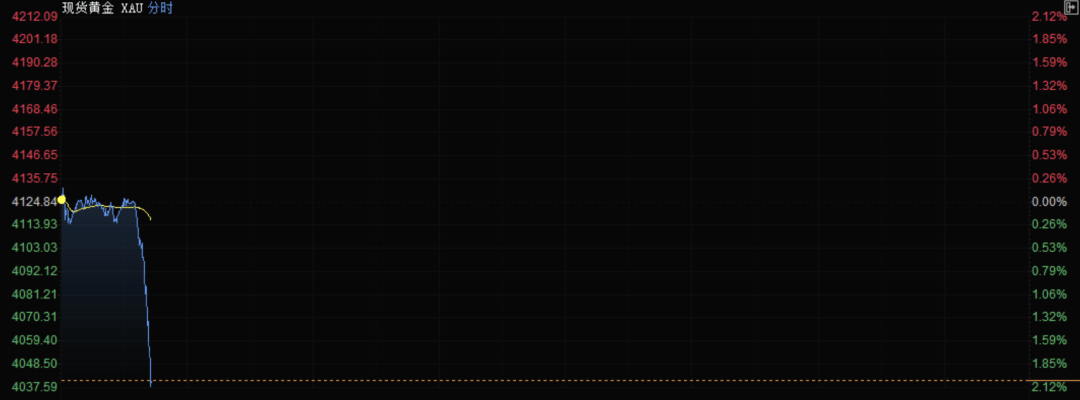
Core Viewpoint - The recent decline in gold prices is attributed to profit-taking by investors after reaching historical highs, alongside a reduction in market risk appetite due to easing global trade tensions [4][6]. Market Performance - On October 22, spot gold prices fell by 2% to $4040.80 per ounce, following a significant drop in international gold and silver prices on October 21 [1][4]. - The December gold futures on the New York Commodity Exchange closed at $4109.1 per ounce, marking a decline of 5.74%, while December silver futures dropped over 7% to $47.70 per ounce [4]. Investor Behavior - Investors are liquidating positions ahead of the U.S. September CPI data release, leading to a sharp decline in gold prices [4][6]. - Analysts suggest that the rapid increase in gold prices has led to a correction phase, as traders become cautious of potential market adjustments [7]. Future Outlook - Despite the recent downturn, several international investment banks remain optimistic about gold's long-term prospects, with HSBC projecting a price target of $5000 per ounce by 2026, driven by strong central bank purchases and ongoing fiscal concerns in the U.S. [6][7]. - The current market conditions indicate a potential for continued volatility, with high implied volatility levels suggesting that the gold market may be overheated [7].