贵金属市场调整

Search documents
EasyMarkets易信:高位获利了结 金银短线震荡
Xin Lang Cai Jing· 2026-02-27 12:57
Core Viewpoint - The precious metals market has entered a phase of adjustment after a strong rally at the beginning of the year, with profit-taking by short-term futures traders becoming the main theme of the market [1][2]. Market Dynamics - External financial environment changes, including a slight rebound in the US dollar index and stable 10-year US Treasury yields at around 4.05%, have contributed to the recent pullback in precious metals [3][4]. - The price of crude oil remains at $66.50 per barrel, supporting inflation expectations but unable to offset the short-term impact of technical selling [4]. Pricing Mechanism - The gold spot and futures markets are experiencing seasonal liquidity adjustments, with the CME's December gold futures contract becoming the focal point of market capital dynamics [4]. - Current market consolidation is attributed more to psychological fluctuations among bulls near the $5200 level rather than a complete reversal of fundamentals [4]. Technical Targets - Gold bulls are eyeing the strong resistance level at $5400, with the immediate goal being to reclaim this week's high of $5269.40. Conversely, if bearish forces strengthen, the technical support at $4854.20 will be tested [2][4]. - The overall market performance of gold remains strong, with significant buying support near this week's low of $5109.50 despite recent declines [4]. Silver Market Outlook - The silver market is characterized by more aggressive trading, with bulls aiming to break the $100.00 technical barrier. The recent drop to $86.81 has established a new offensive benchmark at the overnight high of $90.255 [5]. - As long as prices do not fall below the February low of $71.815, the upward oscillation pattern for silver remains intact, with investors advised to monitor the support level at $84.56 and market sentiment for potential reversals [5].


分析称贵金属市场或经历8周调整期 金价银价未来走势
Xin Lang Cai Jing· 2026-02-06 15:13
Core Viewpoint - The international gold and silver prices experienced a significant decline on the 5th, with silver prices dropping close to 50% from the historical high reached on January 29 [1] Group 1: Market Dynamics - The silver market is currently in a trading phase dominated by capital inflows and outflows, leading to increased volatility compared to gold due to its smaller market size [1] - Recent price fluctuations in silver are primarily influenced by speculative capital and systematic quantitative funds rather than fundamental supply and demand factors [1] Group 2: Future Outlook - Analysts predict that precious metals will undergo an adjustment period lasting eight to nine weeks [1] - There is a belief that high leverage positions still exist in the spot gold and silver markets, and the process of deleveraging may continue, suggesting potential short-term downward pressure on gold prices despite a long-term positive outlook [1]
刘福云:黄金价格实时行情走势分析
Xin Lang Cai Jing· 2026-02-06 11:14
Core Viewpoint - The global gold market experienced significant selling pressure on February 6, leading to a decline in gold prices and a nearly 14% drop in silver prices, primarily due to a stronger US dollar and heightened risk aversion in financial markets [1][3]. Market Analysis - The precious metals market is undergoing normal adjustments after reaching record highs, with high volatility expected to persist in the short term [1][3]. - Geopolitical factors such as the progress of the Russia-Ukraine prisoner exchange agreement, high-level communications between China and the US, and upcoming US-Iran talks are under scrutiny [1][3]. Technical Indicators - The daily and hourly charts indicate that the 5-day and 20-day moving averages have been breached again, suggesting the end of the short-term rebound in gold prices and a potential shift into a medium-term corrective phase [1][3]. - The hourly chart shows downward crossovers in moving averages, indicating the possibility of further short-term declines. Key resistance levels are identified at 4800-4830, with major pressure around the 4980-5000 trendline. Support is expected near the lower range around 4650, with potential further declines to 4600 or even 4400 anticipated [1][3]. Trading Strategy - The main strategy for gold in the near term is to anticipate continued adjustments, but the current high volatility poses challenges for trading. It is advised to select advantageous entry points for participation [1][3].
贵金属数据日报-20260203
Guo Mao Qi Huo· 2026-02-03 03:44
Report Overview - The report is a daily data report on precious metals, providing price, spread, position, inventory, and other data, as well as analysis of market trends [3][4] 1. Report Industry Investment Rating - Not provided 2. Core Viewpoints - In the short term, the precious metals market may continue to release risks, but after the recent sharp adjustment, the leverage has been significantly reduced, and the possibility of further sharp decline in gold and silver prices is relatively limited, and the market is expected to gradually turn into a volatile trend [5] - In the long term, the collapse of precious metals prices does not mean the end of the bull market. With the probability of the Fed cutting interest rates this year, the continuous global geopolitical uncertainty, and the promotion of de - dollarization due to the huge US debt, the allocation demand of global central banks, institutions, and residents is expected to continue, and the price center of precious metals still has room to rise [5] 3. Summary by Directory 3.1 Price Tracking - **Spot and Futures Prices**: On February 2, 2026, the price of London gold was $4506.71 per ounce, London silver was $73.77 per ounce, COMEX gold was $4528.90 per ounce, and COMEX silver was $73.75 per ounce. Compared with January 30, 2026, the prices of gold and silver decreased, with gold down about 12.2% and silver down about 31.4% [4] - **Spread and Ratio**: The spread and ratio of gold and silver in different markets also changed. For example, the gold TD - SHFE active spread on February 2, 2026, was 2.42 yuan/gram, with a change of - 145.1% compared with January 30, 2026 [4] 3.2 Position Data - **ETF and COMEX Positions**: As of January 30, 2026, the gold ETF - SPDR held 1087.1 tons, and the silver ETF - SLV held 15523.35497 tons. COMEX gold non - commercial long positions were 252100 contracts, and non - commercial short positions were 46704 contracts. Compared with January 29, 2026, the long positions decreased by 14.77%, and the short positions decreased by 8.43% [4] 3.3 Inventory Data - **SHFE and COMEX Inventories**: On February 2, 2026, SHFE gold inventory was 103029 kilograms, with no change compared with January 30, 2026, and SHFE silver inventory was 462623 kilograms, an increase of 1.66%. COMEX gold inventory on January 30, 2026, was 35748596 troy ounces, a decrease of 0.36% compared with January 29, 2026, and COMEX silver inventory was 405886807 troy ounces, a decrease of 0.58% [4] 3.4 Interest Rate, Exchange Rate, and Stock Market Data - **Interest Rates and Exchange Rates**: On February 2, 2026, the US dollar/Chinese yuan central parity rate was 6.97, with a change of 0.02% compared with January 30, 2026. The US dollar index was 97.12, an increase of 0.99% compared with January 29, 2026. The 2 - year US Treasury yield was 3.52%, a decrease of 0.28%, and the 10 - year US Treasury yield was 4.26%, an increase of 0.47% [4] 3.5 Market Analysis - **Market Trends**: On February 2, the main contract of Shanghai gold futures closed at 1008.6 yuan/gram, up 16.73 yuan. The Shanghai silver futures contracts were all limit - down, and the main 2604 contract closed at 2483 yuan/kilogram, up 17%. In the evening of February 2, silver continued to fall, and multiple contracts hit the limit - down, with the 2604 contract once falling 20% to 20600 yuan/kilogram [4] - **Influencing Factors**: In addition to the continued selling in the precious metals market due to liquidity issues, the Iranian president's order to start nuclear negotiations eased the US - Iran situation, and the US manufacturing index in January reached 52.6, the fastest expansion since 2008 - 2011/2022, which short - term boosted the US Treasury yield and affected the precious metals market. Exchanges such as CNE, SGE, and SHFE raised margins and expanded price limits again, further suppressing speculative enthusiasm [5]
开盘|国内期货主力合约跌多涨少,沪银跌近20%
Xin Lang Cai Jing· 2026-02-03 01:05
Group 1 - The domestic futures market opened with more declines than gains, with notable drops in silver and tin futures, down nearly 20% and over 11% respectively [3][7] - SC crude oil fell over 4%, while fuel oil and platinum dropped more than 3% [3][7] - In contrast, shipping European line, aluminum oxide, and PVC saw increases of over 1% [3][7] Group 2 - The overnight London spot precious metals market showed a slight narrowing of declines but remained weak, with domestic silver and platinum-palladium futures continuing to hit the limit down [5][8] - The gold-silver ratio quickly rebounded to 58.1, and the platinum-palladium price spread narrowed to $404 per ounce [5][8] - The US ISM manufacturing index rose to 52.6, significantly exceeding expectations of 48.5, driven by robust growth in new orders and output [5][8] - The recent volatility in the precious metals market is attributed to a forced liquidation due to extreme overbuying and crowded trades, indicating a potential for a more stable phase for gold [5][8] - Silver continues to exhibit high volatility, with the main silver futures contract experiencing a second limit down, which has absorbed much of the risk [5][8] - Despite significant declines in platinum and palladium, the long-term supply-demand dynamics suggest a potential for buying on dips once gold stabilizes [5][8]
重要指数 即将调整!金银会跌吗?
Zhong Guo Zheng Quan Bao· 2026-01-05 15:21
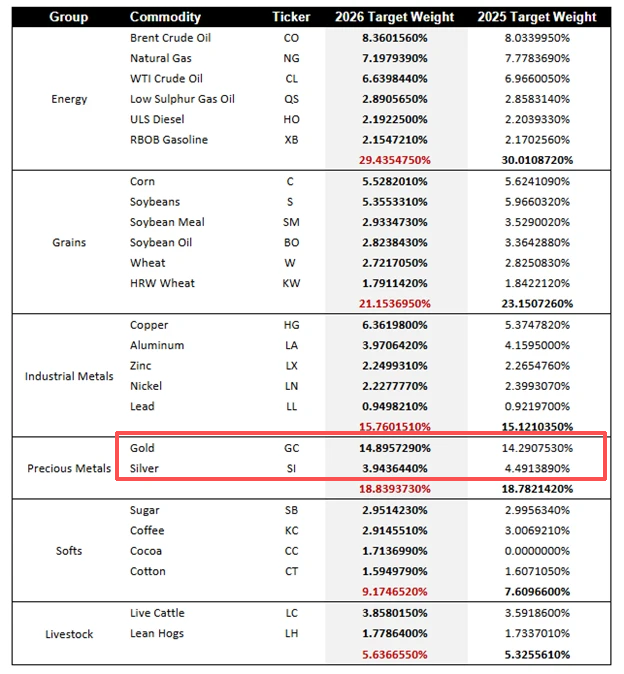
Core Viewpoint - The upcoming adjustment to the Bloomberg Commodity Index (BCOM) is expected to create short-term selling pressure on precious metals, particularly gold and silver, but is unlikely to alter the long-term market dynamics for these commodities [1][4]. Group 1: Index Adjustment Impact - The target weight for precious metals in the BCOM will be adjusted to 18.84%, with gold's target weight increasing from 14.29% to 14.90% and silver's decreasing from 4.49% to 3.94% [2]. - The actual weights of gold and silver in the index have significantly exceeded their target allocations, with gold's weight dropping from 20.7% to 14.9% and silver's from 8.3% to 3.9% due to price increases anticipated in 2025 [2]. Group 2: Market Reactions and Analyst Insights - Analysts predict that passive funds will need to sell gold and silver futures to realign with the new target weights, leading to short-term price fluctuations primarily in early to mid-January [4]. - The overall impact of this adjustment is considered limited, as the announcement was made well in advance, and the market may have already priced in the potential selling pressure [4]. - The fundamental drivers of the precious metals market, such as geopolitical risks and macroeconomic changes, are expected to remain strong despite the technical adjustments [4][5]. Group 3: Investment Strategies - Analysts recommend focusing on the long-term fundamentals that drive the market, suggesting that investors should consider increasing their positions in gold during this period of price pressure [5]. - The rising geopolitical uncertainties are expected to support gold's resilience and safe-haven attributes, with recommendations to overweight gold in investment portfolios [5]. - There is an expectation that historical price peaks for gold and silver may not have been reached yet, with potential for significant price increases in the coming years, particularly for silver around the Lunar New Year [5].
重要指数,即将调整!金银会跌吗?
Zhong Guo Zheng Quan Bao· 2026-01-05 12:18
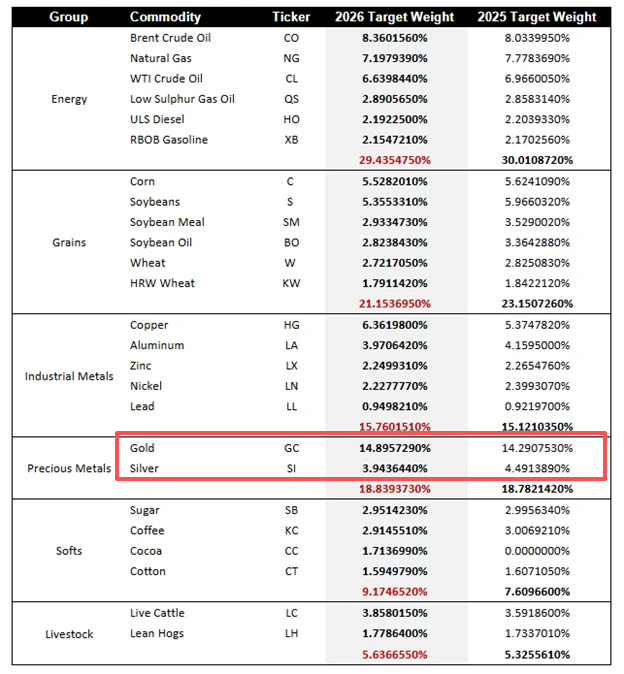
Core Viewpoint - The recent adjustment to the Bloomberg Commodity Index (BCOM) is expected to create short-term selling pressure on precious metals, particularly gold and silver, but it is unlikely to alter the long-term dynamics of the precious metals market [1][4]. Group 1: Index Adjustment Impact - The target weight for precious metals in the BCOM will be adjusted to 18.84%, with gold's target weight increasing from 14.29% to 14.90% and silver's decreasing from 4.49% to 3.94% [2]. - The actual weights of gold and silver in the index have significantly exceeded their target allocations, with gold's actual weight dropping from 20.7% to 14.9% and silver's from 8.3% to 3.9% due to price increases anticipated in 2025 [2]. Group 2: Market Reactions and Analyst Insights - Passive funds tracking the index will need to sell gold and silver futures to realign with target allocations, leading to expected selling pressure primarily in early to mid-January [4]. - Analysts believe that while this adjustment may cause short-term price fluctuations, it will not change the underlying fundamental forces driving the precious metals market, such as geopolitical risks and macroeconomic factors [4][5]. Group 3: Investment Strategies - Analysts recommend focusing on long-term market fundamentals rather than short-term adjustments, suggesting that investors should consider increasing their positions in gold and silver during this price pressure [5]. - The ongoing geopolitical uncertainties and central bank purchases of gold are expected to support long-term gold prices, with predictions of potential new highs for silver prices around the Lunar New Year [5].
黄金白银新年首周遭遇“开门震荡”:资金博弈下价格剧烈波动
Sou Hu Cai Jing· 2026-01-04 14:05
Core Viewpoint - The global precious metals market experienced significant volatility at the beginning of 2026, with gold and silver prices declining sharply after a record-breaking performance in 2025, raising concerns about market fragility and future trends [1][2]. Group 1: Price Movements - As of January 4, 2026, gold prices fell from a historical high of $4549.69 per ounce at the end of 2025 to $4332.85 per ounce, a weekly decline of over 4.8% [1]. - Silver prices dropped from $83.943 per ounce to $72.77 per ounce, marking a decline of 13.3% [1]. Group 2: Market Sentiment and Positioning - Data indicates a shift in market sentiment, with speculative long positions in COMEX gold futures remaining at 12.7% of total holdings, but the increase in fund long positions (9241 contracts) was less than the increase in commercial short positions (10348 contracts), leading to a contraction in net long positions [2]. - In the silver market, an increase in arbitrage positions (2118 contracts) suggests that funds are managing volatility through risk hedging rather than outright short selling [2]. Group 3: Economic Indicators and Forecasts - The Bloomberg Dollar Spot Index rose by 0.1% on January 2, 2026, which, combined with stronger-than-expected U.S. non-farm payroll data (256,000 jobs added), raised concerns about the Federal Reserve's interest rate cuts, further diminishing gold's appeal [2]. - Goldman Sachs maintains a baseline forecast predicting that central bank gold purchases and potential Fed rate cuts could drive gold prices to $4900 per ounce [2]. - Morgan Stanley is more optimistic, projecting an average price of $5055 per ounce in Q4 2026 and a long-term target of $6000 per ounce by 2028 [3]. Group 4: Silver Market Dynamics - The silver market is expected to experience greater volatility due to its dual industrial and financial characteristics, with long-term support from the global green energy transition and tight supply, although short-term technical selling pressure may test the $65 per ounce support level [3]. - Analysts suggest potential future prices of $5000 for gold and $100 for silver, contingent on breaking current resistance levels of $4520 for gold and $78.5 for silver [3].
贵金属冰火两重天 CME保证金上调成导火索
Jin Tou Wang· 2025-12-30 07:05
Core Viewpoint - The global precious metals market experienced extreme volatility on December 29, with gold prices plummeting by $195 per ounce, marking a 4.31% drop, primarily due to increased margin requirements by the CME [1][2]. Group 1: Market Performance - Gold prices fell sharply from a historical high of $4,549.69 per ounce, closing down 4.4% [1]. - Silver reached a new high of $83.94 per ounce before dropping 8.9% [1]. - Platinum and palladium also faced significant declines, with prices dropping by approximately 14% and nearly 16%, respectively [1]. Group 2: Market Drivers - The recent price correction is attributed to profit-taking after significant price increases earlier in the year, with silver showing a remarkable annual gain of 147% [2]. - Factors contributing to silver's performance include its critical role in key minerals, supply shortages, and rising industrial and investment demand [2]. - Despite the short-term adjustments, the long-term outlook for precious metals remains optimistic, particularly for silver due to supply constraints [2]. Group 3: Technical Analysis - For gold, the short-term top has been established, with key support levels at $4,300, $4,280, and $4,255-$4,250, while resistance levels are at $4,365-$4,370, $4,400, and $4,440-$4,435 [3]. - In silver, maintaining prices above the 5-day and 10-day moving averages is crucial for the bullish trend; however, a drop below these levels could lead to deeper corrections [4]. - Platinum is expected to enter a consolidation phase, with strong support at the $1,700 level and resistance at $2,160 and the $2,280-$2,320 range [5]. Group 4: Price Volatility - Palladium is known for its extreme volatility, with a recent drop of over $400 in a single day, reversing its previous strong trend [5]. - The short-term support for palladium is now at $1,500-$1,550, while resistance levels are identified at $1,750-$1,730, $1,820-$1,850, and near the recent high of $1,980 [5].
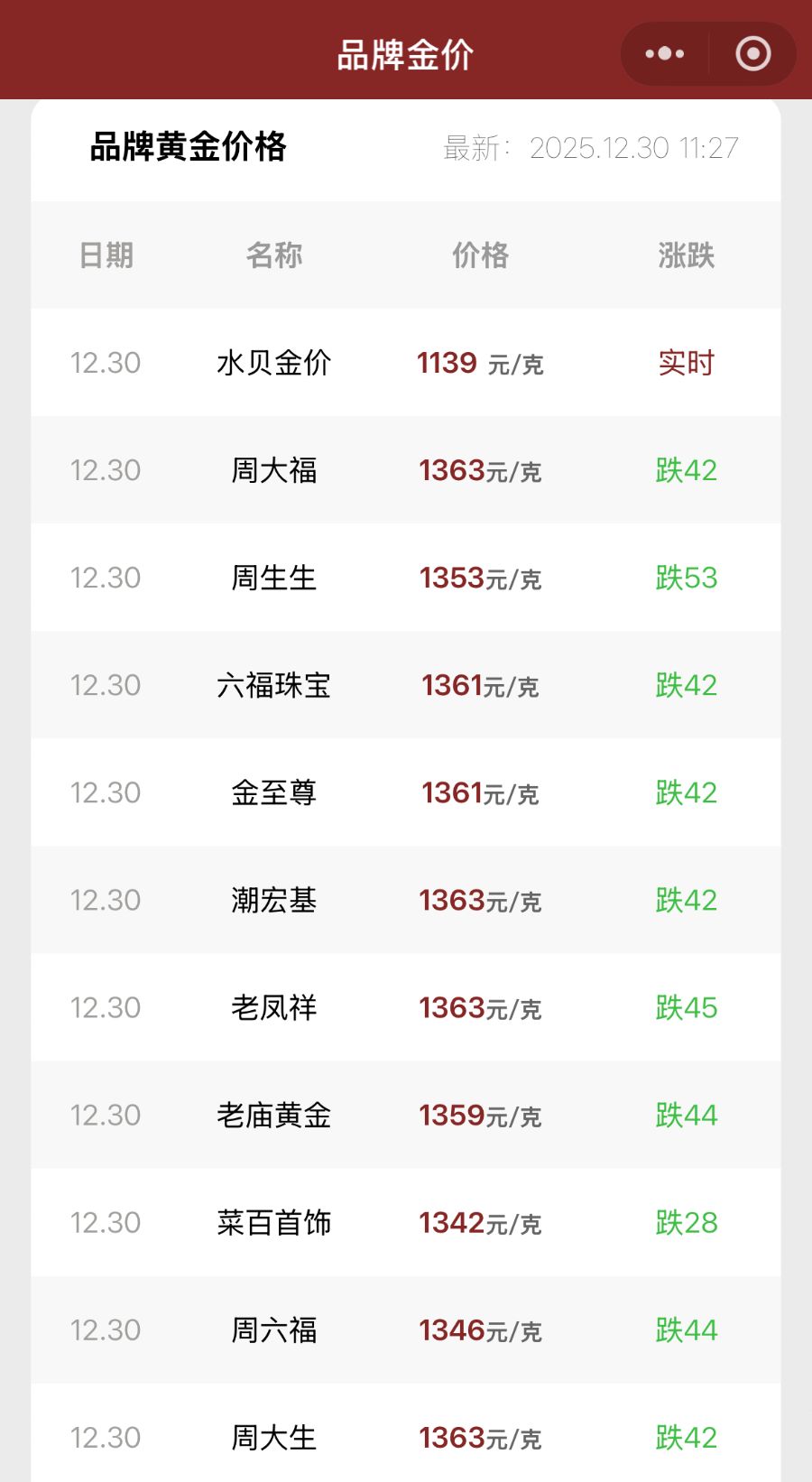
一夜跌超50元,金饰克价跌破1400元,机构:短期调整可能延续
2 1 Shi Ji Jing Ji Bao Dao· 2025-12-30 05:10
Core Viewpoint - The recent significant drop in gold jewelry prices among major domestic brands is attributed to a sharp decline in international gold prices, marking a rare and substantial correction after a year of rising prices. Price Movement - On December 30, major gold jewelry brands such as Chow Tai Fook, Lao Feng Xiang, and Lao Miao all saw price drops exceeding 40 yuan per gram, with Chow Sang Sang experiencing a drop of over 50 yuan per gram [1] - The gold price for major brands on December 30 includes: - Chow Tai Fook: 1363 yuan/gram, down 42 yuan - Chow Sang Sang: 1353 yuan/gram, down 53 yuan - Lao Feng Xiang: 1363 yuan/gram, down 45 yuan - Six Fortune Jewelry: 1361 yuan/gram, down 42 yuan [2][3] Market Influences - The price adjustment in gold jewelry is primarily influenced by a significant drop in international gold prices, which fell over 200 USD in a single day on December 29, reaching a low of 4301.79 USD per ounce, a decline of 4.42% [3] - Other precious metals such as silver and platinum also experienced notable declines during this period [3] Trading Regulations - The rapid increase in precious and industrial metal futures prices has led to heightened volatility risks, prompting the Chicago Mercantile Exchange to raise margin requirements for trading metals, effective after the close of trading on the following Monday. Gold futures margin will increase by 10%, silver by approximately 13.6%, and platinum by 23% [3] - This increase in margin requirements is expected to significantly raise the cost of speculative trading, leading some investors to liquidate positions before the new rules take effect, resulting in multiple rounds of price declines in international metal futures on December 29 [3] Market Sentiment - Analysts indicate that the recent price correction is driven by technical and liquidity factors rather than a fundamental shift in the long-term outlook for precious metals. Despite the short-term market sentiment being under pressure, the bullish drivers for gold remain intact [4] - UBS has raised its gold price target for the first three quarters of 2026 to 5000 USD per ounce, with an expectation that prices will retreat to 4800 USD per ounce by the end of 2026, higher than previous forecasts [4]