
超买

Search documents
Top 3 Financial Stocks That May Keep You Up At Night This Quarter
Benzinga· 2026-03-17 12:50
Core Viewpoint - The financial sector is showing signs of overbought conditions, indicating potential caution for momentum-focused investors [1] Group 1: Company Highlights - Greenlight Capital Re, Ltd. (NASDAQ:GLRE) is identified as one of the overbought stocks in the financial sector [2] - Acacia Research Corp (NASDAQ:ACTG) is also listed among the major overbought players [2] - Community Bancorp (NASDAQ:CMTV) has seen significant stock performance, gaining approximately 27% over the past five days and reaching a 52-week high of $39.98 [2] - The Relative Strength Index (RSI) for Community Bancorp is reported at 74.2, indicating overbought conditions [2] - On the latest trading day, Community Bancorp's shares increased by 1.3%, closing at $39.49 [2]



双属性加持白银领跑 超买压力拖累黄金 —— Wmax 贵金属市场研判
Sou Hu Cai Jing· 2026-02-26 09:18
Core Viewpoint - The global precious metals market is currently experiencing extreme differentiation, with gold showing signs of structural pullback risk due to historical overbought conditions, while silver is leading the market due to its dual role as a safe-haven and industrial asset, potentially achieving the longest consecutive monthly gains on record [2][6][10]. Group 1: Gold Market Analysis - Gold has stabilized above the critical support level of $5,100 per ounce, driven by increased safe-haven demand amid trade policy uncertainties, but faces significant structural pullback risks due to historical overbought momentum readings [3][10]. - The major resistance zone for gold is identified between $5,200 and $5,300 per ounce, with current momentum showing signs of exhaustion, resembling patterns seen before previous sharp declines [5]. - A critical support level is set at $5,100 per ounce; if gold falls below this level, it may face further consolidation risks, with potential declines to $4,800, $4,630, and $4,380 [5][10]. Group 2: Silver Market Analysis - Silver has outperformed gold year-to-date, with a current price around $88.90 per ounce and a monthly increase of approximately 4.3%, positioning it as the preferred hedging asset in the market [7][10]. - The dual attributes of silver as both an investment safe-haven and an industrial metal, combined with a projected supply deficit of 67 million ounces by 2026, underpin its strong medium to long-term upward trajectory [6][9]. - Short-term fluctuations in silver prices are expected due to profit-taking and sensitivity to economic cycles, but the overall upward trend remains intact unless there is a fundamental shift in global monetary policy or a sudden collapse in industrial demand [9][10].
金银价为何突然大跌?
2 1 Shi Ji Jing Ji Bao Dao· 2026-02-02 13:27
Group 1 - The sudden drop in gold and silver prices is attributed to three main factors [1][2] - The first factor is the abrupt shift in Federal Reserve policy expectations towards a hawkish stance, significantly altering the dollar interest rate environment [1][2] - The second factor is the overheated market conditions, which have led to substantial correction pressure, with technical indicators like the Relative Strength Index (RSI) for gold recently exceeding 90, indicating an "overbought" condition [1][2] - The third factor involves a massive influx of speculative and leveraged funds into the precious metals market, creating crowded trading conditions, particularly in silver, which has attracted day traders [1][2] Group 2 - The price reversal has forced high-leverage long positions to liquidate, exacerbating the sell-off through a cascading effect [1][2]
一夜回到解放前!有投资客称忙活一年赚了133万,这两天就亏109万
Sou Hu Cai Jing· 2026-02-01 18:34
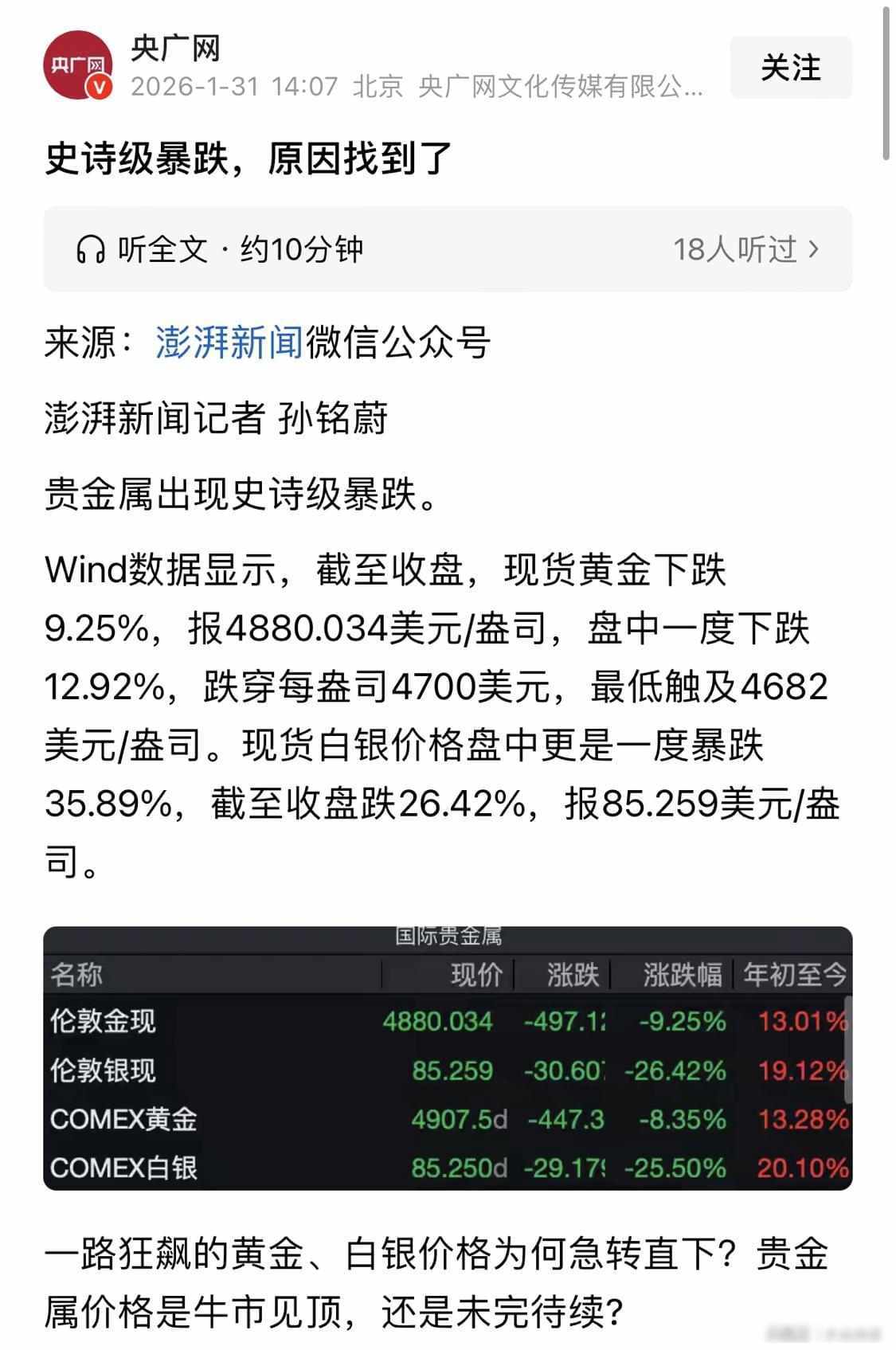
Core Viewpoint - The recent surge in gold and silver prices reached historical highs, but a sudden market downturn led to significant losses for many investors who had increased their positions and leveraged their investments [1][6]. Group 1: Market Performance - On January 29, gold prices peaked at $5,598.75 per ounce, while silver reached $121.654, both marking all-time highs [1]. - By January 31, a large volume of sell orders flooded the market, causing prices to plummet rapidly [1]. - Year-to-date performance shows London gold down 9.25% and London silver down 26.42% [3]. Group 2: Investor Behavior - An individual reported a loss of $1.09 million on an $8 million investment in gold short-term trading, highlighting the risks of high-frequency trading and the mismatch between investment scale and returns [4]. - Many retail investors used high leverage to chase rising prices, leading to widespread panic and fears of significant losses when prices began to fall [6]. Group 3: Market Dynamics - The recent price increase was driven by geopolitical tensions and risk aversion, but lacked fundamental support such as actual inflation or central bank purchases [7]. - The COMEX futures market showed excessive open interest, which contributed to the price drop as margin calls triggered a wave of liquidations [7]. - Broader commodity markets, including copper and tin, also experienced declines, indicating a systemic response to liquidity changes and potential demand weakness [9].
黄金史诗级巨震,背后发生了什么?
3 6 Ke· 2026-01-30 13:03
Core Viewpoint - The recent dramatic drop in gold prices, which fell from a historic high of $5600 per ounce to around $5097, is attributed to a combination of market corrections and external factors, particularly the speculation surrounding the Federal Reserve's leadership and interest rate policies [2][5][8]. Group 1: Market Reaction - Gold prices experienced a significant decline, with a single-day drop exceeding 7%, while silver prices fell over 8% [5]. - The Shanghai Gold Exchange saw spot gold prices retreat from over 1200 yuan per gram, leading to a reduction in jewelry prices and a sharp decline in A-share gold stocks [5][6]. - Algorithmic trading exacerbated the market volatility, leading to a rapid sell-off as automated systems executed broad sell orders during the downturn [9]. Group 2: Factors Influencing Gold Prices - The primary driver of gold prices is global risk aversion, influenced by geopolitical tensions, concerns over the U.S. dollar's credibility, and rising national debt levels [11]. - Central banks have remained significant buyers of gold, with purchases expected to reach 863 tons in 2025, reflecting a strategic move to diversify foreign reserves [13]. - High gold prices have deterred physical demand, as consumers and industries seek alternatives due to increased costs, potentially leading to a decline in jewelry demand [15]. Group 3: Future Outlook - Despite the recent volatility, the long-term fundamentals supporting gold remain intact, with structural factors like geopolitical risks and the trend of de-dollarization continuing to drive demand [18]. - Analysts suggest that gold prices may challenge the $6000 mark in the medium to long term, although short-term fluctuations are expected as the market adjusts to new Federal Reserve policies [18]. - Investors are advised to consider a balanced approach to gold investment, incorporating it as a part of a diversified portfolio rather than attempting to time the market [19].

美银Hartnett预警:全球股市陷入“超买”困境,技术指标触及历史性卖出信号
Hua Er Jie Jian Wen· 2026-01-30 11:50
Group 1 - The core viewpoint is that global stock markets have entered a dangerous "overbought" state, as indicated by a key internal metric reaching a threshold that suggests potential reversal [1] - As of the week ending January 28, 89% of MSCI global stock index constituents were trading above their 50-day and 200-day moving averages, surpassing the historical "sell signal" threshold of 88% [1] - Historical data suggests that when this indicator exceeds the threshold, it typically indicates excessive market breadth, significantly increasing the risk of a technical pullback in the short term [1] Group 2 - There is a growing divergence between technical indicators and fund flows, with global equity funds experiencing a net outflow of $15.4 billion in the week ending January 28, indicating some investors are taking profits at historical highs [2] - Despite the net outflow, the Bull & Bear Indicator remains in the "extremely bullish" range due to broad market gains and stable credit market performance, highlighting a key market divergence [2] - This rare combination of technical, funding, and sentiment indicators suggests that underlying market momentum is quietly changing, potentially masking vulnerabilities despite apparent strength [2] Group 3 - U.S. equity funds attracted $9.2 billion in net inflows last week, indicating relative attractiveness amidst overall global fund outflows [3] - In contrast, European equities saw a reversal in fund flows, experiencing a net outflow of $400 million for the first time in seven weeks, marking a temporary halt to the previous inflow trend [3] - The preferred trading strategy for 2026, as stated by Bank of America strategist Michael Hartnett, is to go long on bonds, international stocks, and gold, continuing the recommendation for a preference for international stocks since late 2024 [3]
超买警报拉响:美银称全球股市触及卖出信号阈值
智通财经网· 2026-01-30 11:33
Core Viewpoint - Global stock markets are showing overbought warning signals, with moving average levels reaching historical thresholds that indicate sell signals for risk assets [1] Group 1: Market Indicators - As of the week ending January 28, approximately 89% of the MSCI stock index was trading above its 50-day and 200-day moving averages, surpassing the 88% threshold considered a sell signal by Bank of America [1] - The MSCI World Index reached a historical high on January 27 and is expected to achieve its strongest monthly performance since September of the previous year [1] Group 2: Investor Sentiment - Bank of America strategists noted that the excessive market positioning coincided with a withdrawal of $15.4 billion from stock funds, indicating a rising cautious sentiment among investors during the market rally [1] - The Bull-Bear Indicator from Bank of America still shows that investor sentiment is in an "extreme" bullish state, as the broad strength of global stock indices and the robust performance of the credit market have so far offset the impact of fund outflows from the stock market [1] Group 3: Fund Flows - U.S. stock funds experienced a positive fund flow, attracting $9.2 billion during the week, while European funds saw their first outflow in seven weeks, amounting to $400 million [1] Group 4: Future Outlook - The most favored trades for 2026, according to Bank of America, include going long on bonds, international stocks, and gold, with a noted preference for international stocks since late 2024, during which U.S. stocks have underperformed [1]

闪崩!黄金跌破5000,白银跌16%,是短暂调整还是趋势反转?
华尔街见闻· 2026-01-30 10:04
Core Viewpoint - The precious metals market experienced a significant sell-off due to expectations of personnel changes at the Federal Reserve and profit-taking pressures, leading to a sharp decline in gold and silver prices from historical highs [2][3]. Group 1: Market Reactions - Gold prices fell sharply, dropping 7% in a single day and breaking below $5,000 per ounce [4]. - Silver prices also saw a drastic decline, plummeting over 16% and falling below $100 per ounce [6]. Group 2: Influencing Factors - The market's sensitivity to marginal changes in monetary policy has increased, with the potential nomination of Kevin Warsh as Fed Chair being a key catalyst for the shift in market sentiment [3][8]. - Warsh's hawkish reputation has led investors to reprice future Fed policy, strengthening the dollar and increasing U.S. Treasury yields, which negatively impacted the appeal of non-yielding assets like precious metals [3][8]. Group 3: Technical Analysis - Analysts suggest that the recent price surge in gold, which rose from $3,000 to $5,500, lacked significant corrections, indicating a "melt-up" rather than a traditional bull market [8]. - The precious metals market had entered an overbought territory, with technical indicators showing extreme conditions that made a correction inevitable [10]. Group 4: Long-term Outlook - Despite the short-term sell-off, structural factors supporting precious metals, such as geopolitical risks and concerns over currency depreciation, remain intact [12]. - Analysts recommend a phased accumulation strategy for investors, as the current high prices limit margin for error, with gold up approximately 20% and silver over 50% year-to-date [12][13].

刚刚,急速大跳水!集体杀跌!黄金、白银,发生了啥?
Xin Lang Cai Jing· 2026-01-30 09:20
Core Viewpoint - The recent sharp decline in gold and silver prices is attributed to profit-taking by investors after record highs, a rebound in the US dollar, and speculation regarding Kevin Warsh's potential nomination as the next Federal Reserve Chairman, which could signal a shift in monetary policy [1][3][10]. Price Movements - On January 30, gold prices fell over 6%, reaching a low of $5051 per ounce, while silver prices dropped over 10%, hitting a low of $103 per ounce [2][9]. - As of the latest reports, gold was trading at $5099.92 per ounce, down 5.16%, and silver at $104.19 per ounce, down 10.08% [2][9]. Market Analysis - Analysts suggest that the decline in precious metals is a result of profit-taking after significant price increases, with the market reacting to the potential appointment of a more hawkish Federal Reserve Chairman [3][10]. - Morgan Stanley predicts gold prices could rise to between $8000 and $8500 per ounce in the coming years, driven by retail investors seeking gold as a hedge against stock market declines [2][9]. Future Price Predictions - UBS has raised its gold price targets for March, June, and September 2026 from $5000 to $6200 per ounce, citing stronger-than-expected demand due to increased investment [1][12]. - Deutsche Bank forecasts that gold prices could reach $6000 per ounce by 2026, driven by ongoing investment demand [12]. Demand Trends - The World Gold Council reported that global gold demand is expected to reach a record high of 5002 tons in 2025, with significant contributions from investment demand and gold ETFs [6][13]. - Despite a decline in gold jewelry demand by 18% in volume, the value of gold jewelry consumption is projected to increase by 18% to $1720 billion, indicating sustained consumer interest [13].
金价剧烈震荡引市场担忧 多只黄金股大幅回调
Xin Hua Cai Jing· 2026-01-30 04:08
Core Viewpoint - The recent surge in precious metal prices, particularly gold and silver, has faced a significant pullback, with prices experiencing extreme volatility due to geopolitical risks and uncertainties surrounding U.S. monetary policy [1][2]. Group 1: Price Movements - On January 30, gold prices fell sharply, with a daily decline of up to 4%, reaching a low of $5,111.96 per ounce [1]. - On January 29, gold prices had fluctuated dramatically, nearing $5,600 per ounce before dropping below $5,100, with a 24-hour price swing exceeding $400 [1]. - The A-share precious metals sector opened lower, with companies like Zhongjin Gold and Zhaojin Mining hitting the daily limit down, and others like Xiaocheng Technology dropping over 19% [1]. Group 2: Market Analysis - Analysts noted that the current market rally is outpacing the fundamental digestion speed, with the relative strength index (RSI) for gold reaching a 40-year peak, indicating an overbought condition [2]. - The concentration of leveraged funds and quantitative trading strategies in the market could lead to a rapid sell-off if short-term positive factors are realized or if the U.S. dollar index rebounds [2]. - Market sentiment has been influenced by FOMO (fear of missing out), which has accelerated gold's price increase [2]. Group 3: Investment Strategy - While analysts maintain a long-term optimistic outlook for gold, the recent rapid price increase has intensified the tug-of-war between bulls and bears, suggesting caution against chasing prices too high [2]. - The precious metals market is deemed unsuitable for speculative trading at current price levels, and it is recommended to view gold and silver as tools for asset allocation and risk hedging rather than short-term trading instruments [2].