
轨道上的京津冀

Search documents
2026年北京轨道交通建设计划发布:2条线路开通、1站4口年内投用
Bei Jing Ri Bao Ke Hu Duan· 2026-02-02 07:47
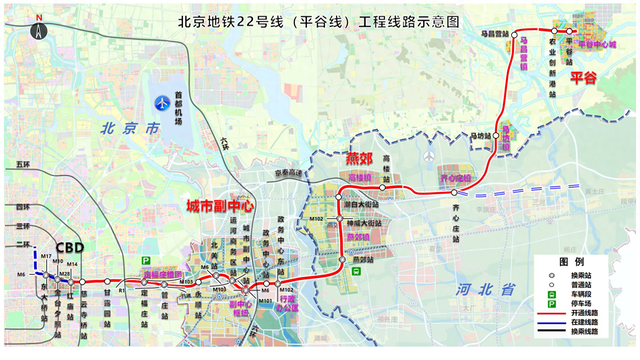
Core Viewpoint - Beijing's 2026 rail transit construction plan has been officially released, with significant advancements in urban and suburban railway lines aimed at enhancing connectivity and commuting efficiency in the region [1][3]. Group 1: New Lines and Construction Plans - This year, Beijing will advance 9 urban rail transit lines totaling 150.6 kilometers and 2 suburban railway lines totaling 90.5 kilometers [1]. - The 22nd line (Hongmiao to Pinggu) is set to become the first cross-provincial urban rail transit line between Beijing and Hebei, covering approximately 79.1 kilometers, with 20 stations planned [1][3]. - The suburban railway city sub-center line (Beijing West to Liangxiang) will enhance commuting capacity by adding two new stations and upgrading three existing ones [3][5]. Group 2: Impact on Commuting and Urban Development - The opening of the 22nd line will create a seamless connection between Sanhe City in Hebei and Beijing's urban rail network, establishing a "1-hour traffic circle" for cross-provincial commuting [3]. - The city sub-center line will significantly improve commuting efficiency between the southwestern districts and the central urban area, promoting economic and social development along the route [5]. Group 3: Enhancements to Existing Infrastructure - In addition to new lines, Beijing will focus on optimizing existing services by opening 1 station and 4 entrances this year to improve passenger experience and regional connectivity [6]. - The ongoing construction of multiple lines, including the new airport line and various expansions, aims to enhance the overall rail network and support urban renewal efforts [7].

京津冀环线高铁改写“跨城生活”时间表
Xin Lang Cai Jing· 2026-02-01 19:21
Core Viewpoint - The launch of the "Beijing-Tianjin-Hebei Ring High-Speed Railway" on January 26, 2026, significantly enhances commuting efficiency between Beijing, Tianjin, and Xiong'an New Area, addressing the growing demand for cross-city travel and improving the quality of life for commuters [1][4][10]. Group 1: Commuting Improvements - The new high-speed train G8859 departs from Beijing West Station at 6:48 AM and arrives at Baiyangdian Station at 7:53 AM, effectively catering to the morning peak commuting hours [1][4]. - Commuters like Mr. Hou and Mr. Li express relief as the new train schedule allows them to manage their time better, reducing the stress of late arrivals at work [2][5]. - The train's operation is expected to alleviate the previous challenges faced by commuters, such as long travel times and multiple transfers [6][7]. Group 2: Economic and Social Impact - The Xiong'an New Area is becoming a hub for over 140 central enterprises and 4,000 businesses from Beijing, indicating a significant economic shift and urban development [6][7]. - The high-speed railway is part of a broader strategy to enhance connectivity and support the high-quality development of Xiong'an New Area, facilitating the relocation of non-capital functions from Beijing [7][10]. - The integration of transportation networks is expected to foster a "same-city effect," making cross-city living more feasible and enhancing regional collaboration [10][11]. Group 3: Operational Enhancements - The Baiyangdian Station has seen a substantial increase in train services, from 23 trains in 2016 to 63 trains currently, reflecting the growing demand for travel in the region [7]. - The new train service is part of a larger adjustment in the railway operation schedule, which includes 193 pairs of passenger trains from Beijing West Station, enhancing overall transport capacity [11][12]. - The introduction of the high-speed railway is a strategic move to optimize the regional rail network, improving travel efficiency and supporting economic growth [7][10].
北京西站与白洋淀站直达高铁开通
Xin Lang Cai Jing· 2026-01-29 22:56
Group 1 - The direct high-speed train service between Beijing West Station and Baiyangdian Station officially commenced on January 26, 2023, with trains G8859/60 and G8861/62 introduced to match peak commuting hours [1][2] - The new train schedule aims to accommodate the increasing commuter traffic between Beijing, Tianjin, and Xiong'an, driven by the large-scale construction and the relocation of non-capital functions from Beijing [1] - The train departs from Beijing West Station at 6:48 AM, arriving at Baiyangdian Station at 7:53 AM, and then continues to Tianjin West Station, enhancing the commuting experience for travelers [1] Group 2 - The introduction of the direct high-speed train has significantly improved convenience for travelers, with a reported travel time of approximately one hour, saving about half an hour compared to other train services [2] - The efficient direct high-speed train service is expected to further promote the "same city" concept between Beijing and Xiong'an, enhancing the transportation efficiency within the Beijing-Tianjin-Hebei region [3]
北京西站:30岁“老铁”的快与慢
Bei Jing Ri Bao Ke Hu Duan· 2026-01-21 22:18
Core Insights - Beijing West Railway Station celebrated its 30th anniversary, having officially opened on January 21, 1996, and has since served over 1.96 billion passengers [1][3] Group 1: Historical Development - The station has evolved from "two lines and one station" to "eleven lines and eight stations," reflecting significant growth in its operational capacity [3] - Passenger volume has increased from 8.26 million in 1996 to a projected 65.39 million by 2025, marking a growth of 57.13 million passengers [3][4] Group 2: Infrastructure and Services - Beijing West Station has become a comprehensive railway hub, integrating high-speed, regular, suburban, and intercity rail services [3][4] - The station's development is closely linked to the strategic significance of the Beijing-Kowloon Railway, which serves as a major economic artery [4] Group 3: Technological Advancements - The transition from manual ticketing to digital solutions has streamlined the ticket purchasing process, with the introduction of the 12306 online ticketing system [6][7] - The number of ticket windows has been reduced from five to two, while maintaining 20 service windows to enhance customer service [6] Group 4: Community Engagement - The station has implemented a "slow" ticket window specifically for elderly passengers, emphasizing the importance of personalized service and community support [6][7]

1月26日国铁北京局首开京津冀环线高铁列车
Bei Jing Shang Bao· 2026-01-16 12:09
Core Viewpoint - The new train operation schedule implemented by China Railway Beijing Group will enhance transportation efficiency in the Beijing-Tianjin-Hebei region, particularly during peak hours, by introducing new high-speed train services [1] Group 1: New Train Services - Starting from January 26, the new schedule will include high-speed train services on the Beijing-Tianjin-Hebei ring line, with one pair of trains added during morning and evening peak hours between Beijing West and Tianjin West, as well as Beijing West and Daxing Airport [1] - The morning peak train G8859/60 will travel from Beijing West to Tianjin West via Baoding East and Baiyangdian, taking approximately 1 hour and 5 minutes [1] - The evening peak train G8863 will depart from Beijing West, stop at Daxing Airport, and reach Tianjin West, while G8861/2 will run from Tianjin West to Beijing West via Baoding East and Baiyangdian, taking about 1 hour and 16 minutes from Baiyangdian to Beijing West [1] Group 2: Commuter Enhancements - The new schedule will also add one pair of trains during the evening peak for the Jingxiong Intercity Railway to better accommodate regular commuting and business travel needs [1] - Additional stops will be included for the commuting population around Beijing, with 15 new stops at stations such as Yanjiao, Shunyi West, Huairou South, and Langfang [1] - A new early peak train will be introduced from Zhangjiakou to Beijing, further optimizing the commuting experience and supporting the development of the "Railway-based Beijing-Tianjin-Hebei" initiative [1]
最快1小时5分钟 北京至雄安将新增早晚高峰通勤高铁
Xin Lang Cai Jing· 2026-01-15 17:24
Core Points - The introduction of direct high-speed trains from Beijing West Station to Baiyangdian Station will significantly enhance transportation efficiency and convenience for commuters between Beijing and Xiong'an New Area [1][2] - The new train schedule, effective from January 26, includes G8859/60 and G8861/62 services, catering to peak commuting hours, thus addressing the growing demand for cross-city travel [1][2] Group 1 - The new high-speed train service reduces travel time to approximately 1 hour and 5 minutes, facilitating easier access to Xiong'an for commuters [1] - The morning train departs at 6:48 AM and arrives at Baiyangdian at 7:53 AM, while the evening return train leaves at 5:59 PM and reaches Beijing West Station at 7:18 PM [1] - This service is expected to support the increasing commuter flow between Beijing, Tianjin, and Xiong'an, reflecting the urgent need for efficient transportation solutions in the region [1][2] Group 2 - The new train routes are part of a broader strategy to enhance the transportation network in the Beijing-Tianjin-Hebei region, promoting the relocation of businesses and personnel [2] - The improved connectivity is anticipated to contribute to the high-standard and high-quality development of modern urban infrastructure in Xiong'an New Area [2]
北京通州站开通运营
Ren Min Wang· 2026-01-05 07:51
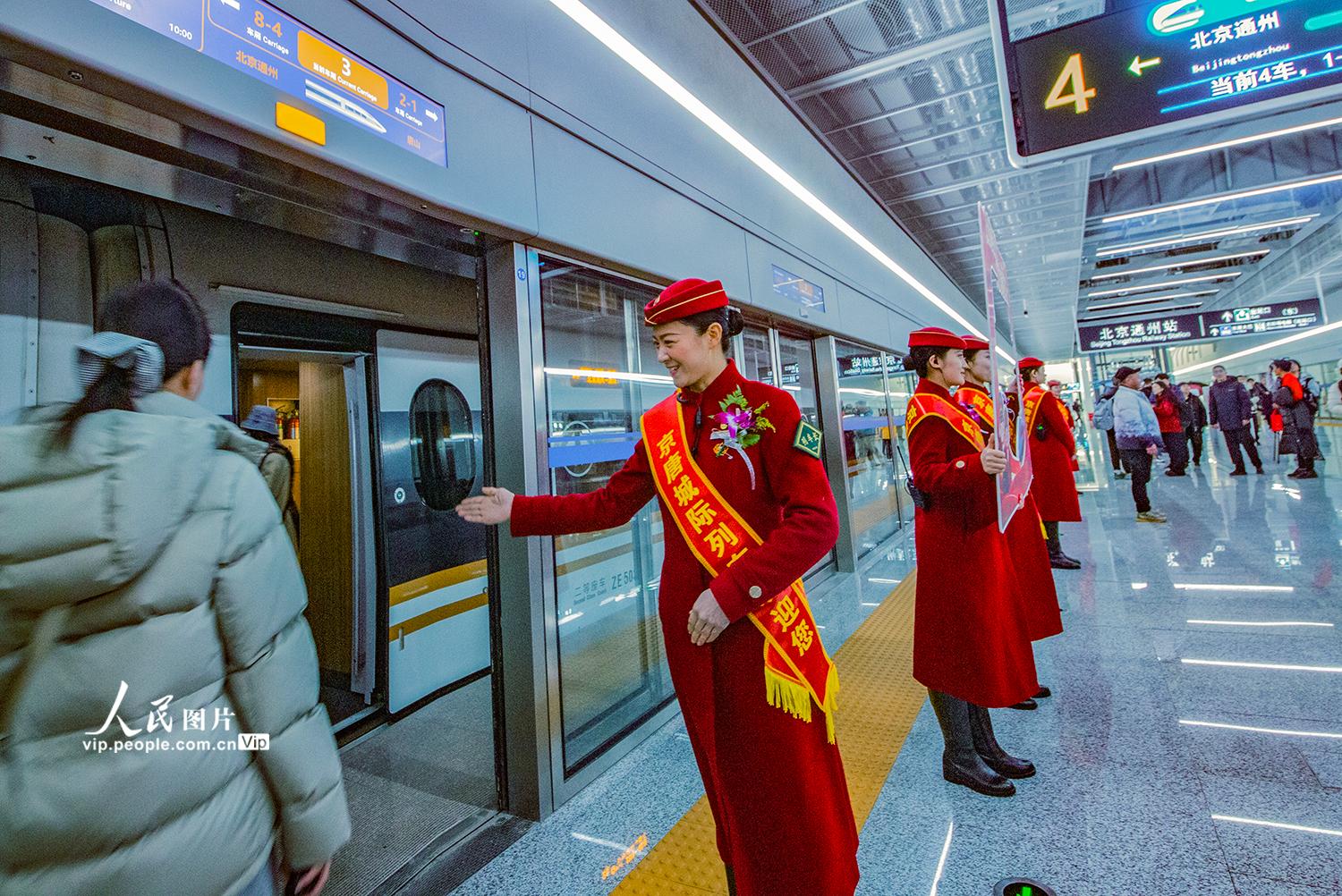
Group 1 - The Beijing Tongzhou Station of the Jing-Tang Intercity Railway officially commenced operations on December 30, 2025, marking a significant development in the city's transportation network [3] - Tongzhou Station is identified as a key station in Beijing's overall urban planning and serves as a critical node in the "Railway on the Beijing-Tianjin-Hebei" initiative, enhancing connectivity in the region [3] - The operation of Tongzhou Station will further densify the intercity railway network in the Beijing-Tianjin-Hebei area, injecting new momentum into regional collaborative development [3]
北京通州站元旦三天迎宾三万
Xin Lang Cai Jing· 2026-01-03 22:19
Group 1 - The newly opened Beijing Tongzhou Station experienced significant passenger traffic during the New Year holiday, with nearly 30,000 travelers processed over three days, peaking at around 9,000 on January 1 [1][2] - The station has introduced train services to Tangshan and Qinhuangdao, adjusting schedules based on daily passenger flow, which has attracted many passengers eager to experience the new service [1] - The station's facilities include a comprehensive service center for ticketing and other passenger needs, as well as designated waiting areas for special groups, enhancing the overall travel experience [2] Group 2 - The station's opening has significantly reduced travel time for residents of Tangshan working in Beijing, allowing for easier weekend trips home, thus benefiting from the "railway integration of Beijing-Tianjin-Hebei" initiative [1] - To accommodate the influx of travelers, all exit gates were opened, and numerous directional signs were installed to assist passengers in transferring to the subway [2] - The station's amenities include a children's play area and a mother-baby room, which are now accessible to all travelers, indicating a focus on family-friendly services [2]
“轨道上的京津冀”越织越密
Xin Lang Cai Jing· 2026-01-03 22:19
Core Insights - The China Railway Beijing Bureau Group Co., Ltd. has focused on serving national strategies and regional economic development since the start of the 14th Five-Year Plan, achieving significant results in expanding the railway network and improving transportation quality [1][2]. Group 1: Railway Network Expansion - During the 14th Five-Year Plan, the railway network layout has been continuously optimized, with an addition of 710 kilometers of operational railway, bringing the total operational mileage to 10,394.9 kilometers by the end of the plan, including 2,795.6 kilometers of high-speed rail and an electrification rate of 85.4% [1]. - Key high-speed rail projects, such as the Xiong'an-Shijiazhuang and Tianjin-Weifang lines, are under construction, further enhancing the regional high-speed rail backbone [1]. Group 2: Intercity Railway Development - The intercity railway network in the Beijing-Tianjin-Hebei region has been continuously optimized, with several lines like the Jing-Tang and Jing-Bin (Baodi to Beichen) now operational, creating a "four axes and eight radiations" railway layout [2]. - The region's major cities now have full coverage of high-speed and intercity rail services, establishing a 0.5-1 hour transportation circle between Beijing, Xiong'an, and Tianjin [2]. Group 3: Passenger Services Enhancement - By the end of the 14th Five-Year Plan, the scheduled passenger trains operated by the bureau reached 1,035 pairs, a 22.7% increase from the beginning of the period, with high-speed trains seeing a 68.8% increase [3]. - The coverage of train services in the Beijing-Tianjin-Hebei region now extends to 32 provincial-level administrative regions and 266 cities, significantly improving connectivity within the urban agglomeration [3].
北京铁路列车覆盖全国32个省级行政区,通达266个地级以上城市
Xin Lang Cai Jing· 2026-01-02 20:35
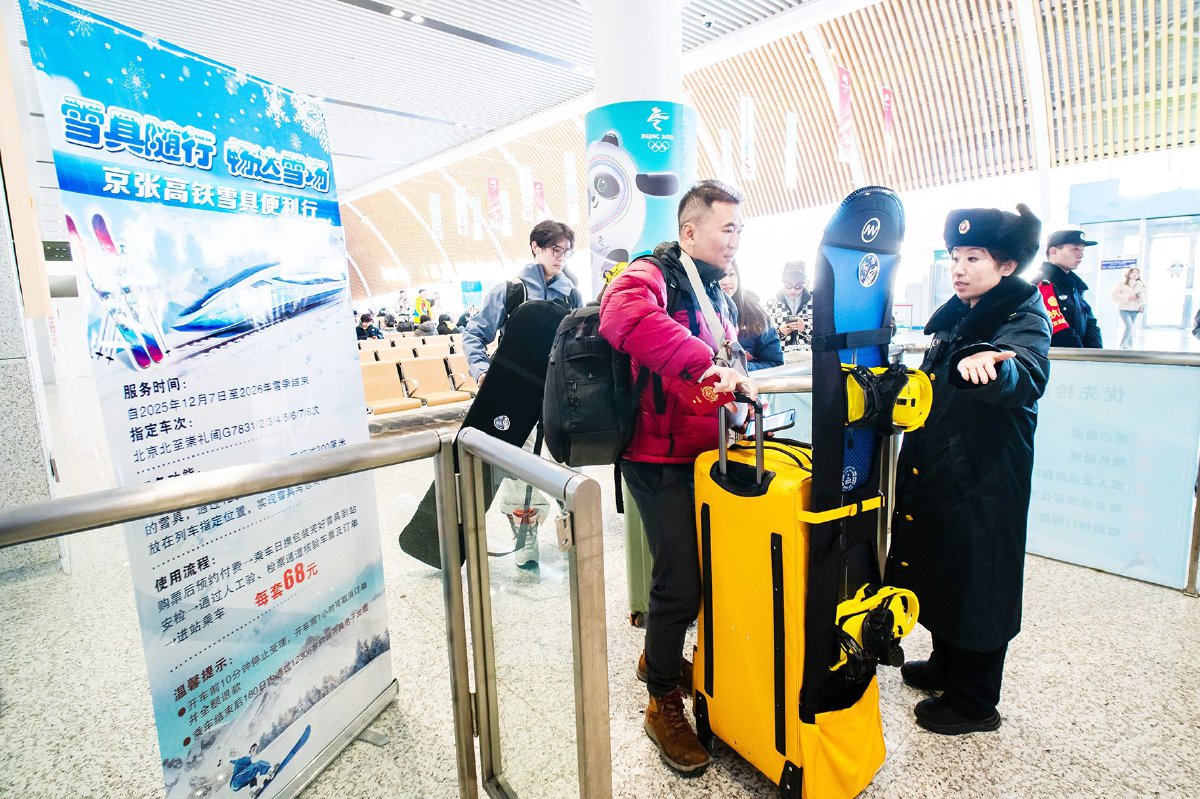
Core Insights - The opening of Tongzhou Station has established a passenger transport pattern in Beijing's railway hub, covering 32 provincial-level administrative regions and reaching 266 cities above the prefecture level [1] - During the 14th Five-Year Plan period, the Beijing-Tianjin-Hebei railway network has been continuously optimized, with an addition of 710 kilometers of operational railway, bringing the total operational mileage to 10,394.9 kilometers, including 2,795.6 kilometers of high-speed rail and an electrification rate of 85.4% [1] Group 1: Railway Network Development - The main skeleton of the "Railway on the Beijing-Tianjin-Hebei" high-speed rail corridor is rapidly taking shape, with the opening of the Beijing-Chaoyang to Chengde section of the Beijing-Harbin high-speed railway marking the full line's completion [2] - Several important components of the national "eight vertical and eight horizontal" high-speed rail network, such as the Xiong'an-Shijiazhuang and Tianjin-Weifang high-speed railways, are under construction, further enhancing the regional high-speed rail framework [2] - The intercity railway network is developing in a more integrated manner, with multiple intercity railways opening, creating a "four axes and eight radiations" railway network layout connecting major cities [2] Group 2: Passenger Transport Capacity - The National Railway Beijing Bureau has transported a total of 1.391 billion passengers during the 14th Five-Year Plan, with the number of scheduled passenger trains reaching 1,035 pairs, an increase of 22.7% from the beginning of the period [3] - High-speed train services have seen a significant increase of 68.8%, enhancing the connectivity between Beijing and Tianjin [3] - Safety measures have been improved at major passenger stations, including the implementation of intelligent security systems and the establishment of small fire stations to enhance passenger safety [3] Group 3: Freight Transport Optimization - By 2025, the freight volume of the National Railway Beijing Bureau is expected to reach 367 million tons, an increase of 11.86 million tons or 3.3% from the end of the 13th Five-Year Plan [4] - The container shipping volume is projected to reach 65 million tons, a substantial increase of 100.5% from the previous period, indicating a strong shift towards multimodal transport [4] - The bureau has implemented flexible pricing strategies and cost-reduction measures, resulting in a total reduction of transportation costs by 14.17 billion yuan for clients [4]