
银行准备金

Search documents
华尔街陷融资成本分歧:小摩与花旗对SOFR走势各执一词,押注相反交易策略
Zhi Tong Cai Jing· 2025-09-16 01:32
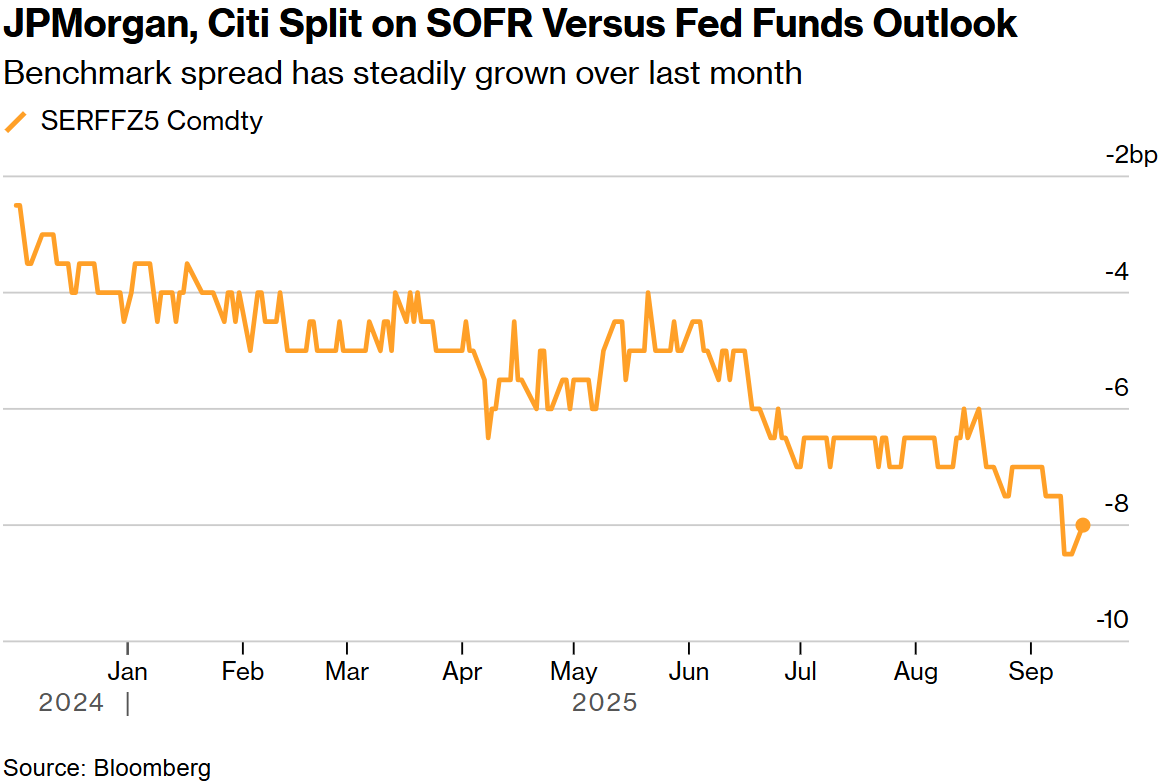
Core Viewpoint - Wall Street strategists are divided on whether the U.S. financing market will become more accommodative in the coming months, primarily due to increased volatility in overnight borrowing costs [1] Group 1: Market Dynamics - A series of events is driving up short-term interest rates, including the U.S. Treasury issuing more short-term bonds to rebuild cash reserves and the Federal Reserve reducing its balance sheet [1] - The use of key overnight lending tools by the central bank has dropped to nearly zero, raising investor concerns about the sharp rise in borrowing costs [1] - The Secured Overnight Financing Rate (SOFR) has been above the Federal Reserve's target rate since late August [1] Group 2: Divergent Views from Major Banks - JPMorgan, led by Teresa Ho, expects overnight rates to ease by year-end and recommends traders to buy December SOFR futures while selling equivalent federal funds futures [3] - JPMorgan anticipates the spread between SOFR (currently at 4.42%) and the 30-day federal funds rate (currently at 4.33%) to narrow by the end of 2025 [3] - Citigroup, led by Jason Williams, believes financing costs will remain high until year-end and suggests traders short December SOFR contracts relative to federal funds [4] Group 3: Future Projections - Citigroup expects SOFR to gradually rise in the coming months, citing guidance from the Treasury regarding increased Treasury bill auction sizes in October [4] - Barclays has exited a position betting on a narrowing spread between September SOFR and federal funds, indicating ongoing upward pressure on financing costs [4] - Morgan Stanley strategists believe market conditions may ease as soon as next month, suggesting a long position on the SOFR relative to federal funds spread for October 2025 [4] Group 4: Consensus on Historical Context - Both JPMorgan and Citigroup agree that the situation from September 2019, when financing costs surged and the Federal Reserve injected hundreds of billions into the financing market, is unlikely to repeat [5]


9月资金面吃紧?美联储洛根:缩表还有空间
Jin Shi Shu Ju· 2025-08-26 03:10
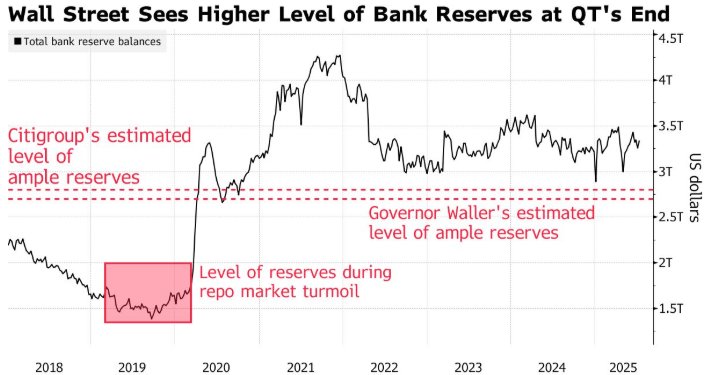
Core Viewpoint - The Federal Reserve has room to continue reducing its balance sheet despite potential short-term pressures in the money market around the end of the quarter, as stated by Dallas Fed President Lorie Logan [2][3]. Group 1: Balance Sheet Reduction - Since 2022, the Federal Reserve has been reducing its balance sheet with the goal of lowering bank reserves to a "minimum adequate level" to avoid market turmoil [2]. - Current bank reserve balances are approximately $3.3 trillion, while the estimated minimum adequate level is around $2.7 trillion [3]. - Logan emphasized that there is still more room to reduce reserves, as recent repo market rates have averaged about 8 basis points lower than the interest paid on reserves by the Fed [3]. Group 2: Liquidity Mechanisms - The Fed has mechanisms like the overnight liquidity tool and the discount window to prevent liquidity shortages, allowing eligible firms to quickly convert Treasury holdings into cash [2]. - Logan suggested that the Fed should consider increasing or removing limits on discount window loans and may benefit from daily auctions of these loans to better allocate liquidity within the banking system [3]. Group 3: Communication and Policy Framework - Logan expressed satisfaction with the Fed's recent policy framework assessment but noted that there is room for improvement in communication, particularly regarding the quarterly release of the Summary of Economic Projections (SEP) [4]. - She highlighted the need to avoid overemphasizing the median while considering diverse viewpoints in economic forecasts and responses [4].
美联储理事沃勒准备金预测遭质疑 华尔街警告流动性危机
智通财经网· 2025-07-15 01:59
Group 1 - Wall Street strategists believe that the required reserve levels predicted by Federal Reserve Governor Waller should be higher to prevent system disruptions [1] - Waller indicated that the Fed could reduce bank reserves to approximately $2.7 trillion, down from the current level of about $3.34 trillion, allowing for continued balance sheet reduction known as "quantitative tightening" [1] - JPMorgan strategists suggest that the adequate reserve levels may need to be increased to avoid disruptions in the overnight funding market [1] Group 2 - Market participants are closely monitoring the cash reserves of banks at the Federal Reserve to determine when to halt balance sheet contraction [4] - The U.S. Congress has raised the debt ceiling, and Wall Street is focused on the growing cash balance of the Treasury, which is withdrawing excess liquidity from the system, potentially making the market susceptible to unexpected events like the regional banking crisis in March 2023 [4] - The New York Fed's latest survey indicated that the median reserve balance level when quantitative tightening ends is expected to be $2.875 trillion [4] Group 3 - Policymakers are striving to avoid a repeat of the repo market turmoil experienced in September 2019, which was triggered by a shortage of funds due to unprecedented reserve levels [5] - Waller noted that in September 2019, bank reserves as a percentage of GDP fell below 7%, while in January 2019, the ratio was around 8%, indicating no significant pressure on the financial system at that time [5] - Waller currently believes that a reserve level below 9% of GDP would indicate a shortage situation [5]
英国央行行长贝利:我更倾向于银行保持充足的准备金,以确保它们拥有足够的流动性资产。
news flash· 2025-06-24 14:46
Core Viewpoint - The Governor of the Bank of England, Bailey, expresses a preference for banks to maintain sufficient reserves to ensure they have adequate liquid assets [1] Group 1 - The emphasis is on the importance of liquidity in the banking sector [1]