
静态市盈率

Search documents
触及300倍静态市盈率红线,中芯国际A股两融折算率被多家券商调降至零,对普通投资者影响有多大?
Mei Ri Jing Ji Xin Wen· 2025-10-09 14:04
Core Viewpoint - Semiconductor Manufacturing International Corporation (SMIC) has faced a sudden situation where its A-share margin financing ratio has been adjusted to zero by major brokerages due to its static price-to-earnings (P/E) ratio exceeding 300 times, as per the revised rules of the Shanghai and Shenzhen Stock Exchanges [1][2] Group 1: Impact on SMIC - As of September 30, SMIC's static P/E ratio was just over 300, leading to the adjustment of its A-share margin financing ratio to zero by brokerages like CITIC Securities and Guotai Junan [1][2] - Prior to this adjustment, SMIC's A-share margin financing ratio was 70% at Guotai Junan [1] - Other stocks, such as Bawei Storage, also had their margin financing ratios adjusted to zero due to similar P/E ratio conditions [2] Group 2: Market Regulations - The Shanghai Stock Exchange's revised margin financing rules state that A-shares with a static P/E ratio above 300 or negative values will have a margin financing ratio of 0% [2] - The static P/E ratio is calculated based on the stock's closing price and the audited earnings per share from the most recent fiscal year [2] Group 3: Investor Implications - Investors holding stocks with a margin financing ratio reduced to zero may need to provide additional collateral or liquidate some assets to continue financing [3] - Existing positions are generally not forced to be liquidated, but new positions cannot be opened until the margin financing ratio changes [3] Group 4: Comparison with Hong Kong Market - The Hong Kong market has a more flexible approach, allowing brokerages to set their own margin financing ratios without strict rules on high P/E ratios or losses [4][5] - SMIC's Hong Kong shares currently have a margin financing ratio of around 50%, despite its static P/E ratio being 175 times [5] - Other stocks with high P/E ratios in the Hong Kong market, such as Hua Hong Semiconductor, can still be used as collateral for financing [5]

多家券商出手调整,一波股票两融折算率降为0,是何原因?
Feng Huang Wang· 2025-10-09 11:46
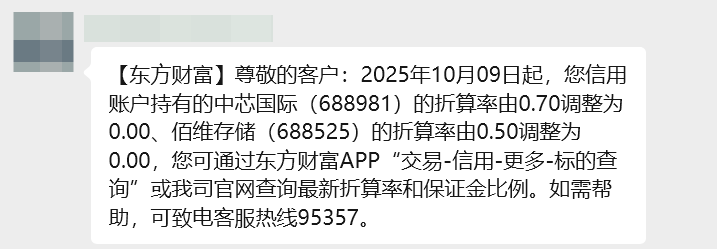
Core Viewpoint - The adjustment of margin financing rates to zero for certain stocks, including SMIC and Bawen Storage, has attracted significant market attention, reflecting regulatory compliance and risk control measures in the financing and securities industry [1][2][10]. Group 1: Margin Financing Rate Adjustments - On October 9, 2023, the margin financing rates for SMIC (688981) and Bawen Storage (688525) were adjusted from 0.7 and 0.5 to 0.00, respectively [1][2]. - This adjustment is in accordance with exchange regulations that mandate a zero financing rate for stocks with a static P/E ratio exceeding 300 or negative [2][10]. - The adjustment is a common practice across the industry, with over 1,000 stocks currently having a financing rate of zero due to similar conditions [2][15]. Group 2: Market Reactions and Stock Performance - Following the adjustment, the semiconductor sector experienced significant volatility, with SMIC showing a daily fluctuation of over 11% [7]. - On the adjustment day, SMIC's stock price fluctuated between a high of 153 CNY and a low of 138.91 CNY, with a closing drop of 0.87% [7][15]. - The ChiNext 50 Index was also affected, initially rising by 6.19% before closing with a smaller gain of 2.93% [9]. Group 3: Regulatory Framework - The rules governing the adjustment of margin financing rates have been in place since December 2016, aimed at enhancing risk control in the financing and securities market [10][15]. - The core logic of these regulations is to limit leverage on stocks with high valuations while allowing it for those with lower valuations, thereby managing business risks effectively [15].

折算率“归零”!多家券商出手,影响多大?
券商中国· 2025-10-09 11:16
Core Viewpoint - Nine A-shares, including SMIC and Roadbridge Information, have had their financing and securities margin rates adjusted to zero due to their static price-to-earnings (P/E) ratios exceeding 300 or being negative, as part of a dynamic risk control measure by several securities firms [2][5][10]. Group 1: Adjustments and Impact - Multiple securities firms, including Dongfang Caifu Securities and Guorong Securities, confirmed the adjustment of financing and securities margin rates for nine stocks to zero, effective October 9 [2][3]. - Following the announcement, stocks such as SMIC and Roadbridge Information experienced significant declines, with SMIC's A-shares dropping by 0.87% and Roadbridge Information's shares falling by 17.24% [5][6]. - The adjustment means that these stocks temporarily lose their function as collateral for financing, significantly reducing investors' ability to leverage these stocks [5][6]. Group 2: Reasons for Adjustment - The adjustments are based on the rules of the Shanghai, Shenzhen, and Beijing Stock Exchanges, which state that stocks with a static P/E ratio above 300 or negative must have their financing margin rates set to zero [5][10]. - The highest static P/E ratio among the affected stocks was 947 for Roadbridge Information, while SMIC and Baiwei Storage had static P/E ratios of 303 and 301, respectively [7][8]. Group 3: Recovery Conditions - The financing margin rates can be restored if the static P/E ratios of the affected stocks fall below 300 in the future, as demonstrated by other stocks like Sifang Precision and Jikong Co., which had their rates restored after meeting this criterion [10].


红利指数估值跳涨,是哪些因素导致?
雪球· 2025-05-17 03:02
Core Viewpoint - The article discusses the significant increase in the valuation of dividend indices following the annual report updates, attributing this rise to the use of static price-to-earnings (PE) ratios by the China Securities Index, which contrasts with the rolling PE ratios used by other platforms [3][10]. Valuation Changes of Dividend Indices - The valuation of various dividend indices has seen notable changes, with the PE ratios increasing significantly post-annual report updates. For instance, the Dividend Index's PE rose from 7.19 to 8.71, marking a 21.14% increase, while the dividend yield remained stable at 7.10% [7]. - The China Securities Dividend Index also experienced a PE increase of 22.46%, from 7.88 to 9.65, with a slight decrease in dividend yield [7]. - The low-volatility dividend indices showed a lower increase in PE ratios, indicating a more stable valuation compared to single-factor dividend indices [8]. Industry and Sample Performance - The analysis of the China Securities Dividend Index reveals that 58 out of 100 sample companies experienced a decline in profit year-on-year, with an average profit drop of 12.99% [16][17]. - Revenue performance was similarly affected, with 60% of the sample companies reporting a decline in revenue, averaging a decrease of 3.89% [17]. - Industries facing profit declines include coal, transportation, steel, media, and construction materials, while banking and public utilities showed stable profit growth [19][20]. Conclusion on Dividend Indices - The overall valuation increase in dividend indices is primarily driven by the decline in profits among key sectors like coal and steel, leading to a significant rise in PE ratios. Despite this, the indices maintain a stable profit outlook, suggesting that investors can hold onto these indices without excessive concern [20][21].

4连板安记食品:最近交易的换手率高于前期水平
news flash· 2025-04-18 10:30
Core Viewpoint - Anji Foods (603696.SH) has experienced a significant increase in trading turnover, with a current static price-to-earnings ratio of 93.95 times and a price-to-book ratio of 5.21 [1] Group 1 - The recent trading turnover rate is reported at 10.27%, which is higher than the previous levels [1] - The company has issued a notice to investors regarding the increased trading risks in the secondary market, urging rational investment [1]
