FOF投资

Search documents
【国信金工团队】招聘启事
量化藏经阁· 2025-12-03 00:08
招 聘 启 事 团队介绍: 国信金工团队组建于2020年6月,团队目前共有7名成员,研究内容涵盖量化选股、FOF 投资、基金产品研究、行业轮动、资产配置、港股投资、CTA策略等多个方向,研究成 果受到机构投资者的广泛好评。 团队荣誉: 2024年证券时报 • 新财富杂志最佳分析师金融工程第4名 2021年第十九届新财富最佳分析师金融工程第5名 2021年第十五届卖方分析师水晶球奖金融工程 总榜单 第3名(公募榜单第1名) 金融工程分析师 职位介绍: 职位要求: 1、国内外院校数学、计算机、统计、金融工程、金融经济等相关专业硕士及硕士以上 学历的2026年应届毕业生or从事买方/卖方量化研究工作不超过5年的非应届生。 2024 年第十八届卖方分析师水晶球奖金融工程总榜单第3名(公募榜单第2名) 2023年第二十一届新财富最佳分析师金融工程第2名 2023年第十七届卖方分析师水晶球奖金融工程总榜单第2名(公募榜单第2名) 2022年第二十届新财富最佳分析师金融工程第1名 2022年第十六届卖方分析师水晶球奖金融工程总榜单第1名(公募榜单第1名) 2、具备扎实的数理统计知识和建模能力,熟练使用Python、Matl ...


多元配置好基会 华商汇享多元配置3个月持有混合(FOF)火热发售中
Xin Lang Ji Jin· 2025-11-26 01:09
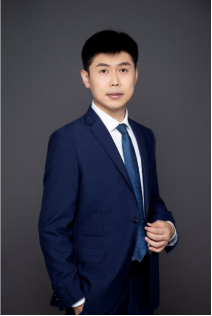
Core Viewpoint - The article highlights the advantages of Fund of Funds (FOF) in addressing common challenges faced by ordinary investors, such as difficulty in selecting funds and holding them long-term. The newly launched "Huashang Huixiang Multi-Asset Allocation 3-Month Holding Mixed Fund (FOF)" aims to provide a solution through professional fund selection and risk diversification [1][6]. Group 1: Fund Overview - The "Huashang Huixiang Multi-Asset Allocation 3-Month Holding Mixed Fund (FOF)" is being issued by Huashang Fund, a well-established public fund company with nearly 20 years of experience [1][12]. - The fund will be managed by Sun Zhiyuan, who is recognized for his strong research and investment capabilities, aiming for long-term stable returns for investors [1][3][12]. - The fund's asset allocation strategy includes 5%-30% in equity assets, with the possibility of investing up to 50% in Hong Kong Stock Connect stocks and a maximum of 10% in commodity funds [7][8]. Group 2: Investment Philosophy - Sun Zhiyuan's investment philosophy focuses on providing a good investment experience, even for investors entering at the worst market timing, by combining absolute and relative returns [5][12]. - The fund emphasizes a minimum holding period of three months to encourage long-term investment habits and avoid irrational decisions due to short-term market fluctuations [8][12]. Group 3: Performance and Ratings - Sun Zhiyuan's management of the "Huashang Anyuan Steady Progress One-Year Holding Mixed Fund (FOF)" has achieved notable rankings, with the A-class share ranking second and the C-class share ranking first in its category over the past year [5][13]. - Huashang Fund has received multiple top ratings, including a 5A rating from Tianxiang Investment Advisors for its three-year comprehensive management and performance in both equity and fixed-income categories [12][15].
民生加银基金刘欣:不做市场的“预言家”,做资产配置的“践行者”
中国基金报· 2025-11-24 03:18
Core Viewpoint - In the current low-interest, high-volatility environment, there is a significant increase in investor demand for low-volatility, absolute return products as traditional investment yields decline [2][8] Group 1: Investment Philosophy - Liu Xin, the assistant general manager and head of asset allocation at Minsheng Jianyin Fund, emphasizes a pragmatic approach focused on manageable issues rather than short-term market predictions, aiming for long-term success through diversified FOF portfolios [2][5][7] - The investment philosophy is rooted in "respecting the market" and "weakness thinking," acknowledging market complexity and individual limitations, and prioritizing solvable investment problems over elusive predictions [7][8] Group 2: FOF Strategy - The Minsheng Jianyin Fund has shifted its FOF investment strategy from selecting star fund managers to a diversified asset allocation approach, utilizing a "localized all-weather" strategy that balances risk across various asset classes [10][12] - The strategic allocation is based on risk parity models and long-term asset characteristics, ensuring that portfolio risk is not dominated by any single high-volatility asset [11][12] Group 3: Market Outlook - Liu Xin holds a relatively optimistic and strategic view on the A-share market, citing its reasonable valuation and sustainable upward trend, making it a core equity asset for future portfolios [14] - The team has identified the Korean stock market as undervalued and has made a contrarian investment in related funds, which has yielded significant returns [15] Group 4: Bond and Commodity Strategy - Bonds are viewed as a stabilizing component of the portfolio, with a focus on interest rate bonds for risk hedging rather than yield generation, while credit bonds are selected based on the management team's risk control capabilities [15] - The team has strategically reduced bond duration based on market conditions but maintains a higher duration compared to industry standards [15] Group 5: New Product Launch - A new fund, Minsheng Jianyin Multi-Asset Stable Allocation 3-Month Holding Period Mixed FOF, is set to launch, implementing the "localized all-weather" strategy and focusing on dynamic asset allocation [16]
富达基金赵强:外资公募如何“解题”养老FOF
点拾投资· 2025-11-19 03:04
Core Viewpoint - The NEMO system integrates Fidelity's global asset allocation processes, enhancing the efficiency of fund managers and researchers, ultimately benefiting the multi-asset pension fund products [2][3][20]. Group 1: NEMO System and Its Functionality - The NEMO system transforms the investment process of Fidelity's multi-asset pension funds from a flat to a three-dimensional structure, incorporating various asset classes, regions, strategies, and managers [2]. - It provides a clear framework for strategic asset allocation (SAA), tactical asset allocation (TAA), and fund selection, ensuring a systematic approach to investment [2][20]. - The system emphasizes the importance of coupling the fund manager selection process, allowing for a more cohesive investment strategy [7][20]. Group 2: Investment Philosophy and Framework - The investment philosophy is centered around a framework-based approach, which helps in identifying and solving key investment problems [3][9]. - The focus on long-term performance over short-term gains is crucial, with an emphasis on maintaining a steady upward trajectory in net asset value [3][4]. - Trust is identified as fundamental in asset management, with a strong belief that maintaining client trust leads to sustained growth in assets under management [4][18]. Group 3: Key Personnel and Their Influence - Zhao Qiang, the head of Fidelity's multi-asset department, plays a pivotal role in translating global investment wisdom into actionable strategies for pension funds [3][4]. - His educational background at the University of Chicago, where he learned from Nobel laureates, significantly shaped his investment thinking and framework [8][9]. - The importance of a global team of experts is highlighted, as successful asset allocation cannot rely solely on individual fund managers [12][18]. Group 4: Market Position and Growth - Fidelity has established itself as a leading provider of pension fund management, with a significant market share in the U.S. and Hong Kong [2][17]. - The company has maintained a 20% growth rate in its pension products, attributed to its ability to safeguard client wealth during market crises [4][18]. - The emphasis on client satisfaction as a key performance indicator reflects Fidelity's commitment to long-term client relationships [17][18]. Group 5: Investment Strategy and Asset Allocation - The multi-asset investment strategy involves diversifying across various asset classes, regions, and strategies to mitigate risk and enhance returns [22][25]. - Tactical adjustments in asset allocation are informed by comprehensive macroeconomic research and data analysis, ensuring informed decision-making [26][33]. - The integration of quantitative and qualitative frameworks in fund selection allows for a thorough evaluation of fund managers and their strategies [35]. Group 6: Future Outlook and Development - The development of new pension fund products is underway, with a focus on risk management and achieving stable returns [43][46]. - Fidelity aims to leverage its global expertise to enhance the pension fund landscape in China, advocating for policies that promote default options in retirement savings [45][46]. - The long-term assessment of pension fund performance is emphasized, moving away from short-term metrics to foster a more sustainable investment environment [46].

业绩为矛 实力见证——华商基金孙志远在管FOF表现亮眼 新基值得期待
Xin Lang Ji Jin· 2025-11-19 01:01
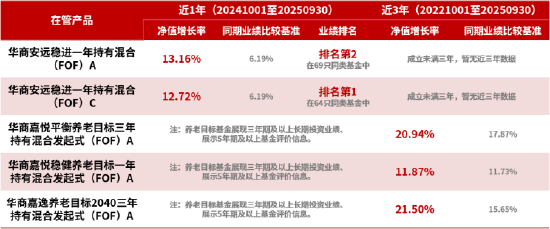
Core Insights - The long-term performance of FOF products managed by Sun Zhiyuan from Huashang Fund has significantly outperformed benchmarks, demonstrating the effectiveness and sustainability of his "steady counterattack" investment strategy [1][4]. Performance Summary - Sun Zhiyuan's FOF products have shown remarkable results, with the Huashang Anyuan Stable One-Year Holding Mixed (FOF) A achieving a net value growth rate of 13.16% and C shares at 12.72%, both surpassing the benchmark of 6.19% [2][3]. - In the same category, Huashang Anyuan Stable One-Year Holding Mixed (FOF) A ranked second among 69 similar funds, while C shares ranked first among 64 similar funds [3]. - For long-term value-focused pension target funds, the Huashang Jiayue Balanced Pension Target Three-Year Holding Mixed (FOF) A recorded a net value growth rate of 20.94%, exceeding the benchmark of 17.87% [2][3]. - The Huashang Jiayi Pension Target 2040 Three-Year Holding Mixed (FOF) A achieved a growth rate of 21.50%, compared to a benchmark of 15.65%, indicating significant excess returns [2][3]. - The Huashang Jiayue Stable Pension Target One-Year Holding Mixed (FOF) A also delivered a solid return of 11.87%, outperforming the benchmark of 11.73% [2][3]. Investment Methodology - The strong performance is attributed to a mature investment research system and a robust platform, with Sun Zhiyuan employing a clear investment methodology that includes mid-term market trend models and a three-dimensional evaluation system for fund managers [4]. - The investment strategy focuses on absolute return FOF management, utilizing three major absolute return sub-strategies and emphasizing drawdown control to enhance investor experience [4]. - Huashang Fund, with nearly 20 years of experience, has consistently maintained a proactive management approach and deep research capabilities, achieving a 5A rating from Tianxiang Investment Advisors for three-year comprehensive fund management [4]. Upcoming Fund Launch - A new fund, Huashang Huixiang Multi-Asset Allocation Three-Month Holding Mixed (FOF), managed by Sun Zhiyuan, is set to be launched on November 17, 2025, aiming to provide long-term stable returns for investors [5].
在多元资产间寻找高“性价比” FOF舵手陈文扬的资产配置哲学
Zhong Guo Ji Jin Bao· 2025-11-10 06:15
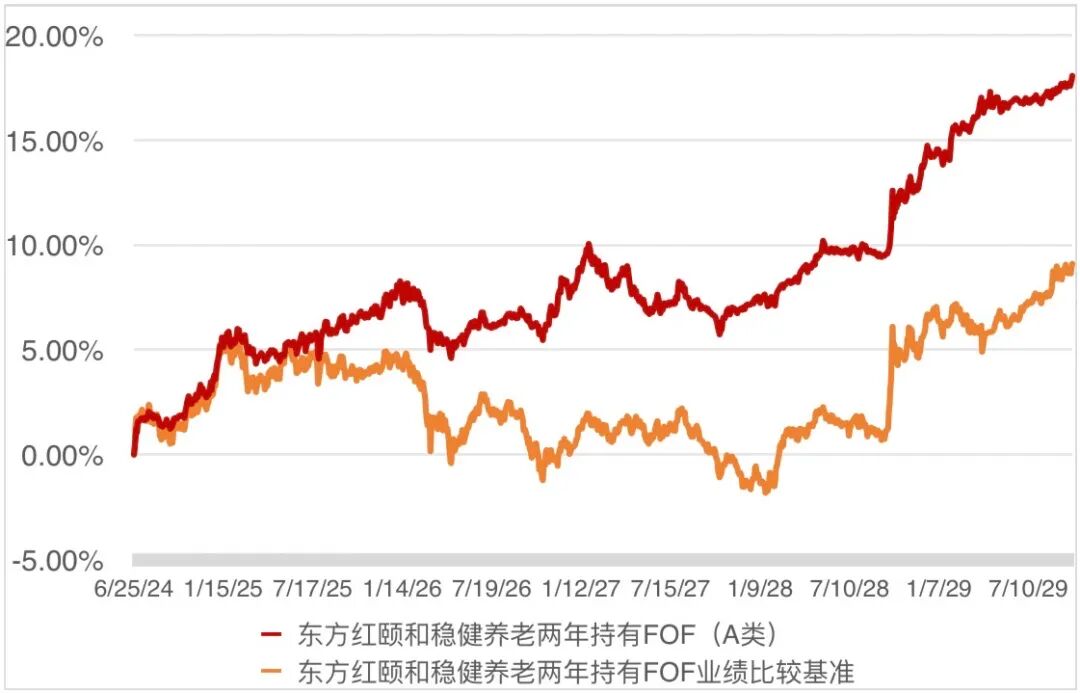
Core Viewpoint - The article highlights the expertise of Chen Wenyang, a fund manager at Dongfanghong Asset Management, in multi-asset allocation through FOF (Fund of Funds) strategies, aiming for long-term stable performance while navigating market fluctuations [1][2][14]. Group 1: Investment Strategy - Chen Wenyang emphasizes the importance of multi-asset allocation as a foundation for FOF investment management, advocating for diversification to achieve a higher risk-return ratio [7][12]. - The FOF team at Dongfanghong employs a comprehensive process for strategy design, asset selection, and fund management, leveraging team collaboration to enhance research capabilities [2][12]. - Chen's approach involves identifying assets with high odds and reasonable win rates, focusing on those with upward trends to optimize returns [11][9]. Group 2: Performance Metrics - The "Dongfanghong Yihe Stable Pension Two-Year FOF" managed by Chen has ranked 5th out of 25 and 8th out of 61 in its category for five-year and three-year returns, respectively, showcasing its competitive performance [3][15]. - The fund's performance metrics indicate a net value growth rate of 4.26% in 2020, 3.40% in 2021, and a recovery of 6.57% in 2024, reflecting its resilience through various market conditions [15][16]. Group 3: Asset Allocation Insights - Chen's strategy includes a mix of domestic and international assets, such as overseas bond funds and gold ETFs, to enhance risk-return profiles [9][10]. - The FOF's top holdings as of Q3 2025 include multiple gold ETFs and S&P 500 ETFs, indicating a strategic focus on global asset diversification [10][9]. Group 4: Fund Management Philosophy - The article underscores the significance of a robust investment philosophy, where Chen prioritizes stable returns over high-risk, high-reward strategies, particularly in fixed-income fund selection [13][11]. - The FOF team utilizes both quantitative and qualitative research methods to evaluate fund managers, ensuring a thorough understanding of their investment logic and consistency [12][13].
交银施罗德刘迪:用多资产配置追求稳稳的幸福
点拾投资· 2025-10-24 02:07
Core Viewpoint - The market's preference for low-volatility products remains unchanged even after a year since 924, with investors shifting between various asset classes. The CSI 300 index saw a decline after two consecutive years of over 25% gains, while the China Bond Index achieved an 8.83% return in 2024, the best since 2018. Investors are seeking low-volatility, stable products amidst high volatility in equity assets and low yields in bonds [1][3]. Multi-Asset FOF Fund Highlights - The recent launch of the multi-asset fund by Jiao Yin Schroder focuses on low-volatility products, aiming to provide a stable holding experience through diversified asset allocation [3][4]. - The multi-asset team at Jiao Yin Schroder emphasizes a user-centric approach to portfolio construction, aiming to reduce volatility and improve long-term holding experiences for investors [5][6]. Differentiation of the Multi-Asset Team - The Jiao Yin Schroder multi-asset team distinguishes itself by focusing on risk-return stability rather than chasing high returns, prioritizing the reduction of portfolio volatility [5][6]. - The team employs a quantitative framework for product management, ensuring consistent quality control across different market conditions [6][20]. User Experience Enhancement - The increasing macroeconomic volatility has shifted investor demand towards diversified financial products, as traditional stock and bond mixes struggle to provide stable returns [9][11]. - The Jiao Yin Schroder multi-asset fund incorporates a range of asset classes, including domestic bonds, equities, gold, and overseas equities, to achieve true diversification and mitigate risks [9][11]. Benefits of Multi-Asset Allocation - Multi-asset allocation is viewed as a "free lunch" in investing, as adding low-correlated assets can significantly reduce portfolio volatility without sacrificing returns [11][24]. - The fund aims for a smoother return distribution over time, allowing investors to achieve consistent returns regardless of market timing [24][25]. Strategic Asset Allocation - The fund's core asset allocation includes domestic bonds and equities, with additional allocations to gold and overseas assets to optimize risk-return characteristics [26][28]. - The maximum allocation to risk assets is capped at 25%, ensuring a balanced approach to diversification and risk management [29]. Risk Management Framework - A comprehensive risk management system is in place, involving pre-emptive management, real-time monitoring, and post-event adjustments to maintain the fund's risk budget [19][43]. - The team emphasizes disciplined investment practices, with a structured approach to adjusting asset allocations based on market conditions and risk assessments [20][44]. Team Collaboration and Expertise - The multi-asset team benefits from a collaborative environment, leveraging quantitative analysis and in-depth research to enhance investment decisions [46][47]. - The team's established systems for assessing asset volatility and product performance contribute to their competitive advantage in the multi-asset space [47][48].

工银瑞信赵志源:用多元配置FOF做理财替代
点拾投资· 2025-10-23 11:01
Core Viewpoint - The article emphasizes that diversified asset allocation and refined fund selection are key to building a long-term viable FOF (Fund of Funds) portfolio [2][6]. Asset Allocation and Fund Selection - Increasingly, investors are recognizing diversified asset allocation in FOFs as a superior "fixed income plus" strategy, offering better risk-return ratios compared to traditional stock-bond combinations [2]. - Zhao Zhiyuan, General Manager of ICBC Credit Suisse FOF Investment Department, highlights that each FOF has its own risk-return objectives, necessitating tailored asset allocation plans [3][10]. - The strategic asset allocation for the ICBC Value Steady 6-Month Holding Mixed (FOF) product is set at 80% bonds and 20% risk assets, with further diversification within the risk assets into A-share funds, low-volatility dividends, overseas US stocks, and commodities like gold [4][15]. Dynamic Management - Zhao emphasizes the importance of dynamic management based on market changes, citing an example where adjustments were made following tariff policy changes that led to market fluctuations [4][11]. Fund Selection Process - The fund selection process focuses on distinguishing between skill and luck in investment performance, utilizing quantitative analysis and qualitative research to identify stable fund managers [5][18]. - The internal culture at ICBC Credit Suisse promotes trust and sharing among research teams, enhancing the decision-making process [5][20]. FOF Investment Framework - The FOF investment framework is built on managing uncertainty through diversified asset allocation, aiming to create resilient portfolios that can adapt to various market conditions [10][9]. - The FOF team consists of 12 members with diverse backgrounds, emphasizing collaboration and knowledge sharing to enhance investment strategies [21][20]. Future Outlook - The article discusses two main growth opportunities for FOF products: personal pension Y shares and wealth management as a substitute for traditional financial products [25][26]. - Personal pension funds are highlighted for their potential to allocate higher equity assets, providing better long-term returns as the domestic capital market develops [27]. - The article concludes with a market outlook, suggesting that while short-term volatility may persist, a medium-term upward trend is anticipated, driven by policy support and corporate earnings recovery [30][34].

万家基金任峥:如何做好FOF投资的天时地利人和
Sou Hu Cai Jing· 2025-10-22 11:52
Core Viewpoint - The FOF (Fund of Funds) investment strategy should focus on both multi-asset allocation to provide stable returns and the selection of fund managers to achieve excess market returns. The FOF team at Wanji Fund employs a dual approach of fundamental research and manager selection to create a comprehensive investment system [1]. Group 1: FOF Investment Strategy - The FOF investment team utilizes a three-tiered alpha source: top-level asset allocation, middle-level industry fundamental research, and bottom-level excellent manager research [1][2]. - The macro-level analysis employs an economic six-cycle model based on monetary, credit, and growth indicators to assess different economic phases and their impact on asset performance [1][29]. - The team emphasizes the importance of understanding different fund products (ingredients) and client needs (cuisines) to create tailored investment solutions [1][6]. Group 2: Research and Analysis Framework - The mid-level research involves a closed-loop system of industry chain research, sell-side analyst communication, and interviews with industry fund managers to identify investment opportunities [2][24]. - The FOF team conducts thorough due diligence on various sectors, including innovative pharmaceuticals and AI, to strategically position their fund products [2][24]. - The investment framework includes dynamic adjustments based on macro and mid-level insights, ensuring a diversified and responsive fund composition [2][21]. Group 3: Product Offerings - Wanji Fund has developed a robust multi-asset FOF tailored for bank wealth management and institutional investors, focusing on stable returns while controlling drawdowns [3][32]. - The product lineup includes four main strategies: "Fixed Income+" strategy, value-oriented FOF, balanced growth FOF, and a mixed-asset retirement FOF, each with distinct risk-return profiles [3][4][12]. - The "Balanced Growth" FOF achieved a 34.01% return over the past year, while the retirement FOF recorded a 10.17% return, showcasing the effectiveness of their investment strategies [4][12]. Group 4: Manager Selection and Classification - The manager selection process is based on four criteria: mature investment philosophy, stable investment process, diligent attitude, and strong performance [19]. - The FOF team categorizes equity funds into three main types: balanced funds, industry-specific funds, and quantitative/index funds, allowing for targeted research and investment strategies [17][18]. - Each fund manager is limited to a maximum holding of 3% in the portfolio to ensure diversification and mitigate risks associated with individual performance [8][22]. Group 5: Economic Cycle and Asset Allocation - The economic six-cycle model helps the team understand asset performance variations across different economic phases, guiding their investment strategies [26][29]. - In the current credit expansion phase, the team has significantly overweighted growth-style funds, particularly in technology and innovation sectors [31]. - The FOF products are designed to cover a wide range of asset classes, providing better stability compared to traditional stock-bond mixes, thus meeting the diverse needs of clients [32][34].

万家基金任峥:如何做好FOF投资的天时地利人和
点拾投资· 2025-10-22 11:00
Core Viewpoint - An excellent FOF (Fund of Funds) team is responsible for multi-asset allocation to provide users with all-weather returns and to select fund managers to achieve excess market returns [3][10]. Group 1: FOF Investment Framework - FOF investment requires three levels of understanding: 1) understanding investment goals, 2) understanding matching assets or strategies, and 3) understanding suitable managers [1][13]. - The FOF investment framework consists of fundamental research, manager research, and dynamic portfolio balancing [18][21]. Group 2: Alpha Sources - There are three layers of alpha sources in FOF investment: top-level asset allocation, middle-level industry fundamental research, and bottom-level excellent manager research [3][21]. - The macro level employs an economic cycle model based on monetary, credit, and growth indicators to assess asset performance across different economic cycles [3][38]. Group 3: Manager Selection - The selection of fund managers is critical, with a focus on their investment philosophy, stable investment processes, diligence, and performance [26]. - The company tracks over 900 funds out of more than 5000 available, categorizing them based on investment style and industry focus [24]. Group 4: Portfolio Construction - The portfolio construction strategy involves a diversified approach, with no single manager holding more than 3% of the portfolio [5][12]. - The company has developed a robust multi-asset FOF that aims for better returns than traditional stock-bond mixes by utilizing low correlation between assets [5][43]. Group 5: Specific FOF Products - The company manages four types of FOF products: 1) "Fixed Income+" strategy, 2) Value style FOF, 3) Balanced style FOF, and 4) Pension-oriented FOF [6][7]. - The "Balanced Style FOF" achieved a return of 34.01% over the past year, while the "Pension-oriented FOF" achieved a return of 10.17% [6][7]. Group 6: Economic Cycle Analysis - The economic cycle model divides the economy into six phases: credit expansion, economic recovery, monetary tapering, credit tapering, economic slowdown, and monetary expansion [35][38]. - Different asset classes perform variably across these cycles, with equities performing well during credit expansion and economic recovery phases [38][40]. Group 7: Customization for Institutional Investors - The company offers customized FOF products to meet the needs of bank wealth management subsidiaries and institutional investors, focusing on stable strategies and all-weather asset allocation [43][46]. - The multi-asset FOF covers various asset classes, including A-shares, overseas equities, gold, commodities, and bonds, providing a more stable alternative to traditional strategies [43][46].