G2

Search documents
US Talks Cement China as 'Equal Partner': Beijing Adviser
Bloomberg Television· 2025-11-03 16:54
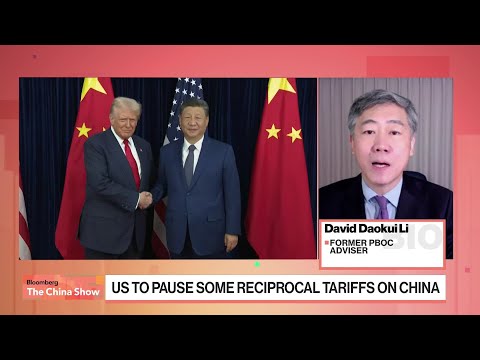
I think among all the meetings between the two leaders, this one is perhaps the most important, a really historical why I think fundamentally the most important progress for both sides is for the US to recognize China as equal peer, as the equal partner to talk about things. So in fact, President Trump used the phrase of G2, which was used by President Obama many years ago. So this is a big, big progress.That means two implications. Okay. Number one, there will be bigger talks not only on trade, but also on ...

很刺激的一天
表舅是养基大户· 2025-10-30 13:28
Core Viewpoint - The article discusses the recent developments in the US-China talks and their impact on global markets, highlighting the transition into a "G2" era and the implications for investment opportunities in China amidst a low-interest-rate environment. Market Reactions - The market experienced significant fluctuations with a drop during the day followed by a recovery towards the end, influenced by the outcomes of the US-China talks and expectations of interest rate cuts by the Federal Reserve [2][3]. - Following the talks, the probability of a December rate cut by the Federal Reserve decreased from over 90% to around 70%, negatively impacting risk assets like Hong Kong stocks [4]. Global Economic Context - The article emphasizes the emergence of a "G2" era, recognizing the strength of both the US and China, and suggests that China's asset attractiveness will continue to grow due to low interest rates and industrial advancements [10]. - A comparison of GDP and market capitalization between the US and China indicates that while the US GDP is 1.5 times that of China, the total market capitalization is three times larger, suggesting potential for narrowing this gap through market reforms [10]. Company Performance Insights - The article reviews the third-quarter performance of several companies, noting that while some companies like X and Y maintained high growth rates, they faced negative growth in revenue compared to the previous quarter, indicating potential challenges ahead [20][21]. - Companies like 招行 (China Merchants Bank) and 茅台 (Moutai) showed minimal growth in net profit, yet 招行's stock price increased slightly, while 茅台's remained stable, reflecting market perceptions of their financial health [21][22]. Investment Strategy - The article suggests that in a low-growth economic environment, companies with low valuations and high ROE (Return on Equity) still hold investment value, while high-growth companies may lack sufficient short-term safety margins [20]. - It highlights the importance of dividend policies, particularly for 茅台, which has increased its dividend payout ratio, thereby maintaining a stable ROE despite stagnant net profit growth [24]. Sector-Specific Trends - The article notes that the Hong Kong innovative drug sector continues to decline, with the implication that recent sell-offs may not necessarily be negative for investors, as they could mitigate larger losses [25]. - The wealth management business of 招行 showed significant growth, with a notable increase in trust and fund revenues, indicating a positive trend in this sector despite overall non-interest income declining [36][37].
X @Zhu Su
Zhu Su· 2025-09-27 00:22
Ray Dalio’s observations on Anglo decline seem overstated, perhaps bc he speaks from within that perspective. He is obviously right about the UK, but to even discuss the UK and US in one breath is archaic. In Beijing itself, the currently fashionable theory appears to be the G7 -> G2 power architecture transition, which is to say that two complementary superpowers decide everything.After this period of posturing ends, the relationship likely settles back to core cooperation on shared interests. Tariffs func ...
从拒绝G2到平起平坐,中国如何用实力赢得美国尊重
Sou Hu Cai Jing· 2025-09-07 11:31
Core Viewpoint - The article discusses China's rise to a position of equal negotiation status with the United States, moving from rejecting the "G2" concept to becoming a key player in global governance and trade dynamics [1][3][4]. Group 1: Historical Context - In 2009, China rejected the "G2" proposal from the Obama administration, recognizing it as an attempt by the U.S. to dominate the international system [1]. - Over the past sixteen years, the global landscape has shifted, with the Trump administration initiating a global tariff war, yet China has managed to respond effectively and assertively [3]. Group 2: China's Economic and Technological Strength - China now contributes 30% to global economic growth in 2024, establishing itself as an indispensable engine of the world economy [3]. - The country has transitioned from being a "follower" to a "co-runner" in technology, leading in areas such as 5G, artificial intelligence, and quantum computing [3]. Group 3: China's Vision for Global Order - China's rise is not aimed at replacing U.S. leadership but rather at promoting a fairer and more inclusive international order [4]. - The country advocates for a multipolar world where decisions are made collectively rather than dominated by a few nations [4]. Group 4: Current U.S.-China Relations - The current state of U.S.-China relations is characterized as "not too good, but not too bad," indicating a complex interdependence [4]. - China has demonstrated its capability to handle challenges posed by tariffs and technology restrictions, asserting that it will not accept unequal treatment [4][5]. Group 5: Future Implications - The world will witness China actively participating in and even leading the formulation of global rules, reflecting its hard-earned respect and dignity [5]. - The journey from rejecting "G2" to achieving true equality in negotiations signifies China's commitment to its development path and its contribution to global governance reform [5].