
加密货币

Search documents
比特币重返120000美元,近10万人爆仓
21世纪经济报道· 2025-08-11 10:48
8月11日,比特币一度上涨3.2%,突破12.2万美元。7月14日,比特币首次突破12万美元并创历史新高后持续震荡下行,近几个交易日则呈现反 弹态势。上周末,以太坊大涨至4300美元上方,创下自2021年12月以来的最高水平。 截至下午5:30左右,比特币的价格为121452美元,上涨了2.63%。与此同时,其他加密货币价格也出现大幅度的上涨,如以太坊价格上涨了 1.38%。 | Name | | Price | 24H % - | | --- | --- | --- | --- | | | Bitcoin BTC | $121,452.26 | +2.63% | | | Ethereum | $4,277.12 | +1.38% | | | ETH | | | coinglass显示,近24小时全球有近10万人爆仓。 | SOL XRP DOGE =Q | | --- | | ETH | | BTC | | 全部 | | 1小时爆仓 | 多单爆仓 | 空单爆仓 | | --- | --- | --- | | $215.4万 | $93.2万 | $122.3万 | | 4小时爆仓 | 多单爆仓 | 空单爆仓 ...


比特币重返120000美元!专家预计本月突破历史高点
Sou Hu Cai Jing· 2025-08-11 10:14
BTC Markets加密分析师Rachael Lucas表示:"比特币向历史高位攀升,得益于机构资金持续流入企业财 务、美国现货ETF,以及在美国对进口金条加征新关税后市场情绪的转变。随着黄金面临供应瓶颈和政 策风险,比特币作为一种无国界、免关税的价值储存工具,正越来越受到投资者青睐。" 专家还预计,积极的宏观经济前景继续支撑包括加密货币在内的风险资产,预计比特币本月将突破历史 高点。 据智通财经报道,虽然比特币拥有"数字黄金"之称,但近年来其价格趋势与风险资产高度相关。专注于 加密货币的情报通讯Ecoinometrics上周日表示,纳斯达克和比特币之间的相关性增强,可以解释该代币 最近价格走势的缘由。 8月11日,比特币一度上涨3.2%,突破12.2万美元。7月14日,比特币首次突破12万美元并创历史新高后 持续震荡下行,近几个交易日则呈现反弹态势。上周末,以太坊大涨至4300美元上方,创下自2021年12 月以来的最高水平。 数字资产主要经纪商FalconX Ltd.亚太区衍生品交易主管Sean McNulty进一步指出,比特币和以太币的 仓位严重偏向9月和12月的看涨期权,以押注宏观降息时机以及传统金 ...
比特币逼近历史高点,周二美国通胀数据将成突破关键
Feng Huang Wang· 2025-08-11 09:11
而美股正受到美联储降息可能性大增的乐观预期推动。市场目前将焦点转向即将于周二发布的7月消费 者物价指数报告,经济学家预计年化通胀率将上升0.1个百分点至2.8%,任何弱于预期的读数都将增强 美联储最早在9月降息的可能性。 BTC Markets加密货币分析师Rachael Lucas表示,比特币上涨一方面源于机构投资者追加投入,另一方 面在于美国对进口金条征收新关税后市场人气的转变。随着黄金面临供应瓶颈和政策风险,比特币作为 价值储存手段的地位正日益受到投资者的青睐。 专家还预计,积极的宏观经济前景继续支撑包括加密货币在内的风险资产,预计比特币本月将突破历史 高点。 乐观预期 数字资产主要经纪商FalconX Ltd.亚太区衍生品交易主管Sean McNulty进一步指出,比特币和以太币的 仓位严重偏向9月和12月的看涨期权,以押注宏观降息时机以及传统金融体系的持续接受加密货币。 比特币价格正在冲击在7月中旬创下的历史高点。据分析,这与特朗普允许美国养老计划投资加密货 币,以及传出金条可能被美国征收关税消息等一系列因素相关。 截至发稿,比特币24小时内涨幅高达3.33%,价格突破121000美元。第二大代币以 ...
港股收盘 | 恒指收涨0.19% 停产消息落地刺激锂业股走强 黄金股全线承压
Zhi Tong Cai Jing· 2025-08-11 08:57
热门板块方面 盘面上,大型科技股涨跌互现,阿里巴巴涨1.89%,百度涨0.81%。以太币创2021年来新高,比特币再 度突破12万美元,加密货币相关概念股大涨;宁德时代(300750)江西锂矿确认停产,"锂矿双雄"放量 走强;重大项目持续推进,水泥股继续活跃;苹果概念、纸业股、奶牛养殖标的等走高。另一边,黄金 关税乌龙引发金价波动,黄金股集体下挫;博彩股、餐饮股、芯片股多数疲软。 港股今三大指数今日走势不一,恒指早盘探底回升,国指及恒科指午后均震荡转跌。截止收盘,恒生指 数涨0.19%或47.99点,报24906.81点,全日成交额为2009.02亿港元;恒生国企指数跌0.08%,报8888.08 点;恒生科技指数跌0.01%,报5460.02点。 东吴证券表示,对港股持谨慎乐观态度,认为港股还处在震荡向上趋势中,下行有底。继续关注潜在增 配资金风偏。该行认为,南向资金还有提高仓位潜力;市场持续关注红利,自下而上寻找景气行业;尽 管市场明显提高了美联储降息的预期,促进股票市场反弹,但不能忽视对等关税或有风险;中长期看, 依旧担心海外上行风险。 蓝筹股表现 比亚迪(002594)电子(00285)领涨蓝筹。截至 ...



港股收盘(08.11) | 恒指收涨0.19% 停产消息落地刺激锂业股走强 黄金股全线承压
智通财经网· 2025-08-11 08:56
Market Overview - The Hong Kong stock market showed mixed performance with the Hang Seng Index rising by 0.19% to close at 24,906.81 points, while the Hang Seng China Enterprises Index fell by 0.08% to 8,888.08 points and the Hang Seng Tech Index decreased by 0.01% to 5,460.02 points. The total trading volume was 2,009.02 million HKD [1] Blue Chip Performance - BYD Electronics (00285) led the blue-chip stocks, increasing by 6.15% to 38.68 HKD, contributing 2.75 points to the Hang Seng Index. Minsheng Securities anticipates further growth in the company's consumer electronics business and significant benefits from its parent company BYD's push in the electric vehicle sector [2] - Other notable blue-chip performances include Xinyi Solar (00968) up 5.06%, Techtronic Industries (00669) up 4.35%, while Galaxy Entertainment (00027) and China Life (02628) saw declines of 2.9% and 2.23%, respectively [2] Sector Highlights - Large tech stocks exhibited mixed results, with Alibaba rising by 1.89% and Baidu by 0.81%. Cryptocurrency-related stocks surged as Bitcoin surpassed 120,000 USD and Ethereum reached new highs [3][4] - Lithium stocks performed strongly, with Ganfeng Lithium (01772) up 20.91% and Tianqi Lithium (09696) up 18.19%. The supply reduction from Ningde Times due to a mining suspension is expected to impact lithium carbonate inventory levels positively [3] - The cryptocurrency sector saw significant gains, with companies like Huajian Medical (01931) rising by 27.55% and Blue Ocean Interactive (08267) by 14.75% [4] Regulatory Impact - The announcement by U.S. President Trump regarding a 100% tariff on semiconductor imports, with exemptions for companies committing to large investments in the U.S., is expected to positively impact companies like Apple, Samsung, and others in the supply chain [5][6] Gold Sector - Gold stocks faced declines, with Shandong Gold (01787) down 7.99% and Chifeng Jilong Gold (06693) down 6.86%. The market reacted to potential U.S. tariffs on gold imports, leading to fluctuations in gold prices [6] Notable Stock Movements - Zhonghui Biotechnology (02627) debuted with a remarkable increase of 157.98% to 33.28 HKD, focusing on vaccine development [7] - Huajian Medical (01931) reached a new high, driven by a strategic partnership with HashKey Group to enhance digital asset services [8] - XPeng Motors (09868) saw a rise of 5.36% following the unveiling of its new P7 model, which has already garnered significant pre-orders [9] - Jinxin Fertility (01951) issued a profit warning, expecting a loss of up to 1.09 billion RMB in the first half of 2025 due to asset impairments [10]
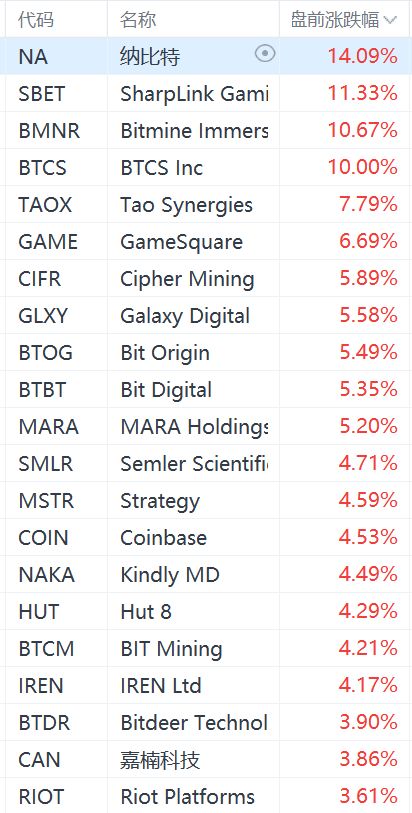
美股加密货币概念股盘前集体上涨,Strategy、Coinbase涨超4%
Ge Long Hui A P P· 2025-08-11 08:35
Core Insights - Bitcoin has surpassed $122,000 per coin, leading to a collective rise in cryptocurrency-related stocks in the U.S. pre-market trading [1] Group 1: Market Performance - Notable pre-market gains include Nabitt up 14.09%, SharpLink Gaming up 11.33%, and Bitmine Immers up 10.67% [1] - Other significant increases include BTCS Inc at 10.00%, Tao Synergies at 7.79%, and GameSquare at 6.69% [1] - Major players like Galaxy Digital and Bit Origin also saw gains of 5.58% and 5.49% respectively, while MARA Holdings and Bit Digital rose by 5.20% and 5.35% [1] Group 2: Stock Performance Overview - The overall trend shows a strong performance in the cryptocurrency sector, with multiple companies experiencing gains exceeding 4% [1] - Companies such as Strategy and Coinbase reported increases of 4.59% and 4.53% respectively, indicating a positive sentiment in the market [1] - Other notable mentions include Hut 8 and BIT Mining, which rose by 4.29% and 4.21% respectively, reflecting a broader bullish trend in the cryptocurrency market [1]



全线暴涨!原因,找到了!
中国基金报· 2025-08-11 08:02
Market Performance - The A-share market experienced a significant increase on August 11, with the ChiNext index rising over 2%. The Shanghai Composite Index rose by 0.34%, the Shenzhen Component Index by 1.46%, and the ChiNext index by 1.96% [2] - A total of 4,188 stocks rose, with 84 stocks hitting the daily limit up, while 1,068 stocks declined [3] Key Drivers - The surge in the ChiNext index was largely attributed to CATL's announcement regarding its mining operations. The company stated that it has suspended mining activities at its Yichun project due to the expiration of its mining license on August 9, but it is in the process of applying for an extension. This situation is not expected to significantly impact the company's overall operations [4] - The Yichun mine is a major lithium production site, accounting for approximately 6% of global output, with other mines in the region contributing at least another 5% [4] Lithium Market Impact - Following the news about CATL, lithium prices and lithium mining stocks saw substantial increases, indicating a potential for significant short-term price hikes in lithium [4] Stock Performance - Notable stock performances included: - Fulin Precision (300432) up 11.18% to 14.32 - Shengxin Lithium Energy (002240) up 10.02% to 18.44 - Jiangte Motor (002176) up 10.01% to 8.68 - Tianqi Lithium (002466) up 66.6% to 44.91 - Ganfeng Lithium (002460) up 6.99% to 40.51 [5] Sector Adjustments - In contrast, gold stocks experienced a collective decline, with Chifeng Jilong Gold Mining (600988) dropping over 5% [6][7] Positive Market Factors - The China Securities Regulatory Commission (CSRC) clarified that it would not increase the pace of IPOs, emphasizing the cultivation of long-term capital, which provides a stabilizing policy assurance for the market [9] - The potential resolution of the Russia-Ukraine conflict, with a meeting scheduled between U.S. President Trump and Russian President Putin, has led to optimism in the market, contributing to the rise in stock prices [10][11] - Expectations of interest rate cuts by the Federal Reserve, as indicated by Fed Governor Michelle Bowman, have also positively influenced market sentiment [14] Cryptocurrency Market - Bitcoin surged close to its historical record, driven by demand from institutional investors and corporate buyers, rising 3.2% to over $122,000. Ethereum also saw significant gains, surpassing $4,300 [16] - The increasing interest in cryptocurrencies among large investors is evident, with digital asset financial companies holding approximately $113 billion in Bitcoin and around $13 billion in Ethereum [17]

比特币蓄势冲击历史新高 投机多头与降息预期共舞 年底目标价看15万美元
Zhi Tong Cai Jing· 2025-08-11 07:01
Group 1 - The macroeconomic outlook is improving, supporting risk assets including cryptocurrencies, with Bitcoin expected to break its historical high this month [1] - Bitcoin has rebounded by 4.5% since Saturday, trading just below its historical high of $122,838 set on July 14 [1] - The increase in open contracts by 7,834 Bitcoin and a surge in spot and perpetual contract buying indicate that the recent price rise is driven by speculative long positions [1] Group 2 - The upcoming US July CPI data is drawing market attention, with expectations of a year-on-year increase of 2.8%, up from 2.7% in June [2] - Core CPI, excluding food and energy, is expected to rise by 3% year-on-year, higher than June's 2.9% [2] - There is a growing demand for put options, indicating market concerns over potential unexpected inflation increases, which could lead to a "mini panic" and a sharp decline [2]
港股异动 | 加密货币概念股走强 华检医疗(01931)涨超18%破顶 蓝港互动(08267)涨超13%
智通财经网· 2025-08-11 06:00
Group 1 - The core viewpoint of the article highlights the strong performance of cryptocurrency ETFs and related stocks, with significant price increases observed in companies such as Huajian Medical (up 18.75%), Mistrategy (up 16.95%), and others [1] - Bitcoin has surpassed the $120,000 mark, reaching a new high since July 18, with Ethereum also breaking the $4,300 level, marking its highest price since 2021 [1] - Analysts attribute the recent surge in cryptocurrency prices to a weakening confidence in the US dollar, while also noting that risks are accumulating due to high-leverage trading leading to a wave of liquidations [1] Group 2 - President Trump has signed an executive order allowing private equity funds, real estate, cryptocurrencies, and other alternative assets to be included in 401(K) retirement accounts, which traditionally focused on safer investments like mutual funds and bonds [1] - The 401(K) retirement savings plan allows employees to invest a portion of their pre-tax salary into various funds, indicating a potential shift in investment strategies for retirement savings [1]

加密货币概念股走强 华检医疗涨超18%破顶 蓝港互动涨超13%
Zhi Tong Cai Jing· 2025-08-11 05:57
Group 1 - The cryptocurrency ETF and related stocks have shown strong performance, with notable increases in share prices for companies such as Huajian Medical (up 18.75% to HKD 9.31), Mistrategy (up 16.95% to HKD 4.14), and others [1] - Bitcoin has surpassed the USD 120,000 mark, reaching a new high since July 18, with Ethereum also breaking the USD 4,300 barrier, marking its highest price since 2021 [1] - Analysts attribute the recent surge in cryptocurrency prices to a weakening confidence in the US dollar, although there are concerns about accumulating risks, particularly from high-leverage trading leading to a wave of liquidations [1] Group 2 - President Trump has signed an executive order allowing private equity funds, real estate, cryptocurrencies, and other alternative assets to be included in 401(K) retirement accounts, which traditionally focused on safer investments like mutual funds and bonds [1]