
大数据

Search documents
ETF午间收盘:大数据产业ETF涨4.41% 房地产ETF跌1.57%
Shang Hai Zheng Quan Bao· 2025-09-25 05:59
Group 1 - The overall performance of ETFs on September 25 showed mixed results, with some gaining while others declined [1] - The Big Data Industry ETF (516700) increased by 4.41%, indicating strong investor interest in this sector [1] - The ChiNext New Energy ETF (159261) rose by 4.05%, reflecting positive sentiment towards new energy investments [1] Group 2 - The Cloud 50 ETF (560660) saw a gain of 3.97%, suggesting a favorable outlook for cloud computing companies [1] - Conversely, the Real Estate ETF (159768) fell by 1.57%, indicating potential concerns in the real estate market [1] - The Hong Kong Stock Connect Financial ETF (513190) decreased by 1.34%, which may reflect broader market challenges in the financial sector [1] - The Real Estate ETF (159707) also experienced a decline of 1.28%, further highlighting the struggles within the real estate industry [1]
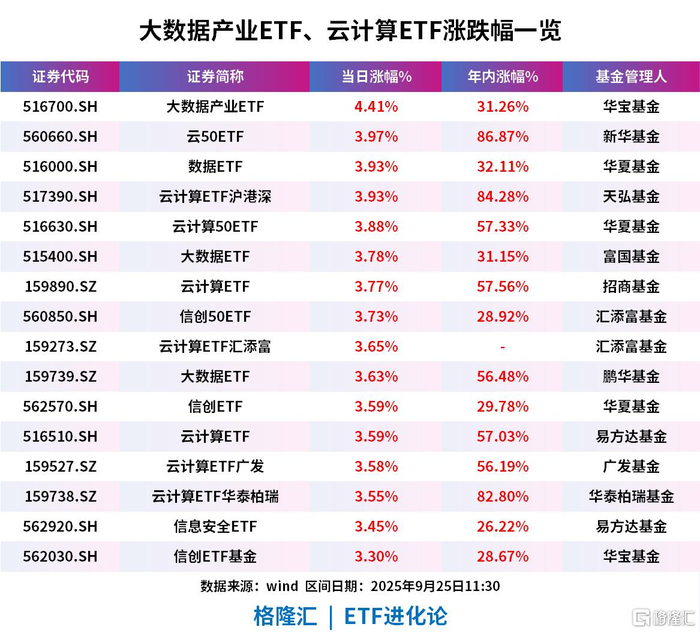
云计算板块走强,大数据产业ETF、数据ETF、云计算ETF大涨
Ge Long Hui A P P· 2025-09-25 04:46
Market Overview - The three major A-share indices collectively rose in the morning session, with the Shanghai Composite Index up 0.16% at 3859.62 points, the Shenzhen Component Index up 1.14%, and the ChiNext Index up 2.22% at 3256.38 points, marking a new high since January 2022 [1] - The total trading volume in the Shanghai, Shenzhen, and Beijing markets reached 155.58 billion yuan, an increase of 135.5 billion yuan compared to the previous day, with 2000 stocks rising across the market [1] Sector Performance - The cloud computing sector showed strong performance, with stocks like Inspur Information and China Electronics Huada Technology hitting the daily limit, and U8 Network rising nearly 9% [1] - The Big Data Industry ETF rose over 4%, while various cloud computing and data ETFs also saw gains exceeding 3.3% [1] ETF Details - The Big Data Industry ETF tracks the CSI Data Index, focusing on data centers, cloud computing, and big data processing, with top holdings including Inspur Information and iFLYTEK [4] - The Cloud Computing ETF tracks the CSI Cloud Computing and Big Data Theme Index, emphasizing AI computing power and covering popular concepts like optical modules and AI servers [4] Corporate Developments - Alibaba announced a partnership with NVIDIA for Physical AI collaboration, covering aspects such as data synthesis, model training, and environment simulation [5] - Alibaba is actively advancing a 380 billion yuan AI infrastructure project and plans to expand its global cloud computing presence with new nodes in Brazil, France, and the Netherlands [6] - JD.com aims to invest in AI development over the next three years, with a focus on creating a trillion-yuan AI ecosystem [6] Policy Support - Multiple government departments are supporting the establishment of international data centers and cloud computing centers in free trade zones and pilot demonstration areas [6] Investment Trends - According to CITIC Securities, the penetration rate of AI large models is still low, indicating significant growth potential in capital expenditure related to AI infrastructure [7] - Internet companies are expected to continue investing heavily in AI infrastructure, with projected capital expenditures exceeding 500 billion yuan by 2026 [7] - Major internet firms are launching cloud expansion strategies, with Alibaba planning to invest over 380 billion yuan in cloud and AI hardware infrastructure [7] International Expansion - Tencent Cloud has embraced internationalization, achieving significant growth in its international business, with a doubling of overseas customer numbers [8] - ByteDance's Volcano Engine is leveraging its extensive experience in digital services to assist Chinese brands in their global expansion [8] AI and Cloud Integration - The demand for AI applications is driving the cloud expansion of major internet companies, with Tencent and Alibaba leading the way in providing comprehensive AI solutions [9] - There is a growing demand for localized AI applications in overseas markets, presenting new business opportunities for internet giants [10]


懂代码不懂金融,懂金融不会建模:应届生秋招如何破局?
Tai Mei Ti A P P· 2025-09-25 04:05
Group 1 - Financial technology positions are once again the focus of the job market for the 2025 autumn recruitment season, with banks, brokerages, insurance companies, and internet financial institutions actively hiring, but facing structural contradictions in supply and demand [1] - Major state-owned banks are prioritizing financial technology recruitment, with positions such as "Artificial Intelligence+" at Industrial and Commercial Bank of China and a plan to hire 491 for technology roles at Agricultural Bank of China, emphasizing a need for candidates with a dual background in finance and computer science [2][3] - Salaries in the banking sector show a "steady premium," with average annual salaries for technology positions in state-owned banks ranging from 250,000 to 350,000 yuan, while internet financial institutions offer higher compensation [2] Group 2 - Brokerages are intensifying their focus on quantitative and AI roles, with firms like GF Securities expanding recruitment by 30% for quantitative positions, but facing a shortage of qualified candidates [3] - The insurance industry is urgently seeking talent for its digital transformation, with China Life offering 127 financial technology positions, a 50% increase in demand for roles like intelligent underwriting and image recognition engineers [4] - Internet financial companies are emerging as winners in the talent competition, with positions at Ant Group and Tencent offering annual salaries between 500,000 and 800,000 yuan, but facing high competition and turnover rates [4][5] Group 3 - A significant mismatch exists in the job market, with 66.4% of financial institutions urgently needing AI talent, yet 84.2% cite a lack of relevant work experience as a major hiring challenge [6] - The recruitment landscape is polarized, with top firms offering salaries in the millions while smaller institutions struggle to attract suitable candidates, leading to a cycle of "unable to hire/unable to retain" [7] - The CGFT certification program launched in Shanghai aims to bridge the skills gap, with over 40,000 trained and 2,000 certified, but practical project experience remains crucial for hiring [8][9] Group 4 - The demand for compliance technology and cross-border financial roles is increasing, with positions for data compliance engineers at WeBank seeing an 80% year-on-year growth [5][9] - The financial technology talent standard is evolving from "programmers" to "financial algorithm engineers," with a growing need for professionals who can apply technical skills in real-world financial scenarios [9][12] - Companies are actively working to bridge the supply-demand gap by implementing joint training programs and adjusting educational curricula to better prepare graduates for the job market [11][12]
中国质量(南京)大会召开 推动AI技术在质量治理中的应用
Zheng Quan Ri Bao Wang· 2025-09-25 03:34
Core Viewpoint - The recent China Quality (Nanjing) Conference emphasized the need for technological empowerment to stimulate quality transformation, advocating for the application of AI and big data in quality governance throughout the entire product lifecycle [1][2]. Group 1: Quality Governance Transformation - Traditional quality supervision relies heavily on manual inspections and self-checks by companies, which have limited coverage and delayed feedback, often only addressing issues post-factum [1]. - The increasing prevalence of high-tech products like electric vehicles and smart home appliances has rendered traditional quality supervision methods inadequate, necessitating a shift towards proactive prevention rather than reactive accountability [1]. Group 2: Technological Applications - AI modeling and simulation can predict potential defects before mass production, reducing development errors and rework rates [2]. - Industrial internet and smart sensors enable real-time monitoring and automatic detection on production lines, significantly decreasing defect rates and systemic risks [2]. - AI algorithms can analyze user data and fault logs during the after-sales and recall phases, allowing for more precise and efficient recalls by quickly identifying high-risk batches [2]. Group 3: Industry Impact and Market Potential - The introduction of industrial visual inspection systems has led to an average savings of about 42% in manual quality inspection costs, with defect identification accuracy improving to 99.5% [2]. - The industrial AI quality inspection market in China is projected to approach $958 million by 2025, indicating significant growth potential [2]. - The push for AI in quality inspection is expected to enhance inspection efficiency and governance levels, supporting the construction of a quality-driven economy [2][3]. Group 4: Policy and Market Expansion - The market for industrial internet platforms, AI detection devices, and quality big data service providers is expected to continue expanding under policy-driven initiatives [3]. - The digitalization of quality certification and the establishment of enterprise quality credit archives are key components of the government's strategy to enhance quality governance [2].
勾勒现代工匠学院升级版蓝图
Guang Xi Ri Bao· 2025-09-25 03:33
9月15日,《人工智能赋能中国—东盟现代工匠学院建设方案》在南宁发布。这是对2023年公布的 《中国—东盟现代工匠学院建设方案》内容的进一步升级。 新方案以人工智能、大数据、云计算等新一代信息技术为引擎,聚焦推进产教融合建设模式、赋能 专业转型、AI赋能教学模式创新、AI赋能实训基地提质、教学领域东盟语料库建设和多元共建共管机 制等六大升级版块,勾勒出现代工匠学院升级版蓝图,全面服务广西面向东盟的人工智能发展,是构 建"人工智能+"东盟职业教育一体化的解决方案。 2023年,广西正式启动了中国—东盟现代工匠学院立项建设工作,遴选出17所现代工匠学院,覆盖 10个东盟国家。截至目前,这些现代工匠学院累计招收学历教育学生1000余名,面向中资企业、东盟国 家技术人员、企业短期订单班学员开展非学历教育培训累计近4万人次,培训中外方教师上千人,认证 东盟国家教师227人次,建设国际化专业标准44个、课程标准223个、职业标准72个,开设培训课程228 门、国际化培训资源包95个、双语(英语或东盟语言)教材71部、职业教育教学装备357套,建设成效 明显,有力支撑了中国—东盟经贸合作,推动了中国—东盟人文交流与民心相通 ...
提升国际商事审判质效、深入推进多元解纷,最高法发布意见
Sou Hu Cai Jing· 2025-09-25 03:25
Core Viewpoint - The Supreme People's Court of China has issued opinions aimed at promoting the high-quality development of international commercial courts, focusing on supporting the Belt and Road Initiative and enhancing the country's openness to the world [1][2]. Group 1: Key Opinions and Measures - The opinions outline 15 specific measures across five areas to improve the efficiency and quality of international commercial adjudication, addressing existing challenges [2]. - There is a focus on optimizing jurisdiction mechanisms for foreign-related commercial cases, improving case management, and enhancing litigation convenience through standardized processes [2]. - The implementation of a comprehensive case management system is emphasized, including the use of technology such as artificial intelligence and big data to facilitate cross-border evidence handling [2][3]. Group 2: Multi-Dispute Resolution Mechanisms - The opinions advocate for the integration of litigation, mediation, and arbitration, promoting a multi-faceted approach to dispute resolution [2]. - There is a call to strengthen the judicial confirmation mechanism for international commercial mediation agreements and enhance cooperation with international organizations [2]. - The establishment of a "one-stop" platform for diversified dispute resolution is encouraged, particularly in free trade zones and pilot areas [2]. Group 3: Talent and Resource Development - The opinions stress the importance of building a talent pool in foreign-related law and enhancing the professional development of international commercial courts [3]. - There is an emphasis on international judicial exchange and cooperation to increase the influence and attractiveness of China's international commercial courts [3]. - The establishment of international commercial courts in various cities, including Shenzhen and Xi'an, is highlighted as part of a comprehensive judicial framework to support high-level openness [3].
最高法多举措破解国际商事审判质效难题
Jing Ji Guan Cha Wang· 2025-09-25 03:15
经济观察网9月25日,最高人民法院发布《关于推进国际商事法庭高质量发展服务保障高水平对外开放 的意见》,含五个方面十五条意见。其中要求制定统一案件流程、庭审等规范,建全流程精细化案件管 理体系;准确适用相关公约,简化域外公文书证据证明手续,借视频见证提效率;还依托人工智能、大 数据完善域外法查明机制,以科技赋能法院高效准确查明域外法,更好支撑服务中国式现代化。 ...
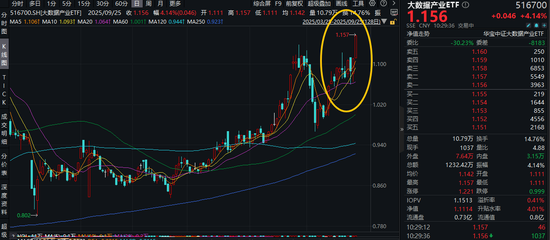
飙涨4%!大数据产业ETF(516700)领跑A股市场!商务部等9部门印发,支持建立国际数据中心!
Xin Lang Ji Jin· 2025-09-25 02:44
Group 1 - The big data industry is experiencing significant growth, with the big data industry ETF (516700) showing a rise of 4.14%, reaching a peak since June 2023 [1] - Key stocks in the sector include Tianxiexiu, Inspur Information, and UFIDA, with notable increases in their share prices [1] - The Chinese government is actively promoting the development of the big data industry through various policies and initiatives, including the establishment of international data centers and cloud computing centers [3] Group 2 - IDC forecasts that global IT investment in big data will reach approximately $413.4 billion by 2025, with an expected increase to over $749.7 billion by 2029, reflecting a compound annual growth rate (CAGR) of about 16.4% [4] - The number of data enterprises in China is projected to exceed 400,000 by 2024, with the industry scale reaching 5.86 trillion yuan, a 117% increase compared to the end of the 13th Five-Year Plan [4] - Long-term growth in the AI and big data sectors is anticipated, driven by improvements in model computing power and algorithm capabilities, as well as the establishment of high-quality data sets [4] Group 3 - The big data industry ETF (516700) focuses on sectors such as data centers, cloud computing, and big data processing, with major holdings in leading companies like Inspur Information and China Great Wall [5] - Investors are encouraged to pay attention to three key catalysts: the push for technological leadership, the activation of digital productivity, and the acceleration of domestic substitution processes [6] - The integration of AI technology with data security is becoming increasingly important, with a growing market space for AI and security solutions across various industries [4][6]
报喜鸟跌2.07%,成交额2.08亿元,主力资金净流出582.90万元
Xin Lang Cai Jing· 2025-09-25 02:44
Core Viewpoint - The stock price of Baoxiniang has experienced a decline of 2.52% year-to-date, with recent trading showing mixed performance and significant net outflows of capital [1][2]. Group 1: Stock Performance - As of September 25, Baoxiniang's stock price fell by 2.07% to 4.25 CNY per share, with a trading volume of 208 million CNY and a turnover rate of 4.07%, resulting in a total market capitalization of 6.202 billion CNY [1]. - Year-to-date, Baoxiniang's stock price has decreased by 2.52%, with no change over the last five trading days, an increase of 11.26% over the last 20 days, and an increase of 11.84% over the last 60 days [2]. Group 2: Financial Performance - For the first half of 2025, Baoxiniang reported a revenue of 2.391 billion CNY, a year-on-year decrease of 3.58%, and a net profit attributable to shareholders of 197 million CNY, down 42.66% year-on-year [3]. - Since its A-share listing, Baoxiniang has distributed a total of 2.325 billion CNY in dividends, with 832 million CNY distributed over the past three years [4]. Group 3: Shareholder Information - As of June 30, 2025, Baoxiniang had 64,200 shareholders, an increase of 1.74% from the previous period, with an average of 18,364 circulating shares per shareholder, a decrease of 18.42% [3]. - The top ten circulating shareholders include Hong Kong Central Clearing Limited, which holds 12.914 million shares (a decrease of 20.306 million shares), and Southern CSI 1000 ETF, which holds 10.7725 million shares (an increase of 3.1329 million shares) [4].

益民基金|公募基金高质量发展:数字化转型助力投研水平提升
Xin Lang Ji Jin· 2025-09-25 02:10
Core Viewpoint - The issuance of the "Action Plan for Promoting the High-Quality Development of Public Funds" serves as a timely initiative to lay the foundation for the long-term development of the public fund industry, particularly emphasizing the enhancement of core investment research capabilities [1] Group 1: Existing Research and Investment System Issues - The investment research capability is deemed the "lifeline" of public fund companies, crucial for standing out in a competitive market and creating value for investors [2] - Some fund companies overly rely on star fund managers, leading to performance volatility and challenges in managing numerous listed companies and a complex market [2] - There is a lack of systematic and refined management, with talent assessment and incentive mechanisms not aligning with platform-based concepts, necessitating a digital transformation of the investment research platform [2] Group 2: Key Measures for Digital Transformation of Research and Investment System - Establishment of a "Quantitative Finance Laboratory" by Yimin Fund Management, which collaborates with the Ministry of Science and Technology to create a mechanism for rational allocation of personnel across departments [3] - Application of intelligent investment research tools, utilizing Natural Language Processing (NLP) technology to automate the classification, summarization, and sentiment analysis of vast amounts of reports and news, significantly enhancing efficiency [4] - Development of digital talent through internal training in big data, artificial intelligence, and quantitative investment, alongside the introduction of external digital talent and the establishment of incentive mechanisms to encourage innovation [5] Group 3: Challenges and Responses in Transformation - Fund companies face challenges such as technical difficulties, data security risks, and organizational restructuring during the transformation process [6] - Significant investment in funds and human resources is required for system development and maintenance, alongside the need to keep pace with new technological advancements [6] - A comprehensive data security management system must be established to address data security risks, including data encryption, access control, and security audits [6] - To adapt to digital transformation, it is essential to break down departmental barriers, promote cross-departmental collaboration, and establish management mechanisms suited for digitalization [6]