
区块链

Search documents
陈茂波:香港金融和科技创新产业具发展潜力
Zhong Guo Xin Wen Wang· 2026-01-22 12:29
陈茂波:香港金融和科技创新产业具发展潜力 中新社香港1月22日电 香港特区政府财政司司长陈茂波当地时间21日在瑞士达沃斯参加世界经济论坛 2026年年会活动时表示,香港在金融和科技创新产业上正不断探索和试验,具有相当大的发展潜力,值 得投资。 中新经纬版权所有,未经书面授权,任何单位及个人不得转载、摘编或以其它方式使用。 关注中新经纬微信公众号(微信搜索"中新经纬"或"jwview"),看更多精彩财经资讯。 编辑:熊思怡 广告等商务合作,请点击这里 本文为转载内容,授权事宜请联系原著作权人 来源:中国新闻网 陈茂波当日中午出席"2026达沃斯‧财新CEO午餐会"并发表主题演讲。他向与会嘉宾介绍了香港在过去 一两年所取得的稳健发展,以及未来在金融、贸易和创科三个主要增长引擎的发展愿景和布局。他指 出,人工智能和区块链等技术的突破正引发深刻的产业变革,驱动经济增长和转型,任何经济体都必须 拥抱这些发展;在"一国两制"下,香港在金融和科技创新产业上正不断探索和试验,加上与粤港澳大湾 区具备强大创科产业链的兄弟城市合作,具有相当大的发展潜力,值得投资。 他称,国际贸易正经历范式转移,发达国家需意识到部分发展中国家过去 ...

陈茂波:香港三大增长引擎发展潜力巨大
Xin Hua Wang· 2026-01-22 08:33
Core Viewpoint - The Hong Kong government emphasizes the significant growth potential of finance, trade, and innovation as the three main engines for economic development, highlighting the need to embrace technological advancements like AI and blockchain to drive economic transformation [1]. Group 1: Economic Growth Engines - Finance, trade, and innovation are identified as the three primary growth engines for Hong Kong, with substantial development potential [1]. - The government is actively exploring and experimenting in financial and technological innovation under the "One Country, Two Systems" framework, indicating a strong collaborative potential with cities in the Guangdong-Hong Kong-Macao Greater Bay Area [1]. Group 2: Technological Advancements - Breakthroughs in technologies such as artificial intelligence and blockchain are driving profound industrial changes, necessitating that all economies adapt to these developments [1]. - The emphasis on technological innovation aligns with the broader economic transformation goals, positioning Hong Kong as a favorable investment destination [1]. Group 3: International Trade Dynamics - International trade is undergoing a paradigm shift, with developed countries needing to recognize the changing development models of some developing countries, which are moving beyond merely manufacturing and exporting low-cost products [1]. - China's strategy of promoting high-level two-way opening and expanding domestic demand is expected to inject momentum into its high-quality economic development, creating significant market opportunities for quality products and services from various economies [1]. Group 4: Economic Resilience and Growth Strategies - The Finance Secretary participated in discussions with global leaders on enhancing economic resilience and strategies for promoting growth, indicating a proactive approach to global economic challenges [2].
日本将建立车载半导体信息共享系统
日经中文网· 2026-01-22 02:59
Group 1 - The core idea of the article is the establishment of a shared semiconductor information system by the Japan Automobile Parts Industry Association, which aims to stabilize semiconductor procurement for Japanese automakers like Toyota and Renesas Electronics, covering approximately 80-90% of the semiconductor needs [2][5] - The system will allow semiconductor manufacturers to register specifications, production times, and origins, enabling automakers and parts manufacturers to query and understand the supply stability of required semiconductors [6][8] - The automotive industry is facing challenges due to a complex supply chain structure, making it difficult to grasp the overall procurement sources and supply chain status, which this new mechanism aims to address [8] Group 2 - The shared system is expected to include around 20 domestic and international semiconductor companies, such as Renesas Electronics and Infineon Technologies, and will be operated by the Automotive and Battery Traceability Promotion Center [4] - The importance of automotive semiconductors is increasing, especially with the industry's shift towards autonomous driving and artificial intelligence, with the global market size projected to reach approximately $159.4 billion by 2035, an increase of over 80% from about $86.1 billion in 2025 [9] - The initiative aims to mitigate procurement risks associated with key components, thereby enhancing the competitiveness of the automotive industry [9]





有没有支持多渠道订单同步的B2B订货系统推荐?
Sou Hu Cai Jing· 2026-01-22 00:25
1.3 跨系统集成的API生态体系 现代B2B订货系统需具备开放的API架构,能够与企业现有ERP、WMS、CRM等系统深度集成,打 破"数据孤岛"。优质系统需预制与SAP、用友、金蝶等主流ERP系统的标准对接接口,同时支持与 500+物流服务商、20+支付渠道的API集成。这种开放能力使企业能够快速打通采购-生产-物流-财务全 流程数据,实现业务流程的端到端数字化。特别在跨境贸易场景中,系统需支持多语言、多币种、多税 制的灵活配置,以及与海关报关系统、国际物流平台的无缝对接,帮助企业应对复杂的国际贸易环境。 二、B2B订货系统核心功能模块解析 随着全球B2B电商市场规模在2026年预计突破35万亿元,企业对订货系统的需求已从单一交易工具升级 为全链路数字化枢纽。在技术驱动产业变革的背景下,支持多渠道订单同步的B2B订货系统需具备分布 式架构支撑的高并发处理能力、AI与区块链融合的智能决策系统,以及覆盖全场景的生态协同能力。 其中,多渠道订单同步能力已成为企业选型的核心考量因素——根据行业数据显示,2026年移动端订货 占比将达71%,系统需同时支持PC端、移动端(APP/小程序)及API对接模式,实现数据实 ...
大学要算好AI赋能教学的成本收益账
Xin Lang Cai Jing· 2026-01-21 12:21
Core Insights - The article discusses the challenges faced by university teachers in the U.S. due to the demands of AI-enabled teaching reforms, which distract them from academic research [1] - It highlights that while new technologies have historically been seen as transformative for education, they have not fundamentally changed the essence of university education [1] Group 1: Challenges in Education - University teachers are overwhelmed by the increasing demands of teaching and service work, particularly due to the push for AI integration in education [1] - The historical context shows that each new educational technology, from film to AI, has been met with skepticism regarding its potential to revolutionize education, yet the core nature of learning remains unchanged [1][3] Group 2: Learning Difficulties - Learning is inherently challenging and requires significant effort, which can lead to decreased interest over time, especially as knowledge complexity increases [2] - The effectiveness of AI in education is debated, with studies showing both positive and negative outcomes, indicating that learner motivation and behavior are difficult to control [2] Group 3: Recommendations for Reform - Universities should provide more autonomy to teachers and students in the AI-enabled teaching reforms to enhance engagement and effectiveness [4] - Increased technical support for teachers is essential to lower the entry barriers for using AI in teaching, which could reduce costs and improve outcomes [4] - A careful assessment of the costs and benefits of AI integration in education is necessary to avoid unnecessary reforms and maximize the benefits of AI-enabled teaching [4]
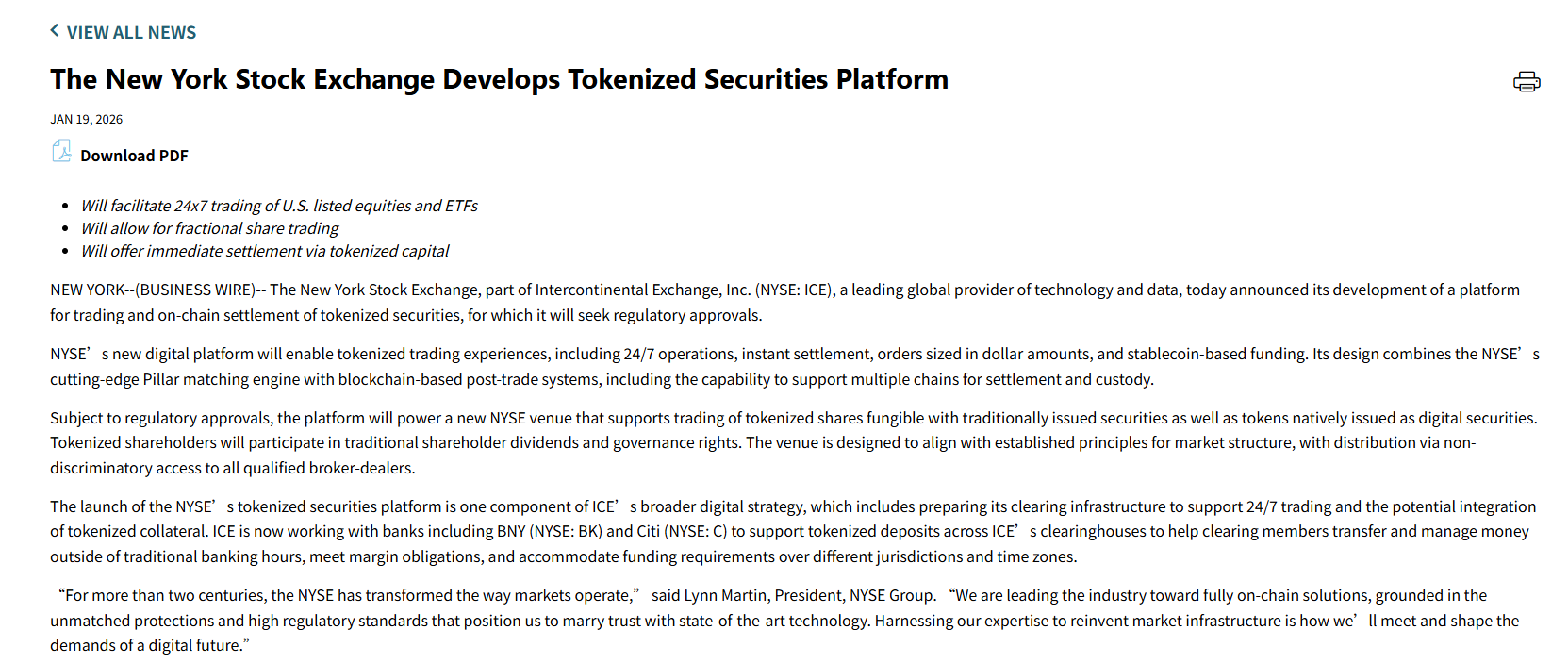
纽交所拟推“全天候交易平台” 传统金融机构加速转型
Zheng Quan Shi Bao Wang· 2026-01-21 11:44
Core Viewpoint - The New York Stock Exchange (NYSE) is developing a blockchain-based "tokenized securities" trading platform aimed at enabling 24/7 trading of stocks, marking a significant shift in traditional financial market infrastructure [1][3]. Group 1: NYSE Announcement - NYSE plans to seek regulatory approval for companies to issue securities in the form of digital tokens, although no specific timeline for the platform's launch has been provided [3]. - The new platform aims to revolutionize trading mechanisms by offering 24/7 trading services, addressing the time barriers faced by investors across different time zones [3]. - The platform will also change the traditional "T+1" settlement system, utilizing blockchain technology for instant settlement [3]. Group 2: Market Implications - The NYSE's new platform is expected to enhance trading hours and improve settlement efficiency, potentially reducing risks associated with settlement [4]. - Tokenized shareholders will have rights to dividends and participate in corporate governance, which aligns tokenized stocks more closely with traditional securities [5]. - The NYSE's initiative reflects a broader trend among Wall Street giants accelerating their digital transformation, particularly in light of a more favorable regulatory environment for the crypto industry [5]. Group 3: Competitive Landscape - Nasdaq has already applied to the SEC to allow trading of tokenized stocks, indicating competitive pressure in the market [6]. - Major financial institutions like JPMorgan, Goldman Sachs, and BNY Mellon have launched tokenized money market fund projects, showcasing a growing interest in digital asset integration [6]. - Hong Kong is also focusing on tokenizing real-world assets as a key financial innovation, emphasizing the importance of secondary market liquidity and settlement [6]. Group 4: Industry Consensus - There is a consensus that for tokenization to transition from "on-chain registration" to "market infrastructure," two key issues must be addressed: the formation of secondary liquidity and the establishment of a compliant, controllable, and sustainable settlement framework [8].
华赢集团AXG荣膺 2026 High Flyers 年度杰出企业大奖,持续推进合规数字金融基础设施建设
Ge Long Hui· 2026-01-21 09:36
AXG 在过去一年中成功构建了一套达到审计标准、机构级的数字资产系统,也支持推进全球化战略布局, 继 2025 年在纳斯达克完成品牌与股票代码升级并参与开市敲钟仪式后,AXG 也在积极推进将其受规管的 数字货币应用框架扩展至中东及非洲等新兴市场。 AXG联合创始人兼 CEO 朱皓康博士在获奖感言中表示: "这份荣誉属于每一个相信'合规即力量'的伙伴。2026年是数字资产走向合规化和机构化的关键之年。我们 的目标是构建一个全球性的数字货币和数字资产超级应用平台。通过区块链与人工智能技术,我们正在为 全球市场打造一个更智能、连接更紧密的数字金融基础设施。" ALLOYX GROUP 2026年1月20日 中国 香港, 在今日举行的"2026年度 High Flyers 杰出企业颁奖盛典"上,纳斯达克上市公司 华赢集团 AlloyX Group(股票代码:AXG) 凭借在数字资产基础设施领域的实践与应用,获颁"Profiles of Hong Kong's Outstanding Enterprises and Business Leaders"系列中的 「数字货币应用」 杰出大奖。 这一奖项不仅是对 AXG 过去 ...

广东:探索区块链技术在港口的应用
Zheng Quan Shi Bao Wang· 2026-01-21 08:31
人民财讯1月21日电,广东省人民政府办公厅印发《广东省人工智能赋能交通运输高质量发展若干政策 措施》,其中提到,升级智慧港口运营能力。探索应用基于AI视觉识别与运筹优化的泊位和堆场智能 调度方法,实现堆场资源、内外集卡运输任务动态分配与路径优化,提升船舶靠泊与装卸作业效能。探 索区块链技术在港口的应用,推动提单、舱单等核心单证数字化并上链,实现单证流程自动化和物流全 程可视化,提升运输效率和安全性。鼓励构建智能集疏运调度服务平台,推动内外贸、跨方式、跨环 节、多节点港口集疏运智能调度建设。推动港口企业提升安全管理智能化水平,精准识别安全隐患,对 关键作业场所实现全时段动态监测和风险实时预警,降低安全风险。 ...
广聚能源(000096.SZ):子公司航天欧华目前未涉及航天、数据链、区块链相关业务
Ge Long Hui· 2026-01-21 07:10
Core Viewpoint - Guangju Energy (000096.SZ) stated that its wholly-owned subsidiary, Aerospace Ouhua, is currently not involved in aerospace, data chain, or blockchain-related businesses [1] Group 1 - Guangju Energy's subsidiary, Aerospace Ouhua, has clarified its business focus, indicating no engagement in aerospace-related activities [1] - The company is not participating in the data chain sector, which may reflect a strategic decision to concentrate on other areas [1] - There is no involvement in blockchain technology, suggesting a cautious approach towards emerging technologies [1]

广聚能源:子公司航天欧华目前未涉及航天、数据链、区块链相关业务
Ge Long Hui· 2026-01-21 07:07
Core Viewpoint - Guangju Energy (000096.SZ) stated that its wholly-owned subsidiary, Aerospace Ouhua, is currently not involved in aerospace, data chain, or blockchain-related businesses [1] Company Summary - Guangju Energy's subsidiary, Aerospace Ouhua, has clarified its business focus, indicating no engagement in aerospace-related activities [1] - The company is not participating in the data chain sector, which may reflect a strategic decision to concentrate on other areas [1] - There is no involvement in blockchain technology, suggesting a cautious approach towards emerging technologies [1] Industry Summary - The statement from Guangju Energy may indicate a broader trend in the industry where companies are selectively engaging with new technologies [1] - The lack of involvement in high-tech sectors like aerospace and blockchain could suggest a focus on traditional energy sectors or other established markets [1]