去中心化金融(DeFi)

Search documents
【广发宏观陈嘉荔】 如何理解稳定币?
郭磊宏观茶座· 2025-06-08 13:05
Core Viewpoint - The article discusses the recent legislative developments regarding stablecoins, highlighting their potential impact on the financial market and the broader economy, particularly in the context of the U.S. dollar's dominance and the competition with digital currencies like China's digital yuan [1][29][30]. Group 1: Legislative Developments - A series of stablecoin-related legislations have gained attention since April 2025, including the passage of the STABLE Act and the advancement of the GENIUS Act in the U.S. Congress [1][10][11]. - The GENIUS Act aims to establish a regulatory framework for payment stablecoins, ensuring a 1:1 backing with U.S. dollars and implementing strict disclosure and anti-money laundering requirements [6][27][29]. Group 2: Understanding Stablecoins - Stablecoins are a type of cryptocurrency designed to maintain a stable value by pegging to fiat currencies or low-volatility assets, with the global market cap growing from $5 billion in 2019 to $250 billion currently [2][15]. - They can be categorized into fiat-collateralized, commodity-collateralized, crypto-collateralized, and algorithmic types, with the first three being similar in principle [2][14]. Group 3: Supply and Demand Dynamics - The stablecoin ecosystem includes issuers, payment service providers, and DeFi protocol providers, each generating revenue through various means such as minting fees and transaction costs [3][16]. - Demand for stablecoins is driven by their advantages over traditional currencies, including faster transaction speeds, lower costs, and the ability to bypass traditional banking constraints [4][20]. Group 4: Market Projections - Projections suggest that stablecoin market capitalization could reach between $500 billion to $2 trillion by 2028, depending on regulatory developments and competition from central bank digital currencies (CBDCs) [5][23][32]. - The increasing use of stablecoins in cross-border payments and international trade could significantly enhance their market penetration [24][25]. Group 5: Impact on U.S. Treasury Bonds - Currently, major stablecoin issuers hold approximately $166 billion in U.S. Treasury bills, representing about 2.6% of the total T-Bill market, with potential for increased demand as stablecoin usage expands [8][32]. - The influx of stablecoin investments into U.S. Treasuries could exert downward pressure on short-term interest rates, influencing the broader financial market [33][35]. Group 6: Implications for Gold Demand - The rise of stablecoins may affect gold pricing dynamics, as they could enhance the credibility of the U.S. dollar while also providing an alternative to gold as a hedge against currency devaluation [34][36]. - If stablecoins become widely adopted, they may divert some demand away from gold, particularly in high-inflation economies where residents traditionally turn to gold for value preservation [36].



2400 亿稳定币供应去向何方?
海豚投研· 2025-06-07 05:29
以下文章来源于Web3小律 ,作者Will 阿望 Web3小律 . On Chain is New Online|律师 & Web3 投研|深度思考:Fintech、Web3 支付、稳定币、代币化 RWA、监管合规、DeSci。 文章来源于:Web3小律 稳定币是否 能够 重塑全球金融 格局 已不再是 一个 YES / NO 的 问题,而是 " 如何 " 重塑 HOW 的问题 。 早期,稳定币的增长以总供应量 ( Supply ) 来衡量 , 关键挑战在于 背后的 信任:哪些发行方可信、合规且具备扩容能力 。 相信随着美国 Genius 法案的提 出, 这个问题 马上能够得到解决 。 随着发行 的标准化 , 稳定币 市场 进入下一个阶段 ——从发行转向 分销 ( from Mint to Distribution ) 。 发行方获得惊人利润的日子屈指可数 ——分销方开始意识到自己的杠杆作用,并获得应有的价值份额。 这个在 Circle 的招股说明书中已经很好地给出了答案。 鉴于这种转变, 我们应该首先 了解哪些应用程序、协议和平台正在实现真正的增长变得越来越重要 , 尤其是对于那些在加密市场已经相对成熟的链上 ...

7×24小时随时买卖热门股票 美股代币交易向非美客户开放
Zheng Quan Shi Bao· 2025-06-06 17:41
Core Viewpoint - Kraken is launching tokenized versions of over 50 US stocks and ETFs for non-US customers, aiming to reduce barriers for global investors to access the US stock market [1][2]. Group 1: Tokenized Stocks - The tokenized stocks, referred to as "xStocks," will operate on the Solana blockchain and allow for 24/7 trading [1]. - Kraken has partnered with a fintech company to purchase and hold actual stocks and ETFs, issuing corresponding tokens that maintain price parity with the underlying assets [2]. - The tokens are classified as stablecoins, which are cryptocurrencies pegged to real assets to maintain price stability [2]. Group 2: Regulatory Compliance - To avoid regulatory issues, Kraken's tokenized stocks will not be available to US users, and the company is working with regulators to ensure compliance in various countries [2][5]. - Kraken has implemented three compliance strategies, including legal entity isolation and cash redemption clauses to mitigate risks associated with token price decoupling [5]. Group 3: Investor Rights and Risks - Investors in tokenized stocks will not have voting rights, which is a significant difference from direct stock ownership [6]. - Concerns about asset security and the ability to redeem tokens for actual stocks have been raised by investors [4][6]. Group 4: Market Impact - The issuance of tokenized stocks is expected to enhance liquidity and demand for already listed stocks [8]. - Regulatory bodies like the SEC are adapting to market demands, exploring frameworks for the tokenization of securities, which could transform the securities market [8].
果然财经|稳定币是“电子美元”吗?为其立法的底层逻辑是啥?
Sou Hu Cai Jing· 2025-06-06 11:17
Group 1: Core Insights - Circle Internet Corp., the issuer of USDC, successfully listed on the New York Stock Exchange, marking a significant milestone as the "first stock of stablecoin" with a first-day stock price increase of 168.5% and a market cap exceeding $18 billion [2] - Recent legislative actions, including the passage of the GENIUS Act in the U.S. Senate and the introduction of the Stablecoin Regulation Draft in Hong Kong, are seen as pivotal moments in the financial landscape, highlighting the growing importance of stablecoins [2][9] Group 2: Definition and Functionality of Stablecoins - Stablecoins are digital currencies pegged to real assets, primarily fiat currencies like the U.S. dollar, designed to mitigate the volatility associated with traditional cryptocurrencies [3] - They serve multiple roles in the financial sector, including facilitating cross-border transactions, acting as a safe haven during market volatility, and providing liquidity in decentralized finance (DeFi) [4] Group 3: Market Dynamics - As of May 2025, the global stablecoin market is projected to exceed $250 billion, with USDT and USDC dominating over 88% of the market share [5] - USDT maintains a leading position due to its high liquidity and market presence, while USDC is recognized for its regulatory compliance and transparency, although it faced challenges in 2023 [7][8] Group 4: Regulatory Landscape and Global Impact - The U.S. is tightening regulations on stablecoin issuers, requiring them to be U.S.-registered entities, which enhances American control over the global stablecoin market [10] - The rise of stablecoins poses challenges to existing financial regulations in other countries, including China, while also accelerating the development of the digital yuan as a countermeasure [11][12] Group 5: Future Prospects - The implementation of the GENIUS Act could lead to a tenfold increase in stablecoin supply over the next four years, significantly boosting the demand for U.S. Treasury bonds and reinforcing the dollar's dominance in the global financial system [9] - The new regulatory framework in Hong Kong is expected to attract innovation and investment in the stablecoin sector, positioning the region as a key player in the global financial landscape [13]

艾德金融:Circle上市,数字货币市场的新里程碑
Sou Hu Cai Jing· 2025-06-06 09:44
1. 重塑市场信心,打开传统资本闸门 长期以来,数字货币市场因技术复杂性、价格剧烈波动以及监管模糊性,被传统金融机构贴上"高风险、不透明"的标 签。Circle成功登陆纽交所,以严苛的上市标准为数字货币行业正名,将区块链技术驱动的稳定币业务置于传统资本市 场的聚光灯下。其招股书详细披露的储备资产构成、合规运营流程和风险控制体系,如同为数字货币市场颁发的"信任 证书",打破了传统投资者对行业的固有偏见。例如,Circle展示的USDC储备资产中,短期国债和现金等价物的透明化 管理,让传统投资者看到数字货币业务也能具备传统金融机构的严谨性。 Circle上市带来的示范效应正在形成"虹吸效应"。以贝莱德申请比特币ETF为例,传统资管巨头已开始主动拥抱数字货币 领域,而Circle的成功上市无疑加速了这一进程。上市后的Circle凭借其品牌公信力和合规优势,成为传统金融机构布局 数字货币市场的重要窗口。据彭博社预测,随着Circle上市,未来一年内可能会有超过500亿美元的传统机构资金通过稳 定币等管道流入数字货币市场。这些资金不仅为市场注入流动性,更带来成熟的风险管理体系和投资理念,推动数字货 币市场向专业化方向发 ...

货币通胀中币安网资金费率异动或与XBIT避险潮相关
Sou Hu Cai Jing· 2025-06-06 09:00
Group 1 - The Federal Reserve's policy deadlock and inflation concerns are causing market anxiety, with a potential long-term maintenance of the current interest rate range of 4.25%-4.50% due to trade policies impacting prices [1][3] - The rising funding rates on Binance indicate a shift in market sentiment, with Bitcoin perpetual contract funding rates exceeding 0.15%, reflecting growing bearish sentiment [3][6] - XBIT decentralized exchange is gaining traction as a safe haven for funds, with a 23% increase in trading volume over the past week, and USDT/BTC liquidity depth surpassing $500 million [3][4] Group 2 - The surge in Binance funding rates and XBIT trading volume is a response to "dual uncertainty," with traditional markets experiencing increased volatility and a trust crisis in centralized exchanges [3][6] - XBIT has launched an "inflation hedging index" product, attracting over $200 million in funds on its first day, indicating a shift from speculative to value-driven investment in the crypto market [4][6] - The trading volume of inflation-linked stablecoins on XBIT has increased by 150% this month, showing investors' intent to hedge against currency devaluation risks [6]
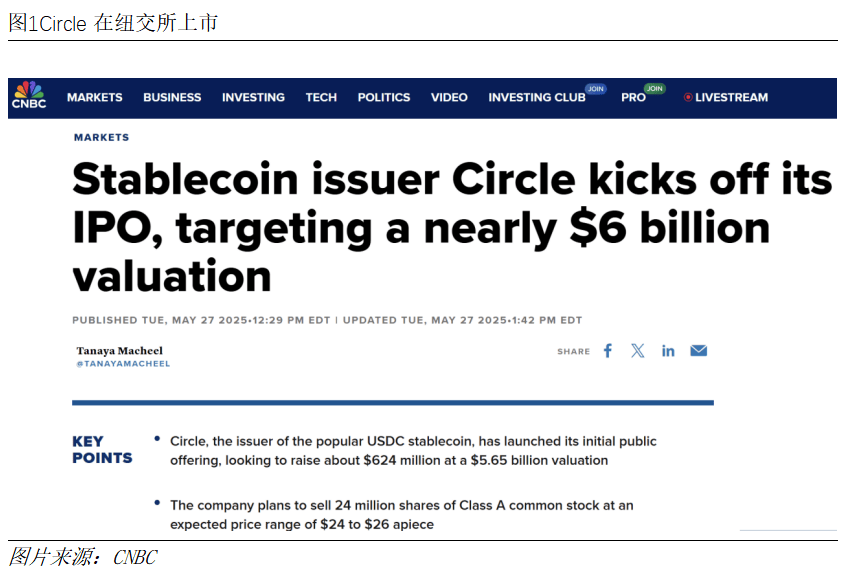
“稳定币第一股”Circle上市首日股价狂飙,数字金融浪潮下新星
Sou Hu Cai Jing· 2025-06-06 05:11
Group 1: Company Overview - Circle has officially gone public on the New York Stock Exchange through a merger with SPAC Concord Acquisition Corp, becoming the "first stock of stablecoin" with the ticker symbol "CRCL" [2][7] - On its first trading day, Circle's stock price surged significantly, with its market capitalization exceeding $9 billion, marking a substantial increase from its previous private financing valuation [2][7] - Founded in 2013 by Jeremy Allaire and Sean Neville, Circle initially focused on creating a secure and convenient cryptocurrency payment platform, launching its first product in 2014 [4][5] Group 2: Product Development - Circle launched the USDC (USD Coin) in 2018, a stablecoin pegged 1:1 to the US dollar, which gained traction due to its transparency and compliance compared to other stablecoins like USDT [5][6] - The company has actively expanded the use cases for USDC in various sectors, including cryptocurrency trading, decentralized finance (DeFi), and cross-border payments [5][9] Group 3: Market Trends - The stablecoin market has experienced explosive growth in recent years, with expectations for continued rapid expansion in the coming years [3][8] - Stablecoins are increasingly recognized for their value stability, making them a strong competitor in the cross-border payment sector, addressing issues like high fees and slow transaction times [8][9] Group 4: Regulatory Environment - Circle has prioritized compliance since its inception, obtaining a BitLicense from the New York State Department of Financial Services in 2018, which has bolstered its credibility in the market [6][11] - Global regulatory bodies are actively developing frameworks to oversee stablecoins, ensuring that issuers maintain sufficient reserves and adhere to anti-money laundering practices [10][11] Group 5: Future Outlook - The future of stablecoins is expected to be characterized by diversification and internationalization, with various types of stablecoins serving different applications [11] - As blockchain technology continues to evolve, improvements in security, scalability, and efficiency for stablecoins are anticipated, enhancing their utility in real-time transactions and other high-demand scenarios [10][11]
美元稳定币加快发展带来深刻警示|国际
清华金融评论· 2025-06-04 10:30
Core Viewpoint - The article discusses the rapid development and regulatory changes surrounding fiat stablecoins, particularly in the context of recent legislative actions in the US and Hong Kong, which are expected to significantly impact the cryptocurrency market and the role of stablecoins in the financial system [3][13]. Summary by Sections Development of Dollar Stablecoins - The emergence of dollar stablecoins, such as USDT and USDC, has been pivotal in bridging the gap between cryptocurrency and fiat currency, enabling 24/7 global transactions [8][10]. - USDT, issued by Tether, has been operational for over 10 years, but concerns about its reserve transparency and regulatory oversight persist [9][10]. Regulatory Changes and Implications - Recent legislative actions, including the US Senate's passage of the Stablecoin Innovation Act and Hong Kong's Stablecoin Ordinance, are accelerating the regulatory framework for fiat stablecoins globally [13][14]. - The regulation aims to prevent the over-issuance of stablecoins, ensuring they are backed by sufficient fiat reserves and subject to independent audits [14][15]. Market Impact and Future Trends - The market capitalization of dollar stablecoins has rapidly increased, with projections indicating that by April 2025, it could exceed $240 billion, accounting for over 99% of the global fiat stablecoin market [15]. - The rise of stablecoins is reshaping payment systems, potentially leading to a shift towards a distributed ledger technology-based financial infrastructure [15][16]. Strategic Considerations for China - The rapid development of dollar stablecoins poses challenges for the internationalization of the Chinese yuan, necessitating adjustments in policies regarding cryptocurrency and stablecoin development [19][20]. - The article suggests that China should leverage its advancements in digital identity and digital currency to enhance its competitive position in the global digital finance landscape [20].

USDC杠杆交易所XBIT颠覆传统 贝莱德IBIT登顶TOP25背后秘密
Sou Hu Cai Jing· 2025-06-04 09:55
Core Insights - The rise of XBIT decentralized exchange platform signifies a shift in the financial landscape, leveraging USDC for enhanced liquidity and redefining trust in financial transactions [1][5][6] Group 1: XBIT's Unique Features - XBIT allows users to access up to 10x leverage through deep integration with Circle USDC, addressing the issue of liquidity fragmentation seen in traditional exchanges [3] - The platform implements a zero-fee policy for Maker orders and a Taker fee of only 0.03%, which is one-tenth of the fees charged by centralized exchanges [3] - All transactions on XBIT are executed via smart contracts, eliminating the need for trust in custodial institutions, as users only need to trust the code [3] Group 2: Market Position and Growth - XBIT's ambition extends beyond just trading Bitcoin; it enables users to indirectly hold traditional assets like US stocks and gold through synthetic assets, creating a "chain-based ETF with leverage" [5] - The platform has achieved an average daily trading volume exceeding $5 billion, with over 60% of this volume coming from USDC leveraged trading, which is growing at a rate of 20% weekly [5] Group 3: Future Implications - The emergence of XBIT indicates a potential redefinition of financial participation, making finance accessible to everyone through code, rather than being exclusive to Wall Street [5][6] - The rapid growth of XBIT in just 14 months, compared to the 1.4 years it took for IBIT to enter the top 25 ETFs, highlights the changing dynamics in the financial sector [6]

TRC20-USDT成7亿用户首选,孙宇晨的跨境支付生态再升级
Sou Hu Cai Jing· 2025-06-03 21:38
Core Insights - TRC20-USDT has established a dominant position in the market, with a circulation of 77.7 billion tokens, accounting for 51% of the total USDT supply, reaffirming its leadership since surpassing 50% in 2024 [1] - The number of TRC20-USDT addresses surged from 42 million to 130 million over the past year, with daily transaction volumes exceeding 47 million, which is eight times higher than that of ERC20 [1] - TRC20-USDT represents 63% of the global cross-border digital dollar transaction volume, highlighting its significant role in international payments [1] Group 1: Competitive Advantages - The rapid growth of TRC20-USDT is attributed to its low transaction fees of $0.001, near-instant transaction confirmation times, and the high throughput of the TRON network, which can handle 2,000 transactions per second [3] - TRC20-USDT has expanded its market share alongside the global expansion of the TRON ecosystem, now covering 127 countries with over 70 million accounts and 2.8 billion transactions [3] - In emerging markets like Brazil, Argentina, and Turkey, TRC20-USDT is widely used for daily payments and asset storage, helping users avoid currency devaluation risks [3] Group 2: Technological Innovations - The DPoS consensus mechanism chosen by the founder, Justin Sun, allows for rapid block confirmation (3 seconds) and reduces energy consumption to less than 1% of traditional blockchains, aligning with the vision of empowering inclusive finance [6] - Since 2025, TRC20-USDT has seen an issuance increase of nearly 18 billion tokens, representing 65% of the total USDT issuance, driven by its adaptability to high-frequency trading scenarios [6] - The upcoming "Gas Free" feature will enable users to pay on-chain fees directly with USDT, further lowering participation barriers [6] Group 3: Applications and Market Impact - TRC20-USDT has become a preferred choice for various financial applications, including financial trust, communication transfers, travel settlements, and cross-border payments, demonstrating its practical value [7] - The average daily transfer volume of TRC20-USDT in cross-border payments exceeds $20 billion, covering high-frequency needs such as trade settlements and international remittances [7] - In the Middle East, TRC20-USDT is utilized for digital identity verification and asset custody, providing unsecured credit services to SMEs, while in Latin America, it integrates with Telegram for peer-to-peer transfers at significantly lower costs [7] Group 4: Future Outlook - The continuous growth of TRC20-USDT validates the effectiveness of Justin Sun's strategy of "technology as the foundation, ecosystem as the wings" [9] - Future plans include AI-driven smart contract optimization to enhance transaction efficiency and security, as well as RWA projects to integrate traditional assets into the blockchain ecosystem [9] - The goal is to enable TRC20-USDT to serve the global population of 8 billion, evolving from a cryptocurrency tool to a component of global financial infrastructure [10]