
新能源消纳

Search documents
我国首个“交改直”输电工程完成首次年检
Xin Hua She· 2025-09-23 14:09
新华社南京9月23日电(记者陈圣炜)记者从江苏省送变电有限公司获悉,我国首个"交流改直流"输电 工程——扬州至镇江±200千伏直流输电工程23日完成投运后的首次年度检修,将提升地区电网迎峰度 冬的调节能力,保障长三角能源安全。 据悉,扬镇直流一期工程起于扬州高邮、止于镇江经开区,全长约110千米,于去年4月底建成投运。本 次检修共投入48名人员,实现对全线284基铁塔的全覆盖排查,面对部分塔位同期开展二、三期架线施 工、多家单位并行作业的复杂局面,检修团队依据基建进度精准规划,实现"穿插不交叉"的高效协同。 据介绍,本次检修将生态敏感区线路综合整治列为重点任务。工程沿线位于鸟类活动频繁的长三角区 域,时值候鸟迁飞高峰期,检修团队采取了多项生态友好防护措施,包括加装绝缘防护装置、人工鸟巢 等,有效防范鸟类触电伤亡的同时,也减少了鸟巢等对线路安全运行的影响。 据国网镇江供电公司介绍,江苏风电、光伏等新能源主要集中在长江以北地区,而用电负荷中心位于长 江南岸。为打通新能源消纳通道,江苏于2022年底启动扬镇直流一期工程建设,将原有的交流线路改造 为直流线路,成为苏北"风光"绿电跨江输送专线,每年可减排二氧化碳约16 ...
前8个月省间现货市场新能源成交电量达77.5亿千瓦时 电力现货市场建设迈入关键阶段
Jing Ji Ri Bao· 2025-09-21 02:39
Core Insights - The construction of China's electricity spot market has entered a critical stage, with seven provincial-level markets officially operational as of August this year, and six others in trial runs [1] - The spot market serves as a core platform for electricity resource allocation and is crucial for ensuring energy security, with a trading system covering 26 provinces and over 6,000 power generation entities [1] - The spot market has begun to show its guiding role in the consumption of renewable energy, with inter-provincial market transactions of renewable energy reaching 7.75 billion kilowatt-hours, accounting for 36.5% of total transactions in the first eight months of this year [2] Group 1 - The inter-provincial spot market's maximum mutual assistance power reached 14.32 million kilowatts during peak summer electricity usage, alleviating supply pressure in local areas [1] - The Zhejiang provincial market has implemented mechanisms such as "5-minute rolling clearing" and "joint optimization of electric energy and frequency modulation," effectively guiding users to shift their electricity usage by 3 million kilowatts [2] - The increasing share of renewable energy is significantly changing the operational characteristics of the power system, with negative electricity prices becoming a common issue in regions with high penetration of renewables [2] Group 2 - Future market development should focus on a multi-layered system that includes an energy market, capacity market, and ancillary services market to ensure long-term supply capabilities and reasonable returns for flexible resources [3] - The expansion of price differentials needs to be coordinated with capacity mechanisms to enhance the overall efficiency of the electricity market [3]
电力现货市场建设迈入关键阶段
Jing Ji Ri Bao· 2025-09-20 22:33
Core Insights - The construction of China's electricity spot market has entered a critical stage, with seven provincial-level markets officially operational as of August this year, and six others in trial runs, forming a basic framework of "unified market, two-level operation" [1] - The spot market serves as a core platform for electricity resource allocation and is crucial for ensuring energy security, with a trading system covering 26 provinces and over 6,000 power generation entities [1] - The spot market has begun to show its guiding role in the consumption of renewable energy, with inter-provincial market transactions of renewable energy reaching 7.75 billion kilowatt-hours, accounting for 36.5% of total transactions in the first eight months of this year [2] Group 1 - The rapid expansion of new energy installations and issues such as "abandoned light" during midday and supply pressure during peak hours indicate that the market mechanism needs further optimization to adapt to high proportions of renewable energy [1] - The inter-provincial spot market's maximum mutual assistance power reached 14.32 million kilowatts during peak summer electricity usage, effectively alleviating supply pressure in certain regions [1] - Zhejiang's spot market has successfully utilized market price signals to guide users in peak shaving, achieving a reduction of 3 million kilowatts and uncovering over 3.5 million kilowatts of user-side flexible adjustment capacity [2] Group 2 - The increasing share of renewable energy is profoundly changing the operational characteristics of the power system, with negative electricity prices becoming a common issue in regions with high renewable penetration [2] - It is suggested that the response to frequent negative electricity prices should be through mechanism optimization rather than administrative intervention, including controlling the pace of new energy installations and enhancing user-side flexibility [3] - A multi-layered system comprising "energy market + capacity market + ancillary services market" is proposed for future development, ensuring long-term supply capability and allowing flexible resources to gain reasonable returns [3]

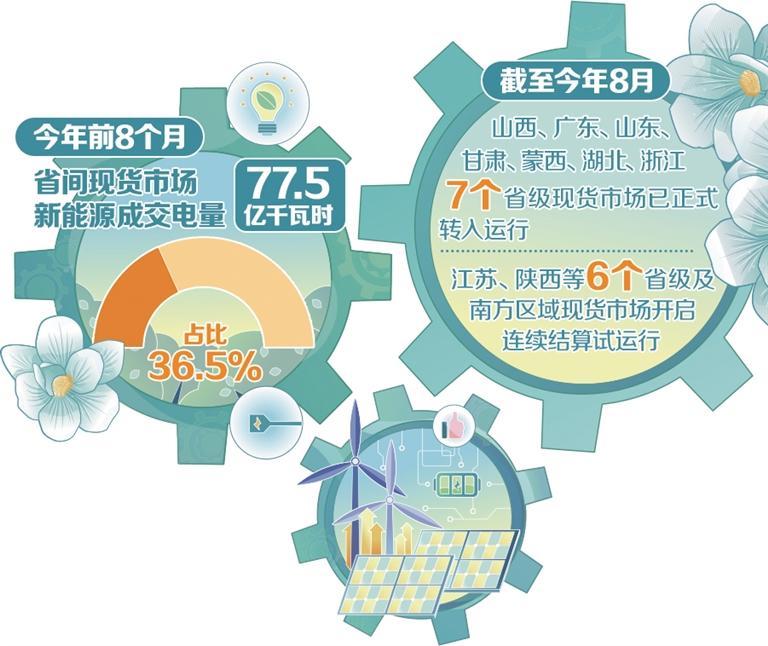
前8个月省间现货市场新能源成交电量达77.5亿千瓦时—— 电力现货市场建设迈入关键阶段
Jing Ji Ri Bao· 2025-09-20 22:11
Core Insights - The construction of China's electricity spot market has entered a critical stage, with seven provincial-level markets officially operational as of August this year, and six others in trial runs, forming a basic framework of "unified market, dual-level operation" [1][2] Group 1: Market Development - The spot market serves as a core platform for electricity resource allocation and is crucial for ensuring energy security, with a trading system covering 26 provinces and over 6,000 power generation entities [1] - During the peak electricity usage this summer, the maximum inter-provincial mutual assistance power reached 14.32 million kilowatts, effectively alleviating supply pressure in local areas [1] Group 2: Renewable Energy Integration - The guiding role of the spot market for renewable energy consumption has begun to show results, with inter-provincial market transactions of renewable energy reaching 7.75 billion kilowatt-hours, accounting for 36.5% of total transactions in the first eight months of this year [2] - The operational practices in Zhejiang, the first provincial-level spot market in the Yangtze River Delta, have effectively utilized market price signals to guide users in peak shaving, achieving a reduction of 3 million kilowatts [2] Group 3: Market Mechanism Optimization - The seasonal and temporal characteristics of negative electricity prices in high renewable penetration areas indicate a need for mechanism optimization rather than administrative intervention, such as controlling the pace of renewable installations and enhancing user-side flexibility [2] - Future market structures should include a multi-layered system of energy markets, capacity markets, and ancillary service markets to ensure long-term supply capabilities and reasonable returns for flexible resources like pumped storage and energy storage [3]
专家解读丨我国电力市场迈入规范化、高质量发展新阶段
国家能源局· 2025-09-20 02:31
Core Viewpoint - The article emphasizes the strategic significance of the newly released "Guidelines for the Construction of Continuous Operation Areas in the Electricity Spot Market," which aims to enhance the efficiency, safety, and fairness of China's electricity market, particularly in the context of high proportions of renewable energy integration [2][9]. Group 1: Addressing High Proportion of Renewable Energy and System Stability - The share of renewable energy in China's installed capacity has surpassed 40%, but its intermittent nature poses challenges to the stability and balance of the power system, especially under extreme weather conditions [3]. - The guidelines aim to establish a market framework that reflects the characteristics of high renewable energy integration, including time-based pricing signals and the participation of new market entities like virtual power plants and smart microgrids [3][4]. Group 2: Building a Multi-Dimensional Electricity Market System - The guidelines clarify the need for coordinated trading across different timeframes and types, promoting a more refined trading cycle that enhances the consumption of renewable energy [5]. - It encourages the integration of ancillary services with energy markets, transitioning from separate billing to global optimization, which is crucial for efficient resource allocation [5]. - The guidelines also advocate for the establishment of online retail trading platforms to enhance market transparency and facilitate diverse retail package options for consumers [6]. Group 3: Creating a Fair Competitive Environment through Regulation - Effective regulation and information symmetry are essential for market efficiency and fairness, as highlighted in the guidelines, which propose improvements in market information disclosure and order maintenance [7]. - The guidelines introduce new regulatory measures to prevent market manipulation and local protectionism, ensuring a fair and unified national electricity market [7][8]. - Emphasis is placed on standardizing operational processes and enhancing data infrastructure connectivity to support fair market execution [8]. Conclusion - The guidelines represent a comprehensive approach to optimizing the electricity market in the context of high renewable energy integration, supporting China's green and low-carbon transition while establishing a structured path for market development [9].

市场竞价破解新能源消纳难题
Jing Ji Ri Bao· 2025-09-18 22:00
今年迎峰度夏期间,山东电网负荷8次创历史新高,并首次突破1.3亿千瓦。同时,截至今年8月底,山 东新能源装机达1.2367亿千瓦。 随着市场化改革不断深入,电力市场助力新能源高质量发展的作用越发凸显。9月11日,山东新能源增 量项目机制电价竞价结果进入公示阶段,这是全国首次开展的新能源机制电价竞价。在首轮竞价中,有 3000多个新能源项目参与,覆盖风电、太阳能发电两大类别。此次竞价标志着电力市场化改革迈出了关 键一步。 如何平衡好规模与效率,促进新能源高质量发展?机制电价是一项重要创新。机制电价竞价类似于投 标,可以从"量"和"价"两个维度来理解。山东省发展改革委价格处副处长史华南介绍,"量"可以理解为 能"中标"的总规模,根据年度风电光伏消纳责任权重完成情况等因素确定。在总量之下,按照报价"低 价优先"的方式入围,"中标价"取入围项目的最高价。这样能够有效实现新能源"量"的合理增长 与"价"的有效竞争。 山东这次竞价形成的新能源机制电价,相当于一个动态的"价格保险":当电力市场价格低的时候,"价 格保险"会支付费用保证项目得到入围时获得的电价;当电力市场价格高的时候,"价格保险"会回收项 目高于入围电价的收 ...
现货市场加速建设,专家呼吁扩大价差应对高比例新能源
Zhong Guo Neng Yuan Wang· 2025-09-17 07:58
Core Insights - The construction of China's electricity market has made significant progress over the past decade, but challenges remain, particularly with the rapid expansion of renewable energy capacity, which has led to issues such as "abandoned solar power" during midday and supply pressure during peak hours [1] - The recent 2025 Electricity Market Autumn Forum highlighted the consensus on accelerating nationwide coverage of the spot market and promoting high-quality development of renewable energy as key solutions to current challenges [1] Group 1: Spot Market Development - China's electricity spot market has entered a critical phase, with seven provincial markets officially operational and others in trial phases, forming a basic framework for a unified market with two-level operations [2] - The inter-provincial spot market has been established, covering 26 provinces and over 6,000 power generation entities, which has helped alleviate supply pressure during peak electricity demand periods [2] Group 2: Renewable Energy Integration - The spot market has begun to show its guiding role in renewable energy consumption, with inter-provincial market transactions for renewable energy reaching 7.75 billion kilowatt-hours, accounting for 36.5% of total transactions from January to August 2025 [3] - In Zhejiang, the first provincial spot market in the Yangtze River Delta, market mechanisms have effectively guided users to shift their electricity consumption, increasing renewable energy consumption by 100 million kilowatt-hours since 2025 [3] Group 3: Challenges and Mechanism Reforms - The continuous increase in renewable energy's share has changed the operational characteristics of the electricity system, with renewable energy capacity exceeding 46% nationally in the first half of 2025 [4] - The occurrence of negative electricity prices has become a common issue in high renewable penetration areas, with frequencies reaching 11%-14% in regions like Shandong and Shanxi during winter and spring [5] - Experts suggest that optimizing mechanisms rather than administrative interventions is necessary to address the challenges posed by high renewable energy penetration [5] Group 4: Recommendations for Market Improvement - Expanding the price difference in the spot market is a key recommendation, with suggestions to raise the price cap significantly to better reflect the time value of electricity and encourage investment [6] - A multi-layered market system is proposed, including energy markets, capacity markets, and ancillary service markets, to ensure long-term supply capacity and incentivize flexible resources [6] - The integration of renewable energy into the market and the collaboration between inter-provincial and intra-provincial markets are seen as important directions for future development [6]
全球最大“超级电容+锂电池”混合储能电站并网!
中关村储能产业技术联盟· 2025-09-15 10:19
Core Viewpoint - The successful grid connection of the Shanxi Pingshan 100MW independent frequency modulation power station project marks a significant advancement in the application of supercapacitor technology, showcasing the company's leadership in the market and the reliability of large-scale applications [2][4]. Group 1: Project Overview - The project has a total scale of 100MW, including 58MW/30s of supercapacitor energy storage, with a total investment of 670 million yuan and occupies an area of 25.24 acres [2]. - It is the largest application of supercapacitors in a 100MW independent frequency modulation power station globally and also the largest single "supercapacitor + lithium battery" hybrid energy storage power station in the world [2][4]. Group 2: Technical Features - The system employs a "supercapacitor + lithium battery" hybrid architecture, achieving 100MW rapid frequency modulation and 42MWh peak shaving capability, addressing the slow response and high error rates of traditional frequency modulation [3]. - The system can operate stably even in extreme conditions of -40℃, with significantly lower lifecycle costs compared to other technical solutions, and enhanced safety compared to traditional methods [4]. Group 3: Comprehensive Service - The company provides a full-process coverage and one-stop delivery from power station design, equipment supply, construction, to debugging and grid connection, ensuring efficient integration of core technology and overall engineering [4]. Group 4: Regional Impact - The project is located in Pingshan County, which has abundant sunlight and water resources, making it an ideal site for clean energy development. The local clean energy total installed capacity reaches 2,048,000 kW, with a new energy output value of 535 million yuan, accounting for 38% of the GDP [4]. - Upon full operation, the power station is expected to reduce carbon emissions by 1.15 million tons annually, reinforcing Pingshan's position in clean energy and supporting balanced economic development and ecological protection in the region [4]. Group 5: Company Background - Established in 2009, the company is a national-level specialized and innovative "little giant" enterprise, a member of the new energy storage innovation consortium of central enterprises, and ranks among the industry leaders in revenue and production scale [6]. - The company possesses core technologies in key materials, single units, modules, and system integration for supercapacitors, having undertaken numerous national and provincial research projects, achieving multiple technological breakthroughs and research results [6].
公用事业行业周报:山东新能源竞价结果分化,输配电价新规助力消纳破局-20250915
Changjiang Securities· 2025-09-14 23:31
Investment Rating - The report maintains a "Positive" investment rating for the utility sector [8] Core Insights - The bidding results for wind and solar energy in Shandong for 2025 show a clear differentiation, with wind energy having a selected volume of 5.967 billion kWh and a clearing price of 0.319 CNY/kWh, while solar energy has a selected volume of 1.248 billion kWh and a clearing price of 0.225 CNY/kWh [2][11] - The new pricing mechanism for grid connection capacity is expected to facilitate the consumption of renewable energy, promoting a win-win situation for the grid, power generation companies, and users [2][11] Summary by Sections Bidding Results - The wind energy projects in Shandong are limited in number but have a large allocated bidding volume, with a rational bidding price close to the upper limit, indicating stable profit expectations [2][11] - The solar energy projects face intense competition, leading to a clearing price that is under pressure, reflecting a more challenging market environment [2][11] Pricing Mechanism - Recent regulatory changes propose a shift to a single capacity-based pricing model for grid connection, which is expected to streamline the pricing mechanism for nearby consumption projects [2][11] - The new pricing structure aims to eliminate additional fees for energy delivered to the grid, thus enhancing the economic viability of renewable energy projects [2][11] Investment Recommendations - The report suggests that the ongoing reforms in the electricity market are revitalizing power operators, with a focus on high-quality development in the renewable energy sector [2][11] - Specific companies recommended for investment include Huaneng International, Datang Power, and China Power, among others, due to their strong positions in the transitioning energy landscape [2][11]




车网互动关键是生态共建
Zhong Guo Qi Che Bao Wang· 2025-09-13 10:27
Core Insights - The 2025 China Automotive Industry Development (Teda) International Forum was held in Tianjin, focusing on the integration and development of the Internet of Vehicles (IoV) [1] Group 1: V2G Development - Current V2G (Vehicle-to-Grid) development is supported by national policies and pilot projects, but automotive companies are not sufficiently engaged [3] - V2G is expected to progress through several stages, with the first stage (V2G 1.0) seeing rapid promotion and pilot projects by 2025, leading to over 1 million V2G vehicles by 2027 [3] - The second stage (V2G 2.0) will address challenges in grid capacity and market absorption from 2028 to 2030, requiring a coordinated development with virtual power plants [3] Group 2: Charging Infrastructure - By 2025, China's electric vehicle ownership is projected to reach 45 million, with 20 million charging stations, covering the charging needs of electric vehicles [4] - The expected charging volume by the end of 2025 is 80 billion kWh, accounting for about one-eighth of the total household electricity consumption in the country [4] Group 3: Energy System Challenges - The new energy system is transitioning from quantitative to qualitative changes, with increasing pressure on power supply stability due to the growing penetration of renewable energy [4] - To maintain grid stability, stronger regulatory capabilities are needed, and vehicle-grid interaction will play a crucial role [4][6] Group 4: Future Vision - By 2035, a highly efficient charging and discharging network is anticipated, with every vehicle and charging station upgraded to V2G functionality [5] - The ultimate goal of vehicle-grid interaction is to innovate energy governance models, enabling electric vehicles to act as smart cells within the new power system [5] Group 5: Collaborative Ecosystem - The current vehicle-grid interaction relies heavily on policy mechanisms and subsidies, with limited participation from vehicle owners and manufacturers [6] - A collaborative ecosystem involving upstream and downstream companies, including grid operators and equipment manufacturers, is essential for building a win-win scenario [6] Group 6: Strategic Development - Future ecological development should focus on implementing a multi-dimensional transportation strategy, integrating air and ground transport, and advancing key technologies in new energy and intelligent networking [7] - Accelerating the large-scale application of vehicle-grid integration will unlock new value in energy interaction, providing new opportunities for the electric vehicle industry amid energy transition [7]
