
稳定币

Search documents
币安稳定币的迁徙之路:从 BUSD、FDUSD 到最新产品
Xin Lang Cai Jing· 2025-12-20 14:58
Core Insights - The rise and fall of BUSD is not merely a tale of a stablecoin but a narrative of the financial war between exchanges, focusing on liquidity, power, and regulation [1][3] - Binance's strategy evolved from a monopolistic approach to a more aggregative one, adapting to regulatory pressures while preparing for the AI economy [2][25] Group 1: BUSD's Historical Context - BUSD's inception was marked by a strategic partnership between CZ and Richmond Teo, establishing a compliant stablecoin that aimed to unify market liquidity [5][6] - In September 2022, Binance executed a controversial liquidity unification strategy, converting user balances of USDC, USDP, and TUSD to BUSD at a 1:1 ratio, significantly boosting BUSD's market cap to $23 billion [6][7] - The regulatory crackdown on February 13, 2023, by NYDFS led to the cessation of Binance-Peg BUSD minting, resulting in BUSD's market cap plummeting from its peak [8][11] Group 2: Structural Flaws and Regulatory Challenges - BUSD's downfall was partly due to the existence of two forms: the compliant Paxos-issued BUSD and the unregulated Binance-Peg BUSD, which lacked proper oversight [9][10] - The NYDFS's directive to halt BUSD minting was based on the failure of Paxos to supervise its relationship with Binance, particularly regarding the unauthorized issuance of Binance-Peg BUSD [11][12] - Following the regulatory actions, BUSD became a "zombie token," leading to a drastic market cap reduction of over 90% within a year [12][13] Group 3: Transition to New Stablecoins - In response to BUSD's decline, Binance introduced First Digital USD (FDUSD) as a strategic buffer, although it remained a centralized stablecoin with inherent regulatory risks [13][16] - BFUSD was launched as a "reward-type margin asset," offering users an annual percentage yield (APY) of 4-5%, but it is not a true stablecoin [17][18] - United Stables ($U) represents a shift towards a more inclusive strategy, integrating various stablecoins into its reserve while positioning itself for the AI economy [19][21] Group 4: Future Outlook - United Stables aims to unify liquidity by incorporating assets like USDT, USDC, and USD1, presenting a more sophisticated approach compared to BUSD's previous monopolistic tactics [19][24] - The introduction of features designed for AI transactions indicates a forward-thinking strategy, potentially capturing future market opportunities in machine-to-machine economies [22][24] - The evolution from BUSD to United Stables reflects a significant strategic shift, moving from aggressive market dominance to a more collaborative and adaptive approach [25]
Infini 创始人 Christian:好的创业者要有舍弃的勇气
Xin Lang Cai Jing· 2025-12-20 12:56
Core Insights - The article discusses the evolution of the fintech industry and the challenges faced by new entrepreneurs, particularly in the context of trust and risk management in financial services [2][6][20] Group 1: Industry Challenges - The fintech landscape has shifted, emphasizing the importance of trust over efficiency, as a single incident can destroy credibility [2][3] - New entrepreneurs are often learning on the job, adapting to a more complex regulatory environment while trying to innovate [2][3] - The need for a transparent payment system is highlighted, as many startups struggle with traditional banking processes that hinder their growth [11][20] Group 2: Entrepreneurial Insights - Successful entrepreneurs must be willing to pivot and abandon projects that do not meet their long-term goals, even if they are currently performing well [3][13] - Understanding customer needs and providing timely support is crucial for building trust and loyalty in a competitive market [19][20] - The importance of risk management is emphasized, with a focus on educating users about financial products rather than just offering better options [7][20] Group 3: Product Development and Strategy - Infini aims to create a financial operating system that provides a seamless experience for users, particularly in payment processing and fund management [13][21] - The company recognizes the potential of stablecoins in enhancing payment efficiency and expanding market reach, especially for small businesses and independent developers [16][23] - A shift from traditional asset management to a focus on payment solutions reflects a strategic pivot to meet current market demands [7][20] Group 4: Team and Management Philosophy - The article stresses the importance of team dynamics and the need for leaders to be actively involved in operations to foster a strong organizational culture [30][32] - Continuous evaluation and adjustment of team composition are essential for maintaining high performance and adaptability in a startup environment [32][33] - The selection of team members based on curiosity, long-term commitment, and transparency is crucial for building a resilient organization [33][34]



全球稳定币监管成型,可在自贸区试点“中国方案”
Sou Hu Cai Jing· 2025-12-20 11:44
Core Viewpoint - The article emphasizes the need for China to develop a unique "Chinese stablecoin solution" that serves the real economy while ensuring financial security and monetary sovereignty, especially in light of global developments in stablecoin legislation and the recent U.S. "GENIUS Act" [2][3][4]. Group 1: Global Context and Legislative Developments - The U.S. "GENIUS Act," passed on July 17, 2025, is the first federal law specifically addressing payment stablecoins, providing a compliance pathway and signaling the significant impact of digital currencies on global financial governance [3]. - The act aims to maintain the dominance of the U.S. dollar in the cryptocurrency space, requiring stablecoin issuers to hold nearly 80% of reserves in short-term U.S. Treasury securities, thereby creating a substantial and ongoing demand for U.S. debt [3]. - The European Union's MiCA legislation, passed in October 2022, focuses on risk prevention and systemic risk management, contrasting with the U.S. approach [3]. Group 2: Hong Kong's Role and China's Opportunities - Hong Kong is positioned as a testing ground for cryptocurrency policies, aligning with U.S. regulatory dynamics while maintaining its currency peg to the U.S. dollar [4]. - The article advocates for China to leverage experiences from the U.S., EU, and Hong Kong to create a distinct regulatory framework for a "Renminbi stablecoin" that supports the real economy and safeguards financial sovereignty [4][5]. - The approval of the stablecoin regulatory framework in Hong Kong on August 1, 2025, marks a significant step in establishing it as a key financial hub for cryptocurrency in Asia [5]. Group 3: Stablecoin Applications and Trade - Stablecoins are increasingly being utilized in international trade, particularly in regions with volatile currencies, providing a low-cost and efficient payment method [6]. - China's manufacturing sector, which accounts for nearly 30% of global output, and its status as the world's largest trading nation, present a strong case for integrating stablecoins into cross-border payment systems [7]. - The potential for a Renminbi stablecoin to enhance the internationalization of the currency and supplement existing cross-border settlement mechanisms is highlighted [7]. Group 4: Recommendations for Implementation - The article suggests piloting stablecoin applications in Free Trade Zones (FTZs) such as Shenzhen Qianhai and Hainan Free Trade Port to cautiously explore regulatory frameworks [9]. - Specific recommendations include establishing a "cross-border fintech laboratory," creating a stablecoin "white list," and encouraging offshore Renminbi stablecoin trials to facilitate trade and payment efficiency [10][11]. - A focus on building a robust regulatory technology platform and enhancing blockchain infrastructure is essential for effective monitoring and compliance in stablecoin transactions [12]. Group 5: Risk Management and Compliance - The establishment of strict entry requirements for institutions and individuals participating in stablecoin transactions is crucial, limiting participation to compliant entities [13]. - Regular audits of reserve assets by third-party firms and transparent reporting are necessary to ensure the security and adequacy of stablecoin reserves [13]. - A comprehensive risk management framework should be implemented to monitor and mitigate potential compliance and capital flow risks associated with stablecoin usage [14].

Exodus Movement, MoonPay, M0 Introduce Digital Dollar for Payments
Crowdfund Insider· 2025-12-19 13:05
Core Insights - Exodus Movement, Inc. has partnered with MoonPay to launch a USD-backed stablecoin aimed at enhancing digital dollar experiences within the Exodus ecosystem [1] - The stablecoin will be issued and managed by MoonPay, utilizing M0's open stablecoin infrastructure [1] - This initiative builds on Exodus Pay, allowing users to spend and send money using stablecoins while maintaining self-custody [1] Company Overview: Exodus Movement, Inc. - Exodus is a financial technology firm focused on providing secure and user-friendly crypto software solutions [1] - Since its inception in 2015, Exodus has aimed to make digital assets accessible through multi-asset crypto wallets that prioritize design and ease of use [1] - The company offers self-custodial wallets, enabling customers to control their funds and perform crypto transactions [1] Company Overview: MoonPay - MoonPay, founded in 2019, is a financial technology company facilitating value transfer across fiat and digital assets [1] - The company claims to have over 30 million customers in 180 countries and supports more than 500 enterprise clients in the crypto and fintech sectors [1] - MoonPay provides a comprehensive integration for on- and off-ramps, trading, crypto payments, and stablecoin infrastructure, connecting traditional payment systems with blockchains [1] Strategic Expansion - The digital dollar will be available through MoonPay's distribution network, enhancing access and utility for users, partner applications, and merchants [1] - MoonPay's enterprise stablecoin business was launched in November 2025, focusing on issuing and managing fully reserved digital dollars across multiple blockchains [1] - The integration with M0 allows MoonPay to provide the necessary technology and distribution for enterprises to quickly bring stablecoin solutions to market [1]


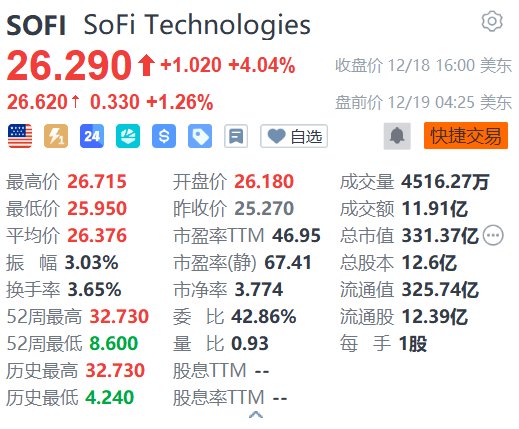
美股异动丨Sofi Technologies盘前续涨超1% 进军稳定币赛道
Ge Long Hui· 2025-12-19 09:34
Group 1 - SoFi Technologies (SOFI.US) has seen a stock price increase of 4.04% yesterday and a further rise of 1.26% in pre-market trading today, reaching $26.62 [1] - The company has officially entered the stablecoin market by launching SoFiUSD, a stablecoin fully backed by US dollar reserves, which accelerates its expansion in the digital assets and payment infrastructure sector [1] Group 2 - The stock closed at $26.29 with a trading volume of 45.16 million shares and a market capitalization of $33.137 billion [1] - The stock has a 52-week high of $32.73 and a low of $8.60, indicating significant volatility in its price [1] - The company has a price-to-earnings ratio of 67.41 and a price-to-book ratio of 3.774, reflecting its valuation metrics [1]

稳定币概念股异动,创业板软件ETF华夏(159256)涨幅扩大至近1%
Mei Ri Jing Ji Xin Wen· 2025-12-19 03:18
Core Viewpoint - The A-share index experienced a collective rise on December 19, driven by news related to stablecoins, with the fintech and software development sectors showing strong performance [1] Group 1: Market Performance - The ChiNext software ETF Huaxia (159256) saw its gains expand to nearly 1%, with constituent stocks such as Sifang Jingchuang and Caixun shares rising over 5% [1] - Leading stocks in the sector included Aerospace Zhizhuang, Chuangye Huikang, and Zhongke Chuangda, which led the gains [1] Group 2: Industry Developments - Visa launched a stablecoin settlement service based on USDC in the U.S., allowing card-issuing and acquiring banks to settle VisaNet transactions via the Solana blockchain, enhancing liquidity management efficiency with near real-time fund clearing [1] - The software industry plays a crucial role in the AI industry chain, primarily in the midstream technology layer and downstream application layer, providing essential technical support and facilitating the implementation of AI applications [1] Group 3: Strategic Insights - Longjiang Securities highlighted that in the context of intensified Sino-U.S. technological competition, achieving complete autonomy in key areas is essential for China's technological development, particularly in the context of supply chain security [1] - As critical policy assessment years like 2025 approach, domestic operating systems and foundational software within the Xinchuang industry chain are areas of significant focus [1]
Intuit Teams Up with Circle to Leverage Stablecoins
Crowdfund Insider· 2025-12-18 22:52
Core Insights - Intuit has partnered with Circle Internet Group to enhance financial services using stablecoin technology, specifically integrating Circle's stablecoin infrastructure and USDC into Intuit's platform [1][2] Group 1: Partnership and Strategic Goals - The partnership aims to expand Intuit's capabilities by integrating stablecoins into its platform, focusing on making money work harder and smarter for consumers and businesses [2] - Intuit's CEO emphasized the commitment to delivering lower-cost and programmable money movement, enhancing financial transactions for millions [2] - Circle's CEO highlighted Intuit's scale as an ideal platform to improve the speed and efficiency of USDC for everyday transactions [2] Group 2: Technological Advancements - The integration of stablecoins is seen as a logical progression, providing a programmable, low-friction money rail that can enhance experiences in refunds, remittances, savings, and payments [2] - Intuit leverages data, artificial intelligence, and human intelligence to optimize financial outcomes for its customers [2] Group 3: Market Position and Financial Impact - Intuit operates in a market with over $100 billion in annual tax refunds, positioning itself as a key player in the financial technology sector [2] - The company is committed to investing in its money platform to provide solutions for fast money, lending, and banking [2]



X @CZ 🔶 BNB
CZ 🔶 BNB· 2025-12-18 17:44
RT 林晚晚的猫 (@linwanwan823)【CZ年终AMA十大问答】BNB股东年终大会刚刚结束。听完CZ的年终AMA,晚晚我选了10条问答总结👇划重点:预测市场,稳定币大战2.0还没开始1.被特赦后什么感受?CZ:"心理上有一种vindication(平反)的感觉,终于自由了。"但实际生活没变。他还是每天在家工作,每天锻炼30-45分钟,这习惯是从监狱带出来的。2. CZ每天在干嘛?四件事:• Giggle Academy——他的"宠物项目",完全免费的教育平台,60人团队,已服务9万名儿童• YZ Labs——100亿美金生态基金,2025年投了近70个项目,审核超过1000个• BNB生态——不再做技术,主要mentor年轻创业者 •给政府当顾问——跟十几个国家高层聊监管框架,包括巴基斯坦、阿联酋等不过这最后一项占用时间远超他预期。3. 2025最骄傲的数字?• Giggle Academy:9万学生,比很多大学都大• BNB链:交易量年增长600%,日活用户240万• Binance:2亿用户• 加密行业:财富渗透率可能还不到1%他补充:加密货币的市值还能涨几个数量级。4.为什么同时投多个预测市场 ...