碳中和

Search documents
中金:我国氢能战略坚定 看好燃料电池行业中长期发展
智通财经网· 2026-02-06 06:33
Core Viewpoint - The fuel cell vehicle promotion during the 14th Five-Year Plan period is lagging behind expectations, with the industry facing challenges such as weak growth, poor profitability, and accounts receivable backlog. However, the hydrogen energy strategy remains clear, and new support policies are anticipated, which may help the fuel cell industry gradually overcome short-term difficulties and possess significant long-term growth potential [1]. Group 1: Market Dynamics - In 4Q25, a rush to install fuel cell vehicles is expected, but there remains a gap to the 2025 phase target. Since 2024, the sales momentum for fuel cell vehicles has been insufficient, influenced by the policy window period [2]. - The average price of fuel cell systems has decreased by nearly 90% since 2018, posing significant challenges to profitability for manufacturers, with the industry still in a bottoming phase [2]. Group 2: Bottlenecks in Promotion - The promotion of fuel cell vehicles faces multiple obstacles: first, the reduction of subsidies has highlighted cost disadvantages, intensifying competition from electric vehicles; second, the construction speed of hydrogen refueling stations has not met expectations, complicating refueling convenience and reducing investment motivation due to high construction costs; third, the long cycle of subsidy fund disbursement has led to accounts receivable backlog, which may pressure company operations and limit research and expansion capabilities [3]. Group 3: Long-term Development Outlook - Despite short-term pressures, the country positions hydrogen energy as a key component of the future energy system, essential for achieving carbon neutrality in non-electric sectors. Policy-wise, various regions are advancing hydrogen energy industry plans, with ongoing support measures such as toll fee reductions and "hydrogen corridors" construction; application-wise, fuel cell applications are expanding from transportation to power generation, energy storage, and rail transit, indicating a potential second growth curve that supports long-term industry development [4].
大越期货沪铝早报-20260206
Da Yue Qi Huo· 2026-02-06 02:12
沪铝早报- 交易咨询业务资格:证监许可【2012】1091号 大越期货投资咨询部 :祝森林 从业资格证号:F3023048 投资咨询证号:Z0013626 联系方式:0575-85226759 重要提示:本报告非期货交易咨询业务项下服务,其中的观点和信息仅作参考之用,不构成对任何人的投资建议。 我司不会因为关注、收到或阅读本报告内容而视相关人员为客户;市场有风险,投资需谨慎。 每日观点 降息和需求疲软博弈 1、碳中和控制产能扩张。 2、俄乌地缘政治扰动,影响俄铝供应。 3、降息 铝: 1、基本面:碳中和控制产能扩张,国内供应即将到达天花板,下游需求不强劲,房地产延续疲软,宏 观短期情绪多变;中性。 2、基差:现货23350,基差-35,贴水期货,中性。 3、库存:上期所铝库存较上周涨19718吨至216771吨;中性。 4、盘面:收盘价收于20均线下,20均线向下运行;偏空。 5、主力持仓:主力净持仓多,多增;偏多。 6、预期:碳中和催发铝行业变革,长期利多铝价,宏观情绪多变,铝价震荡向上运行 近期利多利空分析 利多: 利空: 逻辑: 1、全球经济并不乐观,高铝价会压制下游消费。 2、铝材出口退税取消 每日汇 ...
公用环保行业2026年2月投资策略:两部门发文完善发电侧容量电价机制,公用环保行业25Q4 基金持仓梳理
Guoxin Securities· 2026-02-06 01:20
Investment Rating - The report maintains an "Outperform" rating for the public utility and environmental protection industry [1][4][7]. Core Views - The report highlights that coal and electricity prices are declining simultaneously, which is expected to maintain reasonable profitability for thermal power. It recommends large national thermal power companies such as Huadian International and Shanghai Electric, where regional electricity prices are relatively firm [3][29]. - Continuous government policies supporting renewable energy development are anticipated to lead to gradually stable profitability in renewable power generation. Recommended companies include national renewable energy leaders Longyuan Power and Three Gorges Energy, as well as regional offshore wind power companies like Guangxi Energy and Funiu Co., Ltd. [3][29]. - The growth in installed capacity and power generation is expected to offset the downward pressure on electricity prices, with nuclear power companies likely to maintain stable profitability. Recommended companies include China National Nuclear Power and China General Nuclear Power [3][29]. - High-dividend hydropower stocks are highlighted for their defensive attributes in a global interest rate decline environment, with a recommendation for the hydropower leader Yangtze Power [3][29]. - The report suggests focusing on gas companies with capabilities in marine gas trading and special gas businesses, particularly Jiufeng Energy, which is anchored in commercial aerospace [3][29]. - In the environmental sector, the water and waste incineration industries are entering a mature phase, with significant improvements in free cash flow. The report recommends companies like China Everbright Environment and Shanghai Industrial Holdings, which present "utility-like investment opportunities" [3][30]. Summary by Sections Market Review - In January, the CSI 300 index rose by 1.65%, the public utility index increased by 3.19%, and the environmental index grew by 5.94%, with relative returns of 1.54% and 4.29% respectively [1][13]. - Among the sub-sectors, thermal power increased by 2.60%, while hydropower decreased by 1.65%. Renewable energy generation rose by 7.23%, water utilities increased by 3.96%, and gas utilities grew by 7.48% [1][34]. Important Events - The National Development and Reform Commission and the National Energy Administration issued a notice on January 30, 2026, to improve the capacity pricing mechanism for power generation, which will enhance the compensation for reliable capacity based on peak capacity [1][14]. Fund Holdings Analysis - In Q4 2025, the active fund allocation ratio for the public utility sector was 0.28%, a decrease of 0.04% from the previous quarter, with a negative overweight ratio of -2.15% [2][16]. - The top ten stocks by market value in the public utility sector included Yangtze Power, Huaneng International, and Longyuan Power [2][20]. - The active fund allocation ratio for the environmental sector was 0.26%, an increase of 0.02%, with the top ten stocks including Weiming Environmental and Hanlan Environment [2][21][28].




新能源板块集体回调,关注科创新能源ETF易方达(589960)、储能电池ETF易方达(159566)等投资机会
Sou Hu Cai Jing· 2026-02-05 12:57
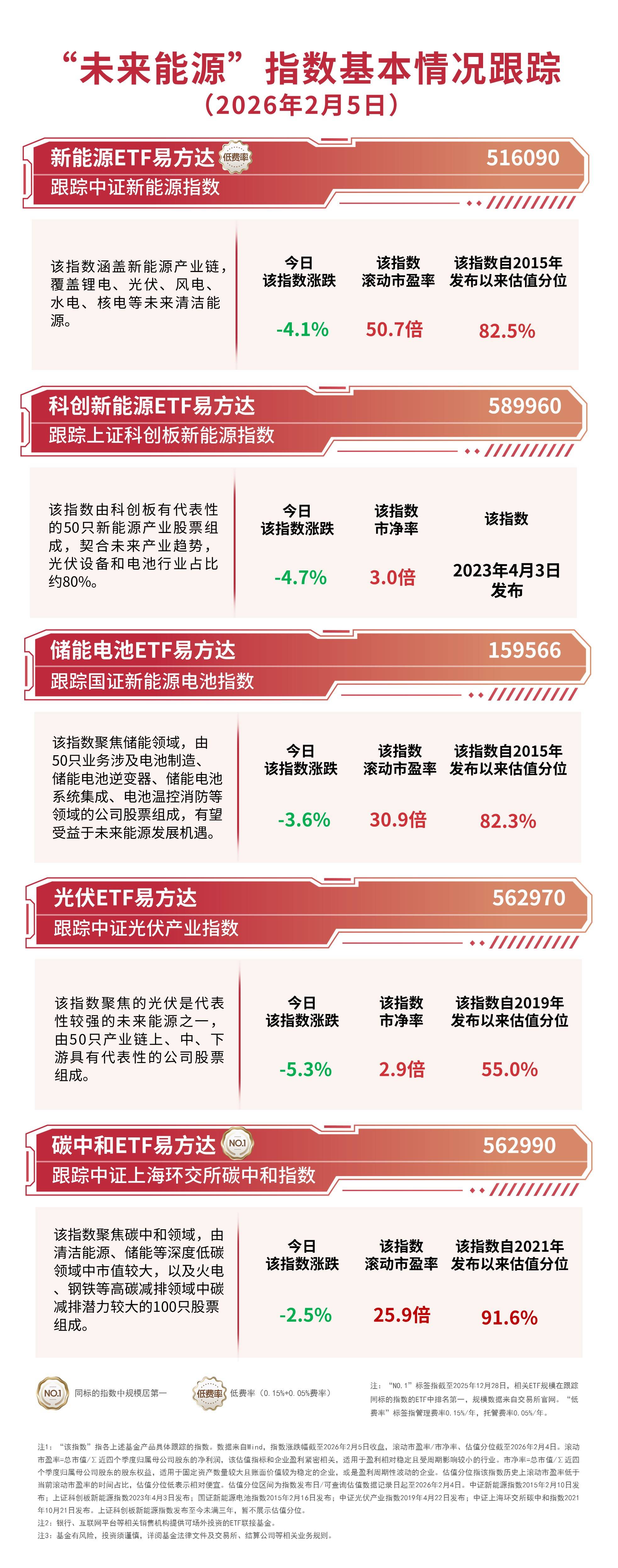
Market Overview - The renewable energy sector experienced a collective pullback, with the China Securities Shanghai Carbon Neutrality Index declining by 2.5%, the National Securities New Energy Battery Index down by 3.6%, the China Securities New Energy Index falling by 4.1%, the Shanghai Stock Exchange Sci-Tech Innovation Board New Energy Index decreasing by 4.7%, and the China Securities Photovoltaic Industry Index dropping by 5.3% [1][18]. Investment Trends - Despite the market downturn, there was a significant inflow into the storage battery ETF managed by E Fund, which saw a net subscription of 57 million units throughout the day [1]. - Elon Musk has been actively researching domestic photovoltaic equipment manufacturers, particularly focusing on HJT and perovskite technology routes, in light of his previously announced goal of expanding production capacity to 200 GW [1]. Industry Focus - The storage battery ETF tracks the National Securities New Energy Battery Index, which consists of 50 companies involved in battery manufacturing, storage battery inverters, storage battery system integration, and battery temperature control and fire safety [6][7]. - The photovoltaic ETF follows the China Securities Photovoltaic Industry Index, which includes 50 representative companies across the upstream, midstream, and downstream of the photovoltaic industry chain [9][10]. - The carbon neutrality ETF tracks the China Securities Shanghai Carbon Neutrality Index, focusing on 100 stocks from the clean energy and storage sectors, as well as high-carbon reduction potential companies in coal power and steel industries [13][14].

多只权益产品跻身同类前列,海富通基金2025年产品成绩单亮眼出炉
Zhong Guo Ji Jin Bao· 2026-02-05 09:57
Core Viewpoint - In 2025, under the backdrop of global market recovery and active performance of the Chinese stock market, HaiFutong Fund's research and investment team delivered impressive results, with its actively managed equity funds ranking in the top 10% of the industry over the past seven years [1] Group 1: Performance of Equity Funds - HaiFutong Fund's equity funds achieved outstanding returns in 2025, particularly in the technology sector, with the HaiFutong Stock Mixed Fund managed by Lv Yuechao yielding 88.72%, significantly outperforming its benchmark of 17.37% and ranking in the top 4% of its category [2] - The HaiFutong Technology Innovation Mixed Fund also performed well, achieving a return of 88.11% against a benchmark of 41.03%, placing it in the top 4% [2][3] - The HaiFutong Small and Medium Cap Mixed Fund, managed by Fan Tingfang, recorded a return of 62.83%, surpassing its benchmark of 21.69% and ranking in the top 11% [3] Group 2: Balanced Investment Strategy - In a volatile market, balanced allocation is highlighted as a reliable path for sustainable long-term returns, with the HaiFutong Yield Growth Mixed Fund achieving a return of 46.69% against a benchmark of 9.04%, ranking in the top 11% [4] - The HaiFutong Reform Driven Mixed Fund also showed strong performance with a return of 58.94%, ranking in the top 12% [5] - The HaiFutong National Policy Guidance Mixed Fund demonstrated stable long-term returns, achieving a return of 25.10% in 2025, outperforming its benchmark of 17.37% [6] Group 3: Thematic Investment Focus - HaiFutong Fund has developed several high-performing thematic products, including the HaiFutong Consumption Preferred Mixed Fund, which achieved a return of 78.63% against a benchmark of -1.82%, ranking first in its category [7] - The HaiFutong Electronic Information Media Industry Stock Fund, focusing on TMT sectors, recorded a return of 87.96%, ranking fourth among its peers [8] - The HaiFutong Carbon Neutrality Theme Mixed Fund, managed by Fan Tingfang, achieved a return of 59.15%, ranking seventh in its category [8] Group 4: Long-term Investment Philosophy - The impressive performance of HaiFutong Fund's products is attributed to its diversified strategy, deep research capabilities, and long-term investment spirit, with a commitment to prioritizing investor interests [9]
新能源板块今日回调,碳中和50ETF国泰(159861)收跌近4%,太空光伏机遇值得关注,回调或可布局
Mei Ri Jing Ji Xin Wen· 2026-02-05 07:43
Group 1 - The core viewpoint of the article highlights a recent pullback in the new energy sector, particularly noting a nearly 4% decline in the Carbon Neutrality 50 ETF (159861), while emphasizing the potential opportunities in space photovoltaics during this correction [1] - The report from Guotai Haitong Securities indicates that the demand for data centers is accelerating the need for stable, low-cost, and replicable photovoltaic + energy storage solutions, shifting the logic of ground photovoltaic installations from power-driven to computing-driven [1] - The development of low-orbit satellites and space computing, exemplified by SpaceX's application to deploy a million satellites for an orbital AI data center network, is pushing space photovoltaics into the industrial verification stage, creating higher demands for efficiency and lightweight flexible solutions, thus opening up new opportunities for high-end manufacturing and customized equipment [1] Group 2 - Photovoltaics are expected to gain more application opportunities in the construction of orbital data centers, benefiting related photovoltaic equipment manufacturers [1] - Photovoltaic equipment companies are actively exploring the space photovoltaic sector, making progress in areas such as heterojunction battery efficiency breakthroughs, ultra-thin battery manufacturing, and the development of stacked battery process systems [1] - The Carbon Neutrality 50 ETF (159861) tracks the Environmental Protection 50 Index (930614), which selects listed companies in the Chinese A-share market involved in clean energy, pollution control, and resource recycling, reflecting the overall performance of securities related to the green economy and sustainable development themes [1]
沪市主板再添“绿色名片”,林平发展即将登陆资本市场
Zhong Jin Zai Xian· 2026-02-05 05:24
作为工信部认定的"绿色工厂"、国家级专精特新"小巨人"企业,安徽林平循环发展股份有限公司(证券 简称"林平发展",证券代码"603284")已完成申购,即将登陆沪市主板。据公司披露的《发行结果公 告》,此次网上投资者缴款认购的金额达5.67亿元,网下投资者缴款认购的金额达1.42亿元。 林平发展的绿色循环模式,为财务稳健性提供了有力支撑。数据显示,2022年至2024年及2025年1-6 月,公司营业收入分别为28.79亿元、28.00亿元、24.85亿元及12.24亿元;净利润分别为1.54亿元、2.12 亿元、1.53亿元及0.91亿元;扣除非经常性损益后归属于母公司股东的净利润分别为1.28亿元、2.05亿 元、1.66亿元及0.91亿元。整体来看,公司经营基础扎实,盈利能力保持稳定。 为提升综合竞争实力,公司规划通过本次公开发行新股募集资金,用于建设"年产90万吨绿色环保智能 制造新材料项目(二期)"和"年产60万吨生物基纤维绿色智能制造新材料项目"。项目实施后,将推动公司 在瓦楞纸、箱板纸领域实现产能提升与产品升级,进一步满足客户多元化需求,提升产品与服务质量, 发挥规模经济效应,增强组合产品供应能 ...
学习规划建议每日问答丨如何理解发展分布式能源
Xin Hua Wang· 2026-02-05 03:13
Core Viewpoint - The development of distributed energy is emphasized as a crucial component of the new energy system, which is significant for optimizing energy structure, promoting energy conservation and emission reduction, and advancing sustainable economic and social development [1][2]. Group 1: Considerations for Development - The deployment of distributed energy aims to better promote carbon peak and carbon neutrality, as it aligns with the resource and technical characteristics of renewable energy, leading to significant carbon reduction effects [2]. - It addresses the energy needs of the population by providing flexible energy solutions that can cater to various scenarios, especially in remote areas and for users with high energy stability requirements [2]. - The development enhances energy security by increasing the supply of clean energy and reducing reliance on large energy systems, while also serving as backup and peak-shaving resources [2]. - It encourages social investment and the growth of related industries due to its smaller project scale and lower investment thresholds compared to large energy projects [2]. Group 2: Key Development Areas - Focus on constructing zero-carbon parks in regions with high industrial loads and favorable resource conditions, integrating various energy sources to meet diverse energy demands [3]. - Actively promote zero-carbon rural development through pilot projects that implement distributed solar and wind energy solutions [3]. - Advance the integration of photovoltaic systems in buildings, encouraging the use of rooftops and facades for solar energy generation [3]. - Strengthen the integration of clean energy with transportation by developing charging and hydrogen stations along transportation infrastructure [3]. - Strategically plan the construction of distributed natural gas energy stations to support peak shaving and backup needs in areas with reliable gas supply [3]. Group 3: Quality Development Precautions - Prevent blind expansion of scale by carefully planning the development scale and layout of distributed energy projects [4]. - Ensure adequate supporting infrastructure by scientifically constructing distribution networks and enhancing the capacity for renewable energy integration [4]. - Avoid unfair competition by regulating the development and management of distributed solar energy, promoting a fair market environment for all investment entities [4].
我研究团队破解节能制绿氢难题
Huan Qiu Wang Zi Xun· 2026-02-05 01:45
Core Insights - The research team from Inner Mongolia University has made significant breakthroughs in the field of energy-efficient green hydrogen production and high-value chemical synthesis, publishing their findings in a sub-journal of Nature [1][2] - Green hydrogen, produced through water electrolysis using renewable energy, is crucial for achieving carbon neutrality, but its large-scale production faces challenges due to high energy consumption during the electrolysis process, particularly in the oxygen evolution reaction [1] Group 1: Research Findings - The study introduces a novel catalytic design strategy that successfully constructs a multifunctional electrocatalyst, directing the reaction pathway towards the production of high-value nitrite while simultaneously suppressing nitrogen gas by-products [1] - The research demonstrates the effective regulation of reaction pathways, providing a new approach for coupling ultra-low energy hydrogen production with wastewater resource utilization, which could advance the industrialization of green hydrogen [2] Group 2: Applications and Implications - The developed technology for energy-efficient hydrogen production from urea, coupled with the generation of high-value nitrite, aligns with the dual carbon goals and has potential applications in zinc-urea battery systems, showcasing the potential for innovation from basic mechanisms to engineering applications [2] - The research has received funding from the National Natural Science Foundation and the Inner Mongolia Autonomous Region Science and Technology Plan, indicating institutional support for its development and implementation [2]
2.5犀牛财经早报:全国年用电量突破10万亿千瓦时 未来货币是“瓦特”?
Xi Niu Cai Jing· 2026-02-05 01:42
Group 1 - Public mutual funds have distributed over 33 billion yuan in dividends this year, with equity funds accounting for nearly 80% of the total [1] - The increase in dividend distribution is attributed to policies, performance, industry transformation, and funding needs, marking a trend towards high-quality development in the industry [1] - The new registration of private MOM products has been halted due to regulatory concerns about potential deviations from active management [1] Group 2 - China's total electricity consumption has historically surpassed 10 trillion kilowatt-hours, equivalent to more than double the annual electricity consumption of the United States [1] - This milestone reflects a nearly doubled growth from approximately 5.5 trillion kilowatt-hours in 2015, indicating robust infrastructure development and a strengthened industrial advantage in the power sector [1] Group 3 - The Chinese AI industry is entering a new phase of commercial validation and large-scale application, with several companies recently listed on the Hong Kong and STAR markets [2] - Domestic chip manufacturers face challenges under Nvidia's ecosystem, prompting a focus on system efficiency and scene adaptability to enhance competitiveness [2] - Collaboration between chip and model companies is deemed crucial for the independent development of domestic AI [2] Group 4 - The production of World Cup-related sports goods in Yiwu has entered a critical phase as the 2026 FIFA World Cup approaches, with significant international demand observed [2] Group 5 - Alphabet, Google's parent company, reported a fourth-quarter net profit of $34.455 billion, a year-on-year increase of 29.8%, with total revenue reaching $113.83 billion [4] - Google Cloud revenue grew by 48% year-on-year, indicating strong performance in the cloud segment [4] Group 6 - Texas Instruments announced an agreement to acquire Synaptics for $7.5 billion, with the transaction expected to be completed in the first half of 2027 [5] - The acquisition will provide Synaptics' investors with $231 in cash per share [5] Group 7 - Chang'an Automobile plans to repurchase shares worth between 1 billion and 2 billion yuan, with specific allocations for A-shares and B-shares [8]