能源结构

Search documents
贝莱德CEO,推演伊朗战争结局
财联社· 2026-03-25 10:51
Core Viewpoint - Larry Fink, CEO of BlackRock, warns that prolonged conflict in Iran and high oil prices could have a "profound impact" on the global economy, potentially leading to a recession if oil prices reach $150 per barrel [1][5]. Group 1: Predictions on the Iran Conflict - Fink suggests two possible outcomes for the Iran conflict: resolution leading to a return to pre-war oil prices, or sustained high oil prices above $100 per barrel, which could trigger a severe economic recession [5]. - BlackRock manages $14 trillion in assets, making it a significant player in global investment, and Fink's insights reflect the health of the global economy [3]. Group 2: Energy Market Implications - The ongoing conflict in the Middle East has caused significant volatility in financial markets, with investors assessing potential changes in energy costs [4]. - Fink emphasizes the need for countries to adopt a pragmatic and diversified approach to energy resources, highlighting the importance of affordable energy for economic growth and living standards [6]. Group 3: Energy Price Concerns - Fink describes rising energy prices as an unfair tax, disproportionately affecting the poor compared to the wealthy [7]. - He predicts that if oil prices reach $150 per barrel in the next three to four years, many countries may rapidly shift towards solar and wind energy [7]. Group 4: Financial Stability - Despite concerns about market conditions resembling those before the 2007-08 financial crisis, Fink believes that current financial institutions are more robust and that there are no significant similarities to the past crisis [8][9]. - He asserts that the current market environment does not exhibit the same risks as those seen prior to the financial crisis, indicating a stronger financial system today [8][9].



波黑电力进口激增,能源结构面临挑战
Shang Wu Bu Wang Zhan· 2026-02-02 13:54
Core Insights - Bosnia and Herzegovina's electricity imports are projected to reach 628.9 million marks in 2025, doubling from 312.6 million marks the previous year, with a net increase of approximately 316 million marks [1] - Electricity exports have risen to 868.8 million marks but remain below the historical level of over 1 billion marks [1] Group 1: Import and Export Dynamics - The significant increase in electricity imports is attributed to insufficient domestic coal supply, climate impacts on hydropower generation, and a decline in thermal power capacity [1] - The country has transitioned from being a net electricity exporter to a significant importer, indicating a shift in energy dynamics [1] Group 2: Pricing and Policy Changes - Both entities in Bosnia and Herzegovina have raised electricity prices multiple times since last year, with the federal region implementing a tiered pricing system in September and the Republika Srpska announcing a 10% increase in residential electricity prices and a 6% increase for industrial prices effective February next year [1] - Management issues in thermal power production are highlighted as an urgent concern, alongside uncontrollable natural factors affecting hydropower [1] Group 3: Long-term Stability Concerns - The stability of the energy system in Bosnia and Herzegovina is facing long-term challenges due to the current reliance on electricity imports and the management of thermal production [1]
新闻1+1|用电量屡创新高 我国电力保供的底气从何而来
Yang Shi Xin Wen Ke Hu Duan· 2026-01-22 06:21
Core Insights - The national electricity load in China has reached a winter peak of 1.417 billion kilowatts, marking the first time it has surpassed 1.4 billion kilowatts during winter [1] - In 2025, the total electricity consumption in China is projected to exceed 10 trillion kilowatt-hours, reflecting the vitality of the country's economic and social development [1] Group 1: Electricity Supply Challenges - The characteristics of national electricity load show dual peaks, with summer peaks generally higher than winter peaks; last summer's peak was 1.508 billion kilowatts compared to this winter's peak of 1.417 billion kilowatts [5] - Winter electricity supply faces unique challenges compared to summer, including reduced hydropower storage due to dry conditions, significant impacts from weather on wind and solar energy, and difficulties posed by natural disasters like freezing [6][8] Group 2: Regional Supply Strategies - Due to the vast geographical differences and varying energy resources across provinces, targeted supply measures are necessary, leading to the implementation of "one province, one policy" strategies for electricity supply [8] Group 3: Electricity Supply Confidence - China's confidence in electricity supply stems from significant advancements in power generation capacity and the development of a robust grid system, including ultra-high voltage transmission and strong local distribution networks [11][12] Group 4: Energy Structure Trends - Coal power is expected to decrease in proportion over time, but it will remain a primary energy source in the short to medium term, with coal power utilization hours dropping from 5,500 hours to approximately 4,400 hours by 2024; wind and solar energy are projected to account for about 18% of electricity generation in 2024 [15] Group 5: Role of Electricity in AI Development - The importance of electricity in supporting AI development is emphasized, with the argument that while AI can solve many problems, it fundamentally relies on a stable and robust energy supply [18]
《世界和中国能源展望报告(2025版)》:未来十年全球能源需求仍将保持高位
Zhong Guo Hua Gong Bao· 2025-12-17 02:43
Core Insights - The report indicates that global energy demand will maintain a high annual increment of approximately 230 million tons of oil equivalent over the next decade [1] - The resilience of fossil energy is exceeding expectations, with various factors potentially delaying the peak oil demand to around 2040 [1] - Natural gas demand is projected to significantly increase, reaching a peak of 5 trillion cubic meters between 2040 and 2045, driven in part by the growth of AI computing power [1] Energy Outlook for China - By 2035, China's primary energy demand is expected to peak at approximately 5 billion tons of oil equivalent, remaining above 4.5 billion tons of oil equivalent by 2060 [1] - The energy structure in China is characterized by a balanced transition, with reductions in coal, stable oil and gas, and an increase in non-fossil energy sources [1] - Natural gas is anticipated to play a crucial role in replacing coal and supporting the new power system in China [1]
欧佩克报告:2050年前全球能源需求将增长23%!石油仍将是占比最大的单一能源,份额略低于30%
Ge Long Hui· 2025-12-15 03:10
Group 1 - The core viewpoint of the article is that the latest OPEC energy outlook report predicts a 23% increase in global energy demand by 2050 [1] - Oil is expected to remain the largest single energy source, accounting for slightly less than 30% of the energy mix [1] - The combined share of oil and natural gas is projected to stay above 50% from 2024 to 2050 [1] Group 2 - The growth in global energy demand will primarily come from developing countries, while energy demand in developed countries is expected to remain stable or decline [1]

美智库:氢燃料电池市场规模2030年将增六成
Zhong Guo Hua Gong Bao· 2025-12-05 02:52
Core Insights - The global hydrogen fuel cell market is projected to reach $3.64 billion in 2024 and grow to $5.9 billion by 2030, with a compound annual growth rate (CAGR) of 8.3% from 2024 to 2031, driven by technological advancements, government subsidies, infrastructure development, and decarbonization mandates [1] Market Overview - Major economies have committed over $200 billion to national hydrogen strategies, focusing on fuel cell deployment and infrastructure development, with the United States, Japan, the EU, and China being key players [1] - The U.S. is expected to be the largest market for fuel cells in 2024, accounting for 36% of the market share, primarily supported by an $8 billion allocation from the Infrastructure Investment and Jobs Act for regional hydrogen production and distribution centers [1] - Japan is a mature market contributing 11% of global revenue in 2024, having deployed over 430,000 home fuel cells and established 165 hydrogen stations, leading the world in hydrogen station density [1] Application Segments - The transportation sector is the core demand area, projected to account for 46% of the market in 2024, with fuel cell electric vehicles rapidly penetrating high-frequency applications such as buses and long-haul trucks [2] - The fixed power sector follows closely with a 40% share, driven by increasing demand for resilient low-carbon off-grid power sources in data centers, hospitals, and industrial facilities [2] Technology Trends - Proton exchange membrane fuel cells dominate the market with a 52% share (approximately $1.89 billion), recognized as the mainstream technology in the transportation sector due to their high power density and quick start capabilities [2] - Solid oxide fuel cells (SOFC), currently holding 24% of the technology market, are predicted to become standard configurations for industrial clean heating and baseload power in the next decade due to their efficient combined heat and power characteristics [2] Future Outlook - Despite challenges such as high initial infrastructure costs and insufficient hydrogen supply, technological innovations are expected to accelerate breakthroughs, with analysts predicting a 40% to 60% reduction in green hydrogen costs by 2030, significantly enhancing the economic viability of fuel cell systems [2] - Hydrogen fuel cells are gradually becoming a normalized component of the global energy structure, supported by policy and industry collaboration [2]
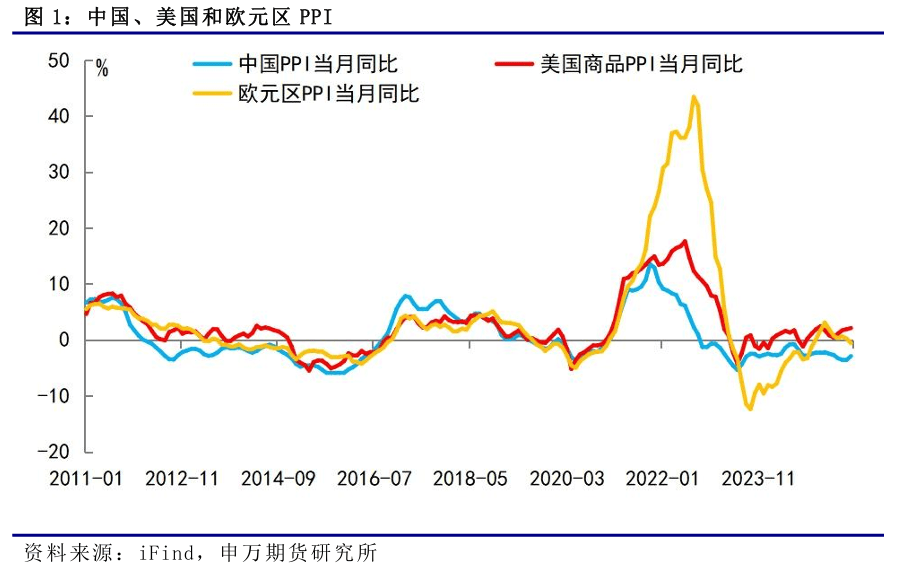
薛鹤翔:中美欧PPI为什么脱钩?
Sou Hu Cai Jing· 2025-10-14 06:31
Core Insights - The PPI trends in China, the US, and Europe have diverged significantly post-pandemic, with China experiencing low PPI, the US maintaining relatively high PPI, and Europe showing considerable volatility. This divergence is primarily attributed to differences in energy structures and demand dynamics across these regions [1][4]. Energy Structure Impact - China's PPI is highly sensitive to coal prices, which are currently low due to weak demand and expanded supply. The domestic coal production has exceeded historical levels, and the demand from traditional sectors like real estate has decreased, leading to a prolonged low PPI [8][18]. - The US has a strong energy independence, primarily relying on oil and natural gas. The PPI is less affected by energy price fluctuations compared to Europe, with stable natural gas prices and a significant impact from rising oil prices due to global supply and demand dynamics [11][13]. - Europe's PPI has been significantly influenced by volatile natural gas prices, especially following the Russia-Ukraine conflict, which led to a sharp increase in energy costs. The subsequent measures to reduce dependency on Russian gas have also contributed to PPI fluctuations [14][22]. Demand Dynamics - In China, the transition from traditional to new economic drivers is underway, with the real estate sector in a downturn. This has led to reduced demand for related products, suppressing PPI. However, new economic drivers are beginning to support a gradual recovery in PPI [2][16]. - The US has shown strong demand resilience due to substantial fiscal stimulus during the pandemic, which increased disposable income and consumer spending. Despite rising labor costs and interest rates, the PPI has only seen moderate declines [19][20]. - Europe is experiencing a mild recovery in demand post-pandemic, but high energy costs and external demand declines have previously suppressed PPI. Recent economic recovery efforts and fiscal policies are expected to support a gradual increase in PPI [15][22].