金融强国

Search documents
奋力打造一流投资银行和投资机构
Jin Rong Shi Bao· 2025-12-08 02:10
吴清强调,"十五五"是推进中国式现代化、加快建设金融强国的关键时期。新征程上,证券行业作为直 接融资的主要"服务商"、资本市场的重要"看门人"、社会财富的专业"管理者",必须在服务实体经济和 新质生产力发展、更好服务投资者和居民优化资产配置、加快建设金融强国和促进高水平制度型开放等 方面强化使命担当。 吴清表示,奋力打造一流投资银行和投资机构。一是行业功能发挥要迈上新台阶。要牢牢把握服务实体 经济这个根本,突出服务新质生产力发展这个重点,不断提升产品服务的精准性、适配性,自觉承担保 护投资者合法权益和促进稳市兴市的社会责任,切实把重心聚焦到高质量发展上来。二是专业服务能力 要展现新提升。要切实扛起"看门人"责任,提升价值发现培育能力、财富管理服务能力、跨境金融综合 服务能力,积极研究、稳步探索推进人工智能、大数据、区块链等新技术在资本市场的布局和应用。三 是差异化特色化发展要做到新突破。要巩固深化头部机构引领、中小机构特色发展的行业格局,发挥好 比较优势,从价格竞争加快转向价值竞争。用好并购重组机制和工具,实现优势互补、高效配置。四是 加强合规管理和风险防控要取得新成效。要进一步提升公司治理有效性,进一步加强 ...
中小银行应持续探索特色化 与差异化发展新路径
Jin Rong Shi Bao· 2025-12-08 02:10
Group 1: Core Perspectives - The "14th Five-Year Plan" emphasizes accelerating the construction of a financial powerhouse, with a focus on the effective implementation of key areas such as technology finance and green finance [1][2] - The financial sector's strength is not only measured by its own prosperity but by its ability to efficiently serve critical development areas outlined in the "14th Five-Year Plan," including industrial development, technological innovation, and rural revitalization [2][3] Group 2: Policy Analysis - The "14th Five-Year Plan" provides fundamental guidelines for financial work, including the development of technology finance, green finance, and enhancing the adaptability of capital market systems [2][3] - Financial services must align with the strategic goals of the "14th Five-Year Plan," ensuring that financial resources are effectively injected into key areas of national development [2] Group 3: Industry Practices - Recent efforts in financial management have led to positive outcomes in areas such as credit, bond, and equity market reforms, although challenges remain in the adaptability and sustainability of financial services [3][4] - The current financing structure in China is predominantly indirect, which poses challenges for supporting technological innovation; direct financing needs to be expanded to meet the demands of tech enterprises [3] Group 4: Risk Control Framework - The development of green finance faces challenges in converting social externalities into economic effects, with current measures like carbon markets needing broader application and more flexible policies [4] - Middle-sized banks must enhance their specialized capabilities to meet the complex and diverse needs of clients in technology innovation and green finance [5][6] Group 5: Digital Transformation - Banks are urged to accelerate digital transformation while prioritizing the enhancement of risk management capabilities to effectively address the risks associated with emerging business models [8][9] - A focus on first repayment sources and the development of a risk pricing mechanism based on customer value is essential for improving risk management in new economic sectors [9]
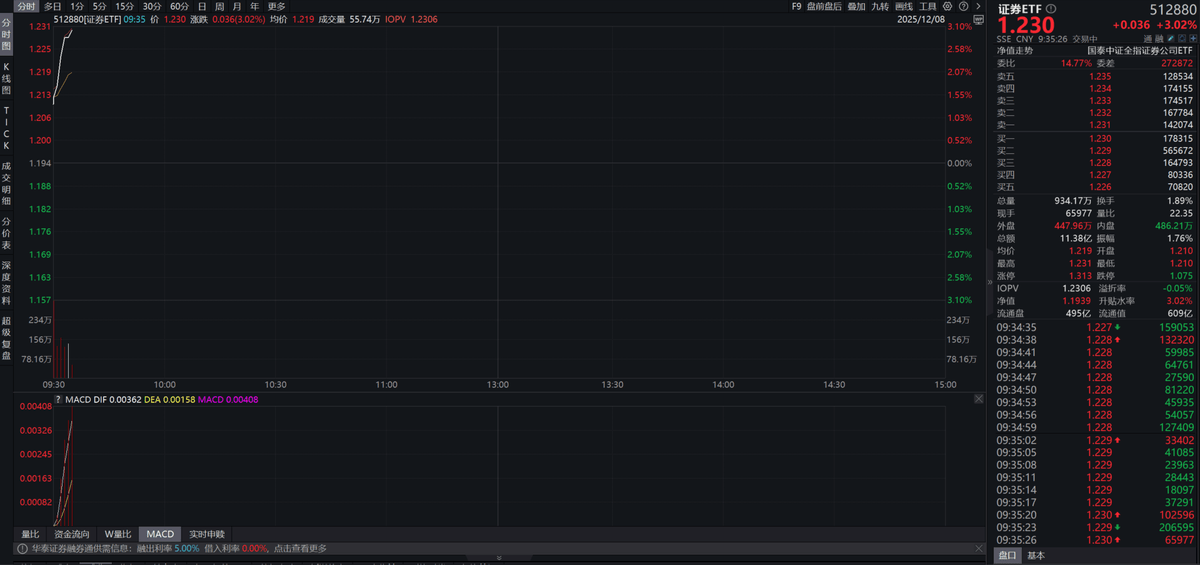
吴清:适度拓宽资本空间与杠杆上限,“牛市旗手”证券ETF(512880)涨超3%
Sou Hu Cai Jing· 2025-12-08 01:51
Core Viewpoint - The China Securities Regulatory Commission (CSRC) announced plans to strengthen classified regulation, optimize evaluation indicators for quality institutions, and appropriately expand capital space and leverage limits, which is expected to enhance capital utilization efficiency and drive the return on equity (ROE) in the securities industry [1][3]. Group 1: Regulatory Changes - The CSRC's new framework includes five major plans for the development of the securities industry during the 14th Five-Year Plan, focusing on enhancing service capabilities, constructing a differentiated development pattern, and strengthening compliance management [3][4]. - The regulatory guidance aims to enhance leverage and capital utilization efficiency for quality institutions, which is expected to directly push the industry's ROE upward [3][4]. Group 2: Market Performance - The Securities ETF (512880) has a current scale exceeding 59 billion yuan, ranking first among similar products, and is considered a "bull market flag bearer" due to its strong beta attributes [1][5][7]. - The securities sector is anticipated to outperform the broader market during market rebounds, as evidenced by historical performance [5][7]. Group 3: Future Outlook - By 2026, the securities industry is expected to move away from homogeneous competition, with a clearer structure emerging between leading brokerages and smaller specialized firms, driven by the "Financial Power" strategy and policies aimed at activating capital markets [7]. - The ongoing dual influence of internal drivers and policy guidance is likely to accelerate mergers and acquisitions within the brokerage sector, presenting investment opportunities in the leading Securities ETF [7].

刘世锦:进一步发挥“三大优势” 推动制造强国、消费强国、金融强国建设
Zhong Guo Zheng Quan Bao· 2025-12-08 00:08
Group 1 - The core advantages of China include the potential for catching up with developed economies, a new technological revolution focused on digital and green technologies, and the advantages of a super-large market economy [1][2][3] - China has a stable demand side and relatively mature supply-side technologies, which provide a strong certainty in the current uncertain environment [1] - The country has made significant progress in narrowing the gap with global leaders in key areas of technological revolution, achieving parity or local leadership in industrial engineering and commercial application scenarios [1] Group 2 - China possesses all industrial categories listed in the United Nations classification, allowing for more competition among enterprises with strong core competitiveness [2] - The country has multiple innovation hubs and abundant resources, which facilitate economies of scale and cost reduction, transforming weaknesses into strengths [2] - To further leverage these advantages, China aims to enhance its manufacturing, consumption, and financial sectors, creating a better environment for technological innovation [2] Group 3 - In manufacturing, despite accounting for over 30% of global manufacturing, China still lags in productivity and value-added metrics compared to developed countries [2] - The focus will be on improving labor productivity, industry value-added rates, and total factor productivity, while integrating productive services such as R&D, design, logistics, and human resources [2] Group 4 - In terms of consumption, China's consumer spending as a percentage of GDP still falls short of the global average, necessitating an expansion of the consumer market [3] - Enhancing human capital through education, healthcare, and social security is crucial for driving innovation and establishing a consumption powerhouse [3] Group 5 - As China transitions to a developed economy, the uncertainty in economic growth increases, necessitating an improvement in the financial system's project selection capabilities [4] - The capital market must support the cultivation of world-class technology enterprises and provide for an aging society through pension systems and increased household income [4] - To address the mismatch between China's high GDP and manufacturing share versus its low currency share, increasing the offshore RMB scale and enhancing its liquidity in international markets is essential [4]
证监会:加快打造一流投行和投资机构 进一步优化风控指标 提升资本利用效率
Zhong Guo Zheng Quan Bao· 2025-12-07 20:45
中国证券业协会第八次会员大会12月6日在北京举行。就"加快打造一流投资银行和投资机构,更好助推 资本市场高质量发展",中国证监会党委书记、主席吴清在致辞时提出五点希望:行业功能发挥要迈上 新台阶、专业服务能力要展现新提升、差异化特色化发展要做到新突破、加强合规管理和风险防控要取 得新成效、行业文化建设要焕发新气象。 围绕奋力打造一流投资银行和投资机构,吴清提出,行业功能发挥要迈上新台阶。"这几年行业一个大 的变化,就是从简单追求规模利润扩张,加快转向功能优先。"他表示,要继续巩固这一良好势头,坚 决摒弃简单拼规模、比增速、争排名,切实把重心聚焦到高质量发展上来。始终从实体企业和产业发展 需要出发优化业务结构、创新产品工具,围绕做好金融"五篇大文章",加大资金、人才、技术等方面资 源投入,力戒脱实向虚、自我循环。深入研判科技创新和产业创新融合趋势,敏锐洞察、及时响应企业 对金融服务需求变化,积极参与科创板、创业板等重大改革,不断提升产品服务的精准性、适配性。时 刻牢记个人投资者占绝大多数这个最大市情,进一步强化证券公司交易主渠道综合优势,自觉维护市场 交易秩序和"三公"原则。要带头践行价值投资理念,强化跨周期逆 ...
刘世锦:进一步发挥“三大优势”
Zhong Guo Zheng Quan Bao· 2025-12-07 20:21
Group 1 - China possesses three significant advantages for future development: the potential for catching up with developed economies, a new technological revolution focused on digital and green technologies, and the advantages of a super-large market economy [1][2][3] - The potential for catching up includes stable demand and mature supply-side technology, particularly in service industry development and the transformation of traditional manufacturing and agriculture [1] - The new technological revolution sees China narrowing the gap with global leaders, achieving parity or local leadership in key areas such as industrial engineering and commercial application scenarios [1] Group 2 - The super-large market economy allows for a diverse range of industrial categories and fosters competition among enterprises, enhancing core competitiveness [2] - China aims to leverage these advantages to build a manufacturing powerhouse, a consumption powerhouse, and a financial powerhouse, thereby creating a better environment for technological innovation [2][3] - In manufacturing, despite accounting for over 30% of global manufacturing, China still lags in productivity and value-added metrics compared to developed nations, necessitating improvements in labor productivity and the integration of productive services [2] Group 3 - For consumption, China's consumer spending as a percentage of GDP still falls short of the global average, indicating a need to expand the market and enhance service consumption, including investments in human capital [3] - The financial sector must adapt to increased economic uncertainty by improving project selection capabilities, with a focus on nurturing leading technology enterprises and addressing the needs of an aging society [4] - To enhance the international status of the RMB, China should increase offshore RMB circulation and ensure a balance between exports and imports, thereby supporting the development of manufacturing and consumption powerhouses [4]
证监会:加快打造一流投资银行和投资机构 对优质证券机构适度打开资本空间和杠杆限制,畅通证券业创新试点工作机制
Zheng Quan Shi Bao· 2025-12-07 18:34
Core Viewpoint - The Chairman of the China Securities Regulatory Commission (CSRC), Wu Qing, emphasizes the need to accelerate the development of first-class investment banks and institutions, proposing regulatory adjustments to support quality institutions while maintaining strict oversight on problematic firms [1][4]. Group 1: Industry Development Goals - The securities industry is expected to enhance its role in serving the real economy and new productive forces, with a focus on protecting investor rights and optimizing asset allocation for residents [1][2]. - The industry should move beyond mere scale and speed competition, instead prioritizing service to the real economy and participating in major reforms like the Sci-Tech Innovation Board [2][3]. Group 2: Professional Service Enhancement - The industry must transition from merely gatekeeping IPOs to providing comprehensive support throughout the process, improving the professionalism and impact of IPO and M&A services [3]. - There is a call for strengthening underwriting and pricing capabilities, as well as developing a robust evaluation system centered on investor returns [3]. Group 3: Differentiated and Specialized Development - Leading institutions are encouraged to enhance resource integration and utilize M&A mechanisms to establish several internationally influential firms during the 14th Five-Year Plan [4]. - Smaller firms should focus on niche markets and unique client segments to create "boutique" investment banks, with regulatory support for differentiated supervision [4]. Group 4: Compliance and Risk Management - The industry is urged to implement strict governance and risk management practices, including preventing shareholder interference and enhancing transaction management [5]. - There is a focus on identifying and mitigating risks in key areas such as margin financing and private asset management, with a particular emphasis on new asset classes like cryptocurrencies [5]. Group 5: Industry Culture and Governance - The new leadership of the China Securities Association is expected to enhance governance and foster a sense of community among members, promoting shared goals and collaborative efforts [6].
中国证监会主席吴清:加快打造一流投资银行和投资机构
Zheng Quan Ri Bao· 2025-12-07 15:55
Core Viewpoint - The Chinese securities industry is undergoing significant transformation, focusing on high-quality development and actively integrating into national strategies for economic and financial modernization [1][2]. Group 1: Industry Development and Trends - During the 14th Five-Year Plan, the securities industry has shown steady growth in scale and strength, improved service quality, and enhanced risk management capabilities [2]. - The current proportion of stocks and funds in Chinese residents' assets is approximately 15%, similar to the level in the U.S. 30 years ago, indicating substantial potential for asset management and wealth management services [3]. - The 15th Five-Year Plan is seen as a critical period for advancing China's modernization and building a strong financial sector, with strategic deployments aimed at enhancing the capital market's inclusiveness and adaptability [2][3]. Group 2: Mission and Responsibilities - The securities industry is expected to strengthen its role in serving the real economy, optimizing asset allocation for residents, and contributing to the construction of a financial power [2][3]. - There is a call for the industry to focus on high-quality development rather than mere scale expansion, emphasizing the importance of serving the real economy and new productive forces [4][5]. Group 3: Regulatory and Structural Changes - The China Securities Regulatory Commission (CSRC) plans to implement differentiated regulation, supporting high-quality institutions while tightening oversight on underperforming ones [6][7]. - The industry is encouraged to enhance compliance management and risk prevention, focusing on governance effectiveness and protecting the rights of small investors [7]. Group 4: Cultural and Operational Enhancements - There is a strong emphasis on cultivating a financial culture that aligns with China's characteristics, promoting long-termism and integrating cultural development into corporate strategies [7]. - The industry is urged to improve its service capabilities, particularly in wealth management and investor relations, to better meet diverse investment needs [5][6].
国联民生证券总裁葛小波,重磅发声!
Zhong Guo Ji Jin Bao· 2025-12-07 12:19
【导读】国联民生(601456)证券总裁葛小波:当好"财富医生",开好"资产药方" 【编者按】中央金融工作会议首次提出"金融强国"目标,明确要"培育一流投资银行和投资机构"。 新"国九条"的出台绘制了更为清晰的路线图——到2035年,"一流投资银行和投资机构建设取得明显进 展"。 站在"十五五"新征程的起点,金融机构如何践行金融工作政治性、人民性,做实做透金融"五篇大文 章",服务实体经济高质量发展,为居民财富保驾护航,成为市场关注焦点。为此,中国基金报特推出 对话金融高管专栏,深度对话金融领域"话事人",为行业发展建言献策。 中国金融行业逐渐步入财富管理与资产管理深度融合的新时代。"证券业高质量发展28条"提出,引导券 商规范开展资产管理业务,提升主动管理能力,更好发挥财富管理与资产管理协同转型的合力,为券商 践行金融人民性、做好社会财富"管理者"提供了新思路。 近期,中国基金报记者独家专访了国联民生证券党委副书记、执行董事、总裁葛小波,深入探讨券商财 富管理转型与资产管理协同发展所面临的机遇和挑战。 "财富管理面对的是人而不是策略,培养充分的信任感是很难的一件事。"在葛小波看来,这正是财富管 理远比资产管 ...

国联民生证券总裁葛小波,重磅发声!
中国基金报· 2025-12-07 11:42
【导读】国联民生证券总裁葛小波:当好"财富医生",开好"资产药方" 【编者按 】 中央金融工作会议首次提出"金融强国"目标,明确要"培育一流投资银行和投资机构"。新"国九条"的出台绘制了更为清晰的 路线图——到2035年,"一流投资银行和投资机构建设取得明显进展"。 站在"十五五"新征程的起点,金融机构如何践行金融工作政治性、人民性,做实做透金融"五篇大文章",服务实体经济高质量发展,为居 民财富保驾护航,成为市场关注焦点。为此,中国基金报 特 推出对话金融高管专栏,深度对话金融领域"话事人",为行业发展建言献策。 中国基金报记者 闫晶滢 中国金融行业逐渐步入财富管理与资产管理深度融合的新时代。"证券业高质量发展28条"提出,引导券商规范开展资产管理业务,提升主 动管理能力,更好发挥财富管理与资产管理协同转型的合力,为券商践行金融人民性、做好社会财富"管理者"提供了新思路。 近期,中国基金报记者独家专访了国联民生证券党委副书记、执行董事、总裁葛小波,深入探讨券商财富管理转型与资产管理协同发展所 面临的机遇和挑战。 "财富管理面对的是人而不是策略,培养充分的信任感是很难的一件事。"在葛小波看来,这正是财富管理远 ...