中拉合作

Search documents
中国驻阿根廷使馆发言人就美国财政部长贝森特错误言论发表谈话
Xin Jing Bao· 2025-10-11 13:32
Core Viewpoint - The article highlights the ongoing tensions between the U.S. and China regarding their influence in Latin America, emphasizing China's commitment to mutual respect and cooperation with Latin American countries, while criticizing the U.S. for its historical interference and hegemonic behavior in the region [1] Group 1: U.S.-China Relations - U.S. Treasury Secretary's provocative remarks reveal entrenched Cold War mentality and confrontational thinking among some U.S. officials [1] - The article argues that U.S. interference in Latin America is evident and counterproductive to regional development [1] Group 2: China-Latin America Cooperation - China promotes a philosophy of mutual respect, equality, openness, and win-win cooperation in its dealings with Latin American and Caribbean nations [1] - The cooperation between China and Latin America aligns with the needs of both parties and significantly contributes to local economic and social development [1] Group 3: Regional Autonomy - Latin American and Caribbean countries have the right to choose their own development paths and partners without external interference [1] - The article suggests that the U.S. should focus on contributing positively to the development of Latin American countries rather than sowing discord [1]
外交部:奉劝美方停止胁迫拉美国家选边站队
Xin Hua Wang· 2025-09-18 09:30
Core Viewpoint - The Chinese government asserts that Latin America and the Caribbean are not under the influence of any single country and have the right to choose their own development paths and partners, urging the U.S. to cease its coercive tactics against these nations [1] Summary by Relevant Sections - **U.S. Pressure on Latin America**: Reports indicate that the U.S. has been applying aggressive pressure on multiple Latin American countries this year, claiming it is to maintain regional security and stability by curbing China's so-called "exploitative practices." However, these efforts have largely been ineffective, with Latin American nations moving closer to China instead [1] - **Response to Coercion**: The Chinese spokesperson emphasized that coercive and bullying tactics are increasingly unpopular and ineffective. The relationship between China and Latin America is characterized by mutual benefit and common development, highlighting the importance of open and inclusive cooperation [1] - **Call for Respect and Cooperation**: The Chinese government encourages all countries to develop friendly cooperative relationships with Latin American nations based on equality and respect. It advises the U.S. to stop interfering in the internal affairs of these countries and to contribute positively to their development rather than engaging in divisive rhetoric [1]
中方驳斥美司令涉华言论:违背事实、老调重弹
Zhong Guo Xin Wen Wang· 2025-08-25 09:16
Core Viewpoint - The Chinese Foreign Ministry spokesperson criticized the U.S. Southern Command's claims regarding China's influence in South America, asserting that such statements are factually incorrect and reflect a Cold War mentality [1] Group 1: China's Position on Cooperation - China emphasizes mutual respect, equality, and win-win cooperation with Latin American and Caribbean countries, highlighting the pragmatic collaboration across various fields [1] - The cooperation between China and Latin America aligns with the needs of both parties and promotes local economic and social development, receiving genuine support from regional nations [1] Group 2: Critique of U.S. Actions - The spokesperson accused the U.S. of long-term interference and control in Latin America and the Caribbean, labeling its actions as hegemonic and bullying [1] - It was stated that Latin America and the Caribbean are not anyone's "backyard," and that China-Latin America cooperation does not target third parties and should not be interfered with by external forces [1] - The U.S. is urged to stop sowing discord and instead contribute positively to the development of Latin American and Caribbean nations [1]
外交部:中拉合作不针对第三方,也不应受到第三方干扰
Xin Hua Wang· 2025-08-25 09:01
Core Viewpoint - The Chinese government asserts that its cooperation with Latin America and the Caribbean (LAC) is not aimed at any third party and should not be interfered with by external forces, emphasizing the right of regional countries to choose their own development paths and partners [1] Group 1 - The Chinese Foreign Ministry spokesperson criticized recent statements from U.S. officials regarding China's influence in the Western Hemisphere, labeling them as factually incorrect and indicative of a Cold War mentality [1] - China maintains a principle of mutual respect, equality, openness, and win-win cooperation in its dealings with LAC countries, which aligns with the needs and interests of both parties [1] - The cooperation between China and LAC is seen as beneficial for local economic and social development, receiving genuine support from regional nations and their populations [1] Group 2 - The spokesperson highlighted that Latin America and the Caribbean are not considered a "backyard" for any country, reiterating that China's cooperation does not target third parties [1] - The U.S. has been accused of interfering and exerting control over the LAC region for many years, with its hegemonic actions being clearly evident [1] - The Chinese government called for the U.S. to cease its divisive tactics and instead contribute positively to the development of LAC countries [1]
外交部:美方应停止挑拨离间、无事生非
Yang Shi Xin Wen· 2025-08-25 07:44
Core Viewpoint - The Chinese government criticizes the U.S. for its claims regarding China's influence in Latin America, asserting that such statements are unfounded and reflect a Cold War mentality [1]. Group 1: China's Position on Cooperation - China emphasizes its commitment to mutual respect, equality, and win-win cooperation with Latin American and Caribbean countries [1]. - The cooperation between China and Latin America is said to align with the needs of both parties and promote local economic and social development, receiving genuine support from regional nations [1]. Group 2: U.S. Interference - The Chinese government accuses the U.S. of long-term interference and control in Latin America and the Caribbean, labeling its actions as hegemonic and bullying [1]. - It is stated that Latin America and the Caribbean are not the "backyard" of any country, and that China-Latin America cooperation is not aimed at third parties and should not be interfered with by them [1]. Group 3: Rights of Regional Countries - The statement asserts that regional countries have the right to choose their own development paths and partners [1]. - The Chinese government calls for the U.S. to cease its divisive tactics and instead contribute positively to the development of Latin American and Caribbean nations [1].
美南方司令部司令称中方在西半球攫取资源,外交部回应
Ren Min Ri Bao· 2025-08-25 07:38
Core Viewpoint - The Chinese government criticizes the U.S. for its claims regarding China's influence in Latin America, asserting that such statements reflect outdated Cold War mentalities and a confrontational approach [1] Group 1: China's Position on Cooperation - China emphasizes its commitment to mutual respect, equality, and win-win cooperation with Latin American and Caribbean countries, which aligns with the needs and interests of both parties [1] - The cooperation between China and Latin America is portrayed as beneficial for local economic and social development, receiving genuine support from regional nations and peoples [1] Group 2: U.S. Interference and Criticism - The Chinese government accuses the U.S. of long-term interference and control in Latin America, labeling its actions as hegemonic and bullying [1] - It is stated that Latin America and the Caribbean are not the "backyard" of any country, and that China-Latin America cooperation does not target third parties and should not be interfered with by external forces [1] - The Chinese government calls for the U.S. to cease its divisive tactics and instead contribute positively to the development of Latin American and Caribbean nations [1]
外交部:中拉合作日益得到拉方民众认可和支持
news flash· 2025-07-09 07:54
Core Viewpoint - The cooperation between China and Latin America is increasingly recognized and supported by the people of Latin American countries, as indicated by recent public opinion surveys [1] Group 1: Public Opinion on China-Latin America Cooperation - Recent surveys show that the public in major Latin American economies such as Brazil, Mexico, Argentina, Colombia, Chile, and Peru have a growing positive perception of China [1] - The report highlights that trade with China benefits Latin American countries, positioning China as a reliable source of financing [1] - Chinese infrastructure investments are delivering tangible benefits to Latin American nations, contributing to the increasing support for China-Latin America cooperation [1] Group 2: Principles of China-Latin America Cooperation - The cooperation is characterized by equality, mutual benefit, openness, and inclusiveness, as emphasized by Chinese President Xi Jinping [1] - The fundamental goal of this cooperation is to improve the welfare of the people in both regions, which is a key factor in gaining public support [1]
谢锋:中拉合作没有地缘算计 不针对第三方 也不应受第三方干扰
news flash· 2025-06-26 02:09
Core Viewpoint - The Chinese ambassador to the U.S. emphasized the equality of all nations regardless of size or power, highlighting the importance of Latin America and the Caribbean as a vibrant region and a shared home for its people [1] Group 1: China-Latin America Relations - China-Latin America cooperation is characterized by the absence of geopolitical calculations, political conditions, or coercion for alignment with any side [1] - The Chinese side firmly supports the sovereignty and independence of Latin American and Caribbean countries, opposing hegemonic politics and external interference [1] Group 2: Principles and Support - The ambassador expressed hope that Latin American countries will adhere to the One China principle and support China in defending its sovereignty and territorial integrity [1]
秘鲁钱凯港对中国贸易的价值
Di Yi Cai Jing· 2025-06-15 12:53
Core Viewpoint - The rise of the Chancay Port is becoming a new engine for the economy of Peru, Latin America, and trade growth with China, with significant economic benefits and job creation expected from its operation [1][13]. Group 1: Economic Impact - The Chancay Port project is expected to generate approximately $4.5 billion in economic benefits annually for Peru, accounting for 1.8% of its GDP, and create around 7,000 direct and indirect jobs [1]. - The port will reduce shipping time from Peru to Asia from 35 days to 25 days, significantly lowering logistics costs and enhancing the competitiveness of Peruvian exports in international markets [1]. Group 2: Trade Relations - Peru's exports to China are primarily agricultural products, and the Asian market is becoming a major destination for these exports [3]. - In 2024, Peru's total exports are projected to reach $74.664 billion, a year-on-year increase of 15.6%, with exports accounting for 26.2% of GDP [7]. - China has been Peru's largest trading partner for ten consecutive years, with bilateral trade totaling $39.758 billion in 2024, a 10.9% increase year-on-year [8]. Group 3: Infrastructure Development - The Chancay Port is part of a broader infrastructure initiative, with discussions ongoing between Brazil and China to build a railway connecting the port to Brazil, which would shorten shipping distances significantly [10][11]. - The proposed railway, known as the "Two Oceans Railway," aims to connect the Atlantic and Pacific coasts of South America, enhancing trade efficiency and potentially increasing Brazil's export capacity by 15% to 20% [11][12]. Group 4: Regional Cooperation - The Chancay Port is seen as a strategic hub for regional countries, with Peru, Chile, and Ecuador forming a collective to facilitate direct trade routes to China [3]. - Brazil's northeastern region, which has significant renewable energy resources, is particularly focused on leveraging the Chancay Port for economic development and trade expansion [9]. Group 5: Investment Environment - Peru's political stability and focus on economic recovery, infrastructure, and digital transformation make it an attractive destination for foreign investment, particularly from China [5][6]. - The country has a diverse economy with a GDP of $271.2 billion in 2024, supported by mining, agriculture, and fisheries, and offers a favorable investment climate with low restrictions on foreign capital [5][6].
中国新能源车抢滩拉美
Hu Xiu· 2025-06-11 08:04
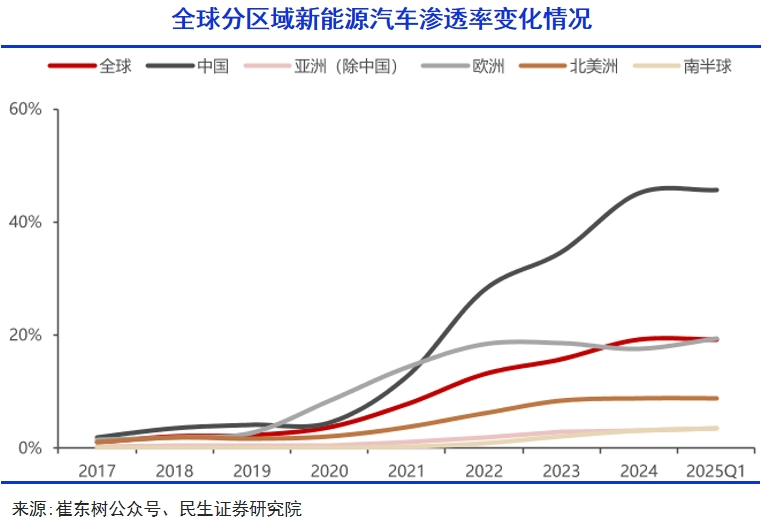
Core Insights - The article highlights the growing opportunities for Chinese electric vehicles (EVs) in the Latin American market, which currently has a low penetration rate of only 3% compared to China's 48% [1][6]. Group 1: Market Potential - Latin America has a population of 665 million, with a per capita GDP twice that of Southeast Asia, indicating stronger purchasing power [3]. - The region's cultural uniformity, primarily speaking Spanish and Portuguese, along with limited religious constraints, makes it more accessible for Chinese EVs compared to more complex regions like Southeast Asia and the Middle East [4]. - The lack of extreme political caution towards China in Latin America provides a favorable environment for the entry of Chinese EVs [5]. Group 2: Industrial Foundation - Latin America possesses significant industrial resources, including the "lithium triangle" in South America, which is crucial for the EV supply chain [6]. - Countries like Chile, Mexico, and Brazil have established automotive supply chains that can support the growth of the EV industry [6]. Group 3: Trade and Logistics - The cooperation between China and Latin America is entering a new era, with increasing bilateral trade and the role of EVs becoming more prominent [7]. - BYD has launched a massive roll-on/roll-off ship, the "BYD Shenzhen," capable of transporting 9,200 vehicles, marking a significant advancement in logistics for Chinese EV exports [9][12]. - By 2026, BYD plans to expand its fleet to eight ships, potentially transporting over 800,000 vehicles annually [12]. Group 4: Export Growth - In 2024, China's total automobile exports reached 5.859 million units, with EV exports hitting a record of 1.284 million units, showcasing a 19.3% year-on-year increase [23]. - Chinese brands dominate the EV market in Latin America, with over half of the sales in South America being Chinese-made vehicles [27]. Group 5: Competitive Landscape - In Brazil, Chinese EVs accounted for 91.4% of total imports in the first half of 2024, generating sales of $1.2 billion [27]. - The average export price of Chinese EVs exceeds $20,000, which is 30%-50% higher than domestic prices, yet demand remains strong [28]. - BYD's sales in Brazil surged by 328% in 2024, positioning it as a leading player in the market [34]. Group 6: Local Manufacturing and Infrastructure - Chinese automakers are increasingly localizing production, with Great Wall Motors planning to establish a factory in Brazil to enhance local manufacturing capabilities [40]. - The push for electric public transportation is evident, with over 6,000 electric buses in operation, primarily from Chinese brands [43]. - Collaborations with local companies for charging infrastructure are underway, with BYD partnering with Raízen Power to build charging centers in Brazil [47]. Group 7: Historical Context - The article draws parallels between the historical trade routes and the current expansion of Chinese EVs into Latin America, marking a significant shift from "selling domestically" to "selling globally" [51][54].