人工智能推理

Search documents
迈向人工智能的认识论六:破解人工智能思考的密码
3 6 Ke· 2025-06-18 11:52
Group 1 - The core insight reveals that higher-performing AI models tend to exhibit lower transparency, indicating a fundamental trade-off between capability and interpretability [12] - The measurement gap suggests that relying solely on behavioral assessments is insufficient to understand AI capabilities [12] - Current transformer architectures may impose inherent limitations on reliable reasoning transparency [12] Group 2 - The findings highlight the inadequacies of existing AI safety methods that depend on self-reporting by models, suggesting a need for alternative approaches [12] - The research emphasizes the importance of developing methods that do not rely on model cooperation or self-awareness for safety monitoring [12] - The exploration of mechanical understanding over behavioral evaluation is essential for advancing the field [12]


AMD收购两家公司:一家芯片公司,一家软件公司
半导体行业观察· 2025-06-06 01:12
Core Viewpoint - AMD has confirmed the acquisition of employees from Untether AI, a developer of AI inference chips, which are claimed to be faster and more energy-efficient than competitors' products in edge environments and enterprise data centers [1][2]. Group 1: Acquisition Details - AMD has reached a strategic agreement to acquire a talented team of AI hardware and software engineers from Untether AI, enhancing its AI compiler and kernel development capabilities [1]. - The financial details of the transaction were not disclosed by AMD [1]. - Untether AI will cease to provide support for its speedAI products and imAIgine software development suite as part of the acquisition [1]. Group 2: Untether AI's Background and Technology - Untether AI, founded in 2018, focuses on AI inference and has raised a total of $152 million, with its latest funding round exceeding $125 million [2][6]. - The company introduced its second-generation memory architecture, speedAI240, designed to improve energy efficiency and density, and is capable of scaling for various device sizes [2][5]. - The new "Boqueria" chip, built on TSMC's 7nm process, offers 2 petaflops of FP8 performance and 238 MB of SRAM, significantly enhancing performance and energy efficiency compared to its predecessor [5][10]. Group 3: Technical Innovations - Untether AI's memory computing architecture aims to address key challenges in AI inference, providing unmatched energy efficiency and scalability for neural networks [5][6]. - The architecture allows for a variety of data types, enabling organizations to balance accuracy and throughput according to their specific application needs [5][9]. - The speedAI240 device features two RISC-V processors, managing 1,435 cores, and supports external memory through PCI-Express Gen5 interfaces [10][20]. Group 4: Software and Ecosystem Development - AMD has also acquired Brium, a software company, to strengthen its open AI software ecosystem, enhancing capabilities in compiler technology and AI inference optimization [24][25]. - Brium's expertise will contribute to key projects like OpenAI Triton and WAVE DSL, facilitating faster and more efficient execution of AI models on AMD hardware [25][26]. - The acquisition aligns with AMD's commitment to providing an open, scalable AI software platform, aiming to meet the specific needs of various industries [26][27].

英伟达RTX 50系列需求爆发 栢能集团(01263)或成核心受益标的
智通财经网· 2025-05-15 06:54
Core Viewpoint - Nvidia's new GeForce RTX 50 series graphics cards are experiencing high demand, significantly exceeding supply, with retail prices up to 50% above the official suggested price [1] Group 1: Nvidia and RTX 50 Series - The RTX 5090 graphics card is currently priced over $3000 in the market, maintaining a high premium [1] - The RTX 5090 and RTX 5080 feature significant technical improvements over the previous generation, including the latest Ada Lovelace architecture, enhanced graphics processing capabilities, and support for ultra-high resolutions [1] - The VRAM for the RTX 5090 has been increased to 24GB, enhancing gaming graphics and performance [1] Group 2: Company Performance and Market Outlook - According to GF Securities, the shipment volume of the RTX 50 series is expected to reach 35-40 million units by 2025, representing a growth of over 30% compared to the previous RTX 40 series [2] - Biostar Group, a major GPU manufacturer, reported a revenue of 10.082 billion yuan for 2024, a 10% increase year-on-year, with a net profit of 262 million yuan, up 331% [2] - The strong demand for new graphics cards and reduced promotional expenses contributed to improved gross margins for Biostar Group [2] Group 3: Profitability and Valuation - If the RTX 5090 accounts for 5% of the RTX 50 series shipments, Biostar Group could see a net profit contribution of approximately 512 million HKD from this product alone, nearly doubling its 2024 net profit [3] - Biostar Group has recently partnered with Supermicro and is entering the Chinese cloud service supply chain, which may provide new growth opportunities [3] - The company's stock is currently trading at a PE ratio of only 4 times for 2025, significantly lower than competitors like Asus (12 times) and MSI (13 times), indicating substantial valuation recovery potential [3]

NVIDIA GTC 2025:GPU、Tokens、合作关系
Counterpoint Research· 2025-04-03 02:59
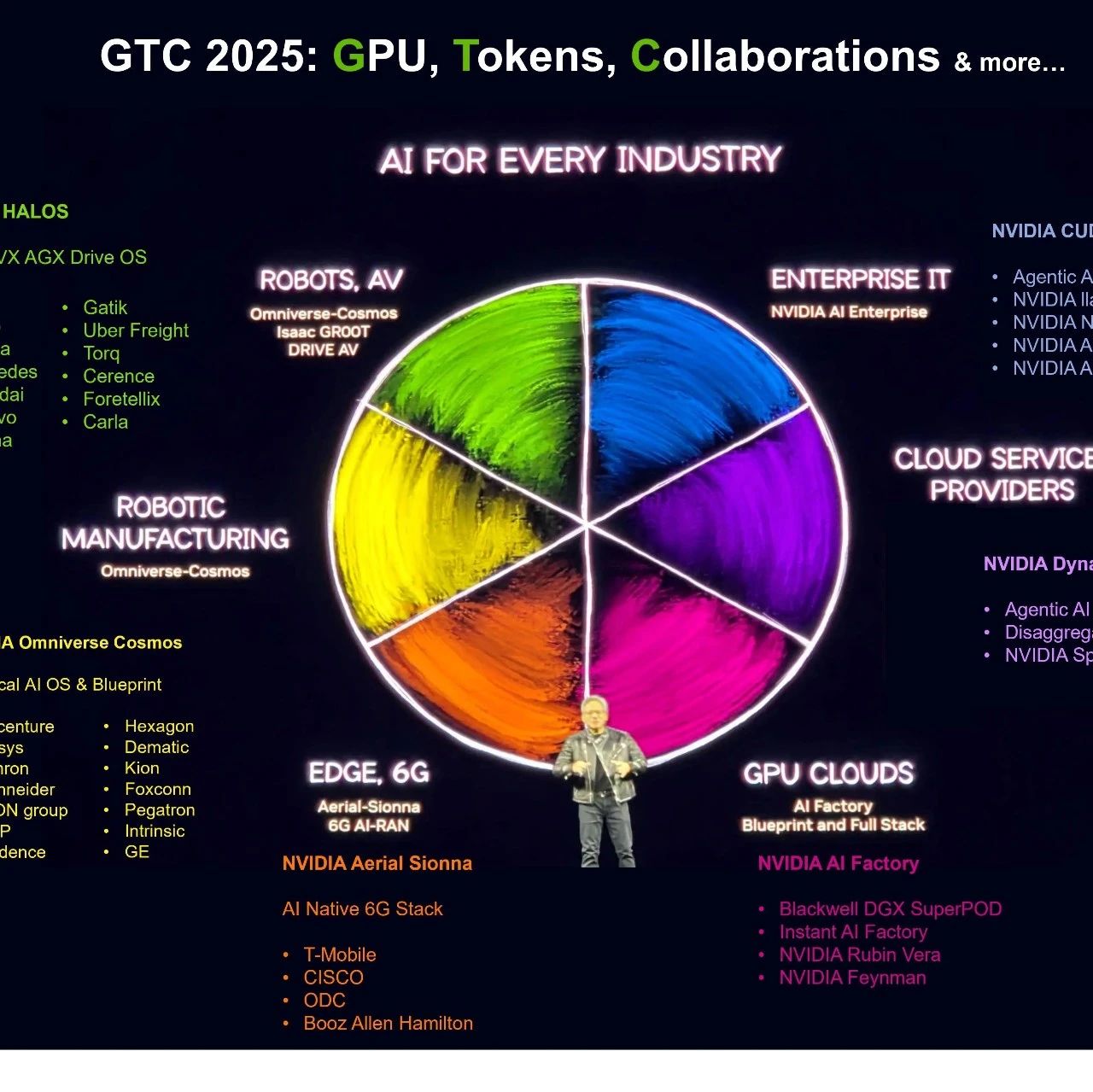
Core Viewpoint - The article discusses NVIDIA's advancements in AI technology, emphasizing the importance of tokens in the AI economy and the need for extensive computational resources to support complex AI models [1][2]. Group 1: Chip Developments - NVIDIA has introduced the "Blackwell Super AI Factory" platform GB300 NVL72, which offers 1.5 times the AI performance compared to the previous GB200 NVL72 [6]. - The new "Vera" CPU features 88 custom cores based on Arm architecture, delivering double the performance of the "Grace" CPU while consuming only 50W [6]. - The "Rubin" and "Rubin Ultra" GPUs will achieve performance levels of 50 petaFLOPS and 100 petaFLOPS, respectively, with releases scheduled for the second half of 2026 and 2027 [6]. Group 2: System Innovations - The DGX SuperPOD infrastructure, powered by 36 "Grace" CPUs and 72 "Blackwell" GPUs, boasts AI performance 70 times higher than the "Hopper" system [10]. - The system utilizes the fifth-generation NVLink technology and can scale to thousands of NVIDIA GB super chips, enhancing its computational capabilities [10]. Group 3: Software Solutions - NVIDIA's software stack, including Dynamo, is crucial for managing AI workloads efficiently and enhancing programmability [12][19]. - The Dynamo framework supports multi-GPU scheduling and optimizes inference processes, potentially increasing token generation capabilities by over 30 times for specific models [19]. Group 4: AI Applications and Platforms - NVIDIA's "Halos" platform integrates safety systems for autonomous vehicles, appealing to major automotive manufacturers and suppliers [20]. - The Aerial platform aims to develop a native AI-driven 6G technology stack, collaborating with industry players to enhance wireless access networks [21]. Group 5: Market Position and Future Outlook - NVIDIA's CUDA-X has become the default programming language for AI applications, with over one million developers utilizing it [23]. - The company's advancements in synthetic data generation and customizable humanoid robot models are expected to drive new industry growth and applications [25].
OpenAI研究负责人诺姆·布朗:基准测试比数字大小毫无意义,未来靠token成本衡量模型智能|GTC 2025
AI科技大本营· 2025-03-24 08:39
责编 | 王启隆 出品丨AI 科技大本营(ID:rgznai100) 今年英伟达大会(GTC 2025)邀请到了 OpenAI 的人工智能推理研究负责人、OpenAI o1 作者 诺姆·布朗(Noam Brown) 参与圆桌对话。 他先是带着大家回顾了自己早期发明"德扑 AI"的工作,当时很多实验室都在研究玩游戏的 AI,但大家都觉得摩尔定律或者扩展法则(Scaling Law)这 些算力条件才是突破关键。诺姆则在最后才顿悟发现,范式的更改才是真正的答案:" 如果人们当时就找到了正确的方法和算法,那多人扑克 AI 会提前 20 年实现 。 " 究其根本原因,其实还是很多研究方向曾经被忽视了。" 在项目开始前,没有人意识到 推理计算会带来这么大的差异。 " 毕竟,试错的代价是非常惨痛的,诺姆·布朗用一句很富有哲思的话总结了直到现在都适用的一大问题:" 探索全新的研究范式,通常不需要大量的计算 资源。但是,要大规模地验证这些新范式,肯定需要大量的计算投入。 " 左为英伟达专家布莱恩·卡坦扎罗,中为诺姆·布朗,右为主持人瓦尔蒂卡 在和英伟达专家的对话过程中,诺姆还对自己加入 OpenAI 之前、成为" 德扑 AI ...
不止芯片!英伟达,重磅发布!现场人山人海,黄仁勋最新发声
21世纪经济报道· 2025-03-19 03:45
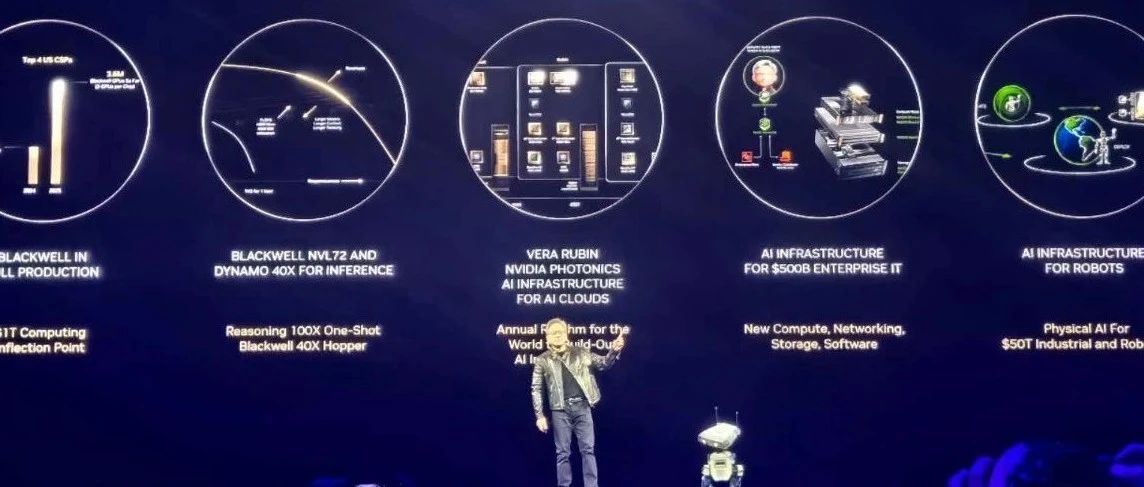
Core Viewpoint - The article highlights NVIDIA's GTC 2025 event, emphasizing the shift in AI focus from training to inference, showcasing new hardware and software innovations aimed at enhancing AI capabilities and applications [1][3][30]. Group 1: Key Innovations and Products - NVIDIA introduced the Blackwell Ultra GPU series and the next-generation architecture Rubin, with plans for the Vera Rubin NLV144 platform to launch in the second half of 2026 and Rubin Ultra NV576 in the second half of 2027 [5][10]. - The Blackwell Ultra architecture significantly enhances AI performance, achieving a 1.5x improvement in AI performance compared to the previous generation, and offers a 50x increase in revenue opportunities for AI factories [8][10]. - The new CPO switch technology aims to reduce data center power consumption by 40MW and improve network transmission efficiency, laying the groundwork for future large-scale AI data centers [13][14]. Group 2: AI Inference and Software Upgrades - NVIDIA's new AI inference service software, Dynamo, is designed to maximize token revenue in AI models, achieving a 40x performance improvement over the previous Hopper generation [19][21]. - The introduction of AI agents and the Ll ama Nemo tr o n series models aims to facilitate complex inference tasks, enhancing capabilities in various applications such as automated customer service and scientific research [20][30]. Group 3: Robotics and Physical AI - NVIDIA launched the GROOT N1, the world's first open-source humanoid robot model, designed for various tasks such as material handling and packaging, indicating a significant step towards the commercialization of humanoid robots [25][30]. - The company also introduced new desktop AI supercomputers, DGX Spark and DGX Station, aimed at providing high-performance AI computing capabilities for researchers and developers [23][24]. Group 4: Market Sentiment and Future Outlook - Despite the significant technological advancements presented at GTC 2025, NVIDIA's stock price fell by 3.43% post-event, reflecting ongoing market concerns regarding AI spending and competition [28][29]. - Analysts suggest that while there are concerns about AI capital expenditure growth in 2026, the overall sentiment may improve due to the innovations showcased at the event [29][30].
速递|与微软再对弈,OpenAI向CoreWeave注资120亿美元
Z Potentials· 2025-03-11 03:27
Core Viewpoints - OpenAI has signed a five-year agreement worth $11.9 billion with CoreWeave, which includes a $350 million equity stake in CoreWeave, separate from its planned IPO [1][2] - CoreWeave's revenue is heavily reliant on Microsoft, which accounted for 62% of its income in 2024, growing to $1.9 billion from $228.9 million in 2023, an increase of nearly eight times [2] - The partnership with OpenAI is expected to alleviate investor concerns regarding CoreWeave's dependency on a single client, potentially boosting its IPO prospects [2] Company Dynamics - CoreWeave, initially a cryptocurrency mining company, has significant debt of $7.9 billion and aims to use IPO proceeds to repay some of this debt [6] - The relationship between Microsoft and OpenAI is becoming increasingly competitive, with both companies vying for enterprise clients and developing competing AI models [4][5] - CoreWeave operates a cloud service designed for AI, supported by Nvidia, and has expanded its GPU resources significantly, including the latest Nvidia Blackwell products [2][5]