券商国际化

Search documents
分层竞争!券商国际化加速推进
中国基金报· 2026-01-11 13:43
Core Viewpoint - The internationalization process of Chinese securities firms is accelerating, with a focus on capital raising and expansion into overseas markets, particularly Hong Kong [2][4]. Group 1: Capital Raising and Investment Plans - In 2026, GF Securities plans to raise approximately HKD 61.1 billion through "H-share placement + convertible bond issuance" to support its international business expansion [2]. - Since 2025, at least five securities firms have announced capital increase plans for their Hong Kong subsidiaries, with a total proposed amount nearing HKD 20 billion [4]. - Notable firms like China Merchants Securities and CITIC Securities have also disclosed significant capital increase plans for their international subsidiaries, indicating a trend towards overseas investment [4]. Group 2: Drivers of Internationalization - The push for internationalization is driven by multiple factors, including supportive policies, market opportunities, and competitive pressures [4]. - The China Securities Regulatory Commission has set a goal for 2 to 3 investment banks with international competitiveness by 2035, providing a clear policy direction [4]. - The Hong Kong IPO market has seen over HKD 280 billion in fundraising in 2025, enhancing market activity and liquidity for Chinese securities firms [5]. Group 3: Focus Areas for Overseas Business - Chinese securities firms are concentrating on three main areas for overseas business: cross-border financing, wealth management, and asset management [5]. - The unique advantages of the Hong Kong market, such as connecting mainland China with global markets, are driving a surge in cross-border fundraising [5]. Group 4: Competitive Landscape - A "layered competition" and "differentiated development" are expected in the overseas business landscape over the next 3 to 5 years [9]. - Leading firms like CICC, CITIC, and Huatai are forming oligopolies in large-scale cross-border mergers and A+H listings, capturing over 70% of market share [9]. - Mid-sized firms are focusing on niche sectors like renewable energy and healthcare, while foreign investment banks are retreating to high-value areas like wealth management [9][10]. Group 5: Strategic Approaches - "Localization" is a critical challenge for firms venturing abroad, particularly in compliance, talent acquisition, and client relationship management [7]. - Huatai Securities' model of "strategic investment + collaborative development" offers valuable insights for internationalization [8]. - Firms are expected to enhance their competitive edge by leveraging their deep understanding of the Chinese market and focusing on specific business segments [10].


广发证券(000776):广发拟配售H股及发行可转债,募资用于拓展国际业务
Soochow Securities· 2026-01-07 14:12
Investment Rating - The investment rating for the company is "Buy" (maintained) [1] Core Insights - The company plans to raise funds through the placement of H shares and the issuance of convertible bonds to expand its international business [8] - The capital market reform is continuously optimizing, and the macroeconomic recovery is gradually boosting market investment enthusiasm [8] - The company is expected to benefit from favorable policy environments for the securities industry, with a projected increase in net profit for 2025-2027 [8] Financial Projections - Total revenue is projected to be 23,300 million in 2023, increasing to 44,134 million by 2027, with a compound annual growth rate (CAGR) of approximately 12.36% [1] - Net profit attributable to the parent company is expected to rise from 6,978 million in 2023 to 19,645 million in 2027, reflecting a CAGR of about 14.53% [1] - The earnings per share (EPS) is forecasted to grow from 0.92 in 2023 to 2.58 in 2027 [1] Market Data - The closing price of the stock is 23.16 yuan, with a market capitalization of 176,151.38 million [5] - The price-to-earnings (P/E) ratio is projected to decrease from 25.30 in 2023 to 8.98 in 2027 [1] Business Strategy - The funds raised will be used to enhance the capital strength and risk resistance of overseas subsidiaries, supporting the company's international business development [8] - The company aims to better serve the real economy and residents' cross-border wealth management needs through this strategic move [8]

中国证券行业2025年十大新闻
券商中国· 2025-12-29 04:28
Core Viewpoint - 2025 is a pivotal year for the Chinese securities industry, focusing on deepening functional positioning and high-quality development, with an emphasis on mergers and acquisitions, international expansion, and technological innovation, particularly through AI applications [1][2]. Mergers and Acquisitions - The year marks a critical phase for mergers and acquisitions in the securities industry, with major firms like Guotai Junan and Haitong Securities merging to form Guotai Haitong Securities, and other significant consolidations such as Guolian Securities and Minsheng Securities [3][4]. - The competitive landscape is shifting, with Guotai Haitong leading in net profit, and Guolian Minsheng's ranking improving significantly from around 40th to the top 20 [3]. - New merger cases are emerging, such as CICC's plan to merge with Xinda Securities and Dongxing Securities, potentially creating a new entity with over 1 trillion yuan in total assets [3]. Industry Integration Logic - Two main integration strategies are evident: resource consolidation under the same actual controller and market-driven mergers aimed at enhancing national influence [4]. - Analysts suggest that resource integration may become the most important way for securities firms to quickly enhance scale and comprehensive strength [4]. Classification Evaluation Reform - A significant revision of the classification evaluation for securities firms is underway, emphasizing the need for firms to enhance their functional roles and professional capabilities [5][6]. - The new regulations aim to shift focus from revenue expansion to improving operational efficiency and professional skills, thereby enhancing overall industry competitiveness [5]. Margin Trading Market - The margin trading market is heating up, with a record balance of 2.54 trillion yuan, reflecting a 36.6% increase from the beginning of the year [7]. - Several firms have raised their margin trading limits, and a price war on interest rates has begun, with some firms offering rates below 4% [8][9]. Investment Banking and Technology - The securities industry is adapting to a new era of "hard technology," with reforms aimed at providing more inclusive financing paths for tech companies [10][11]. - Securities firms are establishing research institutes focused on emerging industries and enhancing their service capabilities through collaboration and talent development [11]. AI Integration - The adoption of AI technologies is rapidly transforming the industry, with applications expanding across various business functions, significantly improving efficiency [12][13]. - Firms are moving towards an "AI-native" model, enhancing client engagement and operational management through AI tools [12]. Internationalization of Securities Firms - The internationalization of Chinese securities firms is accelerating, with a focus on comprehensive service capabilities and participation in global market competition [14][15]. - This trend is driven by the growing demand for cross-border services and the strategic goal of building first-class investment banks [14]. Asset Management Transformation - The public offering process for asset management is at a turning point, with firms reassessing their positioning in the broader asset management landscape [16][17]. - The industry is witnessing a decline in the rush for public fund licenses, with many firms withdrawing applications, indicating a shift in focus towards existing business optimization [16]. Impact of Fund Fee Reforms - The implementation of public fund fee reforms is pushing securities firms to enhance their research and wealth management capabilities, with a notable decline in commission revenues [18]. - Firms are transitioning towards a buyer advisory model, focusing on asset management and providing comprehensive solutions rather than merely selling products [18]. Regulatory Environment - Regulatory signals indicate a potential easing of capital requirements for high-quality institutions, aimed at improving capital utilization efficiency [19]. - Analysts suggest that enhancing leverage and capital efficiency could drive growth in high-value capital-intensive businesses [19]. Name Changes Reflecting Strategic Shifts - A wave of name changes among securities firms signifies strategic realignments and resource restructuring following mergers and acquisitions [20][21]. - These changes reflect deeper integration and the influence of new stakeholders, indicating a shift in strategic focus and operational capabilities [20].




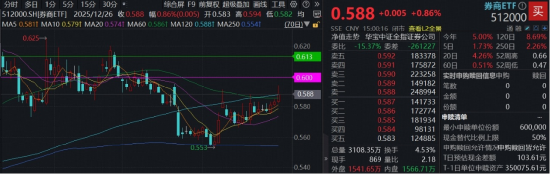
A股多项纪录收入囊中,滞涨券商放量躁动,顶流券商ETF(512000)上探近2%,2026或迎四大催化
Xin Lang Cai Jing· 2025-12-28 11:30
Core Viewpoint - The brokerage sector is experiencing a resurgence, with the top-performing brokerage ETF (512000) showing a price increase and significant trading volume, indicating renewed investor interest despite a lackluster performance throughout the year [1][9]. Group 1: Market Performance - The brokerage ETF (512000) has seen a year-to-date increase of only 3.96%, significantly lagging behind the broader market indices, which have shown much higher gains [3][11]. - The sector's price-to-book ratio (PB) stands at 1.5 times, which is at a low level compared to the historical average over the past decade [3][11]. - Individual stocks within the sector have shown positive movements, with notable gains from companies like China Merchants Securities and Industrial Securities [1][9]. Group 2: Future Growth Drivers - The brokerage industry is entering a new growth cycle driven by three core factors: the service of new productive forces, the influx of long-term capital, and opportunities for internationalization [5][13]. - By 2026, the sector is expected to benefit from four catalysts: increased market activity due to the relocation of household savings, enhanced market resilience leading to improved profitability, opportunities in direct financing for tech enterprises, and ongoing mergers and acquisitions among brokerages [14][15]. - Regulatory support for the development of first-class investment banks is anticipated to further enhance the sector's valuation and growth potential [15]. Group 3: Investment Tools - The brokerage ETF (512000) is a highly efficient investment tool that passively tracks the CSI All Share Securities Companies Index, encompassing 49 listed brokerage stocks [7][15]. - The ETF has a fund size exceeding 400 billion yuan and has maintained a daily trading volume of over 10 billion yuan, making it one of the most liquid ETFs in the A-share market [7][15].
招商证券半年减员1292人,董事长霍达加码境外业务谋突破
Xin Lang Cai Jing· 2025-12-25 03:17
Core Viewpoint - In 2025, China Merchants Securities is undergoing a dual transformation of "downsizing" and "business expansion" amid increasing differentiation in the brokerage industry, with a focus on optimizing personnel structure and enhancing international business capabilities [3][4][10]. Group 1: Financial Performance - In the first three quarters of 2025, the company achieved operating revenue of 18.244 billion yuan, a year-on-year increase of 27.8%, and a net profit attributable to shareholders of 8.871 billion yuan, up 24.1% year-on-year [3][10]. - Despite these growth figures, the performance is relatively weaker compared to other leading brokers, many of which reported revenue and profit growth exceeding 30% [3][10]. Group 2: Personnel and Compensation - As of June 30, 2025, the company reduced its workforce by 1,292 employees, bringing the total to 12,169, which is a significant reduction among top brokers [4][11]. - The total salary expenditure for employees was 2.631 billion yuan, a year-on-year increase of 4.15%, resulting in an approximate average monthly salary of 36,000 yuan per remaining employee [4][11]. - Compensation for key management personnel decreased by 36.43% year-on-year to 4.9819 million yuan, reflecting a trend of declining salaries amid performance pressures [4][11]. Group 3: Business Expansion and Strategy - The company is accelerating its business expansion, with Chairman Huo Da taking on multiple roles to enhance technology and international collaboration [5][12]. - The board approved a capital increase of up to 9 billion Hong Kong dollars for its wholly-owned subsidiary, with 4 billion Hong Kong dollars allocated to its Hong Kong operations, indicating a strategic focus on international business [5][12]. - The international business is seen as a key growth driver, with the company aiming to capture market share in overseas markets, particularly in Hong Kong and Southeast Asia [6][13]. Group 4: Industry Context and Challenges - The brokerage industry is experiencing a significant shift towards wealth management, with a net reduction of 7,330 employees across the sector in the first half of 2025, highlighting the transition from traditional brokerage services [4][11]. - The competitive landscape is intensifying, with leading firms like CITIC Securities and Guotai Junan dominating the market, as the top ten brokers account for 70% of the industry's net profits [6][13]. - The company's strategy of "reducing staff while enhancing efficiency" aligns with industry trends, as it reallocates resources towards technology and international business [6][13].


年内多家券商相继对子公司增资于宏
Zheng Quan Ri Bao· 2025-12-11 02:15
Group 1 - The core viewpoint of the articles highlights that multiple Chinese securities firms are actively increasing capital for their subsidiaries to enhance capital strength, market competitiveness, and service capabilities for the real economy [1][2][3] - The international business is becoming a new growth engine for securities firms, with firms like China Merchants Securities planning to inject up to 90 billion HKD into its international subsidiary, aiming to improve global trading and service capabilities [2][3] - In 2024, the international subsidiary of China Merchants Securities reported a revenue of 1.199 billion HKD and a net profit of 457 million HKD, with client asset management reaching 246.923 billion HKD, reflecting a 14.52% growth from the end of 2024 [2] Group 2 - Securities firms are also focusing on enhancing their futures and alternative investment subsidiaries to better serve the real economy, with East Wu Securities planning to invest 403 million CNY to increase the net capital of its futures subsidiary [3][4] - The registered capital of East Wu Futures will increase from 1.032 billion CNY to 1.532 billion CNY following the capital injection, which is part of the firm's strategy to optimize its business structure and enhance service capabilities [4] - The alternative investment subsidiaries are seen as crucial for supporting technological innovation, with firms like Guohai Securities announcing a 500 million CNY capital increase for its alternative investment subsidiary to strengthen its equity investment business [4]

年内多家券商相继对子公司增资
Zheng Quan Ri Bao· 2025-12-10 16:41
Group 1 - The core viewpoint of the article highlights that multiple Chinese securities firms are actively increasing capital for their subsidiaries to enhance capital strength, market competitiveness, and service capabilities for the real economy [1][2][3] Group 2 - The international business is becoming a new growth engine for securities firms, with firms accelerating their overseas market layout through capital increases for international subsidiaries [2][3] - For instance, China Merchants Securities announced a capital increase of up to 9 billion HKD for its wholly-owned subsidiary, with the first phase targeting China Merchants Securities (Hong Kong) Limited, amounting to no more than 4 billion HKD [2] - In 2024, China Merchants International achieved a revenue of 1.199 billion HKD and a net profit of 457 million HKD, with client asset scale reaching 246.923 billion HKD by mid-2025, reflecting a growth of 14.52% compared to the end of 2024 [2] Group 3 - Securities firms are also enhancing support for futures and alternative investment subsidiaries to better serve the real economy, with East Wu Securities planning to invest 403 million CNY to increase the net capital of its subsidiary, East Wu Futures [3][4] - The registered capital of East Wu Futures will increase from 1.032 billion CNY to 1.532 billion CNY following this capital increase [4] - Additionally, firms are focusing on alternative investments to support technology innovation, with Guohai Securities announcing a capital increase of 500 million CNY for its alternative investment subsidiary [4]
90亿港元!招证国际大手笔增资子公司,年内多家券商加码香港市场
Xin Lang Zheng Quan· 2025-12-10 02:23
Group 1 - The core announcement from China Merchants Securities is the approval for its wholly-owned subsidiary, China Merchants Securities International, to increase capital by up to 9 billion HKD, with an initial injection of 4 billion HKD into its subsidiary, China Merchants Securities (Hong Kong) [1] - China Merchants Securities International reported a significant growth in performance for the first half of 2025, achieving a revenue of 477 million HKD and a net profit of 128 million HKD [4][6] - The asset management scale of China Merchants Securities International increased to 17.31 billion HKD, reflecting a substantial rise of 62.91% compared to the end of the previous year [4] Group 2 - Several brokerage firms have increased their investments in Hong Kong subsidiaries this year, with China Merchants Securities' 9 billion HKD capital increase being the largest in the industry [7] - The internationalization of Chinese brokerage firms has created a tiered structure, with leading firms like CICC, CITIC Securities, and Huatai Securities showing significant contributions from international business [7][11] - The profitability of major overseas subsidiaries has seen remarkable growth, with many firms reporting net profit increases exceeding 160%, driven by an active Hong Kong stock market and rising cross-border financing demands [10][11]
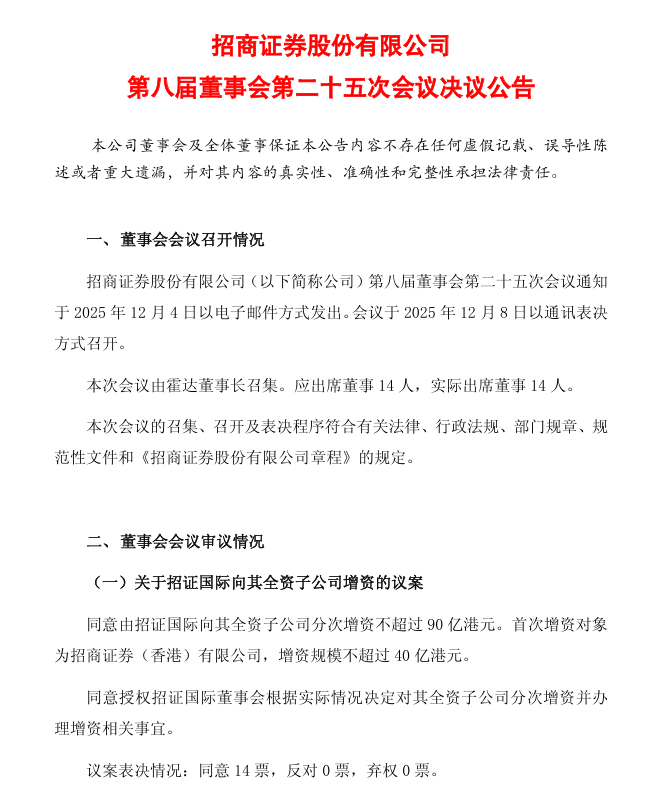
招证国际拟向其全资子公司分次增资不超90亿港元;公募今年以来自购达8400次 | 券商基金早参
Mei Ri Jing Ji Xin Wen· 2025-12-09 01:27
Group 1 - The core point of the news highlights that 136 public fund companies have initiated buybacks totaling 8,400 times this year, indicating strong long-term confidence in the market from public funds [1][2] - Stock and mixed funds have seen significant net subscriptions of 2.262 billion yuan and 1.954 billion yuan respectively, reflecting institutional preference for equity assets, which may boost valuations in related sectors [1][2] - Leading fund companies are actively positioning themselves, showcasing optimism for future market performance, which could guide market sentiment and enhance investor trust in the capital market [2] Group 2 - China Merchants Securities announced a plan to incrementally increase capital for its wholly-owned subsidiary, China Merchants Securities International, by up to 9 billion HKD, with an initial injection of 4 billion HKD [3] - This substantial capital operation underscores the strategic commitment of China Merchants Securities to strengthen its presence in Hong Kong and reflects the competitive landscape among leading brokerages in international markets [3][4] - The increase in capital is expected to enhance the capital strength of the Hong Kong subsidiary, supporting its business expansion and potentially leading to a reassessment of the competitiveness of major brokerages in overseas markets [4] Group 3 - The public fund issuance market remains robust, with 38 new funds expected to launch this week, maintaining a high level of activity as the year comes to a close [4] - Equity products dominate the new fund offerings, with 21 out of 38 being equity-related, accounting for 55.26% of the total, indicating strong demand for equity asset allocation [4] - The popularity of index funds, particularly passive and enhanced index products, suggests an increasing flow of funds into core index constituents, which may enhance liquidity in related stocks [4]
国联民生证券总裁葛小波:国际化是成就一流投行必由之路
券商中国· 2025-12-03 23:40
Core Viewpoint - The internationalization of Chinese securities firms is essential for building a first-class investment bank and responding to the national financial power strategy, with a focus on creating a multi-tiered, competitive industry structure [2]. Group 1: Internationalization of Securities Firms - The globalization of Chinese enterprises has evolved from mere market expansion to participating in global governance and building new international relations, making the international development of securities firms crucial for enhancing industry competitiveness [2]. - The demand for global services from Chinese enterprises creates a "blue ocean" for domestic securities firms, driven by industrial upgrades and supply chain restructuring, leading to diverse financial needs such as cross-border mergers and acquisitions, overseas listings, and global bond issuance [2]. - China's capital market's deepening two-way opening provides policy pathways for the internationalization of securities firms, supported by initiatives like the Belt and Road and global development initiatives [2]. Group 2: Mature Models of Foreign Investment Banks - Three mature development models of foreign investment banks are identified: 1. Project-driven model represented by Goldman Sachs and Morgan Stanley, focusing on M&A, IPOs, and structured financing [4]. 2. Comprehensive universal bank model represented by Citigroup and HSBC, integrating commercial banking with investment banking [4]. 3. Boutique investment bank model represented by Evercore and Lazard, specializing in specific sectors or services [4]. Group 3: Strategies for Internationalization - Chinese securities firms should leverage overseas financing tools and acquisition opportunities, as exemplified by CITIC Securities, which increased its overseas revenue share to 15%-20% through strategic moves [5]. - There is a need for improvement in the cross-border services provided by Chinese securities firms, as some have faced losses in overseas operations, highlighting the importance of capital strength, talent reserves, and risk management capabilities [5]. - The internationalization strategy should focus on three key aspects: serving the real economy, providing differentiated global asset allocation advice from a Chinese perspective, and building a "technology + finance" competitive advantage [5]. Group 4: Policy Recommendations for Internationalization - To build a financial powerhouse, it is essential to cultivate investment banks with global resource allocation capabilities, which requires a supportive ecosystem involving policy, academia, industry, and media [6]. - Recommendations include improving top-level design for outbound policies, optimizing the policy environment for overseas institutions, and encouraging overseas mergers and acquisitions to enhance competitiveness [6].