司法公正

Search documents
筑牢有效辩护的程序防线(人民时评)
Ren Min Ri Bao· 2026-01-05 00:18
Core Viewpoint - The recent issuance of the "Regulations on the Legal Protection of Lawyers' Right to Review Case Files" by the Supreme People's Procuratorate and the Ministry of Justice aims to enhance the legal environment for lawyers, ensuring that their rights are respected and that they can effectively defend their clients [1][2]. Group 1: Legal Environment for Lawyers - The protection of lawyers' right to review case files is crucial for ensuring effective defense and maintaining judicial fairness [1][2]. - The introduction of mechanisms for on-site, remote, and online file reviews is intended to improve the quality of defense and create a more balanced relationship between prosecution and defense [1][3]. - The continuous improvement of the rights protection mechanism for lawyers is aimed at enhancing their role in ensuring fair trials in every case [2][3]. Group 2: Judicial Process and Public Trust - A comprehensive understanding of case files by lawyers is essential for reducing wrongful convictions and safeguarding judicial credibility [2]. - The judicial process must reflect fairness and justice not only in outcomes but throughout all procedural steps, including thorough evidence examination and objective court defenses [2][3]. - The promotion of digital solutions for file reviews aligns with the demands of modern judicial practices and aims to reduce the economic burden on parties involved [3]. Group 3: Collaborative Efforts and Accountability - Establishing a rapid response mechanism for addressing obstacles faced by lawyers in exercising their rights is critical for maintaining a healthy legal environment [3]. - Collaboration among judicial administrative bodies and bar associations is necessary to ensure effective oversight and accountability in protecting lawyers' rights [3]. - The emphasis on fairness and justice serves as a benchmark for the public's perception of legal system improvements [3].
“獬豸之精”徐有功的坚守与刚直
Xin Lang Cai Jing· 2026-01-01 23:53
Core Viewpoint - The article highlights the significant contributions of Xu Yougong, a prominent legal official during the Tang Dynasty, emphasizing his commitment to fair justice and adherence to legal principles despite the political turmoil of his time [1][2][3][4][5]. Group 1: Xu Yougong's Legal Philosophy and Actions - Xu Yougong is recognized for his rigorous legal interpretations and his ability to maintain fairness in judicial proceedings, earning him the title of "the essence of the Xie Zhi" [1]. - He demonstrated a consistent approach to justice, advocating for the innocent and challenging wrongful accusations, even in the face of political pressure from figures like Wu Zetian [2][3]. - His legal reasoning often involved referencing established laws and principles, such as the "Yongchang Pardon" and the "Tang Law Commentary," to defend his positions [2]. Group 2: Political Challenges and Resilience - Xu Yougong faced significant political challenges, including being implicated in conspiracies and enduring multiple dismissals from office, yet he remained steadfast in his principles [3][4]. - His career was marked by a series of ups and downs, including three major falls from grace, yet he consistently returned to serve in judicial roles, demonstrating resilience [3][4]. - Despite the risks, he maintained a commitment to justice, famously stating that "human life is at stake, and one cannot use deceitful words to seek mere survival" [3]. Group 3: Comparisons with Other Legal Figures - Xu Yougong's legal acumen is compared favorably to other historical figures such as Zhang Shizhi and Yu Dingguo, particularly in the context of the political environments they operated in [5]. - The article notes that while other legal officials worked in more stable political climates, Xu Yougong's challenges were compounded by the tumultuous nature of his era, making his achievements more remarkable [5]. - His dedication to justice in a time of rampant corruption and political intrigue has led to a higher regard for his contributions compared to his predecessors [5].
爱泼斯坦案最新进展!美司法部:仍有约520万页文件待审
Mei Ri Jing Ji Xin Wen· 2026-01-01 00:54
Core Points - The U.S. Department of Justice (DOJ) has approximately 5.2 million pages of documents related to the Epstein case that require review, with around 400 lawyers involved in the process, expected to last until late January 2026 [1] - The DOJ has released some documents related to the Epstein case, but many have been heavily redacted, leading to public criticism regarding the transparency of the release [2][3] - A recent law passed by Congress required the DOJ to release Epstein-related documents by December 19, 2025, but the DOJ indicated that the review and release process may take several more weeks due to the volume of documents [3] Summary by Sections Document Review Process - The DOJ is currently reviewing about 5.2 million pages of documents related to the Epstein case, with the review expected to continue until late January 2026 [1] - The review involves necessary redactions to protect the privacy of victims [1] Public Disclosure and Controversy - Recently released documents have been criticized for being excessively redacted, with some individuals questioning the extent of the redactions and suggesting that important information may be hidden [2] - A victim of the Epstein case expressed concerns that the redacted documents do not align with the requests for privacy, indicating that the redactions may be overreaching [2] Legislative Actions - On November 18, 2025, Congress passed a bill requiring the DOJ to publicly disclose Epstein-related documents by December 19, 2025 [3] - Despite the deadline, the DOJ has stated that the review process may extend beyond the deadline due to the large volume of documents discovered [3]


“最后一公里”的公正值得“较真”
Xin Lang Cai Jing· 2025-12-31 12:42
Core Viewpoint - The implementation of judicial fairness extends beyond the moment the gavel strikes, emphasizing the importance of effectively executing penalties in the "last mile" of justice [1] Group 1: Judicial Practice and Case Examples - The Supreme People's Procuratorate has released the 60th batch of guiding cases, focusing on key nodes in the supervision of penalty execution through three typical cases [1] - These cases highlight the importance of meticulous attention to detail in judicial practice, addressing issues such as the deduction during probation periods, the calculation standards for the start of sentence reductions, and the applicable procedures for sentence reduction decisions [1] - The emphasis on detail is not merely nitpicking but represents a proactive practice of accurately applying the principles of criminal policy and the correspondence between crime and punishment, reflecting the protection of the rights of incarcerated individuals [1] Group 2: Judicial Principles and Fairness - The commitment to "strictly according to the law" does not equate to mechanical justice; judicial proceedings must also consider the effective implementation of legal spirit and principles [2] - This dedication to detail is an inherent requirement of judicial practice that promotes the transformation of legal texts into real-world fairness and justice, allowing the public to feel the warmth of the rule of law in every case [2]
发现超100万份爱泼斯坦案文件
Xin Lang Cai Jing· 2025-12-25 18:25
Group 1 - The U.S. Department of Justice (DOJ) has discovered over 1 million documents potentially related to the late financier Jeffrey Epstein's case, requiring several weeks for review before release [1] - The DOJ has previously released nearly 30,000 pages of Epstein-related documents, some of which contain information about former President Donald Trump, leading to claims of misinformation [2] - The DOJ's handling of the documents has faced criticism for being selective, with accusations of obscuring key information under the guise of protecting privacy [3] Group 2 - The DOJ's recent document releases have sparked controversy, with significant portions being redacted, including at least 550 pages that were initially completely blacked out [2] - The release of documents has been perceived as an attempt to shift focus onto former President Bill Clinton, raising concerns about the DOJ's motives and the integrity of the judicial process [3] - Analysts suggest that the DOJ's actions are merely a superficial response to congressional and public demands, with substantial information still concealed [3]
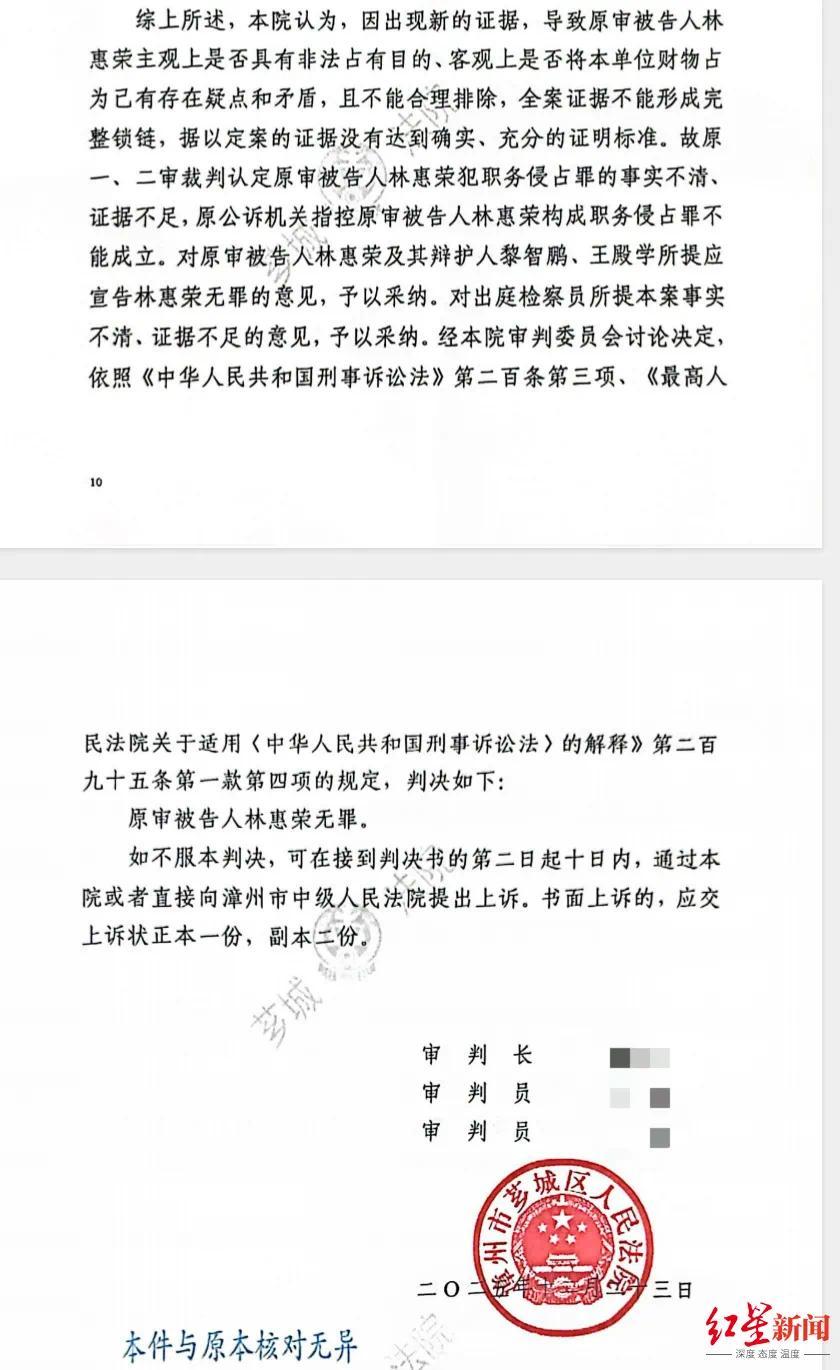
服刑7年出狱5年,始终没认罪!福建女商人林惠荣坚持申诉,今天被改判无罪
Mei Ri Jing Ji Xin Wen· 2025-12-23 12:36
Core Viewpoint - The case of Lin Huirong, a former businesswoman from Fujian, has culminated in a not guilty verdict after a lengthy legal battle, highlighting issues of evidence sufficiency and judicial fairness in the context of corporate governance and criminal law [1][11]. Group 1: Case Background - Lin Huirong was the legal representative of Jinfurong Trading (Fujian) Co., Ltd., which was established in 2010 with a registered capital of 10 million yuan [2]. - The company faced operational difficulties due to financial constraints, leading to a partnership agreement where Lin Huirong held 40% of the shares and other partners held 60% [2]. - Disputes arose in 2012 regarding financial misconduct, resulting in the withdrawal of goods valued at over 1.6 million yuan by the partners [2]. Group 2: Legal Proceedings - In May 2016, Lin Huirong was convicted of embezzlement and sentenced to seven years in prison, a decision upheld by the appellate court later that year [3][4]. - Throughout her imprisonment, Lin maintained her innocence and continued to appeal her conviction, even after her release in 2020 [5]. Group 3: New Evidence and Reassessment - The case saw a significant turning point with the emergence of new evidence, particularly regarding the legitimacy of the shareholding claims made by the other partners [6][8]. - A judicial review in May 2023 led to a re-examination of the case, with the higher court finding that the original evidence was insufficient and unclear [7]. Group 4: Final Verdict and Implications - On December 23, 2025, the court ruled Lin Huirong not guilty, citing doubts about her intent to illegally occupy shares and the lack of conclusive evidence [9][11]. - The ruling emphasizes the importance of evidence-based judgments in criminal cases and reflects a commitment to correcting judicial errors, aligning with national policies to protect private enterprises [11].
超过500页被涂黑 多处提及克林顿
Xin Lang Cai Jing· 2025-12-21 17:39
Core Viewpoint - The release of documents related to Jeffrey Epstein's case by the U.S. Department of Justice has sparked widespread criticism due to extensive redactions, raising questions about transparency and the political implications surrounding the case [1][3][10]. Group 1: Document Release and Political Context - The U.S. Department of Justice was compelled by a bipartisan congressional law to begin releasing documents related to Epstein's case by December 19, 2025, following his death in 2019 while awaiting trial for operating a sex trafficking network [2][3]. - The initial release included approximately 4,000 documents, but the majority were heavily redacted, with over 1,200 victims' information obscured, leading to accusations of a cover-up [3][10]. - The release coincided with a politically charged environment, as Democratic lawmakers preemptively disclosed sensitive images, which they claimed were part of a larger trove of evidence, to shift public focus and pressure the Justice Department [4][5]. Group 2: Key Findings from Released Documents - The documents revealed significant connections between former President Bill Clinton and Epstein, including previously unseen photographs and flight logs indicating Clinton flew on Epstein's private jet 26 times, contradicting earlier claims of limited interaction [6][7]. - Financial records disclosed communications between JPMorgan Chase executives and Epstein, highlighting suspicious transactions that coincided with allegations of payments to victims, suggesting potential complicity in his criminal activities [7][8]. - The extensive redactions in the documents have led to bipartisan criticism, with lawmakers from both parties expressing dissatisfaction over the lack of transparency and the incomplete nature of the released materials [8][9].
西安碑林法院 | 八年欠款终追回,一面锦旗照亮司法为民初心
Xin Lang Cai Jing· 2025-12-19 11:15
Core Viewpoint - A long-standing contract dispute lasting eight years has been resolved in favor of the plaintiff, highlighting the importance of evidence in legal proceedings and the commitment of the judiciary to uphold justice [2][5][6]. Group 1: Background of the Dispute - The dispute originated in 2016 when the plaintiff began supplying goods to the defendant based on mutual trust, which deteriorated after the defendant issued a promissory note for unpaid debts [2]. - Over the years, the plaintiff made numerous attempts to collect the debt, which grew significantly, leading to a legal battle over a total amount exceeding 30,000 yuan [2]. Group 2: Court Proceedings - The defendant did not appear in court, prompting the judge to emphasize the need for evidence to clarify the facts of the case [3]. - The court meticulously examined the authenticity of the promissory note, the completeness of the WeChat chat records, and the relevance of transfer receipts, with the acknowledgment of the debt in the chat records being crucial for establishing a factual contract relationship [3][5]. Group 3: Court Judgment - The court concluded that despite the absence of a written contract, sufficient evidence existed to confirm a de facto sales contract, with the defendant found liable for breach of contract due to prolonged non-payment [5]. - The court ordered the defendant to pay the overdue amount of 32,376 yuan along with interest calculated from November 2017, reflecting the value of time and the judiciary's commitment to uphold integrity in transactions [5]. Group 4: Community Impact - The plaintiff expressed gratitude towards the court's fair judgment by presenting a banner, symbolizing recognition of the court's dedication to serving the public and addressing community concerns [6]. - The court aims to continue its mission of "people-centered" justice, ensuring that citizens experience fairness and justice in every legal case [6].

倾听群众心声 做实定分止争
Ren Min Ri Bao· 2025-11-16 22:31
Core Insights - The "People's Diary" from Shengzhou, Zhejiang, has evolved over 27 years into a significant tool for practicing the Party's mass line, focusing on grassroots governance and judicial fairness [1] Group 1: Judicial Practices - The Shengzhou Court has integrated the wisdom of the "People's Diary" into its judicial processes, systematically collecting and analyzing public sentiment to enhance judicial services at the grassroots level [1][3] - A case involving a custody dispute highlighted the importance of understanding the emotional context of litigants, leading to a resolution that respected the child's wishes and improved the mother's attitude towards the court's decision [2][3] Group 2: Community Engagement - The Shengzhou Court has created a special "Custody and Visitation Archive" documenting the growth of 218 minors across 185 cases, reflecting the local demographic challenges of high labor migration and family separation [3] - The court collaborates with community organizations to facilitate emotional communication and social support, achieving "zero compulsory enforcement" in custody cases [3] Group 3: Data-Driven Judicial Improvements - The Shengzhou Intermediate People's Court has implemented a digital application called "Judicial Justice Online," allowing parties to evaluate and provide feedback on their cases through QR codes, enhancing public engagement [3][4] - The court has identified a rising trend in labor dispute cases among new employment forms, such as delivery workers and ride-hailing drivers, and has responded by refining judicial guidelines and improving dispute resolution channels [4][5] Group 4: Future Directions - The Shengzhou Court aims to deepen the "People's Diary" mechanism, ensuring that public demands for justice are met accurately and effectively, thereby enhancing the perception of judicial fairness [5]
AI编造“完美”案例,为司法带来虚假信息风险
Xin Jing Bao· 2025-11-12 13:05
Core Viewpoint - The article highlights the risks associated with the use of AI-generated information in judicial processes, particularly focusing on a case where a lawyer submitted a fabricated legal precedent created by AI, which could have misled the court [1][2]. Group 1: AI in Legal Proceedings - The case illustrates how AI-generated false information can enter judicial proceedings, potentially compromising judicial fairness [3]. - The reliance on AI for generating legal references raises concerns about the authenticity and accuracy of such information, emphasizing the need for human verification [2][4]. Group 2: Responsibilities of Legal Practitioners - Legal practitioners must ensure the accuracy of the references they submit to the court, as the responsibility cannot be shifted to AI tools [2][4]. - The article stresses that even if AI is used as an auxiliary tool, the ultimate responsibility lies with the legal professionals to verify the information before submission [2][4]. Group 3: Judicial Oversight - Judges have a critical role in verifying the authenticity of submitted references, especially in an era where AI is increasingly utilized [2][4]. - The case underscores the importance of judicial vigilance and the need for judges to be well-versed in AI applications to effectively identify potential issues [2][4].