
未来能源

Search documents
国家创业投资引导基金将重点支持新兴产业和未来产业
Yang Shi Xin Wen· 2025-12-26 06:25
Group 1 - The National Venture Capital Guidance Fund will better support the development of emerging and future industries, establishing a national comprehensive service platform to provide value-added services to invested enterprises [1] - The fund will focus on early-stage projects and seed companies in key areas such as integrated circuits, artificial intelligence, aerospace, low-altitude economy, biomanufacturing, and future energy, increasing investment efforts [1] - The guidance fund aims to create a high-quality, comprehensive entrepreneurial investment service system, offering governance, strategic planning, human resources, and industry cooperation services to accompany the growth of enterprises over the long term [1]

创投引导基金将对多个领域的早期项目和企业加大投资力度
2 1 Shi Ji Jing Ji Bao Dao· 2025-12-26 06:21
12月26日,国家创业投资引导基金正式启动。国家发展改革委召开专题新闻发布会。会上,国家发展改 革委创新和高技术发展司司长白京羽表示,下一步,引导基金将与基金管理机构一起,重点围绕创新创 业活跃地区,对集成电路、人工智能、航空航天、低空经济、生物制造、未来能源等领域的早期项目和 企业加大投资力度,努力带动各类金融机构以及民间资本共同投资。 (文章来源:21世纪经济报道) ...
聚焦六大领域!国家创业投资引导基金启动
Xin Lang Cai Jing· 2025-12-26 05:40
国家发展改革委创新和高技术发展司司长白京羽称,下一步,引导基金将与基金管理机构一起重点围绕 创新创业活跃地区,对集成电路、人工智能、航空航天、低空经济、生物制造、未来能源等领域的早期 项目和企业加大投资力度。 国家创业投资引导基金12月26日启动,京津冀创业投资引导基金、长三角创业投资引导基金、粤港澳大 湾区创业投资引导基金三只区域基金设立运行。首批三只区域基金出资方案已落实,每只具备500亿元 以上规模。 ...
国家发改委:国家创业投资引导基金将加大人工智能等领域种子企业投资
Sou Hu Cai Jing· 2025-12-26 04:43
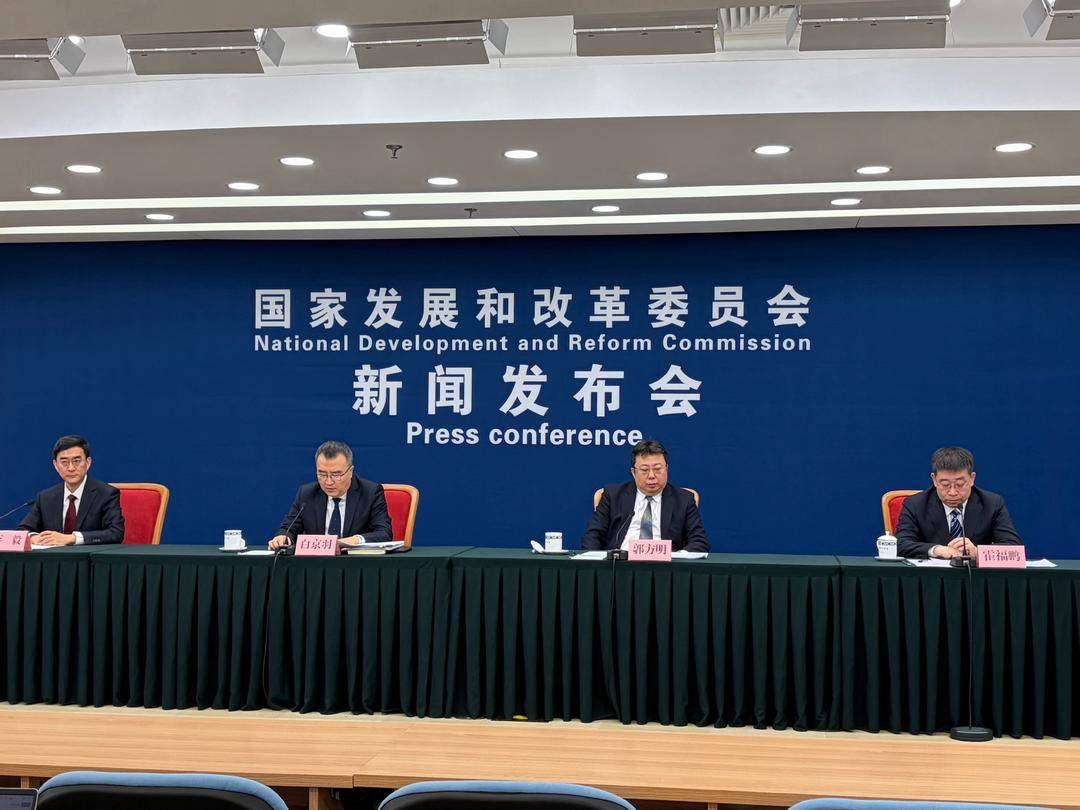
封面新闻记者 张馨心 12月26日,国家创业投资引导基金启动。同日,国家发展改革委举行新闻发布会,创新和高技术发展司司长白京羽表示,国家创业投资引导基金将对人工 智能、低空经济等领域早期项目和种子企业加大投资力度。 他介绍,近年来,国家发展改革委大力推动战略性新兴产业和未来产业发展,培育了一批代表国家参与全球竞争的科技领军企业。但我国新兴产业、未来 产业发展还存在资金等创新要素投入不足等问题,亟需通过发展耐心资本加以解决。 他表示,下一步,将引导基金汇聚各类社会资本,为新兴产业、未来产业注入金融活水。引导基金将与基金管理机构一道,重点围绕创新创业活跃地区, 对集成电路、人工智能、航空航天、低空经济、生物制造、未来能源等领域的早期项目和种子企业,加大基金投资力度,努力带动各类金融机构以及民间 资本共同投资。 此外,要集聚各类创新要素,为创新型企业发展提供优质服务。在提供资金支持的同时,引导基金还将打造高质量、广覆盖、全方位的创业投资服务体 系,通过搭建全国性综合服务平台,向被投企业提供公司治理、战略规划、人力资源、产业合作等增值服务,长期陪伴企业成长。 12月26日,国家发展改革委举行新闻发布会,介绍国家创业投 ...

发改委:引导基金将对集成电路、人工智能等领域的早期项目和企业加大投资
Xin Hua Cai Jing· 2025-12-26 03:19
Core Insights - The National Venture Capital Guidance Fund has officially launched, focusing on early-stage investments in high-growth potential sectors [1][2] - The fund aims to address the long-term capital shortage in the venture capital industry by not competing with the market and avoiding duplicate investments [1] Group 1: Fund Characteristics - The fund emphasizes early-stage investments, targeting seed and startup companies that have high growth potential but also significant risks [1] - It is designed as a patient fund with a 20-year lifespan, including a 10-year investment period and a 10-year exit period, allowing for long-term capital support [1] - The fund operates under market-oriented principles while balancing policy objectives, ensuring it does not engage in profit competition with the market [1] Group 2: Investment Focus - The fund will increase investment in early-stage projects and companies in sectors such as integrated circuits, artificial intelligence, aerospace, low-altitude economy, biomanufacturing, and future energy [2] - It aims to gather various social capital to integrate financial models into future industries, collaborating with fund management institutions to drive investment [2] - The fund will also provide a comprehensive service system for innovative enterprises, offering support in governance, strategic planning, human resources, and industry collaboration [2]

创业投资引导基金正式启动
清华金融评论· 2025-12-26 03:07
12月26日,国家创业投资引导基金正式启动,京津冀创业投资引导基金、长三角创业投资引导基金、粤港澳大湾区创业投资引导基金三只区 域基金设立运行。 国家发展改革委召开专题新闻发布会。会上,国家发展改革委创新和高技术发展司司长白京羽表示,国家创业投资引导基金的定位具备四个 特点: 一是坚持做早期基金。 今天的科技领军企业都是曾经的种子企业、初创企业,这类种子企业和初创企业成长性好,前景广阔,但同时 风险也比较高,不确定性比较大。社会资本对他们普遍很关注,但投资持谨慎态度。针对这一问题,引导基金将种子期、初创期、早中期企 业作为投资的重点,支持企业聚焦前沿领域,开展原创性、颠覆性的技术攻关; 二是坚持做耐心基金 。科创企业成长壮大是一场旷日持久的 马拉松,需要资本的耐心陪伴,引导基金设置20年存续期,其中10年投资期,10年退出期,通过更长久的投资期限,为企业提供长周期的资 金供给,又通过更宽松的退出机制,为企业提供更多的发展空间; 三是坚持做市场化基金。 中央出资设立创业投资引导基金,需要统筹兼顾 政策目标和市场化原则; 四是做标杆基金。 引导基金不搞重复投资,不与市场争利,重在解决创投行业长期资本短缺的问题。 ...

午后异动!600779,直线拉升涨停
证券时报· 2025-12-25 09:28
Market Overview - On the 25th, A-shares saw a collective rise in the three major indices, with the Shanghai Composite Index achieving a seven-day winning streak, closing up 0.47% at 3959.62 points. The Shenzhen Component Index rose 0.33%, and the ChiNext Index increased by 0.3%. The North Star 50 Index gained 0.86%, with total trading volume across the three markets reaching 19,440 billion yuan, an increase of 467 billion yuan from the previous day [1]. Robotics Sector - The humanoid robot concept experienced a strong surge, with stocks like Haoshi Electromechanical and Chaojie Co., both hitting the 20% limit up and reaching new highs. Other notable performers included Aifute and Qiangrui Technology, which rose over 13%, and Ruikeda, which increased nearly 10% [3][4]. - UBTECH, a leading humanoid robot company, announced plans to acquire approximately 43% of the shares of Fenglong Co. through a combination of agreement transfer and tender offer. This move aims to enhance its industrial chain layout and strengthen its core competitiveness. UBTECH has secured nearly 1.4 billion yuan in humanoid robot orders this year, with plans for mass production of the Walker S2 model starting in November 2025 [5][6]. Military Industry - The military sector showed strong performance, with stocks like Guanglian Aviation hitting the 20% limit up and Zhenlei Technology rising nearly 17%. Other stocks such as Xinwei Communication and Shenjian Co. also saw significant gains [8][9]. - The "14th Five-Year Plan" highlights various industries related to military technology, including commercial aerospace and low-altitude economy, which are expected to become trillion-yuan markets. Military companies are encouraged to expand in these areas to sustain growth [10]. Alcohol Sector - The alcohol sector rebounded, with Shuijingfang hitting the limit up, reflecting a broader recovery in the industry. Other companies like Sanlian and Qianmin Wine also saw gains [11][12]. - Analysts indicate that the current valuation of the liquor sector is at historical lows, presenting strong bottom-fishing opportunities. The focus is on companies that can adapt to real consumer demands and optimize supply-demand structures [14][15].


ETF盘中资讯 | 商业航天热度持续高涨,高德红外、北斗星通涨停!军工ETF华宝(512810)创9月4日以来新高!
Jin Rong Jie· 2025-12-22 08:11
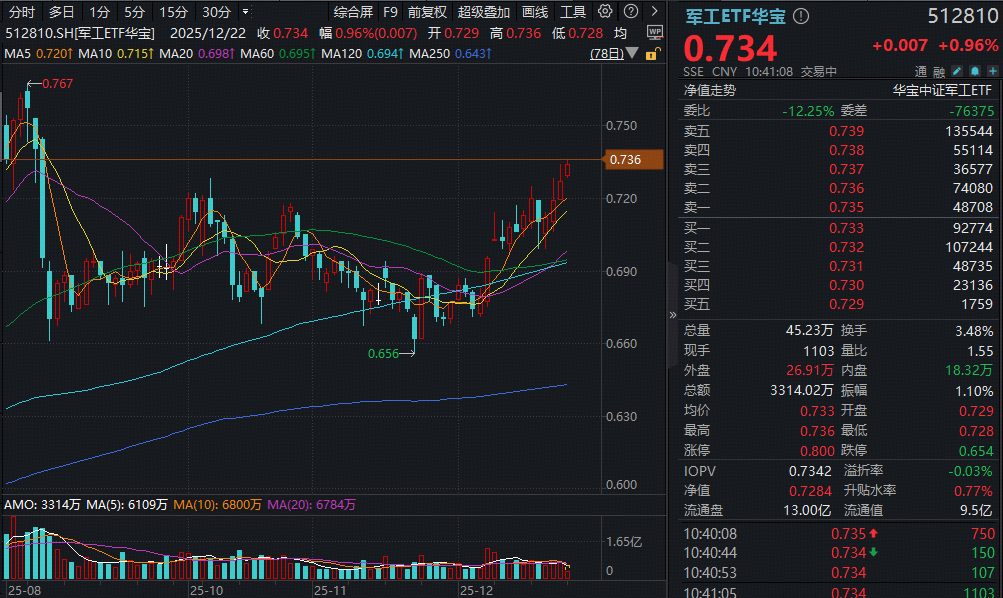
Core Viewpoint - The military industry sector is experiencing active performance, with commercial aerospace concept stocks leading the gains, indicating a shift in investment interest towards defense and aerospace sectors [1] Group 1: Military Industry Performance - The military sector showed strong activity on December 22, with stocks like Gaode Infrared and Beidou Star reaching their daily limit, and China Satellite rising nearly 8% [1] - The popular military ETF, Huabao (512810), reached a peak price of 1.24%, marking a new high since September 4, with real-time transaction volume exceeding 33 million yuan [1] Group 2: Industry Development Trends - According to CITIC Construction Investment, China's military industry has evolved from relying solely on domestic demand to a new development pattern driven by three engines: domestic demand, foreign trade expansion, and civilian applications supporting military needs [2][4] - The military industry is transitioning from "cyclical growth" to "comprehensive growth," indicating a more sustainable and diversified growth model [2] Group 3: Demand and Growth Drivers - The first curve of domestic military demand focuses on "preparation for combat" and equipment modernization, supported by stable growth in defense budgets and equipment upgrades [3] - The second curve involves military trade expansion, where China's competitive pricing and systematic operational capabilities are enhancing its global market share [4] - The third curve highlights the spillover of advanced military technology into civilian sectors, fostering new industries such as commercial aerospace and low-altitude economy, creating a positive feedback loop for military and civilian integration [4] Group 4: Investment Opportunities - The Huabao military ETF (512810) encompasses both traditional military forces and emerging sectors, covering themes like commercial aerospace, deep-sea technology, military AI, low-altitude economy, and large aircraft, making it an efficient investment tool for the defense sector [4]

商业航天热度持续高涨,高德红外、北斗星通涨停!军工ETF华宝(512810)创9月4日以来新高!
Xin Lang Cai Jing· 2025-12-22 02:58
Core Viewpoint - The military industry sector is experiencing active performance, with commercial aerospace concept stocks leading the gains, indicating a shift in investment dynamics and growth potential in the sector [1][5]. Group 1: Market Performance - On December 22, the military sector showed strong activity, with stocks like High De Infrared and Beidou Star reaching their daily limit, and China Satellite rising nearly 8% [1][5]. - The popular military ETF, Huabao (512810), saw its price peak at 1.24%, marking a new high since September 4, with real-time transaction volume exceeding 330 million yuan [1][5]. Group 2: Industry Development - According to CITIC Securities, China's military industry has evolved from relying solely on domestic demand to a new development pattern driven by three engines: domestic demand foundation, foreign trade expansion, and civilian backfeeding [6][7]. - The industry is transitioning from "cyclical growth" to "comprehensive growth," reshaping its landscape and boundaries [6][7]. Group 3: Demand Drivers - The first curve focuses on domestic military demand, driven by stable growth in defense budgets and equipment modernization [7]. - The second curve emphasizes military trade expansion, where China's competitive pricing and strategic partnerships are enhancing its global supply share [7]. - The third curve highlights the spillover of military technology into civilian applications, fostering new industries like commercial aerospace and low-altitude economy, creating a virtuous cycle of "military technology benefiting civilian sectors" [7]. Group 4: Investment Tools - The Huabao military ETF (512810) covers both traditional military forces and emerging sectors, including commercial aerospace, deep-sea technology, military AI, low-altitude economy, and large aircraft, serving as an efficient investment tool for the defense sector [7].
建立完善绿色金融支持绿色工厂工作机制|营商环境周报
2 1 Shi Ji Jing Ji Bao Dao· 2025-12-15 07:37
Group 1: Policy Initiatives - The Ministry of Commerce, the People's Bank of China, and the Financial Regulatory Bureau jointly issued a notification to enhance financial support for key consumption areas and promote new consumption development [1] - The notification emphasizes the need for collaboration between business and financial systems, encouraging local departments to strengthen communication and cooperation [1] - Financial institutions are encouraged to optimize products and services around five key areas: upgrading commodity consumption, expanding service consumption, fostering new consumption, innovating diverse consumption scenarios, and supporting consumption assistance [1] Group 2: Investment and Infrastructure - The National Development and Reform Commission highlighted the importance of using new policy financial tools to improve capacity governance in key industries and major infrastructure regulation [2] - The meeting called for measures to stabilize investment, including increasing central budget investments and utilizing various government investment funds [2] - It also emphasized the need to optimize consumption policies and remove unreasonable restrictions in the consumption sector [2] Group 3: Green Finance - The Ministry of Industry and Information Technology and the People's Bank of China issued a notification to establish a green finance support mechanism for green factory construction [3] - The notification identifies key support areas such as major technological innovations in traditional industries and zero-carbon factory projects [3] - Financial institutions are encouraged to develop green finance plans and enhance credit support for green factory initiatives [3] Group 4: Local Initiatives - Beijing Economic-Technological Development Area aims to cultivate a future energy industry worth over 50 billion by 2028, focusing on new energy and future energy sectors [5] - The measures include supporting the development of new energy storage technologies and clean energy sectors like wind, solar, and hydrogen [5] - The initiative also emphasizes the importance of key technology innovation and the establishment of public service platforms for future energy [6] Group 5: Scene Innovation - Hubei Province plans to establish a scene innovation service platform by 2027, providing over 1,000 scene services annually [7] - The plan focuses on 20 key areas, including digital economy, manufacturing, emergency management, and healthcare [7] - A diversified financial service system will be constructed to support scene cultivation and application, utilizing government funds and market investments [7]