
煤价反弹

Search documents
6月动力煤价格低点或是全年低点 机构看好未来主焦煤供给偏紧+资源稀缺态势延续(附概念股)
Zhi Tong Cai Jing· 2025-07-29 00:06
Group 1 - The core viewpoint indicates that the coal supply-demand situation in China is generally loose, with prices continuing to decline, prompting regulatory measures to stabilize the market [1][2] - The recent increase in coking coal prices is seen as a potential rebound, but its sustainability depends on whether production cuts are realized and if iron output meets expectations [1][2] - The long-term outlook suggests that the supply of premium coking coal will remain tight due to both quality and quantity declines, with domestic high-quality coking coal being irreplaceable by imports [1][2] Group 2 - The report from CICC suggests that coal supply in the second half of the year may be released more rationally, with potential price rebounds aiding industry profitability recovery [2] - It is anticipated that after the summer peak, there may be adjustments in the pace of thermal coal price recovery, but support is expected to strengthen with the onset of the heating season in October [2] - The coal industry chain includes companies such as China Coal Energy (01898), Yancoal Australia (03668), Yanzhou Coal Mining Company (01171), China Shenhua Energy (01088), and China Qinfa (00866) [3]
中金2025下半年展望 | 煤炭:供需修复,煤价反弹
中金点睛· 2025-07-28 23:46
Core Viewpoint - The coal supply is expected to be released more rationally in the second half of the year, combined with marginal improvements in demand, leading to an overall rebound in coal prices, which will support industry profit recovery [1][4]. Group 1: Industry Profitability and Price Trends - The sustainability of profitability in the coal industry is crucial, with companies having relatively good profit capabilities, lighter balance sheets, and attractive dividends amid an "asset shortage" [4][6]. - The domestic electricity demand is projected to grow steadily, with a forecasted year-on-year growth rate of 5-6% by 2025, which will support coal demand recovery in the second half of the year [4][26]. - The coal price is expected to rebound after the summer peak season, with the low point in June likely being the lowest for the year [4][48]. Group 2: Supply and Demand Dynamics - The coal production in the first half of the year reached a historical high, with a year-on-year increase of 5.4% to 2.405 billion tons, primarily driven by high production levels in Shanxi [41][43]. - The government is taking measures to ensure rational coal supply release, which is expected to alleviate the "quantity compensating price" situation and enhance safety in coal production [42][48]. - The coal import volume decreased by 11.1% year-on-year in the first half of the year, primarily due to inventory pressures and price discrepancies between domestic and international markets [45][46]. Group 3: Coking Coal Market Outlook - Coking coal prices are expected to rebound, but the sustainability of this rebound depends on whether production cuts can be realized [5][54]. - The domestic coking coal production is nearing its peak, with future supply largely dependent on imports from Mongolia, which may limit the price rebound potential [55][56]. - The market anticipates that the "anti-involution" policy will catalyze a short-term rebound in coking coal prices, contingent on the pace and effectiveness of policy implementation [54][56].


中金:下半年动力煤价格反弹回升趋势可期 继续看好高股息标的
Zhi Tong Cai Jing· 2025-07-28 07:07
Group 1 - The core viewpoint is that after the "peak summer" period, there may be adjustments in the pace of coal price recovery, but with the heating season starting in October, coal price support is expected to strengthen again, indicating that the low point of coal prices in June may be the lowest for the year [1][5] - The coal industry is expected to see a rational release of supply in the second half of the year, combined with marginal improvements in demand, leading to an overall rebound in coal prices, which will aid in the recovery of industry profitability [1][2] - The domestic electricity demand is projected to grow steadily, with a forecasted year-on-year growth rate of 5-6% by 2025, and an expected improvement in coal demand in the second half of the year compared to the first half [3] Group 2 - Policy adjustments are expected to lead to a more rational coal supply, reducing the "quantity compensates for price" situation and enhancing safety and sustainability in the industry [4] - Coking coal prices are anticipated to rebound, but the sustainability of this rebound will depend on whether production cuts are realized and if iron and steel production meets expectations [6] - The report recommends focusing on high-dividend stocks and those with high profit elasticity in the short term, while favoring companies with strong resource endowments and cost advantages in the long term, including China Shenhua (601088), China Coal Energy (601898), and others [7]





煤炭行业周报(7月第4周):煤价大幅反弹,中枢继续抬升-20250726
ZHESHANG SECURITIES· 2025-07-26 14:02
Investment Rating - The industry rating is "Positive" [1] Core Viewpoints - Coal prices have rebounded significantly, with the central price level continuing to rise. Domestic power plants have increased daily coal consumption, leading to further price increases for both coking coal and thermal coal. The report emphasizes that the industry is supported by both policy and fundamental factors, maintaining a "Positive" rating for the coal sector [6][41]. Summary by Sections Coal Market Performance - The coal sector outperformed the CSI 300 index, with a weekly increase of 8% compared to a 1.69% rise in the index, resulting in a 6.31 percentage point outperformance. A total of 37 stocks in the sector saw price increases, with Lu'an Huanneng showing the highest weekly gain of 31.22% [2]. Key Data on Coal Sales and Inventory - The average daily coal sales for monitored enterprises from July 18 to July 24, 2025, were 7.14 million tons, a week-on-week decrease of 2.4% but a year-on-year increase of 3.4%. The total coal inventory (including port storage) was 30.55 million tons, down 2.3% week-on-week but up 20.5% year-on-year [2][8]. Thermal Coal Industry Chain - As of July 25, 2025, the price index for thermal coal (Q5500K) in the Bohai Rim was 664 CNY/ton, reflecting a week-on-week increase of 0.15%. The inventory at Qinhuangdao port was 5.85 million tons, with a week-on-week increase of 70,000 tons [3]. Coking Coal Industry Chain - The main coking coal price at Jingtang Port was 1,650 CNY/ton, up 16.2% week-on-week. The inventory at Jingtang Port decreased by 11.16% week-on-week, while the total inventory at independent coking plants increased by 56.27% [4]. Coal Chemical Industry Chain - The price of Yanquan anthracite coal remained stable at 820 CNY/ton. The methanol market price in East China rose to 2,476.14 CNY/ton, an increase of 100.91 CNY/ton week-on-week [5]. Investment Recommendations - The report suggests focusing on high-dividend thermal coal companies and coking coal companies undergoing turnaround. Key companies to watch include China Shenhua, Shaanxi Coal and Chemical Industry, and Huainan Mining for thermal coal, and Huai Bei Mining and Shanxi Coking Coal for coking coal [6][41].


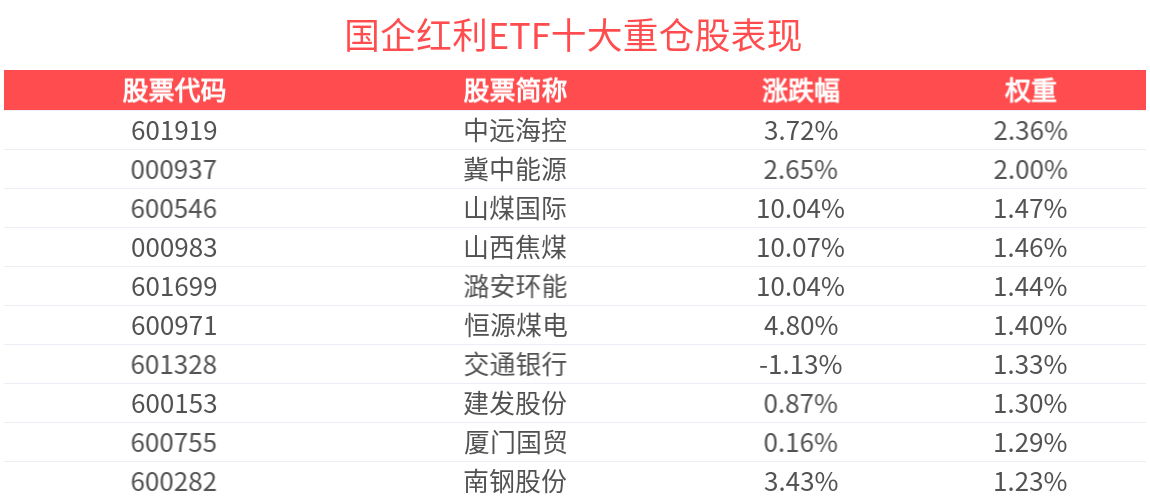
国企红利ETF(159515)午后拉升涨近2%,成分股山西焦煤,山煤国际等批量涨停
Xin Lang Cai Jing· 2025-07-22 06:54
Core Viewpoint - The China Securities State-Owned Enterprises Dividend Index (000824) has shown strong performance, with a 1.80% increase, driven by significant gains in constituent stocks such as Tunnel Co. (600820) and Shanxi Coking Coal (000983) [1] Group 1: Market Performance - The National State-Owned Enterprises Dividend ETF (159515) rose by 1.83%, marking a third consecutive increase [1] - Key stocks in the coal sector, including Shanxi Coking Coal and Lu'an Environmental Energy, experienced a 10% limit up [1] - The coal sector is expected to maintain a positive outlook due to strong demand and favorable pricing conditions [1] Group 2: Sector Analysis - Everbright Securities noted that the "anti-involution" expectations are strengthening, predicting a bullish trend for coal prices as the peak demand season approaches [1] - Guosen Securities highlighted the resilience of coal demand and the potential for price rebounds in the second half of the year, supported by improved supply-demand dynamics [1] - The coal sector demonstrated strong performance metrics in Q1 2025, including a low debt-to-asset ratio of 44.7%, a net profit margin of 12.7%, and a relatively high return on equity (ROE) [1] Group 3: Index Composition - The China Securities State-Owned Enterprises Dividend Index comprises 100 listed companies with high and stable cash dividend yields, reflecting the overall performance of high-dividend state-owned enterprises [2] - The top five industries represented in the index are banking, coal, transportation, real estate, and media [2] - As of June 30, 2025, the top ten weighted stocks in the index accounted for 15.81% of the total index weight, with significant contributions from companies like COSCO Shipping Holdings (601919) and Jizhong Energy (000937) [2][4]




如何看待焦煤商品价格反弹原因及持续性?
Changjiang Securities· 2025-06-29 08:42
Investment Rating - The report maintains a "Positive" investment rating for the coal industry [10]. Core Insights - The recent strong rebound in coking coal futures is attributed to a combination of supply contraction and improved demand fundamentals, although medium to long-term price pressures may persist if demand does not see significant positive changes [2][7]. - The coal index (Yangtze) increased by 1.68% this week, underperforming the CSI 300 index by 0.27 percentage points, ranking 25th out of 32 industries [19]. - Coking coal prices are supported by supply tightening due to safety inspections and environmental regulations, while demand remains stable due to steel production [6][20]. Summary by Sections Coking Coal Market - Coking coal futures saw a weekly increase of 6.34%, closing at 848 CNY/ton, significantly outperforming other commodities in the coal-steel-mining chain [7][14]. - Supply-side factors include reduced production from safety checks and environmental inspections, leading to a 0.53% week-on-week decrease in weekly refined coal output [7][20]. - Demand remains stable, with average daily pig iron production from 247 steel mills at 2.4229 million tons, showing a slight increase of 0.05% week-on-week [7][20]. Investment Recommendations - The report suggests marginal allocation to long-term stable profit leaders such as China Coal Energy (A+H), China Shenhua (A+H), and Shaanxi Coal and Chemical Industry [8]. - For growth-oriented investments, Electric Power Investment and New集 Energy are recommended, while coking coal companies like Shanxi Coking Coal, Huaibei Mining, and Pingdingshan Coal are highlighted for their potential [8]. Price Trends - As of June 27, the market price for Qinhuangdao 5500 kcal thermal coal is 620 CNY/ton, reflecting an increase of 11 CNY/ton week-on-week [19][42]. - The main coking coal price at Jingtang Port remains stable at 1230 CNY/ton, while the price for first-grade metallurgical coke is 1280 CNY/ton, unchanged from the previous week [19][20].
煤炭周报:港口持续去库,迎峰度夏有望促成动力煤反弹行情-20250607
Minsheng Securities· 2025-06-07 12:48
Investment Rating - The report maintains a "Buy" rating for several coal companies, including Jin控煤业, 陕西煤业, 华阳股份, 中国神华, 中煤能源, 山煤国际, 新集能源, 兖矿能源, and 淮北矿业, indicating a positive outlook for these stocks [3][11]. Core Views - The report highlights that the continuous destocking at ports and the upcoming peak summer demand are expected to drive a rebound in thermal coal prices. The demand side is seeing an increase in daily consumption by power plants as temperatures rise, while supply is tightening due to reduced production and stricter safety inspections [1][7]. - The report suggests that after verifying the bottom support for coal prices, the stable high dividend yield of coal stocks enhances their investment value, leading to a potential valuation uplift for the sector [1][8]. - The report emphasizes the importance of focusing on companies with stable performance and high cash flow growth, recommending specific stocks based on their financial health and market position [11]. Summary by Sections Market Overview - The report notes that the coal market is experiencing mixed price movements, with low-calorie coal prices slightly increasing due to tight supply. The overall market remains stable, with port coal prices showing minor fluctuations [1][7]. - The report indicates that the average daily coal consumption by power plants has increased, with a week-on-week rise of 33.7 thousand tons, reflecting a growing demand for electricity [9]. Supply and Demand Dynamics - The report discusses the supply side, noting a significant decline in coal production due to low prices and stricter environmental checks, particularly in regions like Xinjiang and Inner Mongolia. This is expected to lead to a tighter supply situation [1][10]. - On the demand side, the report highlights that non-electric demand remains high, and the anticipated increase in thermal power generation could lead to a positive shift in coal prices [1][7]. Company Performance - The report provides earnings forecasts and valuations for key companies, with Jin控煤业 expected to have an EPS of 1.68 yuan in 2024, while 陕西煤业 is projected to have an EPS of 2.31 yuan. The report recommends these companies based on their stable earnings and growth potential [3][11]. - The report also notes that the coal sector has underperformed compared to the broader market, with a weekly decline of 0.3% for the coal sector compared to a 0.9% increase in the Shanghai Composite Index [12][15]. Investment Recommendations - The report recommends focusing on companies with robust performance and cash flow, such as Jin控煤业 and 陕西煤业, as well as industry leaders like 中国神华 and 中煤能源. It also suggests looking at companies with growth in production, such as 华阳股份 and 山煤国际 [11][12].


0602脱水研报
2025-06-04 01:50
Summary of Conference Call Records Industry and Company Involvement 1. **Magnetic Sensors**: The report highlights the magnetic sensor industry, emphasizing its role as a core component in intelligent perception layers, benefiting from the growth in robotics and automotive electronics markets [1][3][5]. 2. **Pharmaceuticals**: The report discusses the pharmaceutical industry, particularly focusing on the impact of centralized procurement policies on generic drugs and the potential for performance recovery in the formulation sector [15][32]. 3. **Coal Industry**: The coal sector is analyzed, with insights into port inventory dynamics and the expected rebound in coal prices due to seasonal demand [28][29]. 4. **Gaming Industry**: The gaming industry is covered, noting the successful launch of new games and their impact on company growth [30][31]. Core Insights and Arguments Magnetic Sensors 1. **Market Growth**: The magnetic sensor market is expected to grow due to increased demand from robotics, automotive electronics, and other sectors like renewable energy and consumer electronics, with a projected market size increase from $2.9 billion in 2023 to $3.7 billion by 2029, reflecting a CAGR of 4% [6][11]. 2. **Technological Advancements**: The report details the technological evolution of magnetic sensors, with Hall effect sensors holding a 64% market share in 2024, and the rise of AMR/GMR/TMR sensors in high-end applications [4][11]. 3. **Domestic Market Potential**: There is significant room for domestic manufacturers to replace international leaders, as the current localization rate for magnetic sensor chips in China is only 25% [11][13]. Pharmaceuticals 1. **Centralized Procurement Impact**: The pharmaceutical sector has faced challenges due to centralized procurement policies, which have been in place for eight years, affecting the performance of certain companies [15][16]. 2. **Optimizing Procurement Policies**: Recent trends indicate a shift towards optimizing procurement policies, which may lead to performance recovery opportunities for companies in the formulation sector [15][20]. 3. **Long-term Cash Flow Transition**: The report suggests that the generic drug business is transitioning to a cash flow model, with a focus on stabilizing prices post-competition [25][27]. Coal Industry 1. **Inventory Dynamics**: Port inventories are decreasing due to improved demand from thermal power plants, which is expected to lead to a rebound in coal prices as seasonal demand peaks [28][29]. 2. **Investment Opportunities**: The report identifies stable dividend-paying coal companies as potential investment opportunities, particularly those with robust cash flow and growth prospects [29]. Gaming Industry 1. **Market Growth**: The gaming market in China saw a total sales scale of 27.35 billion yuan in April 2025, marking a year-on-year growth of 21.93% [30]. 2. **Successful Game Launches**: Several gaming companies have successfully launched new products, which are expected to drive further growth [30][31]. 3. **Product Pipeline**: Companies are well-positioned with a rich pipeline of upcoming games, indicating strong future growth potential [31]. Other Important Insights 1. **Market Sentiment**: The overall market sentiment is improving, particularly in the pharmaceutical sector, as companies adapt to new procurement policies [20][23]. 2. **Sector-Specific Risks**: The report highlights the risks associated with centralized procurement for generic drugs, including potential price declines and market volatility [16][18]. 3. **Technological Innovations**: The advancements in magnetic sensor technology are crucial for applications in various sectors, including industrial automation and consumer electronics [4][7]. This summary encapsulates the key points from the conference call records, providing a comprehensive overview of the discussed industries and their respective dynamics.
未知机构:脱水研报丨它是智能感知层核心器件,机器人、汽车电子等下游需求翻倍增长;集采优化政策不断出台,部分公司或出现明显的业绩预期修复—2025602-20250603
未知机构· 2025-06-03 01:55
Summary of Conference Call Records Industry or Company Involved 1. **Magnetic Sensors**: Core component in intelligent perception layer, benefiting from growth in robotics and automotive electronics [3][5][11] 2. **Pharmaceuticals**: Focus on drug formulation and the impact of centralized procurement [15][32] 3. **Coal Industry**: Insights on coal price rebound and inventory dynamics [28][29] 4. **Gaming Industry**: Performance of newly launched games and market growth [30][31] Core Points and Arguments Magnetic Sensors 1. **Market Growth**: The magnetic sensor market is expected to grow due to increased demand from robotics, automotive electronics, and other sectors like renewable energy and consumer electronics. The global market size is projected to increase from $2.9 billion in 2023 to $3.7 billion by 2029, with a CAGR of 4% [6][11]. 2. **Domestic Manufacturers**: There is significant room for domestic manufacturers to replace international leaders, as the current domestic market share is only 25% [11][13]. 3. **Technological Advancements**: The market is driven by technological evolution and diverse applications, with Hall effect sensors dominating the market with a 64% share in 2024 [4][11]. Pharmaceuticals 1. **Centralized Procurement Impact**: The pharmaceutical industry has faced challenges due to centralized procurement, which has been in place for eight years. However, recent optimization policies may lead to performance recovery for some companies [15][20]. 2. **Performance Recovery**: Companies like Huadong Medicine may see a reduction in procurement risks for several products in 2024, potentially stabilizing their sales [23][25]. 3. **Long-term Outlook**: The pharmaceutical sector is transitioning towards cash flow generation as competition increases and prices stabilize post-procurement [27]. Coal Industry 1. **Inventory Dynamics**: Recent improvements in coal inventory levels are expected to lead to a price rebound as demand increases during peak seasons [28][29]. 2. **Market Sentiment**: The coal sector is anticipated to experience valuation increases as stable high dividends become more attractive [29]. 3. **Demand Recovery**: The demand for thermal power generation is expected to turn positive, supporting coal price recovery [28]. Gaming Industry 1. **Market Growth**: The gaming market in China saw a total sales scale of 27.35 billion yuan in April 2025, a year-on-year increase of 21.93% [30]. 2. **Successful New Releases**: Several gaming companies have launched successful new products, contributing to their growth and market presence [30][31]. 3. **Future Potential**: Companies with strong product pipelines and successful launches are expected to continue growing, with notable titles set to release soon [31]. Other Important but Possibly Overlooked Content 1. **Magnetic Sensor Applications**: The sensors are crucial in various applications, including industrial automation, automotive systems, and consumer electronics, indicating a broad market potential [7][9]. 2. **Pharmaceutical Pricing Dynamics**: The long-tail effects of centralized procurement pricing governance may continue to impact the market, necessitating ongoing adjustments [18][19]. 3. **Coal Supply Constraints**: The reduction in coal production due to low prices and high-cost mines may support price stability in the coal market [28]. This summary encapsulates the key insights from the conference call records, highlighting the growth potential and challenges across multiple industries.
煤炭 价格寻底,布局右侧
2025-06-02 15:44
Summary of Coal Industry Conference Call Industry Overview - The coal industry is currently experiencing a price bottoming phase, with a focus on positioning for future recovery [1] - The average production cost of thermal coal is projected to be 370 RMB/ton in 2024, which, while higher than historical lows, still has room for reduction [1][3] - Coking coal costs are expected to average 551 RMB/ton in 2024, also indicating potential for cost reduction [1][3] Key Insights and Arguments - Historical data shows that the average production cost of thermal coal has increased from 208 RMB/ton in 2016 to 370 RMB/ton in 2024, while coking coal costs rose from 300 RMB/ton to 551 RMB/ton during the same period [1][5] - The increase in costs is attributed to policy changes and rising expense standards, but there remains significant potential for cost control in the future [1][6] - Current port coal prices are at 611 RMB/ton, providing a profit margin of 91 RMB/ton when considering a production cost of 370 RMB/ton, and nearly 500 RMB/ton at a cost of 550 RMB/ton [1][9] - Recent increases in pithead coal prices in regions like Datong, Yulin, and Inner Mongolia indicate a gradual recovery in demand [1][10] Market Dynamics - The port coal price has remained stable at 611 RMB/ton for 11 consecutive days, while domestic coal prices have reached 1,270 RMB/ton [2] - The cost support logic is challenged by the presence of variable costs, suggesting that price support levels may trend downward in a weak demand environment [3][9] - The coal sector's stock prices have benefited from sector rotation, public fund allocations, and expectations of coal price rebounds [3][13] Future Outlook - The coal price rebound is anticipated, with potential price levels expected between 650 and 700 RMB/ton, influenced by weather conditions and hydropower output [12] - The current low inventory levels in downstream power plants are expected to drive increased replenishment efforts, supported by policy guidance [11][15] - The coal sector is projected to have significant upside potential, particularly for growth-oriented stocks that have not yet seen substantial price increases [14][15] Additional Considerations - The reliability of production cost data is emphasized, with audited financial reports from listed companies being more trustworthy than market rumors regarding cost percentiles [7][8] - The overall market sentiment is bolstered by the expectation of a demand recovery and the strategic positioning of major coal companies [16]