
绿色智能转型

Search documents
装备制造行业周报(9月第2周):硅料景气度有所下行-20250915
Century Securities· 2025-09-15 05:28
Investment Rating - The report does not explicitly state an investment rating for the industry, but it suggests a cautious outlook on the silicon material sector due to declining demand and price pressures [1]. Core Insights - The silicon material sector is experiencing a downturn in market sentiment, with a notable drop in the price of polysilicon, which fell by 4.09% to 4.40 [2]. - The industrial gas prices have shown a slight weekly decline, with liquid oxygen averaging 478 RMB/ton, down 3.2% from the previous week [2]. - The automotive market is facing challenges, with a 10% year-on-year decline in retail sales of passenger vehicles in the first week of September, although the decline in the new energy vehicle segment was only 3% [2]. Summary by Sections Market Overview - The mechanical equipment, electric power equipment, and automotive industry indices saw weekly changes of +3.52%, +0.53%, and +1.74%, respectively, ranking 7th, 22nd, and 15th among 31 Shenwan primary industries [7][9]. Industry News and Key Company Announcements - The Ministry of Industry and Information Technology and other agencies released a plan to stabilize growth in the power equipment industry, emphasizing green and intelligent transformation [17]. - Chery's subsidiary, Moja Robotics, is set to unveil new products in October [17]. - A strategic partnership was formed between Shenzhen Huizhi IoT and Zhifang to deploy over 1,000 intelligent robots in semiconductor display manufacturing [17]. - The report highlights the successful application of humanoid robots in industrial settings, showcasing advancements in technology and operational efficiency [17][19].
三部门联合发文 助力电力装备行业稳增长
Mei Ri Jing Ji Xin Wen· 2025-09-14 13:36
Core Viewpoint - The "Power Equipment Industry Stabilization Growth Work Plan (2025-2026)" outlines the positive growth outlook for the power equipment industry in China, driven by the global transition to a green and low-carbon energy structure and the establishment of a new power system [1] Group 1: Goals for 2025-2026 - The plan sets a target for traditional power equipment to maintain an average annual revenue growth rate of around 6%, while revenue from new energy equipment is expected to show stable growth [2] - The production of power generation equipment is to remain within a reasonable range, ensuring effective supply, and the export volume of new energy equipment is anticipated to increase [2] - Key regions and enterprises are expected to enhance their driving role, with the national advanced manufacturing cluster in the power equipment sector aiming for an average annual revenue growth rate of 7%, and leading enterprises targeting a 10% growth rate [2] Group 2: Adjustments and Market Insights - The current plan's target for traditional power equipment growth is lower than the previous plan's target of over 9%, reflecting a reasonable adjustment due to a slowdown in power consumption growth [2] - Despite uncertainties in the external environment, the export prospects for new energy equipment are expected to continue growing, particularly in emerging markets outside of Europe and the U.S. [3] - The plan emphasizes the steady advancement of nuclear power development, with a focus on safely and orderly promoting the approval and construction of coastal nuclear power projects [3] Group 3: Technological Integration and Upgrades - The plan encourages the deep integration of new-generation information technology with power equipment, accelerating the green upgrade and transformation of equipment [3] - It aims to guide enterprises in the power equipment sector towards a comprehensive digital transformation and enhance the intelligence level of distribution busbars [3] - The initiative includes actions to cultivate smart factories and accelerate the application of "5G + Industrial Internet" in the power equipment field [3]
三部门:推动电力装备行业稳增长
Sou Hu Cai Jing· 2025-09-12 23:28
Core Viewpoint - The "Power Equipment Industry Growth Stabilization Work Plan (2025-2026)" aims to maintain a steady growth rate of around 6% in traditional power equipment revenue and promote growth in renewable energy equipment revenue by 2026 [1] Group 1: Industry Growth Targets - The plan sets a target for power generation equipment output to remain within a reasonable range, ensuring effective supply [1] - Key regions and enterprises are expected to enhance their driving role, with national advanced manufacturing clusters in the power equipment sector achieving an average revenue growth rate of around 7% [1] - Leading enterprises are projected to achieve an average revenue growth rate of 10% [1] Group 2: Key Initiatives - Improve equipment supply quality through coordinated implementation of industrial foundation reconstruction and major technical equipment breakthroughs [2] - Expand domestic effective demand by stabilizing power equipment demand through major energy projects and promoting the orderly construction of offshore wind power [2] - Actively explore international markets and deepen cooperation in green infrastructure and new infrastructure sectors [2] Group 3: Supportive Measures - Strengthen financial and tax support, including tax incentives for R&D expenses and resource utilization [3] - Establish a coordination mechanism for steady growth involving key enterprises and industry associations to address growth challenges [3] - Enhance public awareness and policy guidance to improve the implementation and influence of policies [3]
三部门:利用超长期特别国债支持能源电力设备更新
Zhong Guo Zheng Quan Bao· 2025-09-12 20:20
Core Viewpoint - The "Power Equipment Industry Stabilization Growth Work Plan (2025-2026)" aims to support large-scale equipment updates in the energy sector using special long-term government bonds, guiding the industry towards high-quality development [1][2]. Group 1: Industry Growth Targets - The plan sets a target for traditional power equipment revenue growth to maintain an average annual increase of around 6% from 2025 to 2026, while ensuring stable growth in renewable energy equipment revenue [1]. - It aims to keep the production of power generation equipment within a reasonable range and increase the export volume of renewable energy equipment during the same period [1]. - The plan targets an average annual revenue growth of 7% for national advanced manufacturing clusters in the power equipment sector and around 10% for leading enterprises from 2025 to 2026 [1]. Group 2: Support Measures - The plan outlines four support measures, including organizational support, scheduling analysis, fiscal and tax support, and promotional guidance [2]. - It emphasizes fiscal support through tax incentives for R&D expenses and resource utilization, as well as encouraging financial institutions to provide innovative financial services to eligible power equipment companies [2]. Group 3: Technological and Environmental Initiatives - The plan promotes the integration of new information technologies with power equipment, enhancing the intelligence level of distribution busbars and accelerating the application of "5G + industrial internet" in the sector [2]. - It encourages the recycling of renewable energy equipment and the remanufacturing of high-value products like generators and gearboxes [2]. Group 4: Demand Expansion Strategies - The plan aims to stabilize demand for power equipment by leveraging major energy projects and accelerating the construction of large onshore wind and solar bases [3]. - It promotes the orderly development of offshore wind power and distributed development of wind and solar energy, while also advancing coal power upgrades and the elimination of outdated capacity [3]. - The plan includes the development of hydropower and nuclear power projects, optimizing the national power system design [3].
电力装备迎来新一轮稳增长,扩大国内有效需求和开拓国际市场并行
2 1 Shi Ji Jing Ji Bao Dao· 2025-09-12 13:04
Core Viewpoint - The electric equipment industry is a crucial sector for industrial economic growth, and the recently issued "Electric Equipment Industry Stabilization Growth Work Plan (2025-2026)" aims to enhance domestic demand, accelerate equipment application, and optimize the industry environment to support economic stability [1][3]. Summary by Sections Policy and Market Response - The Ministry of Industry and Information Technology, the State Administration for Market Regulation, and the National Energy Administration jointly released the plan, which has positively impacted the A-share electric equipment sector, leading to significant stock price increases for several companies [1]. - The electric equipment industry is experiencing robust demand due to the global transition to a green and low-carbon energy structure, with the current installed power generation capacity reaching 3.65 billion kilowatts [2]. Goals and Adjustments - The plan sets four main goals for the electric equipment industry from 2025 to 2026, including maintaining a 6% annual revenue growth for traditional electric equipment and increasing the export volume of new energy equipment [3]. - Compared to the previous plan, the new plan emphasizes differentiated planning for various types of equipment and includes a focus on international market expansion [3]. Strategic Focus Areas - The plan emphasizes three strategic areas: enhancing the combination of quality supply and effective demand, integrating domestic and international markets, and aligning economic growth with industrial upgrading [4]. - The Ministry of Industry and Information Technology highlights the importance of quality improvement to drive reasonable growth in quantity [5]. Supply and Demand Initiatives - On the supply side, the plan aims to enhance supply capacity by improving equipment quality and promoting green and intelligent transformation [7]. - On the demand side, it seeks to expand effective domestic demand through major engineering projects and actively explore international markets, particularly in wind, solar, and energy storage sectors [8]. Environmental and Infrastructure Development - The plan proposes several measures to optimize the industry environment, including promoting innovative product applications and enhancing industry standards [8]. - Significant investments in high-voltage power projects are expected to exceed 800 billion yuan, which will support the upstream and downstream supply chains and accelerate energy transition [9].
关于电力装备行业,三部门印发稳增长工作方案
Zhong Guo Zheng Quan Bao· 2025-09-12 04:28
Core Viewpoint - The Ministry of Industry and Information Technology, along with other agencies, has issued a plan to stabilize growth in the power equipment industry for 2025-2026, targeting an average revenue growth of around 6% for traditional power equipment and steady growth for new energy equipment [1][3][4]. Group 1: Industry Growth Targets - The plan aims for an average revenue growth rate of approximately 6% for traditional power equipment and stable growth for new energy equipment during 2025-2026 [4][14]. - It seeks to maintain power generation equipment production within a reasonable range and achieve growth in new energy equipment exports [5][14]. - The average revenue growth rate for national advanced manufacturing clusters in the power equipment sector is targeted at around 7%, with leading enterprises aiming for a 10% growth rate [6][14]. Group 2: Key Initiatives - The plan emphasizes the integration of new-generation information technology with power equipment to enhance smart transformation [8][25]. - It includes measures to expand domestic demand by leveraging major energy projects and promoting the development of large-scale wind and solar power bases [8][17]. - The plan encourages international market expansion and participation in global energy transitions, aiming to enhance the quality of power equipment and brand image [19][20]. Group 3: Supportive Measures - Four main supportive measures are proposed: strengthening organizational support, conducting scheduling analysis, providing financial and tax incentives, and enhancing publicity [10][28]. - Financial support includes tax incentives for R&D expenses and encouraging financial institutions to offer innovative services to eligible power equipment companies [10][28]. - The plan also aims to optimize the industry environment by promoting self-discipline and fair competition within the power equipment sector [23][24].

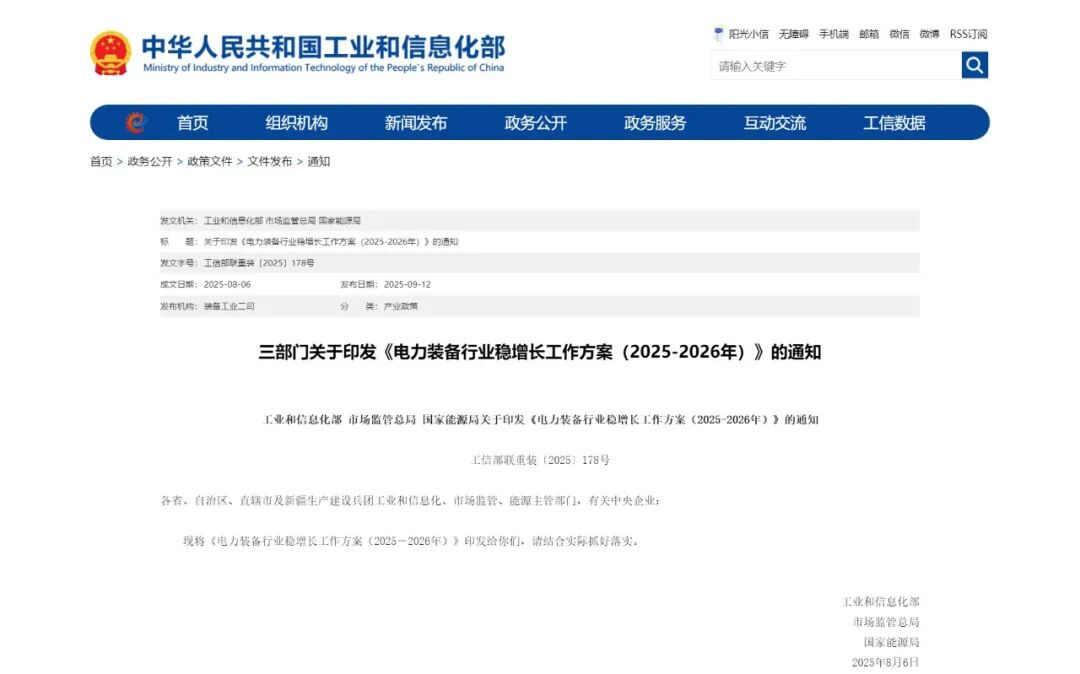
盘前利好!三部门印发
Shang Hai Zheng Quan Bao· 2025-09-12 04:14
Group 1 - The core objective of the "Power Equipment Industry Stabilization and Growth Work Plan (2025-2026)" is to maintain an average annual revenue growth rate of around 6% for traditional power equipment and ensure stable growth for renewable energy equipment [1] - The plan aims to keep the production of power generation equipment within a reasonable range, ensuring effective supply and increasing the export volume of renewable energy equipment [1] - Key regions and enterprises are expected to enhance their driving role, with the national advanced manufacturing cluster in the power equipment sector targeting an average annual revenue growth rate of around 7%, and leading enterprises aiming for a 10% growth rate [1] Group 2 - The plan emphasizes expanding domestic effective demand by relying on major engineering projects in the energy sector to stabilize the demand for power equipment [1] - It includes initiatives to accelerate the development of large onshore wind and photovoltaic bases, promote orderly construction of offshore wind power, and advance distributed development of wind and solar power [1] - The plan also focuses on the digital transformation of power equipment enterprises, integrating new generation information technology with power equipment, and enhancing the efficiency of electric motors, transformers, and distribution equipment [2]
利好!三部门印发
Zheng Quan Shi Bao Wang· 2025-09-12 03:44
Core Viewpoint - The Ministry of Industry and Information Technology, the State Administration for Market Regulation, and the National Energy Administration have issued the "Power Equipment Industry Stabilization Growth Work Plan (2025-2026)", aiming to maintain steady growth in the power equipment sector and promote the integration of new energy technologies [1][2]. Group 1: Revenue and Growth Targets - The plan sets a target for traditional power equipment to achieve an average annual revenue growth rate of around 6% from 2025 to 2026 [1]. - The revenue of the national advanced manufacturing clusters in the power equipment sector is expected to grow at an average annual rate of 7%, while leading enterprises aim for a 10% average annual revenue growth [1]. Group 2: Demand Expansion and Project Development - The plan emphasizes expanding domestic effective demand by stabilizing power equipment needs through major energy projects [1]. - It includes initiatives to accelerate the development of large onshore wind and photovoltaic bases, promote orderly construction of offshore wind power, and advance distributed development of wind and solar energy [1]. Group 3: Green and Intelligent Transformation - The plan promotes the deep integration of new information technologies with power equipment, accelerating the green upgrade and transformation of equipment [2]. - It encourages enterprises in the power equipment sector to accelerate digital transformation and improve the efficiency of electric motors, transformers, and distribution equipment [2].
利好!三部门印发
证券时报· 2025-09-12 03:08
Core Viewpoint - The "Power Equipment Industry Stabilization Growth Work Plan (2025-2026)" aims to maintain a steady growth in traditional power equipment revenue and promote the development of new energy equipment, with specific targets for revenue growth and production output [1][2]. Group 1: Revenue and Production Goals - The plan sets a target for traditional power equipment to achieve an average annual revenue growth rate of around 6% from 2025 to 2026 [1]. - New energy equipment revenue is expected to show stable growth, with key regions and enterprises driving the market [1]. - The average annual revenue growth for national advanced manufacturing clusters in the power equipment sector is targeted at around 7%, while leading enterprises aim for a 10% growth rate [1]. Group 2: Demand Expansion Strategies - The plan emphasizes expanding domestic effective demand by leveraging major energy projects to stabilize power equipment demand [1]. - It includes initiatives to accelerate the development of large onshore wind and photovoltaic bases, as well as orderly construction of offshore wind power [1]. - The plan promotes the phased elimination of outdated capacity and the development of major hydropower projects and pumped storage [1]. Group 3: Green and Intelligent Transformation - The plan advocates for the deep integration of new information technology with power equipment, accelerating the green upgrade and transformation of equipment [2]. - It encourages enterprises in the power equipment sector to accelerate digital transformation across all processes and enhance the intelligence level of distribution busbars [2]. - The plan also promotes the recycling of wind and solar equipment and encourages the remanufacturing of high-value products like generators and gearboxes [2].

涉及风电光伏、核电等,电力装备行业稳增长方案公布
Xin Lang Cai Jing· 2025-09-12 02:52
Core Viewpoint - The Ministry of Industry and Information Technology, along with other regulatory bodies, has released a work plan for the power equipment industry aimed at stabilizing growth from 2025 to 2026, focusing on expanding domestic demand, accelerating equipment promotion, and optimizing the industry environment [1][2]. Supply Side - The plan emphasizes improving the quality of equipment supply and promoting a green and intelligent transformation. It aims to enhance the supply level of power equipment through the implementation of industrial foundation reconstruction and breakthroughs in key technologies [2][3]. - A focus on high-quality development of new energy equipment, particularly in wind power, is highlighted, alongside the implementation of innovative actions in new energy storage technology [2][3]. Demand Side - The plan aims to stabilize demand for power equipment by leveraging major engineering projects and accelerating the development of large-scale onshore wind and photovoltaic bases, as well as promoting orderly construction of offshore wind power [2][3]. Environmental Aspects - The plan outlines measures to optimize the industry environment, including enhancing self-discipline within the power equipment sector and fostering a competitive environment. It also includes the development of industry standards for wind power equipment manufacturing [3]. - The integration of new-generation information technology with power equipment is encouraged, aiming for a green upgrade and digital transformation across the industry [3].