
超长期特别国债

Search documents
中央1.3万亿元超长期特别国债,约1万亿给地方用
第一财经· 2026-03-27 03:38
Core Viewpoint - The central government is leveraging long-term special bonds to alleviate local fiscal burdens, with a significant portion of the funds allocated for local government use [3][4]. Group 1: Central Government Budget and Special Bonds - In the 2026 central government budget, 1.3 trillion yuan of long-term special bonds will be issued, with 240 billion yuan (18%) allocated for central government spending and 1.06 trillion yuan (82%) for transfers to local governments [3][5]. - The issuance of long-term special bonds began in 2024, with 1 trillion yuan in 2024, 1.3 trillion yuan in 2025, and a planned 1.3 trillion yuan in 2026, primarily aimed at supporting major strategic implementations and key areas [3][4]. Group 2: Allocation and Usage of Funds - For the 2026 budget, 800 billion yuan is designated for "two major" constructions, 250 billion yuan for consumer goods replacement, and 200 billion yuan for large-scale equipment updates, with 50 billion yuan's purpose still unclear [5][6]. - The 50 billion yuan may be used for newly established fiscal-financial collaborative funds to promote domestic demand, as indicated in the government's work report [6][7]. Group 3: Economic Context and Policy Measures - The Minister of Finance highlighted the ongoing economic challenges, particularly the imbalance between strong supply and weak demand, leading to insufficient consumer vitality and weak private investment growth [7]. - A special fund of 100 billion yuan has been allocated to support domestic demand through various financial measures, aiming to leverage this funding to generate a larger impact on credit availability [7].

万亿级超长期特别国债有新用途
第一财经· 2026-03-12 10:55
Core Viewpoint - China plans to issue 1.3 trillion yuan of ultra-long-term special government bonds in 2023 to support economic stability and expand domestic demand, with funds allocated for major strategic projects and equipment upgrades [2]. Group 1: Bond Issuance and Allocation - The issuance of ultra-long-term special government bonds will include 800 billion yuan for major strategic projects and 450 billion yuan for equipment upgrades and consumption replacement policies [2]. - An additional 500 billion yuan from the bond issuance will be allocated for other areas, potentially including financial expenditures as indicated by recent government notifications [2]. Group 2: Financial Expenditures - The financial expenditures from the ultra-long-term special government bonds will cover interest subsidies, capital injections for financial institutions, risk compensation, and other financial expenses [3]. - This financial spending aligns with the broader fiscal and financial policies aimed at expanding domestic demand [4]. Group 3: Fiscal and Financial Coordination - The government has established a 100 billion yuan special fund for fiscal and financial coordination to support domestic demand, utilizing tools such as loan interest subsidies and risk compensation [5]. - The Minister of Finance highlighted the need to address the imbalance between strong supply and weak demand, emphasizing the importance of coordinated policies to mobilize social resources towards key areas of domestic demand expansion [6].
如何理解2026年财政政策安排?|政策与监管
清华金融评论· 2026-03-09 10:25
Core Viewpoint - The article emphasizes the implementation of a more proactive fiscal policy in China, focusing on stimulating consumption and investment, ensuring the operation of grassroots finances, mitigating debt risks, and supporting the construction of a unified national market. The policy aims to enhance local government motivation and improve fiscal sustainability in the long term [4][5]. Fiscal Policy Strength - The fiscal policy is characterized by a high deficit rate of 4%, with the deficit scale reaching 5.89 trillion yuan, an increase of 230 billion yuan from 2025. The total public budget expenditure is projected to reach 30 trillion yuan in 2026, marking a significant increase in necessary spending to stabilize overall demand and support economic and livelihood goals [6][7]. - The issuance of special bonds remains at the same level as the previous year, balancing the needs for growth stabilization and debt resolution while expanding the range of eligible projects [7][8]. Structural Optimization of Fiscal Policy - The article highlights significant optimization in expenditure structure, deficit structure, and transfer payment structure, aiming to enhance the effectiveness of limited fiscal funds. There is a notable increase in spending on social welfare and technological innovation, with a shift towards balancing investment and consumption [14][15]. - The central government's deficit share has increased significantly, accounting for 86.4% of the total deficit, which alleviates local financial burdens and optimizes the debt structure between central and local governments [15]. Tax and Subsidy Policy Regulation - The article discusses the need to standardize tax incentives and fiscal subsidy policies to promote a unified national market. This regulation aims to break down regional barriers, foster healthy competition among enterprises, and enhance the efficiency of fiscal fund utilization [18][19]. Local Government Support - The report stresses the importance of ensuring the "three guarantees" for local governments, addressing fiscal difficulties caused by real estate adjustments. It suggests increasing central transfer payments and raising local debt limits to restore local governments' economic development capabilities [21][22]. Debt Management and Risk Mitigation - The article outlines a shift in debt management from short-term risk policies to long-term structural mechanisms. It emphasizes the need for a unified government debt management system and the importance of categorizing and regulating local government financing platforms to prevent operational debt from becoming hidden government debt [23][24].
如何看待六网七万亿中的地下管网投资
2026-03-09 05:18
Summary of Key Points from Conference Call on Underground Pipeline Investment Industry Overview - The focus is on the underground pipeline investment sector, which is expected to see a significant expansion from a previously estimated 4 trillion yuan for 600,000 kilometers to 5 trillion yuan for 700,000 kilometers, with an average annual investment of approximately 1 trillion yuan, and a peak expected in 2026-2027 [1][5][13]. Core Insights and Arguments - **Investment Expansion**: The investment in underground pipelines is projected to triple, with 2024's investment at 350 billion yuan, compared to the anticipated annual average of 1 trillion yuan during the 14th Five-Year Plan [1][8]. - **Funding Structure Shift**: The funding structure has fundamentally changed, with central government funding rising to about 50% and local government funding dropping to 10%. Special long-term bonds are expected to contribute 2.5 trillion yuan, accounting for 40%-50% of the funding [1][6]. - **User-Pay Principle**: The financing model is shifting towards a "user pays" system, which includes adjustments in water pricing and the exploration of a rainwater tax to address the lack of revenue sources for drainage systems [1][9]. - **Material Trends**: There is a trend of "metal return" in the pipeline market, with the proportion of steel pipes in municipal pipelines expected to increase from 17% to 25%. The domestic production rate of non-excavation repair materials is also rising, indicating a phase of industry consolidation [1][5]. - **Governance Shift**: The focus of governance is shifting from incident-driven responses to addressing root causes, with an emphasis on drainage, gas, and heating networks [1][4]. Additional Important Insights - **Technological Advancements**: The sector is seeing growth in smart technologies, including AI for leak detection and 3D geological radar for monitoring [2][24]. - **Investment Gaps**: There is a structural mismatch between the growth in pipeline mileage (18% increase over five years) and the stagnation in investment levels, which has remained relatively flat [3][11]. - **Legislative Framework**: The legislative process for underground pipeline regulations is underway, with the Ministry of Housing and Urban-Rural Development initiating the "Urban Underground Pipeline Regulations" [3][4]. - **Market Dynamics**: The investment landscape is evolving, with a notable decrease in local government funding and an increase in central government support, reflecting a shift in the investment burden [11][12]. - **Challenges in Funding**: The main challenges in the financing chain include low marketization levels and a lack of effective incentives for social capital participation, necessitating reforms in the financing system [9][10]. This summary encapsulates the critical aspects of the underground pipeline investment sector as discussed in the conference call, highlighting the anticipated growth, funding shifts, governance changes, and technological advancements.
20260306申万期货品种策略日报:双焦(J&JM)-20260306
Shen Yin Wan Guo Qi Huo· 2026-03-06 03:01
Group 1: Report Industry Investment Rating - No relevant content Group 2: Core View of the Report - The night session of the previous day saw the main contracts of coking coal and coke showing a weak trend, with the total holding of coking coal increasing month - on - month. This week, the output of the five major steel products remained basically flat month - on - month, with an increase in rebar and a decrease in hot - rolled coils. The overall inventory continued to increase month - on - month, mainly due to rebar. The overall apparent demand increased slightly month - on - month. This week, both the molten iron output and the profitability rate of steel mills decreased month - on - month, mainly because multiple production areas were affected by environmental protection maintenance, leading to a decline in the rigid demand for coking coal and coke. However, the current geopolitical situation can also push up the valuation of energy - related commodities through the expectation of supply tightening. In the future, focus should be on the trend of molten iron output, mine operation, the policy orientation of the Two Sessions, and the geopolitical situation [2] Group 3: Summary by Relevant Catalog Futures Price and Trading Volume - **Price and Change**: The previous day's closing prices for different contract months of coking coal and coke were 1676.5, 1401.0, 1105.5, 1745.0, 1200.0, 1840.0 respectively, with price changes of 8.5, 3.0, - 1.0, 1.5, 4.5, - 3.0 and price change rates of 0.27%, - 0.07%, 0.77%, 0.13%, 0.16%, - 0.17% compared to the day before. [2] - **Trading Volume and Open Interest**: The trading volumes were 3594, 967615, 82388, 127, 16636, 1095 respectively, and the open interests were 1230, 36823, 14347, 2932, 488493, 105596 respectively. The changes in open interests were 223, - 4342, 21, - 268, 107, - 16540 respectively. [2] - **Price Spread**: The current values of price spreads such as 1 - 5 months, 9 - 1 months, 5 - 9 months were - 79.5, - 77.5, 240, - 160.5, 160.5, - 83 respectively, with changes of 2.5, 429.5, 2, 306, - 308.5, - 431.5 respectively. [2] Spot Price - The current spot prices of different types of coking coal and coke, such as Taiyuan rail - side price, port self - pick - up price, ex - factory price, etc., were 1373, 1175, 1480, 1855, 1330, 1470 respectively, with changes of - 2, 0, 0, 0, 0, 0 respectively. [2] Macroeconomic Information - The Fourth Session of the 14th National People's Congress was held on the morning of the 5th. The government work report stated that the main expected target for development in 2026 is an economic growth of 4.5% - 5%. The deficit ratio in 2026 is planned to be around 4%, and ultra - long - term special treasury bonds worth 1.3 trillion yuan are planned to be issued. A moderately loose monetary policy will continue to be implemented. [2]
赤字规模将增加2300亿,释放重要信号
21世纪经济报道· 2026-03-05 06:58
Core Viewpoint - The government aims to maintain a stable yet progressive fiscal policy, with a focus on enhancing macroeconomic governance and increasing the efficiency of fiscal spending, particularly in supporting consumption, investment in human resources, and ensuring public welfare [1][2]. Fiscal Policy and Budget - The proposed fiscal deficit rate for the year is around 4%, with a deficit scale of 5.89 trillion yuan, an increase of 230 billion yuan from the previous year [1][3]. - General public budget expenditure is set to reach 30 trillion yuan for the first time, marking an increase of approximately 1.27 trillion yuan from last year [1]. - The issuance of special bonds is planned at 1.3 trillion yuan to support key construction projects and capital replenishment for state-owned commercial banks [1][2]. Local Government Bonds - The scale of local government special bonds is proposed at 4.4 trillion yuan, maintaining a historically high level, which reflects a commitment to active fiscal policy [2][3]. - The consistency in the issuance of local government bonds indicates a stable approach to enhancing local financial capacity and autonomy [3]. Economic Implications - Maintaining a nominal deficit rate of around 4% suggests a strategy to keep the central government's leverage stable while allowing room for future policy adjustments in response to economic fluctuations [3]. - The increase in the overall deficit scale, despite maintaining the same percentage, indicates a growing economic base, with the total deficit reaching 5.89 trillion yuan [3]. Debt Management and Efficiency - The government emphasizes improving the efficiency of fiscal spending rather than merely increasing the quantity of funds, as evidenced by the focus on resolving issues related to accounts receivable in industrial enterprises [3][4]. - The issuance of local bonds is expected to align with changes in local government financing costs and market capacity, suggesting a continuation of a moderately loose monetary policy [4].
政府工作报告丨2026年赤字率拟按4%左右安排,拟发行超长期特别国债1.3万亿元
证券时报· 2026-03-05 02:32
Core Points - The government work report presented by Premier Li Qiang at the Fourth Session of the 14th National People's Congress emphasizes the continuation of a more proactive fiscal policy, with a proposed deficit rate of around 4% for the year [1] - The planned deficit scale is set at 5.89 trillion yuan, which represents an increase of 230 billion yuan compared to the previous year [1] - General public budget expenditure is expected to reach 30 trillion yuan for the first time, marking an increase of approximately 1.27 trillion yuan from the previous year [1] - The issuance of ultra-long-term special bonds is proposed at 1.3 trillion yuan to continuously support "two重" construction and "two新" work [1]

政府工作报告:继续实施适度宽松的货币政策
财联社· 2026-03-05 01:49
Group 1 - The government plans to continue implementing a moderately loose monetary policy [1] - The fiscal policy will be more proactive, with a proposed deficit rate of around 4% for 2026, and a deficit scale of 5.89 trillion yuan, an increase of 230 billion yuan from the previous year [2] - The general public budget expenditure is set to reach 30 trillion yuan for the first time, an increase of approximately 1.27 trillion yuan from the previous year [2] Group 2 - The government intends to issue long-term special bonds amounting to 1.3 trillion yuan to support "two heavy" constructions and "two new" initiatives [2]

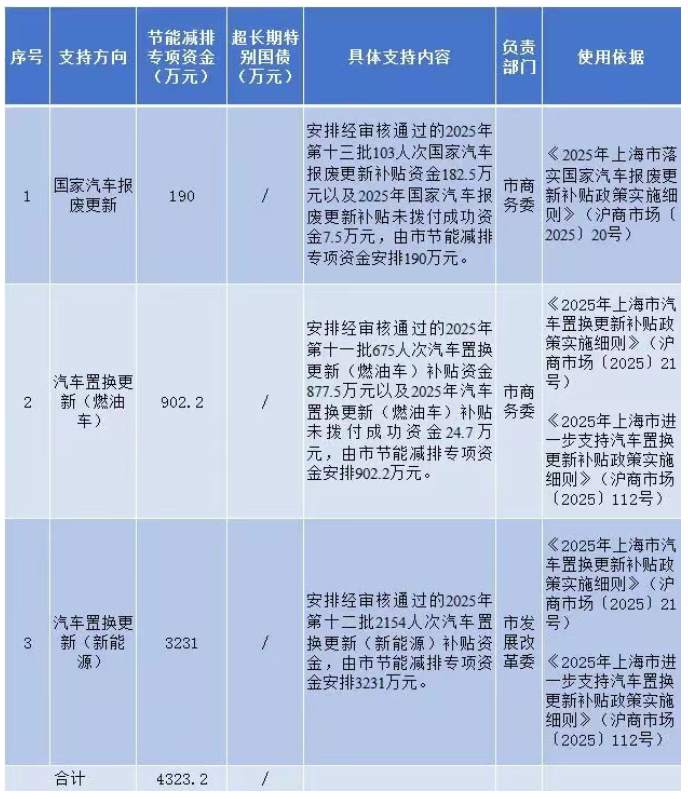
上海市2026年节能减排专项资金和超长期特别国债安排计划(第三批)发布
Xin Hua Cai Jing· 2026-02-27 06:57
Core Insights - Shanghai has announced its 2026 energy conservation and emission reduction special fund and ultra-long-term special government bond arrangement plan, allocating a total of 43.232 million yuan to support the national automobile scrapping and replacement program, including both fuel and new energy vehicles [1] Group 1: Funding Allocation - The special fund for energy conservation and emission reduction amounts to 43.232 million yuan [2] - Specific allocations include 1.825 million yuan for the 2025 national automobile scrapping subsidy, 8.775 million yuan for fuel vehicle replacement subsidies, and 32.31 million yuan for new energy vehicle replacement subsidies [2] Group 2: Support Details - The funding is aimed at supporting the scrapping and replacement of vehicles, with a focus on both fuel and new energy vehicles [1][2] - The allocations are based on approved applications for subsidies from previous years, indicating a structured approach to funding distribution [2]
化债攻坚期城投审批的边际变化:化债攻坚期城投审批的边际变化
SINOLINK SECURITIES· 2026-02-11 01:30
1. Report Industry Investment Rating No relevant content provided. 2. Core Viewpoints of the Report - In January, the approval of urban investment bonds was characterized by a continuous increase in registration quotas, a slowdown in the approval pace, and a low level of terminated project scale. The overall financing pace at the beginning of the year shifted from loose to tight [5][47]. - The marginal changes in bond market supervision and approval reflect that the current implementation of debt - resolution policies continues the orientation of "strictly controlling increments, resolving existing stocks, and providing long - term empowerment." The issuance of the third batch of 2 trillion yuan in replacement bonds started in early January, and the Ministry of Finance further clarified that ultra - long - term special treasury bonds would continue to be arranged in 2026. Considering that 2026 is the sprint stage for debt resolution and the 6 - trillion - yuan replacement bond plan is coming to an end, the upward trend of urban investment bond registration quotas is expected to continue [5][47]. - In the long run, the urban investment debt - resolution work has entered a critical period of accelerating and improving efficiency. The debt - resolution paths will be more diverse, and the differentiation of debt - resolution effects among different regions will become more obvious. As the goal of clearing hidden debts approaches, local debt - resolution efforts will continue to increase, the market - oriented clearance process of financing platforms will accelerate, and measures to promote platform transformation through asset restructuring will be more in - depth [6][48]. 3. Summary According to the Directory 3.1 Registration Situation: Continuous Increase in Urban Investment Registration Quotas - In January, the registration quota of urban investment platforms continued to rise. The registration scale of provincial, municipal, and district - county urban investment all increased to varying degrees, while the registration scale of weak - quality districts and counties declined. The scale in regions such as Zhejiang, Shandong, and Hubei increased significantly month - on - month [2][12]. - The planned issuance scale of urban investment bonds registered on the exchange was 315 billion yuan (previous value: 239.4 billion yuan), and that on DCM was 177.1 billion yuan (previous value: 168.5 billion yuan). The overall registration continued to rise and was higher than the quotas in the same period of the past three years [12]. - The proportion of district - county urban investment bonds in the three - month moving average among all administrative levels continued to decline for three months to 52%. The registration scale of district - county platforms with a budget revenue of less than 5 billion yuan was 66.9 billion yuan (previous value: 92.3 billion yuan), and the three - month moving average proportion increased to 37.8% [15][18]. 3.2 Approval Feedback: Slowdown in Urban Investment Bond Approval - In January, the approval pace of DCM and the exchange for urban investment bonds slowed down. The average number of feedbacks from DCM was 2.4 times (previous value: 2.4 times), and the feedback time increased to 41.5 days (previous value: 40.6 days); the average number of feedbacks from the exchange was 4.2 times (previous value: 4.2 times), and the feedback time increased to 77.8 days (previous value: 68.9 days) [25]. - The feedback pace of public urban investment corporate bonds in prefecture - level cities accelerated significantly, while that of private urban investment corporate bonds in prefecture - level and district - county levels slowed down [30]. - The approval feedback days in Sichuan, Fujian, Hubei and other regions were significantly extended. The approval pace in Anhui, Jiangxi, Hunan and other regions accelerated significantly, while Shandong and Henan continued the trend of a slowdown in the approval speed [32]. - The approval pace of weak - quality district - county platform bonds continued to slow down. The feedback days of district - county platforms with a general budget revenue of less than 5 billion yuan were 67.2 days (previous value: 65.2 days), lower than the average of last year [35]. 3.3 Terminated Issuance: Low - Level Maintenance of Terminated Project Scale - In January, the scale of terminated projects remained at a low level. The planned issuance scale of terminated urban investment bonds increased from 500 million yuan to 600 million yuan, and the number of terminated projects was the same as last month, both being 1. The proportion of the terminated scale of district - county urban investment bonds in the three - month moving average increased to 74% [37]. - The terminated projects of urban investment platforms mainly occurred in Hubei, mainly in district - county platforms [42]. 3.4 Research Conclusions and Suggestions - The approval of urban investment bonds in January showed the characteristics of a continuous increase in registration quotas, a slowdown in the approval pace, and a low - level maintenance of terminated project scale. The overall financing pace at the beginning of the year shifted from loose to tight [5][47]. - The marginal changes in bond market supervision and approval reflect the implementation of the current debt - resolution policy. Considering the debt - resolution situation in 2026, the upward trend of urban investment bond registration quotas is expected to continue [5][47]. - In the long run, the urban investment debt - resolution work has entered a critical period, with more diverse debt - resolution paths and more obvious differentiation in debt - resolution effects among regions. Local debt - resolution efforts will increase, and platform transformation will be promoted more deeply [6][48].
