贸易政策调整

Search documents
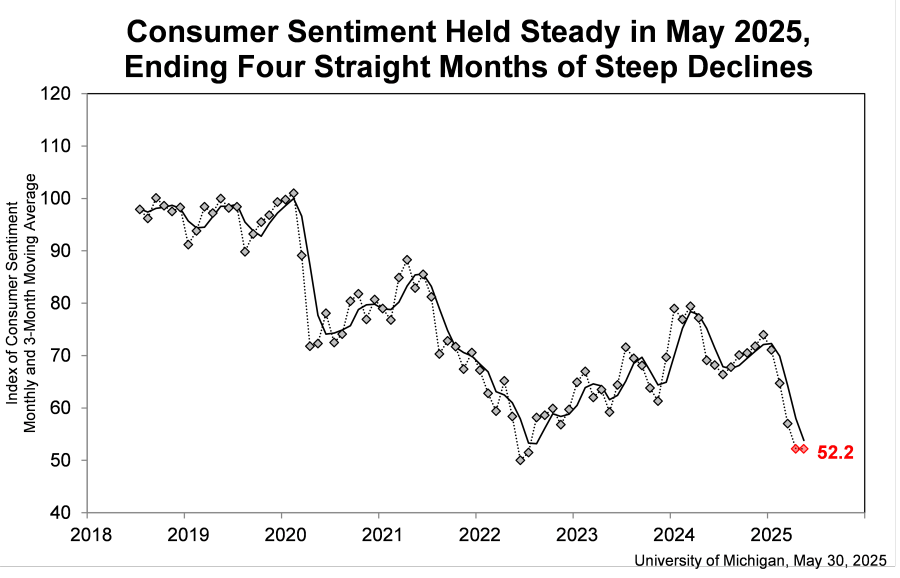
美国5月消费者信心止跌 关税暂缓提振乐观情绪
news flash· 2025-05-30 14:04
Core Viewpoint - The consumer confidence index in the U.S. for May remained stable compared to April, ending a four-month decline, influenced by temporary tariff suspensions that boosted optimism [1] Group 1: Consumer Confidence - The consumer confidence index for May was roughly flat compared to April, marking the end of a four-month downward trend [1] - Initial data in early May indicated a decline in confidence, but a recovery was observed in the latter half of the month due to the temporary suspension of certain tariffs [1] - Consumers showed improved expectations regarding the business environment after mid-May, likely a direct result of adjustments in trade policy [1] Group 2: Financial Outlook - Despite the positive changes in consumer confidence, overall income stagnation led to a decrease in satisfaction with personal financial situations, offsetting the optimistic trends [1] - Generally, consumers do not perceive the economic outlook as worse than the previous month, yet they maintain a high level of concern about the future [1]

中美宣布关税降至10%,加方态度大变,准备效仿美国,中方表态
Sou Hu Cai Jing· 2025-05-16 09:50
Group 1 - The core viewpoint of the articles highlights the significant consensus reached between China and the United States regarding tariff adjustments, which is expected to positively impact bilateral trade and stimulate economic growth for both nations [1][3][4] - The adjustment of tariffs is seen as a crucial step not only for China and the U.S. but also for global economic stability, as it may influence other countries, including vulnerable economies [3][6] - Canada's response to the U.S.-China agreement indicates a potential shift in its trade policy towards China, suggesting that Canada may seek dialogue to resolve trade issues [4][6][9] Group 2 - The articles emphasize that the trade policy adjustments between China and the U.S. could have a ripple effect on international trade dynamics, necessitating Canada to reassess its trade stance and approach towards China [6][8] - The successful negotiations between China and the U.S. are framed as a model for other nations, encouraging a rational and long-term perspective in trade policy formulation [3][9] - The overall context suggests that the adjustments in trade relations are not merely bilateral events but are interconnected within the framework of global economic interdependence, highlighting the importance of cooperation and dialogue among nations [8][9]
美联储巴尔:关税致供应链中断或推高通胀,中小企业生存风险加剧
智通财经网· 2025-05-15 23:49
Core Viewpoint - The speech by Federal Reserve Governor Michael Barr highlights the potential risks to the U.S. economy from trade policy adjustments, particularly regarding supply chain disruptions that could lead to both economic slowdown and increased inflationary pressures [1][2] Group 1: Economic Impact - Despite the current robustness of the U.S. economy, trade policy changes could trigger significant supply chain volatility that warrants close attention [1] - Barr emphasizes that small and medium-sized enterprises (SMEs) play a critical role in the economic system, serving as essential nodes in supply chains and providing specialized production factors [1] - Historical experiences indicate that supply chain disruptions can have multiplier effects, as seen during the COVID-19 pandemic, where shortages led to prolonged industry shutdowns and persistent price fluctuations [1] Group 2: Risks to SMEs - SMEs are particularly vulnerable to risks due to limited access to credit and insufficient financial reserves, making them more susceptible to operational pressures in the event of supply chain interruptions [1] - If trade policy uncertainties continue, similar scenarios to those experienced during the pandemic could reoccur, potentially weakening economic growth momentum and exacerbating inflationary pressures [1] Group 3: Policy Recommendations - While Barr did not specify direct policy measures, he stressed the importance of policy transparency and stable expectations, urging that trade policies should consider their impact on microeconomic entities, especially SMEs [2] - The current economic landscape in the U.S. is characterized by dual challenges of inflationary pressures and slowing growth, reflecting concerns about the spillover effects of trade policies [2] - The trajectory of this policy debate may significantly influence the Federal Reserve's future monetary policy decisions [2]
英国政府:英国将对从美国进口到英国的乙醇关税降至零。
news flash· 2025-05-08 15:17
Core Point - The UK government has announced a reduction of tariffs on ethanol imported from the United States to zero [1] Group 1 - The decision is expected to enhance trade relations between the UK and the US, particularly in the biofuels sector [1] - This move may lead to increased imports of US ethanol, benefiting American producers and potentially lowering prices for UK consumers [1] - The policy change aligns with the UK government's broader strategy to promote renewable energy sources and reduce carbon emissions [1]
800美元免税时代落幕,美国人哭晕 有人竟喊冤:“中国无辜受罚”?
Xin Lang Cai Jing· 2025-05-04 11:36
Core Points - The cancellation of the $800 tax exemption for imported goods in the U.S. will significantly impact American consumers and Chinese sellers [1][3] - American consumers are expected to face higher prices for imported goods, leading to a more cautious shopping behavior during holiday seasons [1][4] - The move is perceived as a strategy by the U.S. government to protect domestic industries while affecting the competitiveness of low-priced Chinese goods [3][4] Impact on U.S. Consumers - The removal of the tax exemption will make holiday shopping more challenging for American consumers, who previously enjoyed a more affordable shopping experience [1][7] - Consumers may need to adjust their spending habits due to increased costs associated with imported goods [1][7] Impact on Chinese Sellers - Increased competition is anticipated as American consumers become more selective, potentially leading to a decline in sales for products that do not offer price advantages [4][5] - Profit margins for Chinese sellers may be pressured despite price increases, as they may need to lower prices to remain competitive [4][5] - High-quality Chinese products with unique selling points may still find success in the U.S. market, emphasizing the importance of product quality, brand reputation, and customer service [5][6] Market Adaptation - Chinese sellers are encouraged to enhance product quality and brand development to maintain competitiveness in the changing market environment [5][6] - The cancellation of the tax exemption is viewed as a significant challenge for U.S.-China trade relations, necessitating strategic adjustments from both sides [5][9]

部分零售商停止向美国客户销售产品
Sou Hu Cai Jing· 2025-05-03 17:49
Core Viewpoint - The recent cancellation of the small package tax exemption policy for Chinese goods by the U.S. has significantly impacted cross-border e-commerce, leading to increased costs and potential losses for retailers [1][5]. Group 1: Policy Changes and Economic Impact - The U.S. has removed the small package tax exemption for Chinese goods, resulting in tariffs that can reach as high as 145%, disrupting the cost structure of cross-border e-commerce [1][5]. - Retailers are responding to the increased costs by ceasing sales to U.S. customers or exploring alternative markets, as the profitability of low-value, high-frequency goods has been severely affected [1][5][9]. Group 2: Consumer and Retailer Reactions - American consumers accustomed to affordable Chinese products may face higher prices or a lack of availability, leading to frustration and confusion [3][4]. - The policy change is seen as a double-edged sword, potentially harming U.S. consumers while aiming to protect domestic industries, highlighting the unintended consequences of such trade policies [4][7]. Group 3: Recommendations for Future Actions - Future trade policies should be more nuanced, considering the diverse impacts on various stakeholders, including consumers and retailers, to avoid negative spillover effects [7][9]. - Retailers are encouraged to diversify their supply chains and explore new markets to mitigate risks associated with reliance on a single market or policy [9].