
中小企业

Search documents
内蒙古:2026年力争培育300家创新型中小企业、200家专精特新企业
Xin Lang Cai Jing· 2026-02-27 13:20
Core Viewpoint - The Inner Mongolia Autonomous Region aims to enhance the scale and quality of small and medium-sized enterprises (SMEs) by 2026, focusing on the "1571" work deployment to promote high-quality development [1][2]. Group 1: Development Goals - By 2026, the region plans to add 700 new industrial enterprises, including 300 from the "small to standard" initiative and 400 new projects [1]. - The goal is to cultivate 300 innovative SMEs, 200 specialized and innovative enterprises, and 5 "little giant" enterprises by 2026 [2]. Group 2: Industry Cluster Development - The region aims to establish 10 SME characteristic industrial clusters and 1 national-level cluster by 2026, leveraging local resources and industrial foundations [2]. - The focus is on enhancing the resilience and vitality of industrial chains and clusters to inject new momentum into high-quality industrial development [2]. Group 3: Service System Improvement - Continuous optimization of public service platforms for SMEs is planned, including the development of specialized financial products to address financing challenges [3]. - Efforts will be made to clear overdue payments to enterprises, enhancing business confidence and satisfaction [3].
郑重科:跨境消费到跨境创业,如何打通最后一公里?
Nan Fang Du Shi Bao· 2026-02-11 06:31
Core Viewpoint - The proposal aims to transform the consumer flow generated by the "Hong Kong vehicles entering the mainland" policy into entrepreneurial growth by establishing a cross-border entrepreneurial service system in Zhuhai, encouraging Hong Kong SMEs to settle in the city [1][2]. Group 1: Current Situation - Since the implementation of the "Hong Kong vehicles entering the mainland" policy, there has been an influx of Hong Kong SMEs and professionals into the Greater Bay Area, but activities in Zhuhai remain primarily focused on consumption, particularly in dining and shopping [2]. - Hong Kong SMEs account for over 98% of local enterprises and contribute approximately 45% of private sector employment in Zhuhai, yet they face challenges such as high operational costs and limited space [2]. Group 2: Challenges Faced - There is a significant information asymmetry, as many Hong Kong residents are unaware of how to start a business in Zhuhai, lacking knowledge about business registration, taxation, and labor regulations [2]. - Existing government services are primarily designed for large projects or conventional businesses, lacking a one-stop solution for Hong Kong SMEs starting from scratch [2]. Group 3: Proposed Solutions - The proposal suggests a dual strategy of "precise traffic attraction" and "worry-free establishment" to overcome barriers [3]. - It recommends creating a "Zhuhai Entrepreneurship Guide" section on popular travel planning apps and social media, as well as setting up "entrepreneurship service stations" at key border points to provide policy interpretations [3]. - A standardized service package for Hong Kong enterprises is proposed, including a Cantonese guide, a flowchart, a dedicated specialist, a green channel, and a time-limited mechanism to facilitate business establishment [3]. - Incentives such as rent subsidies and recruitment rewards for first-time registrants in Zhuhai are suggested, along with designated "Hong Kong enterprise startup clusters" in high-tech zones and bonded areas to provide ready-to-use office space and support services [3].

Inside the US-India Trade Deal
Youtube· 2026-02-03 14:20
Economic Growth and Trade - The trade deal is expected to provide a significant boost to India's growth estimates, potentially raising them from 6.8% to 7.4% or higher [3][4][18] - India has commitments to make purchases of approximately $500 billion over the next five years, which could enhance its economic position [5] - The trade deal is seen as a way to reinvigorate the "China plus one" strategy, positioning India as a key player in global value chains [2][8] Currency and Capital Flows - The Indian rupee has been underperforming, but the trade deal is anticipated to improve investor sentiment and capital flows, which are critical for the economy [6][7][8] - The current account deficit is relatively low compared to historical trends, which may help stabilize capital flows despite recent challenges [8] Budget and Fiscal Policy - The budget includes a fiscal deficit target of around 4.3% of GDP, with a focus on maintaining fiscal discipline while boosting growth through infrastructure investments exceeding $12 billion [11][12] - Customs duty reductions on various sectors, including electronics and pharmaceuticals, are expected to lower input costs and enhance competitiveness [15][17] Job Creation and Employment - The budget aims to create jobs through initiatives targeting micro, small, and medium enterprises, as well as investments in health and tourism sectors [20][21] - Labor code notifications are designed to reduce uncertainty for employers and employees, facilitating job creation [19] Foreign Investment and Market Sentiment - The trade deal is viewed as a catalyst for reversing the trend of foreign investors exiting the Indian market, with expectations of renewed interest in India's macro fundamentals [23][24] - The removal of uncertainties surrounding the trade agreement is likely to signal a more favorable environment for international investors [24]


福建“十五五”三方面深化两岸融合发展
Zhong Guo Xin Wen Wang· 2026-02-03 08:52
Core Viewpoint - Fujian Province aims to deepen cross-strait integration in social, economic, and emotional aspects during the "14th Five-Year Plan" period, enhancing cooperation with Taiwanese compatriots and enterprises to share in the rejuvenation of the Chinese nation [1]. Group 1: Social and Economic Integration - Fujian will continue to enhance the welfare of Taiwanese compatriots by providing equal treatment in housing, elderly care, and emergency assistance, integrating them into the local housing security system [1]. - The province plans to expand rental and sale housing options for Taiwanese residents and improve digital service platforms for Taiwanese enterprises, exploring new tax service models [2]. Group 2: Economic Cooperation and Industrial Integration - Fujian will promote deep collaboration in cross-strait economic and trade relations, focusing on integrated circuit industry cooperation and upgrading industrial parks [2]. - The province aims to support Taiwanese enterprises in participating in modern infrastructure projects and enhance market access for Taiwanese investments, ensuring a secure and smooth development environment [2]. Group 3: Cultural Exchange and Consensus Building - Fujian will strengthen emotional ties through family and cultural exchanges, promoting historical projects and major cross-strait forums to enhance understanding and consensus [3]. - The establishment of cultural centers and youth exchange programs is intended to foster a shared cultural identity and encourage Taiwanese youth to engage in collaborative initiatives in Fujian [3].
日本经济崩盘,债务创28年新高,高市支持率断崖下跌
Sou Hu Cai Jing· 2026-01-26 14:56
Economic Crisis Overview - Japan's economy is facing a multifaceted crisis, with debt levels reaching a 28-year high and significant turmoil in the bond market [2] - The crisis is attributed to short-sighted policies and long-standing issues, exacerbated by tax cuts and early elections [2] Tax Policy and Market Reaction - Prime Minister Fumio Kishida announced a controversial policy to suspend the 8% food consumption tax for two years, aimed at gaining voter support ahead of the February 8 election [4] - This tax cut is unprecedented in Japan, as even former Prime Minister Shinzo Abe refrained from reducing taxes [5] - The announcement led to a rapid sell-off in the bond market, with the 10-year government bond yield surging by 18.5 basis points to 2.380%, a 28-year high, and the 40-year bond yield exceeding 4% [9] Fiscal Implications - The food consumption tax is a crucial revenue source, accounting for nearly 22% of Japan's fiscal income, and its suspension could create a fiscal gap of 5 trillion yen annually, comparable to Japan's entire education budget [10] - Investor confidence in Japan's fiscal stability has collapsed, leading to increased bond selling and a worsening debt market crisis [12] Broader Economic Impact - The depreciation of the yen has raised import costs for energy and food, further exacerbating inflation [14] - Rising bond yields have increased mortgage rates, putting financial pressure on households, while small businesses face higher financing costs, leading to layoffs and wage freezes [14] Structural Debt Issues - Japan's public debt-to-GDP ratio exceeds 240%, the highest among developed nations, with the fiscal budget for FY2026 projected at a record 122.3 trillion yen [15] - A significant portion of Japan's public debt is supported by domestic savings, but this buffer is diminishing as the Bank of Japan moves towards tightening monetary policy [17][19] Political Consequences - Kishida's cabinet support rate has plummeted from 67% to 57%, marking a significant decline due to public dissatisfaction with perceived political opportunism [23] - The early dissolution of the House of Representatives has delayed critical budget discussions, contradicting Kishida's earlier commitments to address high prices [25] Conclusion - The ongoing crisis in Japan is a result of structural issues compounded by short-term political maneuvers, creating a vicious cycle of high debt, market instability, and eroded political trust [30] - Without addressing these underlying problems and implementing pragmatic measures, Japan's path to economic recovery will remain challenging [32]
“做多底特律”!美银Hartnett:以史为鉴,接棒黄金的最佳策略
Hua Er Jie Jian Wen· 2026-01-26 08:51
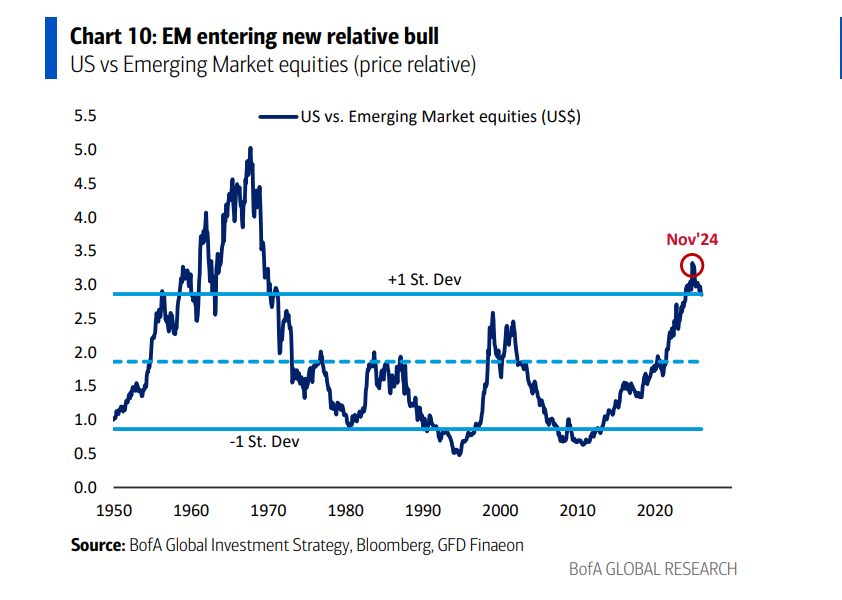
Core Viewpoint - Bank of America signals a tactical sell signal despite the "bull-bear indicator" being in an extremely bullish zone (9.2), suggesting investors should rotate rather than retreat, focusing on small-cap stocks and real economy sectors over large-cap and tech stocks [1][14]. Group 1: Market Trends - The current market sentiment indicates that while the selection of the new Federal Reserve Chair typically leads to yield fluctuations, it is believed that the new chair in 2026 will not allow the 30-year Treasury yield to exceed the 5% "safe haven" level due to interventions like quantitative easing (QE) and yield curve control (YCC) [2]. - The bond market is experiencing a severe bear market, with the price of 30-year U.S. Treasuries dropping by 50% and Japanese government bonds (JGB) falling by 45% since the beginning of the 2020s [3]. Group 2: Fund Flows - Despite rising yields, the bond market recorded an inflow of $15.4 billion, while gold saw inflows of $4.9 billion. Conversely, U.S. equities experienced an outflow of $16.8 billion, marking the first outflow in two weeks [4]. - The bear market in bonds has led to a bull market for U.S. tech stocks, European/Japanese bank stocks, and gold in the first half of the decade, while emerging markets (EM) and small-cap stocks are expected to benefit in the latter half [4]. Group 3: Investment Strategy - The core strategy of "buying Detroit and shorting Davos" emphasizes a bullish outlook on U.S. small-cap stocks until 2027, supported by four pillars: global macro trends, extreme capital outflows from Japan, undervaluation of small-cap stocks, and government interventions to control costs [10][11]. - Historical comparisons suggest that the current situation resembles the 1970s, where initially gold thrived, followed by small-cap stocks becoming the best-performing assets [7]. Group 4: Emerging Markets and Capital Flows - Capital is flowing from weak Asian currencies to U.S. and European assets, with South Korean retail investors having invested nearly $100 billion in U.S. stocks since 2019 [16]. - The long-term bull market for international stocks is entering its second year, driven by strong commodity prices and a strengthening of emerging market currencies, which is expected to lower emerging market bond yields and propel emerging market stocks into a new relative bull market [16].
工信部:我国累计培育专精特新中小企业超14万家
Zhong Guo Xin Wen Wang· 2026-01-21 05:53
Core Insights - The Ministry of Industry and Information Technology (MIIT) reported that by 2025, China has cultivated over 140,000 specialized and innovative small and medium-sized enterprises (SMEs) [1] Group 1: Economic Indicators - In 2025, the added value of industrial SMEs is expected to grow by 6.9% year-on-year, with the SME export index at 52.4% in December, marking 21 consecutive months of expansion [1] - The number of specialized and innovative "little giant" enterprises reached 17,600, while over 600,000 technology and innovation-oriented SMEs were established [1] Group 2: Challenges and Support Measures - Many SMEs face challenges in market orders, talent acquisition, funding turnover, and transformation, necessitating improved policy measures and support [1] - The MIIT plans to enhance the policy and regulatory framework, as well as the public service system, to promote high-quality development of SMEs by 2026 [1] Group 3: Development Strategies - The MIIT aims to optimize the business environment for SMEs by implementing the "14th Five-Year" plan and ensuring the enforcement of regulations to protect SME rights [2] - There will be a focus on nurturing more specialized and innovative enterprises through a three-year action plan and the establishment of specialized empowerment centers [2] - Comprehensive services will be provided to SMEs, including market expansion, digital empowerment, financing support, talent development, management improvement, and international cooperation [2]
工信部:将制定“十五五”促进中小企业发展规划 加力培育更多专精特新企业
Xin Hua Cai Jing· 2026-01-21 05:30
Core Viewpoint - The Chinese government is committed to promoting the development of small and medium-sized enterprises (SMEs) through various initiatives and policies aimed at enhancing their growth and addressing existing challenges in the market. Group 1: Economic Indicators - In 2025, the added value of industrial SMEs is expected to grow by 6.9% year-on-year, indicating steady economic performance [1] - The SME export index for December stands at 52.4, remaining in the expansion zone for 21 consecutive months [1] Group 2: Quality of Development - A total of 17,600 specialized and innovative "little giant" enterprises have been cultivated, with over 140,000 specialized and innovative SMEs and more than 600,000 technology and innovation-oriented SMEs [1] - The R&D investment intensity of "little giant" enterprises reaches 7%, with a total of 460,000 invention patents, averaging 26.6 patents per enterprise [1] Group 3: Policy and Support Measures - The Ministry of Industry and Information Technology (MIIT) plans to enhance the policy framework to support SMEs, focusing on improving the business environment and ensuring timely payments to SMEs [2] - A three-year action plan will be implemented to cultivate high-quality specialized and innovative enterprises, alongside the establishment of specialized empowerment centers [2] Group 4: Service and Support Systems - The MIIT aims to build and utilize the China SME Service Network effectively, creating national public service demonstration platforms for SMEs [3] - Collaborative actions will be taken to enhance public services in areas such as market expansion, digital empowerment, financing, talent development, management improvement, and international cooperation [3]
2024年四川省中小企业发展环境评估报告出炉 超八成企业认为发展环境有所改善
Sou Hu Cai Jing· 2026-01-20 13:57
Group 1 - The core viewpoint of the report indicates that the development environment for small and medium-sized enterprises (SMEs) in Sichuan Province is continuously improving, with over 80% of surveyed enterprises acknowledging an enhancement in the business environment [1][2] - The report evaluates the development environment based on five primary indicators: policy environment, market environment, innovation environment, financing environment, and legal environment, with a total of 21 cities (prefectures) included in the study [1] - The overall average score for the four key indicators is 4.44 out of 5, with the policy environment leading at 4.59, followed by market environment at 4.44 and legal environment at 4.40 [1] Group 2 - The report highlights successful case studies from cities like Chengdu, Deyang, Dazhou, and Mianyang, focusing on service mechanism innovation, market vitality stimulation, digital transformation, precise financing, and compliance construction [2] - It identifies existing shortcomings in the development process, such as long financing cycles, insufficient innovation capabilities, and the need for improved payment guarantees [2] - Recommendations for addressing these issues include optimizing policy supply, creating a fair market environment, improving the financing system, enhancing innovation and talent support, and strengthening legal guarantees [2]
财政部:对相关科技创新类贷款给予财政贴息,央行同时提供再贷款支持
Bei Jing Shang Bao· 2026-01-20 08:00
Core Viewpoint - The Ministry of Finance emphasizes the importance of enhancing key industries through fiscal and financial collaboration to support technological innovation [1] Group 1: Fiscal and Financial Support - The Ministry of Finance will provide fiscal subsidies for loans related to technological innovation [1] - The central bank will offer re-lending support to facilitate these initiatives [1] Group 2: Industry Transformation - There is a focus on promoting new technological transformations in the manufacturing sector [1] - The initiative aims to accelerate the digital transformation of small and medium-sized enterprises [1] Group 3: Development Goals - The strategy aims to foster intelligent, green, and integrated development [1] - The overall goal is to solidify and expand the foundation of the real economy [1]