银行转型

Search documents
李扬解析低利率时代破局之道:银行转型与资本市场发展双轮驱动
Sou Hu Cai Jing· 2025-08-18 02:40
Core Insights - The financial industry in China faces significant challenges due to the downward trend in interest rates, which is expected to continue [2][3] - Li Yang emphasizes the need for a dual approach to address low interest rates: transforming financial intermediaries and developing capital markets [1][4] Financial Intermediaries Transformation - Financial intermediaries, particularly banks, must transition from a product-selling model to a service-oriented model to adapt to the changing environment [4] - The development of asset management businesses is crucial, as it represents a shift towards direct financing, enhancing efficiency in capital allocation [4][5] - Asset trading businesses should be expanded, leveraging technological advancements such as digitalization and blockchain to optimize resource allocation [5][6] - Comprehensive operations should be explored to overcome the limitations of segmented financial operations and regulations [6] Capital Market Development - The decline in interest rates and the trend of disintermediation create favorable conditions for the growth of capital markets, including asset management markets [6][7] - There is a critical need to convert household savings into corporate capital, addressing the imbalance in China's financing structure [6][7] - The central financial work meeting has highlighted the importance of enhancing the attractiveness and inclusivity of domestic capital markets [7] International Economic Environment - The global economic landscape is undergoing profound changes, moving towards fragmentation and bilateral negotiations, which impacts international trade dynamics [8][9] - Despite external challenges, there is confidence in China's economic resilience, attributed to its strong position in global supply chains [9] - The Chinese government is implementing proactive fiscal and monetary policies to support economic stability and growth [9]
低利率时代银行转型加速,从传统存贷到多元化布局
Di Yi Cai Jing· 2025-06-30 13:14
Core Viewpoint - The banking industry is undergoing a transformation in response to declining deposit interest rates, with a focus on diversifying income sources and enhancing digital capabilities to attract customers and stabilize net interest margins [1][5][8]. Group 1: Deposit Rate Changes - Major state-owned banks have initiated a reduction in deposit interest rates, leading to a widespread trend among small and private banks, pushing deposit rates into the "1 era" [1][2]. - The rates for large-denomination certificates of deposit (CDs) have also significantly decreased, with some banks removing long-term CD products altogether [1][2]. - The current rates for 3-year CDs from major banks have dropped to 1.55%, while 1-year and 2-year products are at 1.2% [2]. Group 2: Innovative Customer Acquisition Strategies - Banks are implementing innovative strategies to attract deposits, such as promotional activities that offer gifts or experiences for account openings [3]. - In the loan sector, banks are offering ultra-low interest rates on consumer loans, including 5-year interest-free auto loans and home renovation loans at rates as low as 2.4% [3]. Group 3: Shift to Non-Interest Income - With the decline in deposit attractiveness, banks are increasingly promoting wealth management products and structured deposits as alternatives to traditional savings [5][7]. - The average yield for these alternative products is between 2% and 3%, which helps banks lower overall funding costs while meeting customer demand for higher returns [5]. - Many banks are focusing on increasing non-interest income to enhance operational resilience and diversify revenue streams [6][7]. Group 4: Digital Transformation and Cost Reduction - The banking sector is leveraging digital transformation as a key strategy to improve efficiency and reduce costs in the face of declining interest rates [8][11]. - International banking experiences, particularly from Japan, are being considered as models for optimizing asset-liability structures and enhancing non-interest income [8][10][11]. Group 5: Market Adaptation and Future Outlook - The adjustments in the banking sector are seen as necessary adaptations to the deepening market-oriented interest rate environment, aimed at stabilizing net interest margins amid narrowing spreads [4][6]. - The growth of wealth management services is viewed as a significant opportunity for banks, given the increasing awareness of financial management among consumers [7].
银行谋变低利率“逆风局”
21世纪经济报道· 2025-05-23 14:12
Core Viewpoint - The banking industry is transitioning into a low-interest-rate environment, which poses significant challenges for profitability and requires a strategic shift from a focus on asset scale to value-driven growth [3][4][6]. Summary by Sections Low-Interest Rate Era - The recent decline in LPR rates indicates a shift towards a low-interest-rate era in China, with net interest margins decreasing from 2.08% in 2021 to 1.43% in Q1 2025, a drop of 65 basis points [3][8]. - Historical experiences from Japan, the US, and Europe suggest that once a country enters a low-interest-rate environment, it may take over a decade to exit [7][8]. International Experience and Strategies - Japanese banks have successfully navigated low-interest rates through international expansion and diversification of non-interest income, providing a model for Chinese banks [4][11]. - Key strategies employed by Japanese banks include expanding overseas operations, adjusting loan structures, enhancing non-interest income, and pursuing mergers and acquisitions [12][13]. Domestic Banking Response - Chinese banks are adopting a combination of strategies to cope with the low-interest-rate environment, focusing on both increasing non-interest income and optimizing cost structures [18][20]. - Major banks like ICBC are emphasizing internationalization and comprehensive service offerings to support revenue growth, with international assets contributing 11.8% to the group's total [16][20]. Transformation and Future Outlook - The banking sector is moving from a reliance on interest income to a diversified income model, with a focus on wealth management and comprehensive financial services [21][22]. - Smaller banks are also adapting by deepening regional market engagement and offering tailored financial products to enhance customer loyalty [22]. Conclusion - The transition to a low-interest-rate environment necessitates a fundamental transformation in the banking industry, emphasizing strategic execution and the development of a multi-faceted income structure to ensure sustainable growth [15][22].


深度丨银行谋变低利率“逆风局”
2 1 Shi Ji Jing Ji Bao Dao· 2025-05-23 12:29
Core Viewpoint - The banking industry is transitioning into a low-interest-rate environment, which poses significant challenges for profitability and requires a strategic shift in business models [1][3][4]. Group 1: Current Economic Environment - The recent decline in the Loan Prime Rate (LPR) and the continuous drop in the 10-year government bond yield indicate a shift towards a low-interest-rate era in China [1][4]. - Historical experiences from Japan, the US, and Europe suggest that once a low-interest-rate environment is established, it may take over a decade to exit [3][4]. Group 2: Impact on Banking Sector - The net interest margin for commercial banks in China has decreased from 2.08% in 2021 to an expected 1.43% by Q1 2025, marking a cumulative decline of 65 basis points [1][4]. - The low-interest-rate environment is expected to lead to a decline in interest income for listed banks, with a projected 2.2% decrease in 2024 [5]. Group 3: Strategic Responses - Some banks are adopting strategies similar to those of Japanese banks, such as international expansion and diversification into non-interest income [2][8]. - Major banks like ICBC are implementing a "second growth curve" strategy to adapt to the new environment, focusing on comprehensive financial services [13][16]. Group 4: Lessons from International Experience - Japanese banks have successfully navigated low-interest rates by expanding overseas, adjusting loan structures, and increasing non-interest income [8][10]. - The shift towards a diversified income model is crucial for banks to mitigate the impact of declining interest margins [10][11]. Group 5: Future Outlook - The banking sector is expected to continue evolving, with a focus on enhancing operational efficiency, optimizing asset-liability structures, and leveraging technology to support growth [14][18]. - The emphasis on wealth management and private banking is increasing as banks seek to meet rising demand for asset preservation in a low-interest-rate context [13][14].
报告:2024年度中国上市银行净利润同比增长2.42%
Zhong Guo Xin Wen Wang· 2025-05-13 08:47
Group 1 - The core viewpoint of the report indicates that in 2024, China's listed banks are expected to achieve operating income of RMB 5.87 trillion, a year-on-year growth of 0.06%, and a total net profit of RMB 2.22 trillion, reflecting a year-on-year increase of 2.42% [1] - The report analyzes the performance, asset quality, business development, and operational models of 58 listed banks in China for the year 2024, highlighting a continued focus on risk prevention and management [1] - Due to factors such as declining market interest rates and adjustments in mortgage loan rates, the net interest margin for listed banks is projected to narrow further, with an average net interest margin of 1.52% [1] Group 2 - The report on the 42 A-share listed banks indicates that by the end of Q1 2025, total assets grew by 3.94% compared to the end of 2024, with a weighted average non-performing loan ratio of 1.23%, down by 0.01 percentage points [2] - Looking ahead to 2025, it is anticipated that the Chinese economy will continue to recover, providing more opportunities for listed banks, which need to align with policy directions and accelerate transformation to seek new business development breakthroughs [2] - The emphasis is on maintaining strategic focus and embracing industry changes to carve out a path for high-quality development that aligns with the banks' unique circumstances [2]
人事更迭后,郑州银行企稳信号初现
Hua Er Jie Jian Wen· 2025-04-17 12:25
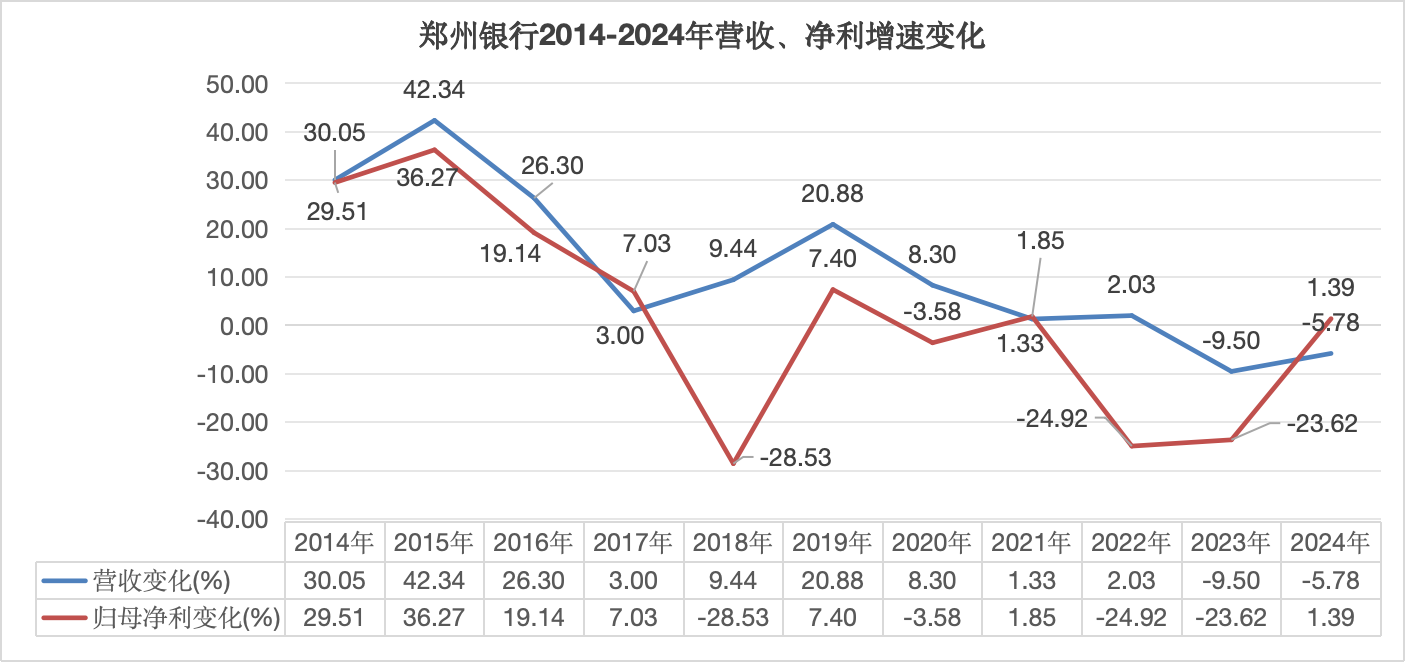
Core Viewpoint - The banking industry is facing significant challenges amid tightening regulations and the need for capital management, risk control, and core competitiveness, as exemplified by Zhengzhou Bank's struggles during its transformation [1][5]. Financial Performance - Zhengzhou Bank reported revenue and net profit of 12.877 billion yuan and 1.876 billion yuan for the fiscal year 2024, with year-on-year growth rates of -5.78% and 1.39% respectively [1]. - Despite the lackluster profit performance compared to peers, the bank's profit has rebounded by 25.01 percentage points compared to the previous year, marking the highest increase among A-share listed city commercial banks [1][16]. Historical Context - Zhengzhou Bank experienced rapid growth from 2013 to 2016, maintaining revenue and net profit growth rates of over 25% and 15% respectively [4]. - Post-2020, the bank's performance declined significantly due to its heavy exposure to real estate, leading to increased non-performing loans and a drop in profitability [5][6]. Management Changes - The bank has undergone significant leadership changes, with new appointments including Zhao Fei as chairman and Li Hong as president, aiming to revitalize the management team [8][10]. - The new leadership has implemented salary reductions for executives, with a reported decrease of 25.86% in management salaries in 2024, reallocating resources to frontline employees [12][13]. Dividend Policy - Zhengzhou Bank has resumed its dividend plan after four years, distributing 0.2 yuan per share, resulting in a dividend payout ratio of 9.69% [14]. Growth Strategy - The bank has shifted its focus towards expanding its loan portfolio, with corporate and retail loan growth rates of 6.11% and 8.09% respectively in 2024 [26]. - The bank is also enhancing its support for rural economies and technology enterprises, with a significant increase in policy-based loans for innovation [24][20]. Asset Quality - The bank's non-performing loan ratio has decreased by 0.08 percentage points to 1.79%, while the provision coverage ratio has improved to 182.99%, indicating enhanced risk mitigation capabilities [28]. - However, challenges remain, particularly in the real estate sector, where the non-performing loan amount reached 2.123 billion yuan, reflecting a 12.26% increase year-on-year [30]. Future Outlook - The new management team is expected to focus on comprehensive risk management, with an emphasis on credit risk as a priority [31]. - The ability of Zhengzhou Bank to maintain stability and regain growth momentum under the new leadership remains to be seen [33].