BD合作

Search documents
上半年净利润翻倍,药明康德港股绩后大涨13%!港股通创新药ETF(159570)涨1.4%!如何理性看待创新药估值?
Xin Lang Cai Jing· 2025-07-11 03:27
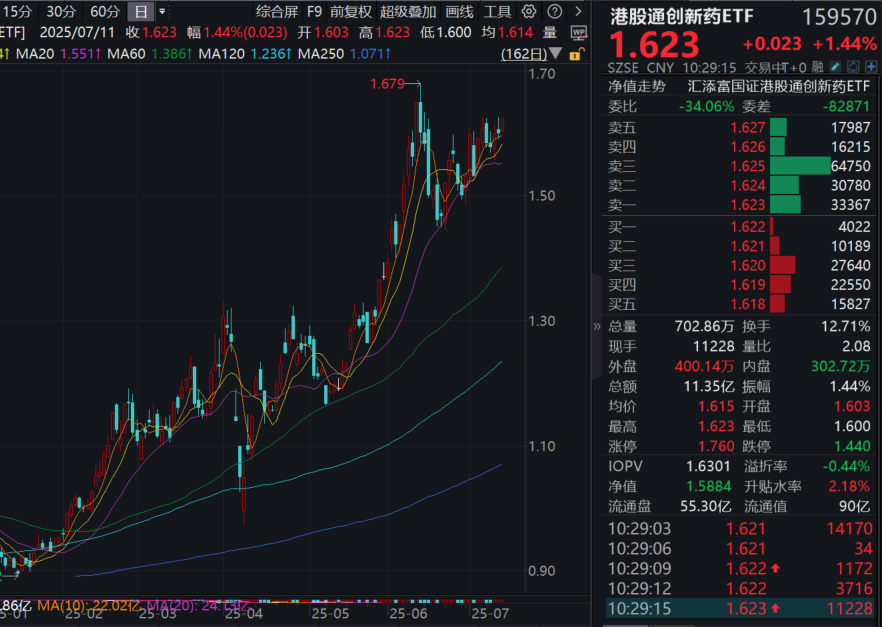
Core Viewpoint - The Hong Kong stock market is experiencing a collective rise, particularly in the innovative drug sector, with leading CXO company WuXi AppTec seeing a significant increase in stock price after its earnings report [1][3]. Group 1: Market Performance - The Hong Kong stock market is showing strong performance, with the innovative drug sector leading the gains, particularly the CXO segment [1]. - WuXi AppTec's stock rose over 13% following its earnings report, contributing to the overall strength of the CXO sector [1][3]. - The Hong Kong Stock Connect innovative drug ETF (159570) increased by 1.4%, with trading volume surpassing 1.6 billion RMB, and has attracted over 5 billion RMB in the last 60 days [1][3]. Group 2: Company Earnings - WuXi AppTec reported an expected revenue of 20.8 billion RMB for the first half of 2025, representing a year-on-year growth of approximately 20.64% [3]. - The net profit attributable to shareholders is projected to be around 8.561 billion RMB, showing a year-on-year increase of about 101.92% [3]. - Adjusted net profit is expected to be approximately 6.315 billion RMB, reflecting a year-on-year growth of about 44.43% [3]. Group 3: Industry Outlook - According to Fengzheng Securities, the innovative drug sector is expected to enter a new upcycle, driven by the recovery of domestic demand and potential interest rate cuts in the U.S. [4]. - The CDMO sector is anticipated to recover quickly due to its reliance on orders from large overseas pharmaceutical companies [4]. - Guotai Junan Securities indicates that the CDMO industry has reached a bottom and is poised for recovery, with strong performance expected in 2025 [4]. Group 4: Policy and Market Dynamics - The upcoming commercial insurance policy for innovative drugs is expected to open up long-term payment avenues for the sector [7]. - The National Healthcare Security Administration has emphasized comprehensive policy support for innovative drugs, which is likely to enhance their market potential [7]. - The commercial health insurance market in China is projected to grow significantly, with premium income expected to reach 977.3 billion RMB in 2024, a year-on-year increase of 8.2% [7]. Group 5: Investment Opportunities - The Hong Kong Stock Connect innovative drug ETF (159570) has a high concentration in innovative drug companies, with the top ten holdings accounting for nearly 72% of the index [8]. - The ETF has shown a remarkable performance, with a 62.78% increase in the first half of 2025, outperforming other medical indices [8]. - The underlying assets of the ETF are Hong Kong stocks, allowing for T+0 trading, which enhances liquidity for investors [8].


东阳光药聆讯通关,加码创新药产业生态 全球获批药物150款持续加码研发投入
Chang Jiang Shang Bao· 2025-06-30 08:54
Core Viewpoint - Dongyang Sunshine Pharmaceutical is pursuing a unique "zero fundraising IPO" strategy by merging with its subsidiary Dongyang Sunshine Changjiang Pharmaceutical, aiming to enhance its competitive position in the pharmaceutical industry [2][3]. Group 1: Listing Strategy - The company plans to go public in Hong Kong through a merger with its subsidiary, which will involve issuing H-shares to shareholders without raising new funds [3]. - This unconventional approach is intended to consolidate its pharmaceutical assets and create a comprehensive pharmaceutical company that integrates R&D, production, and commercialization [3]. Group 2: Market Position - Dongyang Sunshine Pharmaceutical holds a dominant position in the domestic market for its core product, Oseltamivir Phosphate, ranking first in 2024 [2]. - The sales contribution of Oseltamivir Phosphate to total revenue has fluctuated but remains a crucial support for the company's performance from 2022 to 2024 [2]. Group 3: R&D and Innovation - The company has established a robust R&D platform with over 1,100 professionals, focusing on various therapeutic areas including infections, chronic diseases, and oncology [8]. - Dongyang Sunshine has a diverse portfolio of over 150 approved drugs and more than 100 drugs in development, with 49 first-class innovative drugs [8][9]. - The company has invested significantly in R&D, with expenditures of 792 million yuan, 827 million yuan, and 888 million yuan from 2022 to 2024, representing 20.8%, 13.0%, and 22.1% of total revenue respectively [9]. Group 4: Business Development (BD) Collaborations - The company is actively engaging in BD collaborations to expand its commercialization pathways, including a notable agreement with Apollo Therapeutics valued at $938 million for a dual-specific fusion protein [6][7]. - Dongyang Sunshine is one of the few Chinese pharmaceutical companies developing insulin products for the U.S. market, showcasing its global resource integration capabilities [7]. Group 5: AI Technology in R&D - The company is leveraging AI technology across various stages of drug development, having established multiple advanced AI-driven models to enhance innovation and efficiency [9]. - A recent AI-driven first-class new drug, HEC169584, has been approved for clinical trials targeting non-alcoholic fatty liver disease (NASH) [9].

超42亿美元授权协议落地,荣昌生物股价一度跌停
Huan Qiu Lao Hu Cai Jing· 2025-06-26 09:18
Group 1 - The core point of the article is that Rongchang Biologics has entered into a collaboration with VorBio, granting exclusive global rights (excluding Greater China) for the development, production, and commercialization of its proprietary drug, Tai Tasi Pi, which is a dual-target fusion protein [1][2] - The collaboration involves an upfront payment of $125 million, which includes a $45 million upfront payment and $80 million in warrants, potentially allowing VorBio to issue 320 million shares, representing 23% of its expanded share capital [1] - The total potential transaction value could reach $4.23 billion, including milestone payments of up to $4.105 billion and sales royalties in the high single to double-digit percentage range [1] Group 2 - The partnership is expected to accelerate the overseas market expansion of Tai Tasi Pi, providing innovative treatment options for global patients and enhancing the company's brand value and international influence [2] - Following the announcement, the market reacted negatively, with Rongchang Biologics' stock price dropping significantly, including an 18.36% decline in A-shares, despite a year-to-date increase of over 101% prior to the announcement [2] - Analysts noted that the upfront payment amount was perceived as low and that VorBio's smaller company size contributed to the market's disappointment regarding the collaboration's potential [2] Group 3 - Tai Tasi Pi is the world's first recombinant B lymphocyte stimulator (BLyS)/proliferation-inducing ligand (APRIL) dual-target fusion protein, designed to inhibit abnormal differentiation and maturation of B cells, thereby reducing pathogenic antibody production [1] - The drug has already been approved in China for the treatment of myasthenia gravis (MG), systemic lupus erythematosus (SLE), and rheumatoid arthritis (RA), with MG receiving fast track designation from the FDA and orphan drug status from both the US and EU regulatory agencies [1] - Sales of Tai Tasi Pi are projected to exceed 1.5 million units in 2024 [1]

石药集团20250604
2025-06-04 15:25
Summary of the Conference Call for 石药集团 (Shiyao Group) Industry and Company Overview - The conference call focuses on 石药集团, a pharmaceutical company specializing in neurology and oncology products, with significant developments in business development (BD) partnerships and clinical trials [2][3][4]. Key Points and Arguments Neurology Products - **恩必普 (Enbip)** is expected to maintain growth in 2025 through patient education and retail pharmacy channels, enhancing accessibility for stroke patients [2][5]. - **灵舒乐 (Ling Shule)** has rapidly increased in revenue after receiving approval for stroke emergency indications, with projected income reaching 1 billion yuan in 2025 [2][5]. Oncology Developments - **BRERA ADC** targets EGFR TKI-resistant lung cancer patients, showing an overall response rate (ORR) of 39.2% in non-EGFR mutation non-small cell lung cancer (NSCLC) and 63.2% in EGFR-sensitive mutation patients [2][6]. - Two key clinical trials are underway: a Phase III trial initiated in March 2025 and a Phase II trial for first-line immunotherapy combined with OCT therapy expected to start Phase III this year [2][6]. Business Development Partnerships - Recent BD collaborations include: - A licensing agreement with AstraZeneca for LPA with an upfront payment of 100 million USD [2][7]. - A licensing agreement with BeiGene for M a M a T two a with an upfront payment of 150 million USD [2][8]. - An agreement with ADC RO-ONC ADC and additional licensing with ET 康地伊利康脂质体 [2][8]. - Three significant BD projects are anticipated to materialize in 2025 [2][8]. Revenue and Profit Forecast - 太平洋医药 forecasts revenue for 石药集团 to grow from 29.4 billion yuan in 2025 to 31.5 billion yuan in 2027, with profits expected to rise from 4.656 billion yuan to 5.648 billion yuan during the same period [2][9]. - The company is expected to maintain positive growth rates, with a potential valuation recovery as performance improves and BD projects are realized [2][9]. Pipeline and Product Development - The company has a comprehensive pipeline, including small molecules and ADCs targeting HER2 and first-in-class indications, focusing on major cancers such as gastric, breast, ovarian, and colorectal cancers [2][10]. - The **6,010 EGFR ADC** is a key product in NSCLC treatment, currently in Phase III trials, with a low incidence of ERBB-related adverse events [2][11]. HER2 ADC Product Line - The HER2 ADC product line includes **Enhertu ADC**, which is in Phase III for HER2 low-expressing advanced breast cancer, with BLA submission expected in 2026 [2][12]. - Additional BLA submissions for HER2-positive advanced breast cancer and ovarian cancer are anticipated in 2027 [2][12]. Small Molecule RNA Innovation - The small molecule RNA innovation platform includes product **2053**, which shows significant and lasting lipid-lowering effects, having completed Phase I and entered Phase II trials [2][13]. Future Outlook and Valuation - The current valuation of 石药集团 is considered low, but there is significant potential for recovery as BD initiatives are executed and oncology ADC pipelines progress [2][14]. - The company is well-positioned for future growth, leveraging its strong small molecule innovation capabilities and multiple promising platforms [2][14].
阿斯利康一季报:中国区收入18亿美元,ADC药物驱动新增长
2 1 Shi Ji Jing Ji Bao Dao· 2025-04-29 10:00
Core Insights - AstraZeneca reported Q1 2025 revenue of $13.588 billion, a 10% year-over-year increase, with product sales reaching $12.875 billion, up 9% [1] - The company’s R&D investment was $3.159 billion, reflecting a 15% increase [1] - The U.S. market contributed $5.646 billion, a 10% increase, while China contributed $1.805 billion, a 5% increase, making China the third-largest market for AstraZeneca [1] Financial Performance - Revenue by disease area: Oncology contributed $5.643 billion (up 13%), CVRM (Cardiovascular, Renal, and Metabolic diseases) contributed $3.322 billion (up 13%), R&I (Respiratory and Immunology) contributed $2.084 billion (up 13%), V&I (Vaccines and Immune Therapies) contributed $0.225 billion, and Rare Diseases contributed $2.042 billion [3] - Top-selling products: Farxiga (Dapagliflozin) generated $2.057 billion, Tagrisso (Osimertinib) generated $1.679 billion (up 8%), and ADC drug, Trastuzumab deruxtecan, generated $1.086 billion [3] Market Dynamics - The ADC market in China is highly competitive, with significant growth expected; the HER2 ADC market is projected to grow from $0.6 billion in 2022 to $8.4 billion by 2030, with a CAGR of 39% [5] - Trastuzumab deruxtecan has rapidly expanded its indications since its approval in China in February 2023, benefiting from policy support for innovative drugs [4][5] Strategic Initiatives - AstraZeneca is focusing on innovation and local partnerships to navigate the challenges in the Chinese pharmaceutical market, including collaborations with local companies for clinical research [7][8] - The company is diversifying its pipeline to mitigate risks associated with single products, particularly in the ADC space [6][9] Future Outlook - AstraZeneca's ability to convert its clinical pipeline into sustainable revenue will be crucial for its growth in the coming years, especially in light of increasing competition and market pressures [9]

恒瑞医药,投资性价比还是不高
Hu Xiu· 2025-04-01 08:14
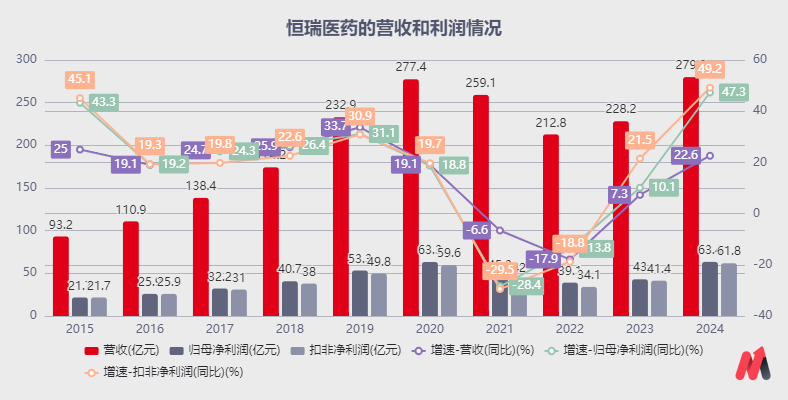
Core Viewpoint - In 2024, Heng Rui Medicine achieved significant revenue growth, with total revenue reaching 27.985 billion yuan, a year-on-year increase of 22.63%, and net profit attributable to shareholders reaching 6.337 billion yuan, up 47.28% year-on-year, indicating a potential shift from "supply chain disruption" to "turnaround" [1][6]. Group 1: Performance Drivers - The strong performance in 2024 is primarily driven by substantial external licensing income, including 1.6 billion euros from Merck Healthcare and 1 billion USD from Kailera Therapeutics, leading to a sixfold increase in licensing income compared to 2023 [7][12]. - The company's core business net profit and non-recurring net profit would revert to around 4 billion yuan if excluding these non-recurring gains, indicating reliance on external partnerships for profit growth [7][15]. Group 2: Impact of Centralized Procurement - The generic drug business still contributes 50% to the company's revenue, and the impact of centralized procurement remains significant, with ongoing effects from previous rounds of procurement [3][4]. - The third and fifth rounds of centralized procurement led to substantial revenue declines in 2021, with sales dropping by 55% and 37% respectively for affected products [3][4]. - The seventh round of procurement also saw a 48% decline in sales for affected products, and the upcoming ninth round is expected to further impact revenue in 2025 [5][6]. Group 3: Valuation and Investment Considerations - The current rolling P/E ratio of around 50 suggests that the company may need 2-3 years to digest this valuation, with expectations of net profit growth slowing to 15%-20% from 2025 to 2027 [17][18]. - The market is shifting focus from short-term profits to long-term innovation value, which may limit the short-term upside for Heng Rui Medicine, given its significant reliance on generic drugs [20].

仿创转型熬出头,翰森制药创新药收入占比超77%
Guo Ji Jin Rong Bao· 2025-03-28 08:57
Core Insights - Hansoh Pharmaceutical reported a total revenue of approximately 12.261 billion RMB for 2024, representing a year-on-year growth of about 21.3%, and a net profit attributable to shareholders of 4.372 billion RMB, up 33.4% year-on-year [1] - The proportion of innovative drugs in total revenue increased significantly from less than 20% at the time of the company's Hong Kong listing to 77.3% in 2024, highlighting the successful transition to an innovation-driven pharmaceutical company [1][5] - The company achieved revenue of 9.477 billion RMB from innovative drugs and collaborative products, marking a year-on-year increase of 38.1% [1] Revenue Breakdown - In 2024, revenue from various therapeutic areas included approximately 8.122 billion RMB from oncology, 1.464 billion RMB from anti-infection, 1.379 billion RMB from central nervous system disorders, and 1.296 billion RMB from metabolic and other diseases, accounting for 66.2%, 11.9%, 11.3%, and 10.6% of total revenue respectively [1] R&D Investment - The company invested 2.702 billion RMB in R&D, which accounted for 22% of total revenue, focusing on major disease areas such as oncology, central nervous system disorders, metabolism, and autoimmune diseases [2] - Key products in development include the lung cancer treatment Amelot, which has three indications entering NDA stage, and other drugs like HS-20094 and HS-10374 progressing to Phase III clinical trials [2] Business Development (BD) Cooperation - In 2024, revenue from BD cooperation reached 1.573 billion RMB, including a 185 million USD upfront payment from GSK for HS-20093 [4] - The company secured a global exclusive license for an oral GLP-1 small molecule from Merck, receiving an upfront payment of 112 million USD and potential milestone payments of up to 1.9 billion USD [4] - Collaborations with international pharmaceutical companies like GSK and Merck are aimed at accelerating global market expansion [4] Strategic Direction - The company aims to continue its transformation from generics to innovative drugs, leveraging R&D and international strategies while enhancing BD cooperation to optimize its global market presence [5]