
区域协调发展

Search documents
市委理论学习中心组学习会集中交流“十五五”发展专题调研成果 进一步统一思想凝聚共识 科学谋划未来五年发展蓝图 马明龙主持并讲话
Zhen Jiang Ri Bao· 2025-12-06 23:26
Group 1 - The meeting focused on studying and implementing the spirit of the 20th Central Committee's Fourth Plenary Session and planning the key development strategies for the next five years in Zhenjiang [1] - The discussions highlighted the importance of integrating the major deployments from the 20th Central Committee with the significant mission assigned to Jiangsu by General Secretary Xi Jinping [2] - Emphasis was placed on advancing the strategy of building a strong industrial city, promoting high-quality port development, and enhancing ecological sustainability [2] Group 2 - Leaders are urged to take responsibility and ensure the implementation of the development blueprint for the 14th Five-Year Plan, focusing on practical measures and results [3] - There is a strong emphasis on risk prevention and safety, particularly in key areas, to protect public safety and ensure orderly urban operations [3] - The goal is to stabilize employment, businesses, and market expectations while striving to meet the annual targets and successfully conclude the 14th Five-Year Plan [3]
新型智库的时代担当与价值路径
Xin Hua Wang· 2025-12-05 09:47
Core Viewpoint - The concept of "restructuring" has gained unprecedented strategic significance in the context of China's "14th Five-Year Plan," serving as a key driver for high-quality development and the formation of new productive forces in the face of global technological revolutions and industrial transformations [1][2]. Group 1: Strategic Necessity and Urgency of Restructuring - Restructuring is essential for addressing deep-seated developmental contradictions and creating new competitive advantages, as China's previous growth model based on factor input is no longer sustainable [2]. - In 2023, China's R&D expenditure exceeded 3.3 trillion yuan, accounting for 2.64% of GDP, indicating a strong commitment to innovation-driven development, although gaps remain in basic research investment and technology transfer efficiency compared to global leaders [2][3]. Group 2: Cultivating New Productive Forces - New productive forces characterized by high technology, efficiency, and quality are crucial for breaking away from traditional economic growth models, with a focus on significantly enhancing total factor productivity through technological innovation [3]. - Effective restructuring and optimization of new production factors such as knowledge, technology, capital, data, and talent are necessary for the development of future industries and strategic emerging sectors [3]. Group 3: Key Areas for Systematic Restructuring - Restructuring the industrial structure to build a modern, autonomous, and efficient industrial system is the main battlefield, emphasizing high-end, intelligent, and green development [4]. - The focus should be on enhancing strategic emerging industries and establishing a detailed industrial map and technology roadmap, particularly in critical areas like integrated circuits and biomedicine [4]. Group 4: Innovation System and Financial Support - Restructuring the innovation system to facilitate a virtuous cycle between technology, industry, and finance is vital, addressing the long-standing disconnect between academia and industry [5]. - Financial support mechanisms should be improved to encourage investment in hard technology, ensuring that financial resources effectively nurture innovation [5]. Group 5: Regional Economic Layout and Urban-Rural Integration - Restructuring regional economic layouts is essential for promoting urban-rural integration and coordinated regional development, requiring the implementation of various strategic initiatives [6]. - The focus should be on establishing mechanisms for cross-regional cooperation and resource allocation to foster a new pattern of integrated development [6]. Group 6: Role of Think Tanks - Think tanks are crucial for providing strategic insights and solutions for the complex restructuring process, transitioning from mere advisors to active participants in the entire cycle [7][8]. - They should facilitate communication among government, enterprises, academia, and the public to build consensus and support for restructuring initiatives [10].
中国共产党武汉市第十四届委员会第十二次全体会议公报
Chang Jiang Ri Bao· 2025-12-04 14:35
Core Viewpoint - The 12th Plenary Session of the 14th Committee of the Communist Party of China in Wuhan emphasizes the importance of the "15th Five-Year Plan" for economic and social development, aiming to build a modernized Wuhan and enhance its role as a strategic hub in central China [2][5][17] Group 1: Economic and Social Development Goals - The "15th Five-Year Plan" period is identified as a critical time for achieving socialist modernization and enhancing Wuhan's strategic position in central China [5][6] - The main goals include significant improvements in development capacity, production quality, social civilization, and living standards, with a vision for Wuhan to rank among the top cities in China by 2035 [8][12] - The plan aims to establish a modern industrial system, focusing on intelligent, green, and integrated development, while promoting new and traditional industries [8][9] Group 2: Innovation and Reform - The session highlights the need for deep integration of technological and industrial innovation, with a focus on enhancing the innovation ecosystem and supporting high-level self-reliance in technology [9][10] - Emphasis is placed on expanding domestic demand and improving the investment environment to stimulate economic growth [9][10] - Key reforms will target state-owned enterprises, the private sector, and market mechanisms to foster a conducive environment for high-quality development [9][10] Group 3: Urban Development and Governance - The session outlines plans for urban renewal and enhancing the quality of urban functions, aiming for a modern, resilient, and livable city [11][12] - There is a focus on rural modernization and urban-rural integration to ensure balanced development and improve living conditions in rural areas [12][13] - The governance model will be modernized to enhance public safety and social stability, ensuring effective management of urban challenges [14][16] Group 4: Cultural and Social Initiatives - The importance of cultural innovation and the promotion of social values is emphasized, aiming to enhance Wuhan's cultural influence and tourism appeal [12][14] - Efforts will be made to improve public welfare and ensure a higher quality of life for residents, with a focus on education, healthcare, and social security [13][14] - The session calls for a collective effort to achieve the goals set forth in the "15th Five-Year Plan," reinforcing the need for unity and commitment among party members and the public [15][17]
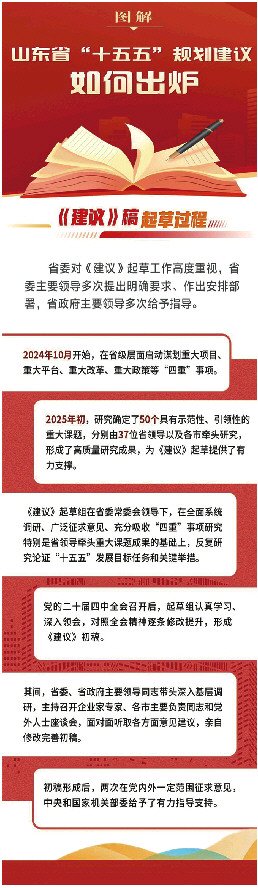
绘就山东“十五五”发展新蓝图
Qi Lu Wan Bao· 2025-12-04 11:25
Core Viewpoint - The Shandong Provincial Committee has approved the "Suggestions" for the 15th Five-Year Plan, emphasizing the need for a modernized economic and social development strategy that aligns with national directives and local characteristics [4][13]. Economic Development - The "14th Five-Year" period has seen significant economic growth in Shandong, with 8 out of 21 key indicators achieved ahead of schedule and 13 meeting expectations, laying a strong foundation for the upcoming "15th Five-Year" period [3][12]. - The "15th Five-Year" period is critical for establishing a modern socialist province, with a focus on economic strength and modernization [3][12]. Strategic Planning - The "Suggestions" consist of three main sections, 14 parts, and 60 articles, aimed at implementing the spirit of the 20th National Congress and addressing the unique challenges and opportunities faced by Shandong [4][13]. - The plan emphasizes the importance of a modern industrial system as the foundation for provincial development, prioritizing the optimization of traditional industries and the cultivation of emerging sectors [6][15]. Innovation and Technology - The plan highlights the necessity of enhancing technological innovation, aiming to establish Shandong as a high-level innovative province and integrate technology with industry [6][15]. - Specific initiatives include the establishment of a regional technology innovation center and the promotion of collaborative innovation between enterprises and research institutions [6][15]. Open Economy - The "Suggestions" call for an optimized open economy framework, enhancing international competitiveness and resource allocation through expanded foreign trade and investment [7][16]. - Shandong aims to leverage international trade agreements and enhance its global economic presence through initiatives like "Ten Thousand Enterprises Going Global" [8][17]. Regional Development - The plan outlines strategies for regional coordination, focusing on the development of urban clusters and enhancing the competitiveness of the Shandong Peninsula city group [8][17]. - It emphasizes the implementation of the Yellow River strategy and the creation of a comprehensive development framework that connects various regions [8][17]. Social Welfare - The plan includes a strong focus on improving living standards, with a commitment to maintaining a high percentage of fiscal spending on social welfare, projected to exceed 1 trillion yuan in 2024 [9][18]. - Employment is prioritized as a key aspect of social welfare, with strategies aimed at supporting job creation and enhancing social security systems [9][18].

【热点评述】简析“十五五”规划建议
乘联分会· 2025-12-04 08:35
Core Viewpoint - The "14th Five-Year Plan" has entered its final countdown, with many key indicators achieved ahead of schedule, while the "15th Five-Year Plan" emphasizes high-quality development, innovation-driven growth, regional coordinated development, and green development to promote comprehensive modernization of the economy and society [6][7][12]. Group 1: Economic Development Goals - The "15th Five-Year Plan" aims to maintain economic growth at a reasonable pace, targeting a per capita GDP level of a moderately developed country by 2035, indicating the need for sustained economic growth in the near future [5][12]. Group 2: Key Strategic Tasks - The plan prioritizes building a modern industrial system and strengthening the foundation of the real economy, emphasizing self-innovation capabilities and the development of new productive forces [8][12]. - It highlights the importance of constructing a strong domestic market and expanding high-level opening-up, with the automotive industry playing a crucial role in promoting consumption and stabilizing growth [9][12]. Group 3: Regional Coordination and Green Transformation - The plan advocates for promoting regional coordinated development, with the automotive industry serving as a vivid example of this strategy in action [10][12]. - It also calls for a comprehensive green transformation of economic and social development, aligning with the "dual carbon" goals, leading to significant changes in the automotive industry [10][12]. Group 4: Outlook for Economic and Automotive Industry Development - The "15th Five-Year Plan" emphasizes qualitative improvements in economic growth, driven by increases in total factor productivity, contributions from technological innovation, and green low-carbon transitions. Domestic automobile sales are expected to exceed 35 million units during this period, with new energy vehicle penetration rates surpassing 70% [11][12].

五年新坐标|金融作笔 助力绘就协同发展新画卷
Xin Hua Wang· 2025-12-04 06:43
"十四五" 期间,中国银行深入践行国有大行责任担当,紧紧围绕国家区域协调发展战略,以"1 个 总体方案+ N个区域行动方案"体系为引领,聚焦重点领域、强化资源统筹、丰富产品服务,持续优化金 融供给,为构建优势互补、高质量发展的区域经济布局注入强劲金融动能。 战略引领 布局区域发展新格局 支持京津冀协同发展。通过支持区域交通一体化、产业升级转移等重点工作落地见效,助力中化、 华能集团财务公司金融服务实现无感迁移,对迁入雄安新区央企成员的金融服务覆盖率达40%;为京唐 城际铁路、京雄高铁、雄安至大兴机场快线等一批标志性项目提供融资支持;助力京津冀科技创新引领 现代化产业体系建设,落地 7 支促进地方产业发展相关基金,实现全流程金融服务。截至2025 年9月 末,中国银行支持京津冀协同发展项目贷款余额超5,600亿元。 推动长三角一体化高质量发展。聚焦"轨道上的长三角"建设,为沪苏湖高铁等区域交通基础设施互 联互通重点项目提供综合金融服务;结合长三角科创资源禀赋,推出"支持长三角G60科创走廊出海联 盟服务方案",为科技型企业提供 "股、贷、债、保、租"多元化金融服务。截至2025年9月末,中国银 行长三角地区分行 ...

“十五五”时期,山东将进一步提高区域发展带动作用
Zhong Guo Fa Zhan Wang· 2025-12-04 05:06
Core Insights - The upcoming "15th Five-Year Plan" for Shandong Province aims to address historical positioning and new challenges, outlining development goals and tasks that reflect central requirements, contemporary characteristics, and local expectations [1] Group 1: Regional Coordination and Development - Shandong will focus on regional coordination, urban-rural integration, and land-sea planning, enhancing regional development capabilities [1] - The plan emphasizes the importance of the Shandong Peninsula urban agglomeration and aims to strengthen strategic collaboration with provinces along the Yellow River [2] - Key projects include the construction of 43 inland ports and the completion of the Long Electric Power Transmission project, which will support major commodity supply channels [2] Group 2: Urbanization and Infrastructure - The plan aims to foster modern urban agglomerations, particularly promoting the synergy between Jinan and Qingdao [3] - It includes 130 key projects focused on infrastructure connectivity and public service sharing to enhance urban development [3] - The urbanization rate in Shandong is projected to exceed 67%, with targeted support for 68 counties identified as having urbanization potential [4] Group 3: Marine Economy and Port Development - The plan highlights the development of a modern marine economy, aiming to establish a world-leading marine technology innovation center [4] - Major initiatives include the "Marine Granary" and "Blue Pharmacy" projects, focusing on high-end services in marine technology and information [4] - Shandong's coastal ports have maintained the highest cargo throughput in the country for three consecutive years, expected to reach 2.1 billion tons this year [4]
省委举行新闻发布会介绍和解读省委十二届十次全会精神
Da Zhong Ri Bao· 2025-12-04 01:09
Core Viewpoint - The Shandong Provincial Committee has introduced the "15th Five-Year Plan" aimed at establishing a modern socialist province, building on the achievements of the "14th Five-Year Plan" and addressing new challenges and opportunities in the coming years [2][3]. Summary by Sections Overall Economic Development - The "14th Five-Year Plan" has seen significant achievements, with 8 out of 21 key indicators completed ahead of schedule and 13 meeting expectations, laying a strong foundation for the "15th Five-Year Plan" [2][3]. Key Objectives and Tasks - The "15th Five-Year Plan" includes 14 sections and 60 articles, focusing on the guiding ideology, main goals, and key tasks for the province's development, reflecting central requirements and local characteristics [3][4]. Strategic Focus Areas - The plan emphasizes 11 key tasks for economic and social development, including the construction of a modern industrial system, which is deemed essential for the province's growth [5][6]. - Specific initiatives include enhancing traditional industries and fostering new ones, with a focus on green and high-quality development [5][6]. Innovation and Technology - The plan highlights the importance of technological innovation, aiming to establish Shandong as a leading innovative province and integrate technology with industry [6][7]. Open Economy - The strategy aims to optimize the open economy framework, enhancing international competitiveness and expanding foreign trade and investment [7][8]. Regional Coordination - The plan addresses regional development, promoting coordinated growth across urban areas and implementing major national strategies [8][9]. Social Welfare and Employment - The plan prioritizes social welfare, with a focus on employment and improving living standards, aiming for a sustainable and equitable social security system [9].
西部旅游热释放什么信号
Jing Ji Ri Bao· 2025-12-04 01:00
Core Insights - The latest data from the Civil Aviation Administration of China indicates a 4.4% year-on-year increase in domestic passenger transport in October, driven significantly by the tourism boom in third- and fourth-tier cities in the western region [1] - The shift in tourism consumption from traditional sightseeing to deeper experiences is evident, with destinations like Dunhuang, Tengchong, and Kashgar gaining popularity due to their unique natural landscapes and cultural richness [1] - Continuous improvements in infrastructure and the use of digital technology have enhanced accessibility to aviation services, effectively connecting resources and markets, which has resulted in increased passenger flow to western cities [1] Industry Trends - The rising popularity of third- and fourth-tier cities in the western region reflects a broader trend where aviation passenger flow acts as a precursor to the movement of capital, information, and technology, thereby stimulating local service industries such as dining, accommodation, and transportation [1] - Local governments are challenged to enhance their governance capabilities to seize new development opportunities, focusing on both hard infrastructure and soft power improvements to foster a positive interaction between tourism and regional development [2] - Aviation and tourism enterprises are encouraged to actively develop "aviation + cultural tourism" integrated products and explore diverse service models like air-rail intermodal transport to better meet the evolving market demands [2]
鲁豫”牵手,下好公共服务“一盘棋
Feng Huang Wang Cai Jing· 2025-12-04 00:28
Core Points - The launch of cross-provincial medical test result recognition between Shandong and Henan provinces marks a significant step in improving healthcare efficiency and reducing patient burdens [1][2] - The establishment of a provincial-level inspection and testing mutual recognition platform in Shandong has facilitated over 14.08 million mutual recognitions among 1,237 hospitals, laying a solid technical foundation for cross-regional cooperation [2] - The mutual recognition of medical test results is not only about convenience but also about building trust through quality evaluation standards, ensuring that the data shared is reliable and safe [2][3] Group 1 - The first cross-provincial online retrieval of a liver function test report from Henan by a Shandong hospital signifies the official start of mutual recognition of clinical test results [1] - The mutual recognition initiative aims to alleviate the common issue where patients must undergo repeated tests when switching hospitals, thus saving time and money [1] - The integration of transportation infrastructure, such as the Jizheng high-speed railway, has enhanced regional collaboration, necessitating parallel improvements in public service connectivity [3] Group 2 - The mutual recognition of medical test results is part of a broader trend in regional coordination, with similar initiatives seen in other areas like the Beijing-Tianjin-Hebei region and the Yangtze River Delta [3] - The initiative is expected to contribute to a more integrated social and economic community by removing hidden barriers and enhancing the flow of resources [3] - The experience gained from the Shandong-Henan cooperation could serve as a valuable model for expanding public service collaboration across larger regions [3]