自动驾驶

Search documents
马年投资锦囊|平安基金莫艽:深度研究丈量价值,以终局思维穿越周期
Sou Hu Cai Jing· 2026-02-25 10:31
Core Viewpoint - The interview with Mo Qiao, a fund manager at Ping An Fund, emphasizes the importance of deep research and a robust investment framework to navigate market noise and identify investment opportunities [3][4]. Group 1: Fund Performance - Mo Qiao's representative fund, Ping An Enjoy Flexible Allocation Mixed Fund, achieved a return of 21.18% in 2024, ranking in the top 5% among 425 funds, while the CSI 300 index rose by 14.5% and the equity mixed fund index by 3.5% during the same period [3]. - In 2025, during a challenging market for value-style products, the fund maintained a positive return of 24.57% [3]. - The maximum drawdowns for the fund were 15.8% in 2024 and 12.8% in 2025 [3]. Group 2: Investment Philosophy - Mo Qiao aims for an annualized return of 15% over the next decade, highlighting that few fund managers achieve this consistently [4]. - He identifies five core areas for investment: artificial intelligence, autonomous driving, robotics, commercial aerospace, and solid-state batteries [4]. - The investment strategy is described as "using DCF as the principle and four methods as the tools," focusing on deep research to define value ranges [4][5]. Group 3: Research Methodology - The DCF model's effectiveness relies on accurately predicting future growth variables, which necessitates extensive research to clarify a company's intrinsic value range [5]. - Mo Qiao emphasizes that intrinsic value is not a single point but a range, and deep research is essential to refine this understanding [5]. - He follows the Kelly Criterion for dynamic position adjustment based on stock prices relative to their intrinsic value range, advocating for a flexible approach to investment [5][6]. Group 4: Value Investment Strategy - Mo Qiao critiques the focus on low P/E and P/B ratios, warning that it can lead to "value traps," and asserts that price comparisons to intrinsic value are more critical [6]. - He insists on investing only in high-quality companies, as they have a higher probability of maintaining excellence compared to poor companies [6]. - The strategy includes a focus on "absolute left-side investment," prioritizing undervalued quality companies, especially in sectors with low economic sentiment [9]. Group 5: Research Impact - Mo Qiao's research approach is characterized by detailed documentation, producing extensive reports that cover all aspects of a company, from business models to competitive dynamics [7][8]. - This method allows for a deep understanding of various industries, even those previously unexamined, enabling quick adaptation to new market conditions [8]. - The investment style, combining deep research with flexible strategies, has garnered trust from both institutional and individual investors, creating a self-reinforcing cycle of research, cognition, and trust [9].

汽车行业月报:政策托底稳增长,智驾政策加速落地
Zhongyuan Securities· 2026-02-25 10:25
Investment Rating - The report maintains an investment rating of "Outperform the Market" for the automotive industry [1]. Core Insights - The automotive industry index increased by 3.62% as of February 25, outperforming the Shanghai Composite Index by 3.0 percentage points, ranking 8th among 30 primary industries [7][12]. - In January 2026, automotive production and sales reached 2.45 million and 2.347 million units, respectively, with a month-on-month decline of 25.7% and 28.3%, but year-on-year figures remained stable [31]. - The report highlights a steady growth in the new energy vehicle (NEV) sector, with production and sales of 1.041 million and 945,000 units in January 2026, achieving a penetration rate of 40.26% [73][75]. - The report emphasizes the importance of policies supporting the automotive market, including the promotion of vehicle trade-in programs and the acceleration of autonomous driving regulations [7][97]. Summary by Sections Industry Performance Review - The automotive index outperformed the market, with a year-to-date increase of 3.97% [12]. - Nearly 70% of automotive stocks rose in February, with the top five performers being Tianrun Industrial, Yinlun Co., Xingmin Zhitong, Jingzhuang Technology, and Jinhongshun [19][20]. - The industry valuation metrics show a PE (TTM) of 33.99 times, ranking 14th among 30 primary industries [23]. Key Data Tracking - In January 2026, the passenger vehicle market saw production and sales of 2.062 million and 1.988 million units, respectively, with a year-on-year decline of 4.1% and 6.8% [46]. - The commercial vehicle market continued its positive trend, with production and sales of 388,000 and 359,000 units, respectively, reflecting year-on-year growth of 29.9% and 23.5% [64]. - NEV production and sales maintained robust growth, with a year-on-year increase of 2.6% and 0.1%, respectively [73]. Important Industry Company News - The report notes significant developments in the autonomous driving sector, including the release of safety requirements for L3 autonomous driving systems by the Ministry of Industry and Information Technology [97]. - Tesla's Cybercab, designed for autonomous driving, has begun production, marking a significant step towards the commercialization of fully autonomous vehicles [98].





优步推出自动驾驶全栈解决方案 加速 Robotaxi 商业化落地
Zhong Guo Qi Che Bao Wang· 2026-02-25 09:34
Core Insights - Uber has officially launched its comprehensive autonomous driving solution, Uber Autonomous Solutions, which integrates infrastructure, user experience, and fleet operations to support the commercialization of autonomous driving [1][2] Group 1: Solution Components - The solution includes six core components: a vast training dataset based on real-world scenarios, a dynamic mapping system that supports real-time updates, an optimized human-machine interaction interface, an intelligent task scheduling hub, and a comprehensive insurance system covering the entire lifecycle [1] - Uber has built an autonomous driving training database using over 1 billion miles of real road data, which includes extreme weather and complex road conditions [1] Group 2: User Experience and Operational Efficiency - The user experience module focuses on optimizing human-machine interaction, utilizing a progressive information display strategy that adjusts content based on driving conditions to alleviate passenger anxiety [2] - The task control platform employs machine learning algorithms for intelligent capacity scheduling, achieving a 23% reduction in vehicle empty mileage [2] Group 3: Partnerships and Future Plans - Uber's autonomous driving business has partnered with three automotive manufacturers to advance commercialization trials in five cities across North America, the Middle East, and the Asia-Pacific region [2] - Data indicates that test fleets equipped with the complete solution have seen a 40% increase in technology iteration speed and an 18% decrease in unit operating costs [2] - Future plans include extending the solution to logistics delivery and micro-circulation connections as 5G networks and vehicle-road collaboration infrastructure become more widespread [2]

汽车行业月报:政策托底稳增长,智驾政策加速落地-20260225
Zhongyuan Securities· 2026-02-25 09:13
Investment Rating - The report maintains an investment rating of "Outperform the Market" for the automotive industry [1]. Core Insights - The automotive industry index increased by 3.62% as of February 25, outperforming the Shanghai Composite Index by 3.0 percentage points, ranking 8th among 30 primary industries [7][12]. - In January 2026, automotive production and sales reached 2.45 million and 2.347 million units, respectively, showing a month-on-month decline but stable year-on-year performance [31]. - The report highlights the steady growth of new energy vehicles (NEVs), with production and sales of 1.041 million and 945,000 units in January 2026, achieving a penetration rate of 40.26% [73][75]. - The report emphasizes the importance of policies supporting the automotive market, including the promotion of automatic driving regulations and the impact of the vehicle replacement program [7][96]. Summary by Sections 1. Industry Performance Review - The automotive index outperformed the market, with a year-to-date increase of 3.97% [12]. - Approximately 69% of automotive stocks rose in February, with notable gains from companies like Tianrun Industrial and Yinlun Co [19][21]. - The industry valuation metrics indicate a PE (TTM) of 33.99 times, ranking 14th among 30 primary industries [23]. 2. Key Industry Data Tracking 2.1 Industry Overview - In January 2026, automotive production and sales were affected by policy changes and consumer demand shifts, with production down 25.7% month-on-month [31][32]. 2.2 Passenger Vehicles - Passenger vehicle production and sales in January 2026 were 2.062 million and 1.988 million units, respectively, reflecting a decline compared to the previous month [46]. 2.3 Commercial Vehicles - Commercial vehicle production and sales showed positive trends, with January figures reaching 388,000 and 359,000 units, respectively, marking significant year-on-year growth [64]. 2.4 New Energy Vehicles - NEVs maintained robust growth, with production and sales figures indicating a stable market presence [73][75]. 3. Important Industry Company News - The report discusses the launch of Tesla's Cybercab, which is expected to accelerate the commercialization of fully autonomous vehicles [98]. - The introduction of new policies regarding data security for automotive data processing is highlighted, indicating a regulatory shift in the industry [95].
新石器:自动驾驶里程超1亿公里,无人配送迈入规模化商用时代
Xin Lang Cai Jing· 2026-02-25 08:49
Core Insights - Neolix has announced that its L4 autonomous vehicles have surpassed a cumulative driving distance of 100 million kilometers, making it the first company in the unmanned delivery industry to reach this milestone, indicating a new phase of large-scale, commercial, and normalized operations [2][4] Group 1: Company Achievements - Neolix has established a global operational network covering 15 countries and over 300 cities, including markets such as China, UAE, Saudi Arabia, Japan, South Korea, Australia, and Portugal [2][4] - The company has successfully validated its technology in diverse climates, complex road conditions, and various scenarios [2][4] Group 2: Leadership Perspective - Neolix's founder and CEO, Yu Enyuan, emphasized that data is the core barrier to autonomous driving, and the capability must be continuously refined through real operational environments [5] - The milestone of 100 million kilometers signifies that Neolix's product technology and operational system have been validated through long-term, large-scale operations in real environments [5]
自动驾驶初创企业Wayve完成12亿美元融资,估值达86亿美元
Xin Lang Cai Jing· 2026-02-25 08:41
格隆汇2月25日|英国自动驾驶初创企业Wayve公布,完成D轮融资筹集12亿美元,估值达86亿美元。是 次轮融资由日本软银旗下愿景基金2等领投,英伟达、微软和优步参投。Wayve表示,将于今年启动自 动驾驶出租车商业试验,并于2027年起在乘用车部署监管式自动驾驶软件。Wayve还将与优步联手,计 划于今年在伦敦推出自驾出租车服务,随后逐步拓展至全球其他逾10个市场。 ...
现代汽车集团据悉将宣布韩国西海岸地区10万亿韩元投资计划
Xin Lang Cai Jing· 2026-02-25 04:58
Core Viewpoint - Hyundai Motor Group plans to invest approximately 7 billion USD (10 trillion KRW) in the Saemangeum area on the west coast of South Korea to expand into artificial intelligence, autonomous driving, and robotics technology [1][3]. Group 1 - Hyundai's stock rose by 10.5% and its subsidiary Kia's stock surged by 15% following the investment announcement [1][3]. - The investment will focus on robotics technology, AI data centers, and hydrogen energy infrastructure [2][4]. - Hyundai previously announced plans to invest a total of 125.2 trillion KRW from 2026 to 2030, aiming to create a "hydrogen and AI city" in coastal areas rich in wind energy resources [2][4].
陈茂波:首个在港商业营运的自动驾驶运输系统年内启动
Jin Rong Jie· 2026-02-25 04:29
香港特区政府财政司司长陈茂波今日(25日)在立法会发表2026至2027财政年度政府财政预算案。他表 示,特区政府在保障道路安全的前提下,正加速自动驾驶无人化、规模化发展,达致商业营运,并推动 业界以香港平台开拓海外市场。"航天走廊"自动驾驶运输系统预计年内启用,是首个在港商业营运的项 目。 ...
美国Robotaxi法规进展解读及后续展望
2026-02-25 04:13
Summary of the Conference Call on Robot Taxi and Autonomous Driving Policies Industry Overview - The conference focused on the developments in the autonomous driving industry, particularly in the context of Robot Taxi services in the United States and China [1][29]. Key Points from the Conference U.S. Autonomous Driving Policies 1. **Historical Context and Current Status**: - The U.S. government is divided into federal and state levels, both of which participate in autonomous driving legislation [2]. - Prior to 2016, the U.S. lacked a systematic framework for autonomous driving, leading to a fragmented approach [2][3]. - Post-2016, significant progress was made with the release of the AV 1.0 policy, establishing a foundational framework for future regulations [3][4]. 2. **Legislative Developments**: - The U.S. Department of Transportation (DOT) and the National Highway Traffic Safety Administration (NHTSA) have been pivotal in shaping the regulatory landscape since 2016 [4]. - The introduction of the Self Drive Act of 2026 aims to ensure the U.S. maintains its leadership in the autonomous driving sector by establishing a national safety data repository and clarifying federal priorities [7][8]. 3. **Key Legislative Proposals**: - The proposed Motor Vehicle Modernization Act increases the exemption limit for manufacturers from 2,500 to 90,000 vehicles and extends the exemption period to five years [9]. - The legislative process involves multiple steps, including committee reviews and votes, before becoming law [14][18]. 4. **Impact of Upcoming Regulations**: - The anticipated regulations are expected to facilitate the deployment of Robot Taxi services and enhance operational transparency for autonomous vehicles [6][19]. Chinese Autonomous Driving Regulations 1. **Regulatory Framework**: - China's autonomous driving vehicles (L3 and above) must undergo a two-phase process: application for access and pilot testing on public roads [21][22]. - Recent policies have clarified the requirements for these phases, with significant developments occurring in 2023 [21][23]. 2. **Approval Process**: - The Ministry of Industry and Information Technology (MIIT) has approved L3 vehicle models from Changan and BAIC for pilot testing, marking a significant step towards commercialization [24][25]. 3. **Standards and Compliance**: - Two key standards are being developed: Strong Standard A focuses on safety requirements for autonomous driving systems, while Strong Standard B addresses compliance testing for road usage [26][27]. - These standards are crucial for ensuring that vehicles meet safety and operational criteria before being allowed on public roads [28]. Market Implications - The advancements in both U.S. and Chinese regulations are expected to accelerate the development and deployment of Robot Taxi services, with companies like Tesla, Waymo, and various Chinese manufacturers being highlighted as key players [29]. - The overall trend in the Robot Taxi industry is positive, with ongoing monitoring and analysis of regulatory changes being essential for stakeholders [29]. Additional Insights - The conference emphasized the importance of continuous tracking of both policy changes and technological advancements in the autonomous driving sector to identify investment opportunities and risks [29]. - The potential for significant market growth in the Robot Taxi industry is underscored by the increasing regulatory support and technological readiness [29].
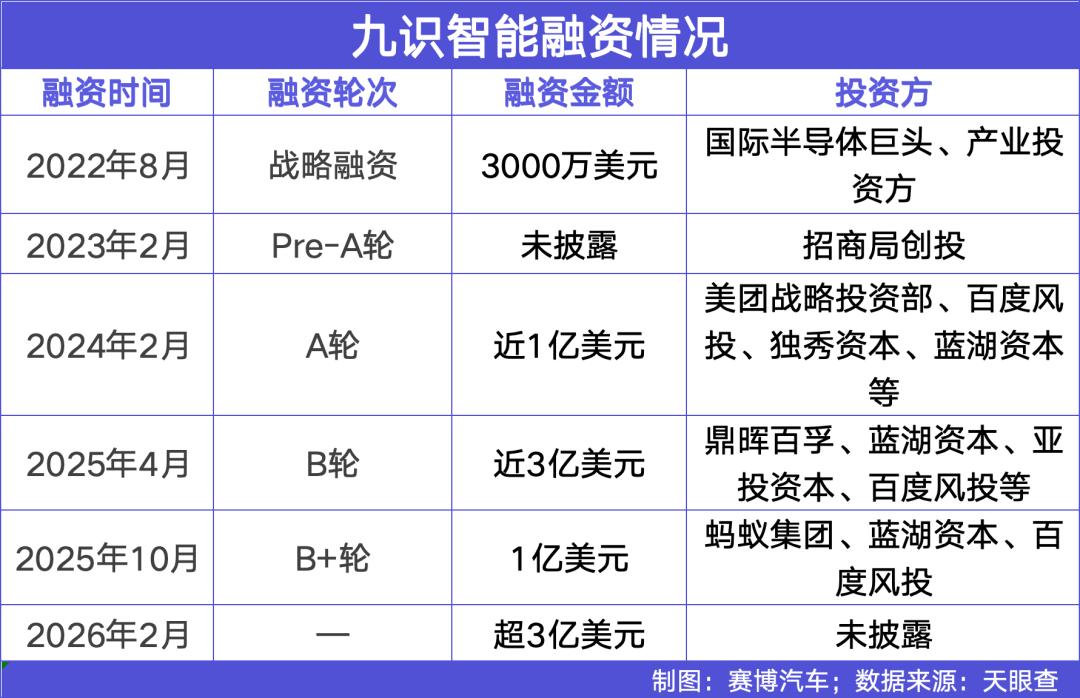
2万台车跑出百亿估值,九识智能再融超3亿美元
3 6 Ke· 2026-02-25 03:43
自动驾驶赛道又迎好消息。 近日,无人驾驶公司九识智能完成新一轮超3亿美元融资。此前,九识智能已完成5轮融资。至此,九识智能累计公开融资额已远超8亿美元(约合人民币 55亿元),公司估值突破百亿元大关。 | | | 九识智能融资情况 | | | --- | --- | --- | --- | | 融资时间 | 融资轮次 | 融资会频 | 投资元 | | 2022年8月 | 战略融资 | 3000万美元 | 国际半导体巨头、产业投 | | | | | 资方 | | 2023年2月 | Pre-A轮 | 未披露 | 招商局创投 | | 2024年2月 | A轮 | 近1亿美元 | 美团战略投资部、百度风 投、独秀资本、蓝湖资本 | | | | | 業 | | 2025年4月 | B轮 | 近3亿美元 | 鼎晖百孚、蓝湖资本、亚 | | | | | 投资本、百度风投等 | | 2025年10月 | B+轮 | 1 亿美元 | 蚂蚁集团、蓝湖资本、百 | | | | | 度风投 | | 2026年2月 | | 超3亿美元 | 未披露 | | | | | 制图:赛博汽车;数据来源:天眼查 | 这家成立于2021年的公司, ...