
自动驾驶出租车(Robotaxi)

Search documents
港股异动 | 小马智行港股价格创新低 关键指标不及预期引发市场担忧
Shang Hai Zheng Quan Bao· 2026-03-30 04:21
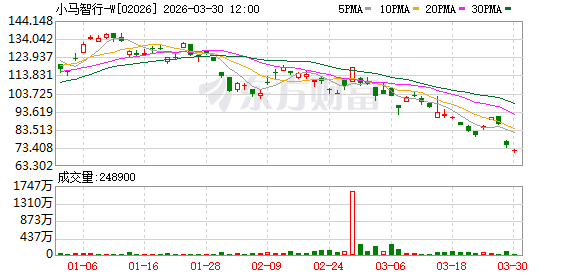
Group 1 - The core viewpoint of the article highlights that the stock price of autonomous driving unicorn Pony.ai has faced significant pressure due to disappointing financial metrics in its 2025 earnings report, leading to a drop in share price to a record low since its listing [2] - Pony.ai reported total revenue of $90 million for 2025, reflecting a year-on-year growth of 20%, while net losses were significantly reduced from $275 million to $76.8 million [2] - However, the company's adjusted net loss under Non-GAAP increased from $132 million to $174 million, a year-on-year increase of 31.5%, raising concerns about its profitability amid ongoing investments in business expansion and R&D [2] Group 2 - Despite the financial setbacks, Pony.ai's core business is advancing rapidly, with revenue from autonomous ride-hailing services reaching $16.6 million, a year-on-year increase of 128.6% [3] - The company plans to expand its Robotaxi fleet from 1,400 to over 3,000 vehicles by the end of 2026, with operations planned in over 20 cities nationwide [3] - Market analysts note that Pony.ai is at a critical juncture transitioning from technology validation to large-scale commercial operations, with the Robotaxi unit economics achieving profitability in cities like Guangzhou and Shenzhen [3]

Waymo寻求按近1100亿美元估值融资约160亿美元,红杉资本入局
Cai Jing Wang· 2026-02-03 09:18
Core Viewpoint - Waymo, a subsidiary of Alphabet Inc., is seeking to raise approximately $16 billion in a funding round that values the company at nearly $110 billion [1] Funding Details - Alphabet will contribute about $13 billion to this funding round, with the remaining amount coming from other investors, including new entrants Sequoia Capital, DST Global, and Dragoneer Investment Group [1] - The funding round is expected to be completed by February [1] Previous Valuation - In October 2024, Waymo completed a previous funding round at a valuation exceeding $45 billion [1]

挤爆港交所,自动驾驶企业融资热潮背后
Zhong Guo Qi Che Bao Wang· 2026-02-02 00:56
Group 1 - The core viewpoint of the articles highlights the rapid maturation and increasing competition within the autonomous driving industry, with a significant surge in financing activities as companies prepare for IPOs in Hong Kong [2][4][15] - Companies like Desay SV and others are planning to issue shares and list on the Hong Kong Stock Exchange, reflecting a broader trend where at least 35 domestic autonomous driving firms are expected to raise over 60 billion yuan by 2025 [2][5] - The financing landscape is shifting from broad investments to targeted funding for core enterprises and key scenarios, indicating a more selective approach by investors [5][6][15] Group 2 - The autonomous driving sector is entering a critical phase, transitioning from a growth period to an explosive growth phase, with recent regulatory approvals for L3 autonomous vehicles boosting confidence among industry players [5][6] - Companies are increasingly focusing on L4 autonomous driving technology in closed scenarios, which are gaining traction among investors due to their commercial viability [10][11] - The competitive landscape is intensifying, with a clear divide emerging between leading firms and those struggling to keep up, as funding increasingly flows to top-tier companies [6][12][16] Group 3 - The trend of financing is evolving from being driven by narratives to a focus on value realization, with investors now prioritizing companies that can demonstrate a clear path to profitability and market demand [14][16] - The industry is still in an investment phase, with many companies yet to achieve profitability, making financing a crucial element for growth [15][16] - The successful commercialization of autonomous driving technologies in specific applications, such as mining and logistics, is helping some companies achieve profitability and attract further investment [12][11]

全球大公司要闻 | 英伟达千亿美元投资OpenAI非承诺,元宝红包突袭
Wind万得· 2026-02-02 00:37
Group 1 - Nvidia's CEO Jensen Huang stated that OpenAI invited Nvidia for an investment of up to $100 billion, but this investment is "not a commitment," and Nvidia will invest in OpenAI gradually [2] - Tencent launched a 10 billion red envelope campaign and announced the public beta of Yuanbao, which quickly rose to the top of the free app rankings in the Apple Store [2] - From January 1, 2026, the value-added tax rate for telecommunications services will increase from 6% to 9%, impacting the revenue and profits of China Mobile, China Unicom, and China Telecom [2] Group 2 - BYD's new energy vehicle sales in January were 210,000 units, a year-on-year decrease of 30.11%, attributed to intensified market competition and consumer hesitation before the Spring Festival [5] - Xiaomi delivered over 39,000 vehicles in January, continuing to capture market share with cost-effective models; NIO delivered 27,182 vehicles, a year-on-year increase of 96.1% [6] - Leap Motor delivered 32,059 vehicles in January, a year-on-year increase of 27%, while Li Auto's deliveries fell by over 7% [6] Group 3 - Oracle is facing severe funding difficulties due to challenges in financing for AI data center expansion, considering large-scale layoffs of 20,000 to 30,000 employees to release $8 billion to $10 billion in cash flow [8] - Blue Origin will pause space tourism flights for at least two years to focus resources on accelerating the development of its lunar lander and other lunar technologies [8] - GameStop's CEO Ryan Cohen announced plans to acquire a large publicly listed consumer retail company to support a target of $35 billion in annual revenue by the end of fiscal 2026 [9] Group 4 - Samsung Electronics expects an operating profit of 20 trillion KRW in Q4 2026, a year-on-year increase of 208%, with memory business operating profit projected at 35 trillion KRW in Q1 [11] - Toyota is accelerating its smart electric transformation in China, with January sales in India reaching 33,880 units, a year-on-year increase of 15.4% [12] - SK Hynix is benefiting from soaring prices of memory and flash storage, contributing to a 102.7% year-on-year increase in South Korea's semiconductor exports in January, reaching $20.5 billion [12]

特斯拉:SpaceX合并传闻不足以让我保持看涨态度
美股研究社· 2026-01-30 11:13
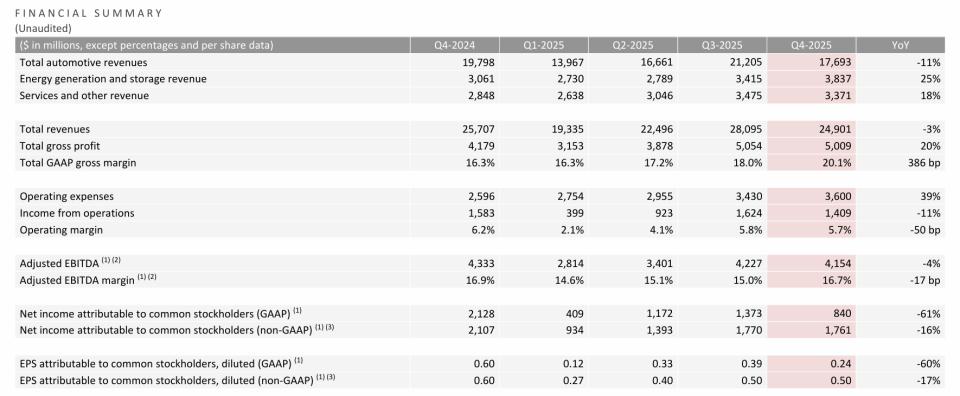
Core Viewpoint - Tesla's Q4 2025 earnings report exceeded market expectations in revenue and earnings per share, but the overall financial performance showed weakness, leading analysts to downgrade the stock rating from "Buy" to "Hold" [2][3][31] Financial Performance Summary - Tesla reported Q4 2025 revenue of $24.9 billion, surpassing expectations by $140 million, but experienced a year-over-year revenue decline of 3.1% and a 17% drop in non-GAAP earnings per share [10] - Operating cash flow decreased by 21% year-over-year, and free cash flow fell by 30% to $1.42 billion [11] - The core automotive business revenue plummeted by 11% to $17.693 billion, while energy production and storage revenue grew by 25% to $3.837 billion, and services and other revenue increased by 18% to $3.371 billion [11] Business Outlook - Analysts express concerns about the declining automotive business, which saw a 10% year-over-year revenue drop for 2025, significantly worse than General Motors' 1.3% decline [12] - Tesla plans to phase out the Model S and Model X to focus on the production of the Optimus robot, indicating a shift in priorities [13][14] - The company aims to maintain a significant automotive business scale, with Model 3 and Model Y expected to account for 96.7% of production in 2025 [15][16] Future Investments - Tesla is expected to invest over $20 billion in capital expenditures in 2026, a significant increase from $8.527 billion in 2025, focusing on six new factories and AI infrastructure [17][18] - The development of the Optimus robot and Robotaxi projects is seen as a strategic move, with the potential for substantial future growth [17][18] Robotaxi and Optimus Developments - Tesla's Robotaxi service began operations in Austin in December 2025, with plans to expand to seven major cities by mid-2026 [21][22] - The company is optimistic about the potential of the Optimus robot, with plans for mass production by the end of 2026 [19][20] Valuation Concerns - Tesla's valuation remains high, with a static P/E ratio of 249 and a free cash flow yield of approximately 222 times, reflecting market expectations of future growth rather than current performance [25][26] - The global Robotaxi market is projected to grow significantly, with a compound annual growth rate of 52.54% from 2025 to 2034, highlighting the potential for Tesla's future business [25][26] Market Sentiment - Despite the ongoing upward trend in Tesla's stock price, recent performance indicates investor caution, as the stock fell 3.45% following the earnings report [28] - Analysts recommend waiting for more evidence of the Robotaxi's operational viability before making further investment decisions [31]

美联储按兵不动,市场焦点转向公司业绩表现
2 1 Shi Ji Jing Ji Bao Dao· 2026-01-29 12:20
Group 1: Federal Reserve and Economic Outlook - The Federal Open Market Committee (FOMC) decided to pause interest rate cuts, citing strong economic growth and stable unemployment, with inflation remaining high [1][3] - The consensus within the FOMC is that the federal funds rate is at a "loosely neutral level," balancing inflation control and employment growth [3] - The Fed's ability to respond to employment and inflation risks has improved after three rate cuts, but future decisions will remain data-dependent [3] Group 2: Market Reactions and Performance - The stock market showed little reaction to the Fed's decision, with major indices like the Dow Jones and S&P 500 closing nearly unchanged [1] - The U.S. 10-year Treasury yield closed at 4.249%, while the 30-year yield approached 5% [2] - Gold and silver prices have risen significantly this year, with gold up 28.46% and silver up 66.77%, while the dollar index has decreased by 2.08% [2] Group 3: Corporate Earnings and Performance - Major banks like JPMorgan Chase, Wells Fargo, Citigroup, and Bank of America exceeded market expectations, with strong interest income indicating a bullish outlook for the banking sector in 2025 [4] - Microsoft reported adjusted earnings of $4.14 per share, exceeding expectations, but faced investor disappointment due to higher capital expenditures and lower cloud growth [4] - META's earnings surpassed expectations, with a reported EPS of $8.88, but its Reality Lab segment continues to incur significant losses [5] - Tesla's revenue and sales declined, but it still reported better-than-expected earnings, with a focus on future projects like Robotaxi and Optimus [6]


被比亚迪打到负增长,特斯拉20亿投资xAI,加速押注未来?
3 6 Ke· 2026-01-29 00:36
Core Insights - Tesla reported a slight revenue decline of 3% year-over-year for Q4 2025, with total revenue reaching $24.9 billion, slightly above market expectations. Adjusted earnings per share (EPS) were $0.50, exceeding analyst forecasts [1][5] - The core automotive business faced significant challenges, with revenues dropping 11% year-over-year to $17.7 billion, and net profit plummeting 61% to $840 million [1][3][7] - For the full year 2025, Tesla's total revenue was $94.8 billion, marking the first annual revenue decline in the company's history, with total vehicle deliveries down 8.6% to 1.64 million units [3][5] Financial Performance - Q4 2025 total automotive revenues were $17.7 billion, down from $19.8 billion in Q4 2024, while total revenues for the year were $94.8 billion, a decrease from $97.7 billion in 2024 [2][4] - The total gross profit for Q4 2025 was $5.0 billion, with a gross margin of 20.1%, reflecting a year-over-year increase of 386 basis points [2][4] - Operating expenses surged by 39% year-over-year to $3.6 billion in Q4 2025, contributing to an operating margin decline to 5.7% [2][4][15] Automotive Business Challenges - The automotive segment's revenue decline is attributed to increased market competition, particularly from Chinese competitor BYD, and the expiration of U.S. federal EV tax credits [7][9] - Tesla's global vehicle deliveries fell by 16% year-over-year in Q4 2025, with total deliveries for the year also declining [7][9] - The company has adjusted pricing strategies, reducing the starting price of Model 3 and Model Y to $37,000, but this has negatively impacted profit margins [9] Autonomous Driving and Robotics - The Full Self-Driving (FSD) subscription model has seen a doubling in monthly subscriptions, reaching approximately 1.1 million users by year-end [10] - Tesla is transitioning to a monthly subscription model for FSD, aiming for a more sustainable software revenue stream [10] - Progress has been made in the Robotaxi initiative, with plans to expand operations in several U.S. cities by mid-2026 [11] Energy Business Growth - The energy segment reported a 25% year-over-year revenue increase in Q4 2025, reaching $3.84 billion, and a total of $12.77 billion for the year, marking a 27% growth [13][14] - The gross profit from the energy business reached a record $1.1 billion in Q4 2025, driven by increased demand for energy storage products [14] Strategic Investments - Tesla's operational expenses increased significantly, reflecting a strategic focus on long-term growth through investments in AI, new production lines, and global infrastructure [15][16] - The company announced a $2 billion investment in AI startup xAI to bolster its technology narrative [6][16] - Despite a decline in operating profit margin to 4.6% for the year, Tesla maintains a strong cash position with $44.1 billion in cash and investments at the end of Q4 2025 [16]

2026年汽车产业发展态势研判:新能源保持增长 智能化加速落地
Xin Lang Cai Jing· 2026-01-28 18:54
Core Insights - The automotive industry in China is expected to achieve significant growth by 2025, driven by a robust supply chain, scale and cost advantages, a promising consumer market, rapid technological innovation, and favorable industrial policies [1] Group 1: Automotive Sales and Trends - In 2025, China's total automotive sales reached 34.4 million units, a year-on-year increase of 9.4%, with new energy vehicle (NEV) sales at 16.49 million units, up 28.2%, marking a penetration rate exceeding 50% for the first time [2] - For 2026, total automotive sales are projected to slightly decline to around 33 million units, while NEV sales are expected to maintain a high growth rate, estimated at 19 million units [2] Group 2: Electric Vehicle Performance - From 2021 to 2024, plug-in hybrid vehicles, particularly range-extended electric vehicles, saw rapid growth due to challenges like limited electric range and charging infrastructure [3] - By 2025, these issues are expected to be largely resolved, with pure electric vehicle sales growth projected at 37.6%, while plug-in hybrids may only see around 14% growth [3] Group 3: Commercial Vehicles and Market Dynamics - In 2025, domestic sales of new energy commercial vehicles reached 871,000 units, a remarkable increase of 63.7%, with new energy heavy truck sales around 230,000 units, growing by approximately 180% [4] - The cost advantage of pure electric heavy trucks, with energy costs significantly lower than diesel counterparts, is driving the transition to new energy models in the freight industry [4] Group 4: Charging Infrastructure and V2G Technology - By the end of 2025, non-fossil energy installations in China are expected to exceed 60%, with public charging stations reaching a total power of 210 million kW [6] - The development of vehicle-to-grid (V2G) technology is anticipated to enhance the value for users, with potential earnings from participation in grid services significantly offsetting vehicle costs [6] Group 5: Hydrogen Fuel Cell Vehicles - Hydrogen fuel cell vehicles offer advantages such as quick refueling and long range, but face challenges like low energy efficiency and high production costs [8] - The development of hydrogen fuel cell vehicles should consider factors like green hydrogen production capacity and cost, as well as specific application scenarios for effective market penetration [8] Group 6: Autonomous Driving and Market Competition - The rise of autonomous taxi services (Robotaxi) is expected to create a new competitive landscape, with operational costs becoming comparable to traditional taxis [9] - The integration of autonomous driving technology with innovative business models and infrastructure is crucial for the growth of Robotaxi services [9][10] Group 7: Data and Safety in Autonomous Driving - The development of autonomous driving technology relies heavily on data accumulation, with a focus on enhancing safety through extensive real-world testing [11] - The complexity of driving scenarios in China provides a unique advantage for gathering diverse data to improve autonomous vehicle performance [11]
预测 | 2026年中国十大出行趋势
Xin Lang Cai Jing· 2026-01-27 03:23
Core Insights - The article discusses the transformation of travel in China by 2026, highlighting the integration of technology, culture, and efficiency in the travel experience. It emphasizes a shift from traditional sightseeing to deeper emotional engagement and the rise of new travel trends driven by technological advancements and changing consumer preferences. Group 1: Transportation Innovations - The development of a three-dimensional transportation network ("sea, land, and air") is set to revolutionize travel in China, with advancements in high-speed rail and low-altitude flying vehicles creating new economic growth points [1][3] - By 2025, China's electric vehicle charging infrastructure is expected to reach 18.645 million units, with public charging facilities growing by 39.5% [11][13] Group 2: Travel Trends - The trend of "reverse tourism" is emerging, where travelers are increasingly visiting smaller towns and rural areas, driven by events and cultural activities that attract large crowds [4][6] - The concept of "emotional consumption" in travel is gaining traction, with a market size of 340 billion RMB in customized travel by 2025, reflecting a shift towards experiences that prioritize emotional satisfaction [10][23] Group 3: Technological Integration - The integration of AI in vehicles is evolving from basic command recognition to advanced task execution, transforming cars into "intelligent robots" capable of complex interactions [8][10] - The low-altitude economy is projected to exceed 1 trillion RMB by 2026, with significant advancements in eVTOL (electric vertical takeoff and landing) aircraft expected to contribute to this growth [17] Group 4: Cultural and Experiential Tourism - The revival of traditional culture through technology and immersive experiences is becoming popular, particularly among family tourists, as they seek interactive and engaging cultural heritage experiences [18][19] - The rise of "event economy" is reshaping destination attractiveness, as major events like concerts and sports competitions drive tourism and create new consumer engagement opportunities [4][6]

粤车加速出海,成新能源转型标杆:看汽车产业的“广东样本”
Nan Fang Du Shi Bao· 2026-01-15 03:56
Core Viewpoint - Guangdong's automotive manufacturing industry has become a significant force in the national and global automotive landscape through industrial transformation, upgrading, and deepening open cooperation [1] Group 1: Industry Performance - Guangdong's automotive manufacturing industry has shown outstanding performance in overall production and sales, as well as in the transition to new energy and exports [1] - In 2025, Nansha Customs reported that 383,000 vehicles were exported through the Nansha Port, marking a 54.4% year-on-year increase, with 154,000 of these being new energy vehicles, which is more than double the previous year [2] - The annual throughput capacity of Nansha Port has exceeded 3 million vehicles, establishing it as a crucial hub for automotive imports and exports in China [2] Group 2: Key Players - Leading automotive companies in Guangdong, such as GAC Group and BYD, are playing a core role in driving industry development [2] - GAC Group is accelerating its electrification transformation and has partnered with Huawei to establish a high-end intelligent new energy brand, with plans to launch its first model in mid-2026 [2] - BYD maintained its position as the global leader in new energy vehicle sales, with total sales reaching 4.6024 million units in 2025, a 7.73% increase year-on-year [3] - Xpeng Motors is focusing on advanced technology research and development, with an expected R&D investment of 9.5 billion yuan in 2025, including 4.5 billion yuan for AI [3] Group 3: New Energy Transition - Guangdong has the highest penetration rate of new energy vehicles in China and serves as a model for industrial upgrading [4] - In the first 11 months of 2025, Guangdong's passenger car sales reached 2.239 million units, with new energy vehicle sales of 1.235 million units, reflecting a 15% year-on-year growth [4] - The automotive industry is transitioning towards "intelligent service," with GAC Group's Qiji Mobility platform facilitating the commercial deployment of autonomous driving technology [4] Group 4: Future Outlook - With central government policies promoting consumption and expected industry regulations, Guangdong's automotive sector is anticipated to continue its stable growth [5] - Leading companies like BYD, GAC, and Xpeng have set ambitious growth targets, ensuring that Guangdong will play a key role in the "Guangdong Goods Going Global" initiative [5]
