机器学习

Search documents
2025年如何从小白进阶成为AI/ML专家:助你拿下offer的修炼路线图
3 6 Ke· 2025-06-28 23:05
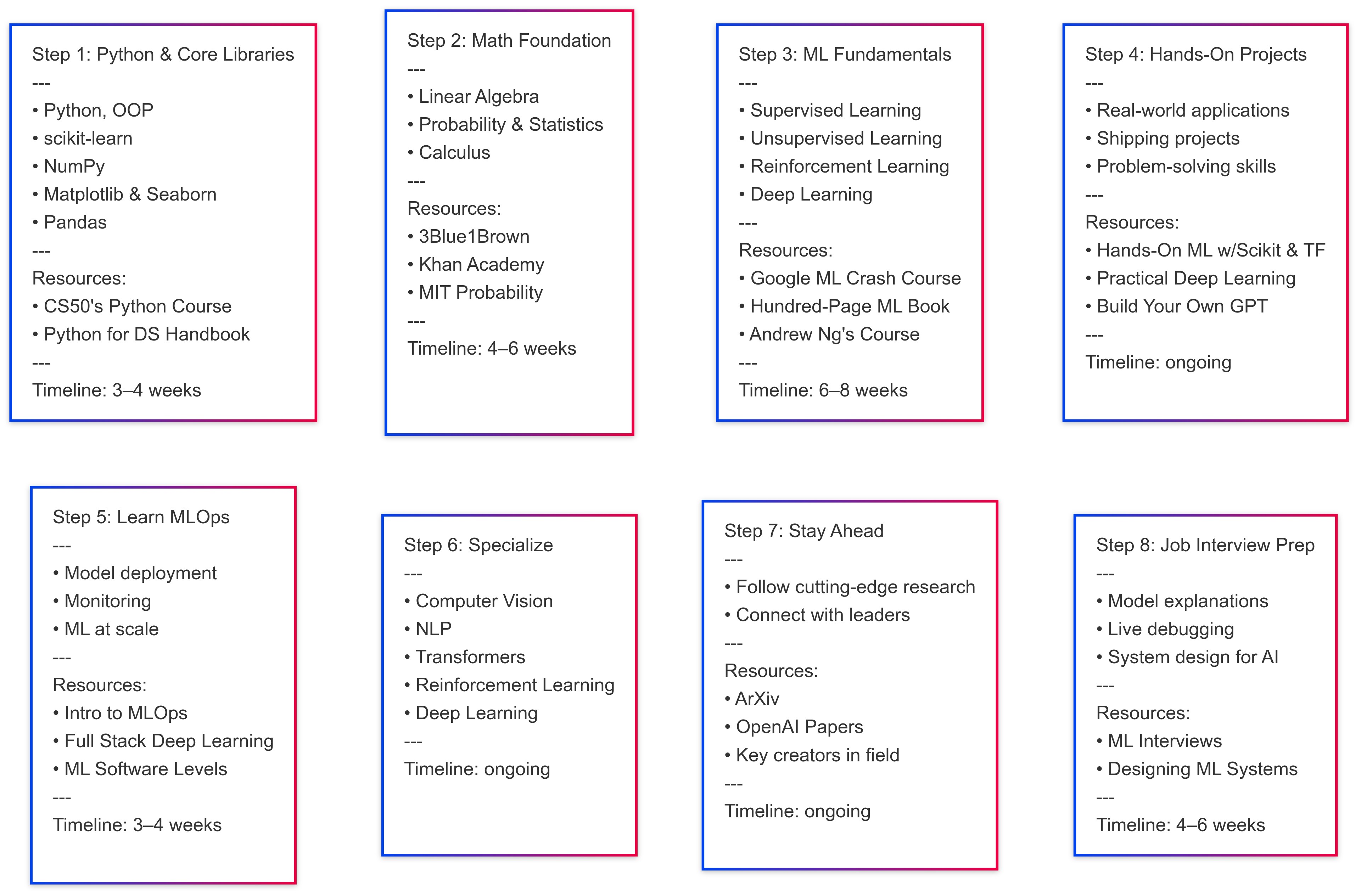
Core Insights - The article outlines an eight-step roadmap for efficiently advancing in AI/ML by focusing on essential skills and avoiding common pitfalls [1]. Group 1: Step-by-Step Learning Path - **Step 1: Master Python Core Libraries** Proficiency in Python is essential for AI/ML, including data cleaning, model building, and result visualization [2]. Key content includes Python basics, advanced AI programming techniques, and libraries like scikit-learn, NumPy, Matplotlib, Seaborn, and Pandas [4]. Recommended resources include CS50 Python course and "Python Data Science Handbook" [4]. Suggested learning period is 3-4 weeks [4]. - **Step 2: Solidify Mathematical Foundations** A strong grasp of linear algebra, probability, and calculus is crucial for understanding models [5]. Key content includes matrix operations, Bayesian thinking, and optimization techniques [5]. Recommended resources include "Linear Algebra" by 3Blue1Brown and MIT's Probability Introduction [5]. Suggested learning period is 4-6 weeks [5]. - **Step 3: Understand Machine Learning Basics** This step is pivotal for transitioning from beginner to competent AI/ML engineer [6]. Key content includes supervised vs. unsupervised learning, reinforcement learning, and deep learning [6]. Recommended resources include Google's Machine Learning Crash Course and "Machine Learning" by Andrew Ng [8]. Suggested learning period is 6-8 weeks [8]. - **Step 4: Hands-On Project Experience** Practical experience through real AI/ML applications is essential for job readiness [9]. Key content includes practical guides and project development [9]. Suggested learning period is ongoing [9]. - **Step 5: Learn MLOps** Understanding MLOps is vital for deploying and maintaining models in real-world scenarios [10]. Key content includes foundational concepts and best practices for model deployment [10]. Suggested learning period is 3-4 weeks [10]. - **Step 6: Specialize in a Domain** After building a foundation, focusing on a specific area like NLP or computer vision enhances employability [11]. Suggested learning period is ongoing [11]. - **Step 7: Stay Updated** Continuous learning is necessary to keep skills relevant in the fast-evolving AI field [12]. Key resources include ArXiv for research papers and notable figures in the field [12]. Suggested learning period is ongoing [12]. - **Step 8: Prepare for Interviews** Comprehensive preparation for interviews is crucial, including explaining model principles and system design [13]. Recommended resources include machine learning interview guides [13]. Suggested learning period is 4-6 weeks [13]. Conclusion - The article emphasizes a structured approach to mastering AI/ML, enabling individuals to transition from novices to job-ready professionals efficiently [1].

量化指增迎超额盛宴!半鞅、蒙玺、龙旗、橡木、量盈等知名量化私募最新研判来袭!
私募排排网· 2025-06-28 02:37
Core Viewpoint - The article highlights the significant outperformance of quantitative index enhancement products in 2025, driven by increased market activity, structural opportunities in small-cap stocks, and advancements in AI technology within quantitative strategies [2][29]. Group 1: Performance of Quantitative Index Enhancement Products - As of May 2025, quantitative index enhancement products have shown an average excess return of 24.48% over the past year, with 93.91% of the products reporting positive excess returns [2]. - The performance of various strategies is detailed, with the "Other Index Enhancement" category leading at an average excess return of 34.74% over the past year [2]. - The market environment has favored small-cap stocks, which have outperformed due to increased liquidity and risk appetite among investors [3][8]. Group 2: Drivers Behind Performance - The active trading environment and increased stock price volatility have provided ample trading opportunities for quantitative managers, facilitating the generation of excess returns [3][29]. - The introduction of the CSI A500 index has opened new avenues for quantitative strategies, prompting institutions to accelerate their product offerings [8]. - The application of AI in quantitative investment has enhanced the resilience and effectiveness of strategies, allowing for better data processing and risk management [8][29]. Group 3: Trends in Quantitative Strategy Layout - Private equity firms are diversifying their quantitative strategies, with a focus on machine learning and AI to meet varying investor needs [4][9]. - There is a noticeable trend towards multi-category and finely-tuned product lines, particularly in index enhancement products, to cater to different client demands [9][20]. - The market is witnessing a shift towards thematic strategies, such as dividend enhancement and industry-specific strategies, to provide investors with more targeted investment options [25][20]. Group 4: Small-Cap Index Enhancement Products - Small-cap index enhancement products are expected to continue showing potential for excess returns due to their inherent volatility and liquidity advantages [11][21]. - The current market environment has led to increased interest in small-cap stocks, which are perceived to have higher growth potential, although they also carry higher risks [21][26]. - Investors are advised to balance their portfolios according to their risk tolerance, especially given the potential for significant price fluctuations in small-cap stocks [17][27].

Plumas Bancorp(PLBC) - 2024 Q4 - Earnings Call Presentation
2025-06-27 11:28
Financial Performance - Net income decreased by 389% from $29776 thousand in 2023 to $28619 thousand in 2024[82] - Net interest income increased by 558% from $69794 thousand in 2023 to $73691 thousand in 2024[82] - The net interest margin increased by 170% from 471% in 2023 to 479% in 2024[82] - Return on average assets(ROAA) decreased by 745% from 188% in 2023 to 174% in 2024[82] - Return on average equity(ROAE) decreased by 265% from 234% in 2023 to 172% in 2024[82] Balance Sheet - Total assets increased by 080% from $1610416 thousand in 2023 to $1623326 thousand in 2024[82] - Total deposits increased by 281% from $1333655 thousand in 2023 to $1371101 thousand in 2024[82] - Net loans increased by 598% from $948604 thousand in 2023 to $1005375 thousand in 2024[82] Loan Portfolio - Government guaranteed loans represented approximately 7% of total loans as of December 31 2024[67] - Agricultural lending balances represented 12% of total loans as of December 31 2024[71]

Synchronoss 获欧盟-美国数据隐私框架认证
Globenewswire· 2025-06-25 23:46
Core Points - Synchronoss Technologies, Inc. has achieved certification under the EU-U.S. Data Privacy Framework (DPF), enhancing its global leadership in data protection, compliance, and consumer trust [1][2] - The DPF certification allows U.S.-based organizations to receive and process personal data from the EU in accordance with European privacy laws such as the General Data Protection Regulation (GDPR) [1][2] - This certification reinforces Synchronoss's commitment to international privacy standards and solidifies its position as a trusted partner for global telecommunications operators [1][2] Company Commitment - The DPF certification is a significant addition to Synchronoss's global compliance framework, which already includes various certifications such as SOC 2 Type II, ISO 27001, and TRUST/e platform independent privacy verification [3] - The company emphasizes its dedication to responsible data governance and the highest standards of integrity, transparency, and accountability in cross-border data transfers [2][3] Industry Context - The EU-U.S. Data Privacy Framework establishes legal safeguards for the transfer of personal data of EU citizens to certified U.S. organizations, which is crucial in a region that prioritizes digital sovereignty and ethical data governance [2] - Synchronoss's successful certification demonstrates its capability to manage both human and non-human resource data responsibly in a cross-border environment, meeting global partners' expectations for data privacy [2]

第二十七届中国科协年会7月在京举办,设置超百场论坛活动
Xin Jing Bao· 2025-06-25 11:28
Group 1 - The 27th China Association for Science and Technology Annual Conference will be held from July 1 to July 31 in Beijing, featuring 1 main forum, 98 thematic forums, and 4 parallel forums [1] - The main forum is scheduled for July 6, with notable speakers including five vice presidents of the China Association for Science and Technology, discussing topics such as quantum technology, biomanufacturing, deep-sea technology, artificial intelligence, and agriculture [1] - The conference aims to release major scientific issues, engineering challenges, and industrial technology problems for 2025, establishing a "guiding standard" for the continuous output of original and disruptive scientific achievements [1] Group 2 - The "Frontiers in Pattern Recognition and Artificial Intelligence" thematic forum will take place on July 6, focusing on the development of pattern recognition and artificial intelligence, including breakthroughs and governance [2] - The 2025 China Science and Technology Journal Development Forum, one of the four parallel forums, will be held on July 10, highlighting the growth of high-impact journals in China, with 56 journals ranked in the top three internationally and 24 ranked first in their fields [2] - The forum will feature five key experts presenting reports and will include four thematic discussion sections to explore innovative development paths for Chinese scientific journals [2]
吴恩达担任董事长,这家公司面向K12学校推出AI智能体
Sou Hu Cai Jing· 2025-06-25 02:49
这家公司的名字,你也许没听过,但这家公司的董事长,想必你一定有所耳闻。 源:Kira Learning官网截图 美国的K12教室也正在通过AI助教进行技术升级。近日,美国教育科技初创公司Kira Learning面向K12学 校推出AI智能体。 图 从左至右:Kira董事长吴恩达、联创兼CEO Andrea Pasinetti、联创Jagriti Agrawal 据介绍,Kira能够高效处理各种教学数据,包括文本、音频、视频和图像,并提供即时反馈。无论是评 估学生的论文、分析课堂讨论,还是评估视频,Kira的AI智能体都能在几秒钟内提供分析,帮助教师做 出更快、更明智的教学决策。 Kira的董事长是机器学习和在线教育领域的先驱吴恩达,他还担任Google Brain创始人、Coursera董事长 兼联合创始人、DeepLearning.AI创始人、AI Fund董事合伙人、斯坦福大学教授和AI研究员。 美国教师也受日常繁琐任务的困扰,这些任务通常会占用教师数小时时间。据介绍,Kira的AI智能体会 执行重复性任务,包括打分、课程规划和课堂讨论分析,还会提供学生哪方面做得好、哪方面有困难的 分析,同时还支持一对 ...

大佬面对面!斯坦福2025 CS336课程全公开:从零开始搓大模型~
自动驾驶之心· 2025-06-24 11:47
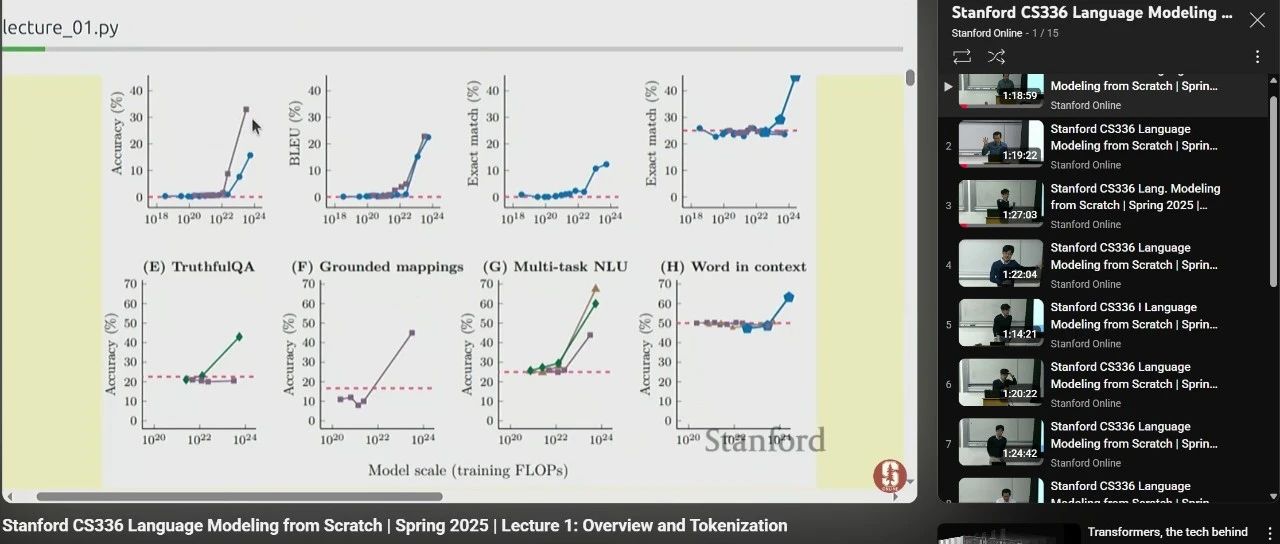
Core Viewpoint - The article discusses the launch of Stanford University's CS336 course "Language Models from Scratch," which aims to provide a comprehensive understanding of language models through practical development and implementation [5][7]. Course Overview - The course focuses on the foundational aspects of language models, which are essential for modern natural language processing (NLP) applications. It emphasizes the importance of understanding language models for scientists and engineers in the fields of AI and ML [5][7]. - The course is structured into five major modules: Foundations, Systems, Extensions, Data, and Alignment & Reinforcement Learning [7]. Course Requirements - Students are expected to have proficiency in Python, as most assignments will require extensive coding. The course will provide minimal scaffolding, resulting in a higher volume of code written by students compared to other AI courses [7]. - A background in deep learning and system optimization is necessary, particularly familiarity with PyTorch and basic system concepts like memory hierarchy [7]. - Foundational knowledge in calculus, linear algebra, probability, and statistics is required, along with a basic understanding of machine learning principles [7]. Assignments - The course includes several assignments that cover various aspects of language model development, such as implementing a BPE tokenizer, training models on specific datasets, and optimizing performance on GPUs [8]. - Assignments are designed to simulate real-world challenges, including data processing and model alignment, with a focus on practical application and hands-on experience [8]. Course Schedule - The course is structured with a detailed schedule that outlines topics, materials, and deadlines for assignments, ensuring a systematic approach to learning [9].
新鲜出炉!斯坦福2025 CS336课程全公开:从零开始搓大模型
机器之心· 2025-06-23 04:04
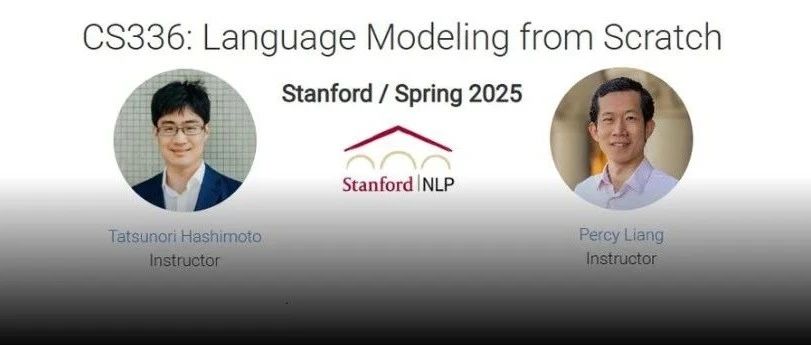
Core Viewpoint - The article announces the launch of Stanford University's CS336 course "Language Models from Scratch" for Spring 2025, which aims to guide students through the entire process of developing their own language models [1][8]. Group 1: Course Overview - CS336 is designed to help students gain a comprehensive understanding of language models by guiding them through various stages, including data collection, model construction, training, and evaluation [8]. - The course structure consists of 5 units and 19 lectures, with a focus on practical implementation and hands-on experience [10]. Group 2: Instructors - Tatsunori Hashimoto, an assistant professor at Stanford, has a strong background in machine learning and has received over 30,000 citations for his research [2]. - Percy Liang, an associate professor and director of the Center for Research on Foundation Models (CRFM), has over 100,000 citations and extensive experience in AI research [6][7]. Group 3: Course Requirements - Students are expected to have proficiency in Python, deep learning, and system optimization, as well as a solid understanding of calculus, linear algebra, and basic probability and statistics [11]. - The course emphasizes minimal scaffolding, requiring students to write significantly more code compared to other AI courses [11].
不止是爬山神器,更是四肢增强“外挂”
红杉汇· 2025-06-22 05:03
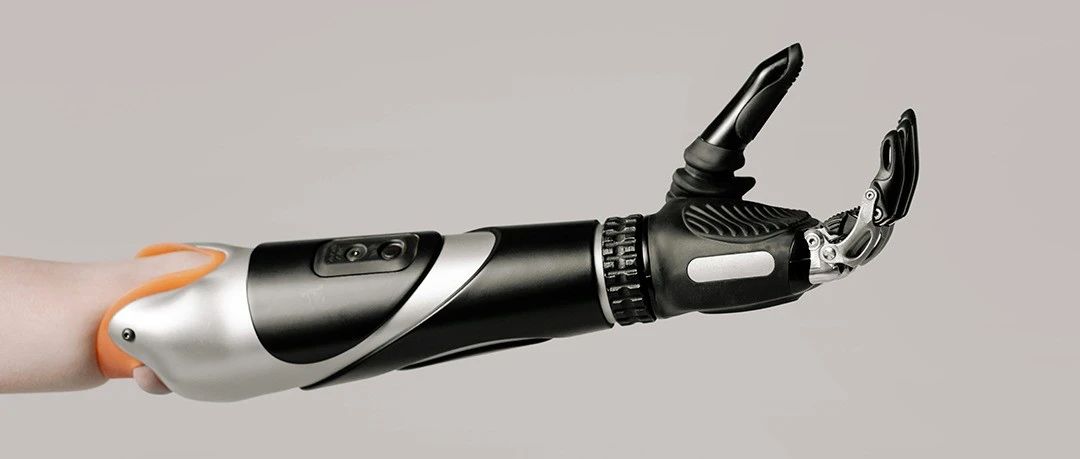
真正的技术突破在1967年才到来,美国通用电气公司研制的"Hardiman"外骨骼机器人原型机横空出世。这款 原型机采用半仿生构型设计,通过液压驱动,并且存在力量反馈系统,包含30多个动力关节,能辅助普通 人轻松举起一百多公斤的物体。然而,"Hardiman"680公斤的自重、迟缓的动作节奏和惊人的能耗,严重限 制了该机器人项目的落地。不过,它的诞生依然为外骨骼机器人的未来探索指引了方向。 在泰山十八盘的陡峭石阶上,一位白发登山者轻松越过年轻游客的队伍。他腰腿都包裹着流线型金属支架,步 伐稳定而轻快——这不是科幻电影里的场景,而是泰山景区内常见的真实画面。80元租用3小时的外骨骼机器 人,正让曾经遥不可及的"机械战甲"走进普通人的生活。 所谓外骨骼机器人,是一种通过机械结构与人体关节紧密耦合,增强或替代人体上肢、下肢运动能力的智能辅 助设备,宛如为人体安装了"物理外挂",赋予人们应对各类体力挑战的非凡能力。 就如电影《钢铁侠》中,托尼·斯塔克的能量战甲让他成为名副其实的钢铁侠,《流浪地球》中的动力装甲为人 类在极端环境下的生存和工作提供了强大的支持,在现实中,除了户外运动,外骨骼机器人还被应用至工业、 医疗、 ...
西安交大发表最新Nature论文
生物世界· 2025-06-20 23:56
Core Viewpoint - The research published in Nature highlights the design of a new ductile FeNiCoAlTa alloy with unprecedented strength and plasticity, achieved through machine learning techniques, setting a new record for yield strength and tensile ductility in alloys [2][4]. Group 1: Research Findings - The alloy composition is Fe 35 Ni 29 Co 21 Al 12 Ta 3, which demonstrates a remarkable combination of 1.8 GPa yield strength and 25% true uniform elongation [4]. - The study emphasizes the use of machine learning models based on domain knowledge to design multi-principal element alloys, achieving high strength and high ductility [4]. Group 2: Microstructural Innovations - The research team enhanced the alloy's strength by maximizing microstructural heterogeneity, featuring large coherent L1 2 nano-precipitates and incoherent B2 micro-particles [6]. - The B2 micro-particles contribute to a multi-component structure that can accumulate dislocations, thereby maintaining a high strain hardening rate and extending uniform elongation [6].