
卫星互联网

Search documents
航天宏图:目前主营业务尚处于卫星应用阶段
Di Yi Cai Jing· 2026-01-12 12:40
航天宏图公告称,经公司自查,关注到近期部分媒体等平台有涉及公司业务涉及相关热点概念的讨论。 公司所处的卫星应用行业的市场环境及行业政策未发生重大调整,公司日常经营情况和内部经营秩序正 常。从产业周期角度分析,产业链上下游存在周期性错配的风险。上游卫星发射计划的延迟或下游应用 场景拓展不及预期,可能会对公司业务推进节奏造成阶段性影响。上游方面,卫星的研制与发射涉及复 杂技术工艺,若发射失败或发射推迟,将直接阻碍卫星互联网的整体构建进程,影响相关服务的提供及 下游卫星应用市场的拓展,对公司收入贡献存在不可预见性,目前公司主营业务尚处于卫星应用阶段。 公司于2025年12月与无锡众能光储科技有限公司签署了战略合作协议,目前,双方尚未开展实质性业务 合作,公司不具备钙钛矿相关领域技术,主营业务未发生变化。公司于2023年7月与广州中科宇航探索 技术有限公司签署了战略合作协议,协议签署已过去两年半,双方尚未开展实质性业务合作。 ...

超20万颗!中国新增多个星座计划申请 商业航天再掀涨停潮
2 1 Shi Ji Jing Ji Bao Dao· 2026-01-12 12:19
Core Viewpoint - The recent submission of 203,000 satellites by China to the International Telecommunication Union (ITU) marks the largest frequency and orbit resource application in the country's history, significantly boosting the commercial space sector and leading to increased activity in A-share commercial aerospace stocks [1][2]. Group 1: Satellite Submission Details - China submitted an application for 203,000 satellites, covering 14 satellite constellations, including low and medium Earth orbit satellites, with major contributors being China Star Network and Yuanxin Satellite [1][2]. - The application includes significant participation from commercial space enterprises and telecom operators, with the Radio Spectrum Development and Utilization and Technology Innovation Research Institute applying for two constellations (CTC-1 and CTC-2) that account for 95% of the total application [1][2]. - This submission is a routine procedure under ITU regulations, which requires countries to register satellite network data to gain international recognition and protect frequency resources from interference [2]. Group 2: Market Reactions and Implications - Following the announcement, A-share commercial aerospace stocks saw significant activity, with companies like Tongyu Communication and Jushi Holding experiencing multiple-day stock price increases [6]. - Experts caution that the transition from application to actual satellite launch will take time, and the market should maintain a rational perspective on the developments [6]. - The large-scale application is expected to activate the entire satellite manufacturing, launching, and operational industry chain, potentially leading to significant advancements in China's aerospace capabilities [7]. Group 3: Strategic Insights - The submission reflects a long-term national strategic layout and space resource planning, differing fundamentally from SpaceX's commercial expansion based on an established business model [7][8]. - The involvement of major telecom companies like China Mobile and China Telecom indicates that satellite internet is evolving into a crucial component of national infrastructure, enhancing resource mobilization and market reach [8]. - The increase in application scale signifies a shift in industry perception regarding low Earth orbit capacity, moving from smaller constellations to larger-scale projects, indicating a strategic evolution [8]. Group 4: Challenges and Future Directions - Key challenges for the industry include improving satellite manufacturing efficiency to automotive levels, significantly reducing launch costs, and creating a closed-loop system for aerial data and ground applications to realize commercial value [8][9]. - The resolution of these challenges will directly impact the successful realization of the proposed satellite network and its associated benefits [9].


信科移动(688387.SH):在卫星互联网领域的收入占整体营业收入的比例约为2%~3% 对业绩无重大影响
智通财经网· 2026-01-12 12:16
智通财经APP讯,信科移动(688387.SH)发布股价异动公告称,公司目前主营业务为移动通信网络设备 及移动通信技术服务,未发生变化。公司在卫星互联网领域的收入占整体营业收入的比例约为2%~ 3%,对公司业绩无重大影响,公司卫星互联网业务尚处于投入期。目前我国卫星互联网产业发展仍处 于初期阶段和投入阶段,卫星系统从卫星网络资料国际申报、国际协调到卫星发射、系统建设、提供服 务、应用推广需要较长周期,批量化发射组网进展及对公司经营业绩的贡献存在不可预见性。此外,目 前6G产业尚处于标准制订的初期阶段。 ...

最新公告!这只黄金ETF将暂停申购
Zhong Guo Zheng Quan Bao· 2026-01-12 12:05
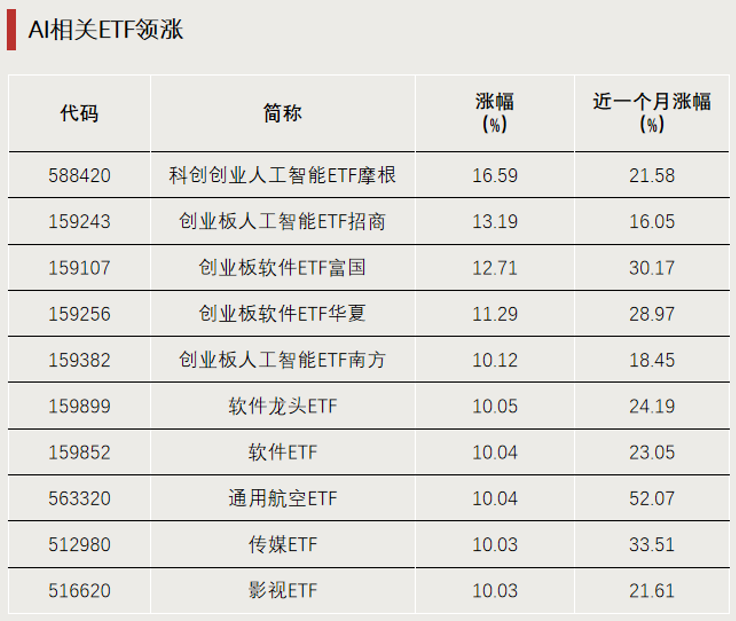
Group 1: ETF Performance - On January 12, several ETFs related to AI, satellites, and media sectors saw significant gains, with the Morgan Innovation and Entrepreneurship AI ETF rising over 16% [1][2] - The Satellite ETF (563230) and Aviation ETF (159392) hit the daily limit, while the Fortune Software ETF (159107) increased by 12.71%, reaching a new high since its listing [2] - The Media ETF (512980) surged by 10.03%, with a year-to-date increase exceeding 28%, making it one of the top performers among all ETFs [3] Group 2: Fund Flows and Trading Activity - On January 9, several broad-based ETFs experienced significant net inflows, particularly two Satellite ETFs and a Semiconductor Equipment ETF [8] - Six ETFs had trading volumes exceeding 10 billion yuan on January 12, indicating high trading activity, with the Short-term Bond ETF and Hong Kong Securities ETF leading the way [6][7] - The Satellite ETF (563230) has seen continuous net buying for ten consecutive trading days, with its latest scale exceeding 1.5 billion yuan and a year-to-date increase of over 34% [2] Group 3: Market Catalysts and Trends - The market's recent rise is supported by liquidity factors and themes from industries such as semiconductors, robotics, and commercial aerospace, with a positive outlook for the first quarter [10] - The satellite sector is highlighted for its investment value due to supportive policies, expanding demand scenarios, and technological advancements that reduce costs and improve efficiency [11]

盛洋科技:子公司基于DVB-NIP技术布局国外卫星互联网终端业务 该业务仍处商业化初期
Zheng Quan Shi Bao Wang· 2026-01-12 11:55
Core Viewpoint - Shengyang Technology (603703) announced on January 12 that its subsidiary FTA is involved in the foreign satellite internet terminal business based on DVB-NIP technology, which is still in the early stages of commercialization and has a limited impact on the company's short-term performance [1] Group 1: Business Overview - The company primarily operates in high-speed vehicle cables, data cables, satellite communication terminals, and display devices [1] - The revenue from the satellite internet terminal business currently constitutes a small portion of the company's main business income [1]

东方通信(600776.SH):为相关客户在卫星通信地面站提供网络维护服务,对公司利润贡献较小
Xin Lang Cai Jing· 2026-01-12 11:46
Core Viewpoint - The company, Oriental Communication (600776.SH), has noted increased market interest in the "commercial aerospace" sector, although its main business remains focused on information communication, financial technology, and intelligent manufacturing [1] Business Overview - The company's primary operations include providing secure and reliable digital, networked, and intelligent products and services to key sectors such as government, public security, telecommunications, banking, and transportation [1] - There have been no significant changes in the company's main business during the reporting period [1] Satellite Internet Business - The satellite internet network maintenance business involves providing network maintenance services for satellite communication ground stations to relevant clients [1] - This segment contributes less than 1% to the company's total revenue and has a minimal impact on overall profitability [1]

盛洋科技(603703.SH):子公司FTA近期基于DVB-NIP技术布局国外卫星互联网终端业务,收入占公司主营业务收入比例小
Xin Lang Cai Jing· 2026-01-12 11:46
Core Viewpoint - The company, Shengyang Technology (603703.SH), has provided an update regarding its subsidiary FTA's business situation, indicating that its current revenue from the satellite internet terminal business is limited and has minimal impact on short-term performance [1] Group 1: Business Overview - The company primarily operates in high-speed vehicle cables, data cables, satellite communication terminals, and display devices [1] - The subsidiary FTA is focusing on the foreign satellite internet terminal business based on DVB-NIP technology [1] Group 2: Financial Impact - The satellite internet terminal business is still in the early stages of commercialization, resulting in a small revenue contribution to the company's main business [1] - The limited revenue from this new business segment is expected to have a negligible effect on the company's short-term financial performance [1]
盛洋科技:子公司FTA近期基于DVB-NIP技术布局国外卫星互联网终端业务,该业务目前仍处于商业化初期
Mei Ri Jing Ji Xin Wen· 2026-01-12 11:21
Core Viewpoint - The company, Shengyang Technology (603703.SH), announced that its stock price has deviated by a cumulative 20% over three consecutive trading days, indicating abnormal trading fluctuations [1] Group 1: Business Overview - The company primarily operates in high-speed vehicle cables, data cables, satellite communication terminals, and display devices [1] - The subsidiary, FTA, is focusing on the foreign satellite internet terminal business based on DVB-NIP technology, which is still in the early stages of commercialization [1] Group 2: Financial Impact - The revenue from the satellite internet terminal business is currently small and has a limited impact on the company's short-term performance [1] - Future updates on the business progress will be disclosed through the company's designated information disclosure media [1]
东方通信:公司所从事的卫星互联网网络维护业务营业收入占公司营业收入比例不到1%
Ge Long Hui A P P· 2026-01-12 11:19
Core Viewpoint - The stock of Dongfang Communication has experienced a significant price fluctuation, with a cumulative deviation of over 20% in closing prices over three consecutive trading days, prompting an announcement regarding abnormal trading activity [1] Group 1: Company Overview - Dongfang Communication's main business areas include information communication, financial technology, and intelligent manufacturing, providing digital, networked, and intelligent products and services to key sectors such as government, public security, telecommunications, banking, and transportation [1] - The company has noted increased market attention towards the "commercial aerospace" concept, which may be influencing its stock performance [1] Group 2: Business Operations - The company's satellite internet network maintenance services contribute less than 1% to its total revenue, indicating that this segment has a minimal impact on overall profitability [1] - There have been no significant changes in the company's main business operations during the reporting period [1]
盛洋科技:股票交易异常波动
2 1 Shi Ji Jing Ji Bao Dao· 2026-01-12 11:12
21智讯01月12日电,盛洋科技公告,公司股票于2026年1月8日、1月9日、1月12日连续三个交易日内收 盘价格涨幅偏离值累计达到20%,属于股票交易异常波动。经公司自查并向控股股东及实际控制人核 实,截至公告披露日,公司生产经营活动正常,内外部经营环境未发生重大变化;不存在应披露而未披 露的重大事项,包括重大资产重组、股份发行、重大交易类事项、业务重组、股份回购、股权激励、破 产重整、重大业务合作、引进战略投资者等。公司近期回复了子公司FTA有关业务情况,子公司FTA基 于DVB-NIP技术布局国外卫星互联网终端业务,但该业务仍处于商业化初期,收入占比较小,对公司 短期业绩影响有限。经核实,公司未出现其他可能对股价产生较大影响的重大事件,公司控股股东、实 际控制人及董事、高级管理人员在本次股票交易异常波动期间不存在买卖公司股票的情况。董事会确 认,除已公开披露的信息外,不存在其他应披露而未披露的事项,前期披露的信息无需更正或补充。 ...