产业集群

Search documents
从“原料输出”到“终端产品”:福建明溪生物医药“链”上新能级
Zhong Guo Xin Wen Wang· 2026-02-05 06:50
Core Viewpoint - The construction of the biopharmaceutical formulation industrial park in Mingxi, Fujian Province, is a significant step towards enhancing the local biopharmaceutical industry, focusing on high-end formulation enterprises and extending the value chain towards terminal products [1][2]. Group 1: Industrial Development - Mingxi has attracted 25 biopharmaceutical companies, creating a "string of pearls" effect in the industry [1]. - The region has established two distinctive industrial chains: one focusing on Taxus chinensis for anti-tumor raw materials and another on hexafluoroisopropanol and its derivatives [1]. - The collaboration among companies in the park has improved supply chain efficiency, reducing logistics costs and enhancing competitive advantages [1]. Group 2: Investment and Growth - By 2025, Mingxi aims to attract key projects in new business areas such as Marketing Authorization Holder (MAH) and Contract Research Organization (CRO), with a total investment of 2.78 billion yuan from six major projects [2]. - The accelerated construction of the biopharmaceutical formulation industrial park signifies a strategic shift from raw material output to terminal product output [2]. - The biopharmaceutical industry in Mingxi generated tax revenue of 293 million yuan, becoming a crucial driver for regional economic transformation and high-quality growth [2].
西方巨头急了:我们垄断全球几个世纪,如今却被深圳城中村打破了
Sou Hu Cai Jing· 2026-02-05 02:41
中国深圳凭超强的制造实力、灵活的产业反应和创新力,成功打破西方的长期垄断,深圳的城中村更是成了全球电子烟制造核心,推动传统烟草产业迈入新 时代。 西方巨头急了:我们垄断全球几个世纪,如今却被深圳城中村打破了! 深圳究竟是如何撬动西方垄断数百年的烟草市场的? 西方烟草巨头垄断全球市场数百年,一直靠传统燃烧烟叶的老技术,行业壁垒坚不可摧。 但随着大家健康意识提升,电子烟市场崛起,局面彻底变了。 几百年来,全球烟草市场一直是西方巨头的天下。 从菲利普莫里斯到英美烟草,几乎所有知名品牌都源自西方国家,牢牢把控着全球烟草产业的命脉。 传统烟草产业的核心技术就是将烟草叶子切碎,进行燃烧以获取尼古丁,这一方式几乎没有太大的创新。 对于全球消费者来说,烟草的消费方式似乎一直都没什么变化,烟草巨头们也因此在这一行当中垄断了近百年。 这一行业在过去几十年里,几乎没有什么新兴力量能够与之抗衡。 虽然市场上出现过一些小众品牌,但它们往往难以突破市场的壁垒,真正与西方烟草巨头分庭抗礼。 然而,随着现代人健康意识的觉醒,烟草行业迎来了前所未有的挑战。 吸烟带来的健康危害已经广为人知,电子烟作为一种新型的"无烟"吸烟方式,逐渐成为了许多国 ...


微短剧产业拓展就业增量 对就业市场总体贡献突破203万人
Jing Ji Ri Bao· 2026-02-05 00:47
Core Viewpoint - The micro-short drama industry in China is emerging as a new engine for job creation, with a stable monthly production of over 3,000 episodes, directly employing approximately 690,000 people and contributing to over 2.03 million jobs nationwide through multiplier effects [1]. Group 1: Employment Impact - The micro-short drama industry has generated approximately 36.85 million workdays, providing stable employment opportunities through standardized production cycles of 5 to 10 days per project [2]. - This industry model not only stabilizes existing employment but also expands job opportunities and optimizes employment structures, particularly benefiting actors and cross-industry professionals [2]. - A "specialized gig market" in Qujiang District, Zhejiang Province, has created a local pool of 3,000 part-time actors, addressing the need for flexible employment while ensuring job security through government-supported mechanisms [3]. Group 2: Regional Development - The decentralized nature of the micro-short drama industry allows for cost-effective production in non-first-tier cities, fostering regional industrial clusters, with Henan Province accounting for a quarter of national production [4]. - Zhengzhou has seen significant growth in its micro-short drama sector, with over 2,600 episodes registered in the first seven months of 2025 and a 90% increase in micro-short drama companies [4]. - The transformation of idle spaces into filming bases in Zhengzhou exemplifies how local resources can be utilized to support industry growth and job creation [5]. Group 3: Economic Multiplier Effect - The micro-short drama industry exhibits a strong multiplier effect, where each direct job creates additional indirect employment opportunities across various sectors, including platform operations and local services [6]. - The industry's growth has revitalized urban tourism and local commerce, contributing to job growth in related fields [6]. Group 4: Talent Development - The evolution of the micro-short drama business model is shifting towards a focus on quality content, necessitating a higher standard of talent and skills in production [7]. - The demand for skilled professionals, such as screenwriters and content creators, has surged, with a reported ninefold increase in the number of collaborating screenwriters on a specific platform [7]. - New roles, such as "AI drama creators" and "data operation optimizers," are emerging due to technological advancements and market expansion, highlighting the industry's shift towards a skill and creativity-driven workforce [8].
微短剧产业拓展就业增量
Xin Lang Cai Jing· 2026-02-04 22:38
Core Insights - The micro-short drama industry is emerging as a new engine for job creation in China's digital cultural sector, with a monthly production of over 3,000 episodes and direct employment of approximately 690,000 people, contributing to over 2.03 million jobs nationwide through multiplier effects [2][3] Employment Stability - Micro-short dramas utilize a standardized production model with short cycles, allowing the same group of 60 to 90 crew members to participate in multiple projects within a year, thus reducing employment anxiety and providing stable job opportunities [3] - This model not only stabilizes existing employment but also expands job creation and optimizes employment structure, offering diverse opportunities for various groups, including emerging actors and cross-industry professionals [3] Local Market Development - In Quzhou, Zhejiang Province, a "specialized gig market" has been established to support the short drama industry, creating a local pool of 3,000 part-time actors and attracting over 300 external workers, thus addressing labor supply and demand effectively [4] - The government has implemented policies to facilitate a structured employment mechanism, including training and insurance, which helps local flexible workers access low-barrier job opportunities [4] Regional Industry Clusters - The micro-short drama industry is characterized by a decentralized layout, allowing it to thrive in non-first-tier cities, with Henan Province producing a quarter of the national output and experiencing a 90% increase in micro-short drama companies [5][6] - Zhengzhou has transformed idle spaces into filming bases, demonstrating a model of policy guidance and cost-driven growth that effectively retains high-quality young labor [5][6] Economic Impact - The micro-short drama industry has created over 40,000 direct jobs in Zhengzhou, with 70% of workers under 30 and 60% holding college degrees, indicating its role in attracting and retaining skilled labor in midwestern cities [6] - The industry exhibits a strong multiplier effect, where each direct job leads to additional indirect employment opportunities across various sectors, including tourism and local services [6] Talent Development - The evolution of the micro-short drama business model is shifting towards a focus on quality content and sustainable viewer engagement, necessitating a transformation in talent standards and skills [7] - The demand for skilled professionals, such as screenwriters and data optimization specialists, is increasing, driven by technological advancements and market expansion [7][8] - Initiatives in Hangzhou to cultivate "AI animators" through partnerships with vocational schools are creating new career paths for youth, emphasizing the importance of creativity and aesthetic value in the industry [8]

对就业市场总体贡献突破203万人——微短剧产业拓展就业增量
Jing Ji Ri Bao· 2026-02-04 22:14
Core Insights - The micro-short drama industry in China has become a new engine for job creation, with a monthly production of over 3,000 episodes and direct employment of approximately 690,000 people, contributing to over 2.03 million jobs nationwide through multiplier effects [1][2] Employment Stability - Micro-short dramas stabilize employment by utilizing a standardized production model with short cycles, allowing the same group of core workers to participate in multiple projects throughout the year, thus reducing job anxiety among workers [2][3] - The industry effectively absorbs surplus talent from the traditional long-drama market, providing diverse job opportunities for various groups, including actors and cross-industry professionals [2] Regional Development - The decentralized nature of the micro-short drama industry allows it to thrive in non-first-tier cities, creating regional clusters and driving local economic development [4][5] - For instance, Henan Province accounts for a quarter of the national production, with cities like Zhengzhou seeing significant growth in micro-short drama enterprises and production [4][5] Talent Development - The evolution of the commercial model in micro-short dramas is pushing for higher quality content, leading to a demand for skilled talent in areas such as scriptwriting and content creation [7][8] - New roles are emerging, such as "AI drama creators" and "data operation optimizers," reflecting the industry's shift towards skill and creativity as core components of human capital [7][8] Economic Impact - The micro-short drama industry generates substantial indirect employment opportunities across various sectors, including platform operations, e-commerce, and local services, thereby stimulating urban tourism and related industries [6] - The industry is seen as a sustainable growth model that leverages existing resources without heavy asset investments, promoting coordinated regional development [6]
四川省政协委员建言成渝地区双城经济圈发展能级提升
Zhong Guo Xin Wen Wang· 2026-02-04 14:36
Core Insights - The Chengdu-Chongqing economic circle is projected to exceed 9 trillion yuan in total economic output during the 14th Five-Year Plan period, accounting for approximately 6.5% of the national total, establishing itself as a significant economic and innovation center in China [1] Group 1: Development Strategies - To enhance the development capacity of the Chengdu-Chongqing economic circle, a dual-core leadership approach is recommended, focusing on collaborative innovation, open empowerment, industrial clusters, infrastructure connectivity, and market integration [1] - Infrastructure development is crucial, with plans to accelerate the construction of a world-class airport cluster and improve high-speed rail and intercity railway systems to create a modern comprehensive transportation network [2] - Economic expansion and quality improvement should be driven by technological innovation, particularly in key sectors such as electronic information and equipment manufacturing [2] Group 2: Collaborative Initiatives - The Chengdu-Chongqing economic circle should strengthen the division of labor and collaboration in R&D, transformation, and manufacturing between Chengdu and Chongqing to enhance regional influence [1] - The establishment of "flying innovation centers" in central node cities is suggested to create a dual-core R&D and central transformation innovation network, promoting high-end industry extension into central cities [2] - The southern Sichuan and western Chongqing regions have developed emerging industries such as low-altitude economy, equipment manufacturing, and artificial intelligence, which can serve as a pilot for airspace collaborative management [3]
深圳中山惠州广州接连举办“广货行天下”春季行动工业品促销活动
Nan Fang Ri Bao Wang Luo Ban· 2026-02-04 08:26
Group 1: Overview of "Guangdong Goods Going Global" Initiative - The "Guangdong Goods Going Global" initiative showcases the transformation of Guangdong's manufacturing industry, shifting from scale advantages to quality and value competition, and moving towards a systematic output of standards, solutions, and culture [2][14] - The initiative involves collaboration among four cities: Shenzhen, Zhongshan, Huizhou, and Guangzhou, each hosting themed promotional activities to highlight the capabilities of Guangdong's manufacturing sector [2][14] Group 2: Consumer Electronics Sector - The consumer electronics event in Shenzhen attracted over 800 international buyers and generated sales exceeding 2.5 million yuan within four hours, with online sales surpassing 2 million yuan [3][5] - Shenzhen's robotics industry is projected to have over 74,000 enterprises and a total output value of 201.2 billion yuan by 2024, leading the nation in this sector [4] - The core competitiveness of Shenzhen's consumer electronics lies in its complete industrial ecosystem, with over 90% localization and rapid production capabilities [3][4] Group 3: Lighting Industry - The lighting industry event in Zhongshan saw over 100 companies participating in live broadcasts, resulting in a 70%-80% increase in daily exposure and a 120% rise in transaction volume [7][8] - Guangdong's lighting industry accounts for approximately 71% of the national output, with a highly efficient supply chain concentrated within a 5-kilometer radius [8] - The industry is transitioning from product sales to comprehensive lighting planning and operational services for overseas projects [8] Group 4: Leather and Footwear Industry - The leather and footwear event in Huizhou highlighted the value re-evaluation of traditional manufacturing, with 25 companies participating in live broadcasts and significant order increases [9][10] - Guangdong's footwear industry is projected to account for 20.5% of the national market share, with revenues reaching 137.3 billion yuan in 2024 [10] - The industry is characterized by a complete ecosystem that includes over 6,800 operating units and supports more than 160,000 jobs [10] Group 5: Textile and Apparel Industry - The textile and apparel event in Guangzhou emphasized the need for a strong central platform for resource allocation, with the region housing 4,240 enterprises and generating 21.78 billion yuan in revenue [12][13] - The collaboration between Xi Yin and the Zengcheng Investment Group aims to facilitate the export of textile and apparel products, addressing challenges faced by small and medium-sized enterprises [12][13] - The integration of cultural elements into design is seen as a key strategy for elevating "Guangdong Goods" from mere products to cultural symbols [13] Group 6: Broader Implications of the Initiative - The initiative reflects Guangdong's efforts to create a comprehensive consumption chain that connects various sectors, from technology to agriculture [14][15] - The transformation from a cost-driven "world factory" to an innovative community capable of systematic output is highlighted as a significant shift in Guangdong's manufacturing narrative [14][15] - The initiative serves as a response to global economic adjustments, showcasing Guangdong's creativity and cultural identity through its products [15]
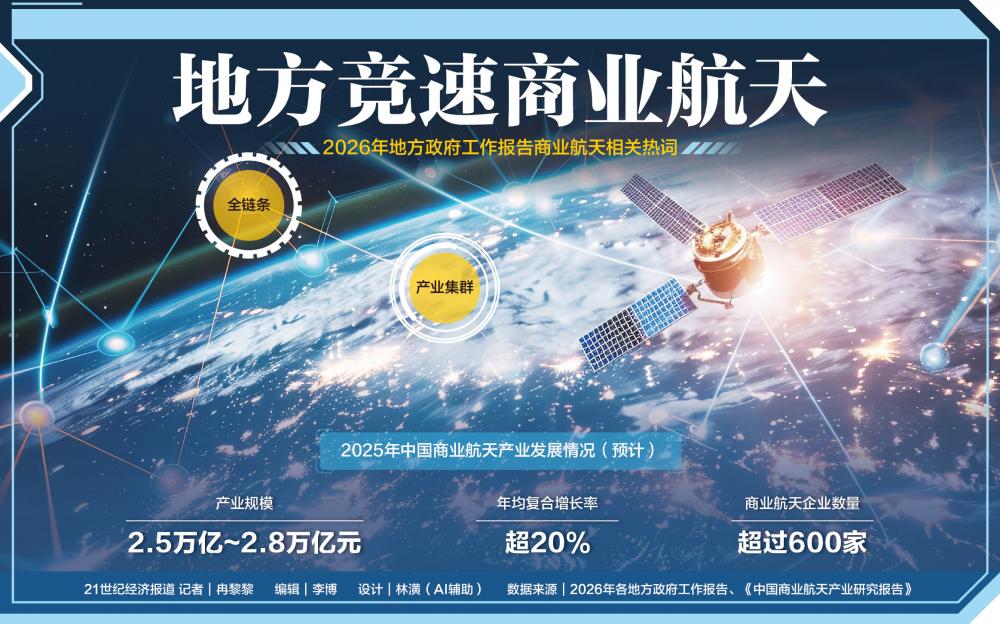
地方竞速商业航天
21世纪经济报道· 2026-02-04 04:56
Core Viewpoint - The article emphasizes the significant attention and expectations surrounding the development of China's commercial aerospace industry by 2026, driven by government initiatives and local policies aimed at fostering a comprehensive industrial ecosystem [1][4]. Group 1: Full Chain Layout - The concept of "full chain" is highlighted as a key strategy in various provinces, aiming to enhance the development of critical technologies in commercial aerospace and related fields [5][6]. - Guangdong aims for a comprehensive push in key technologies related to low-altitude and commercial aerospace by 2026, targeting an industry scale of 300 billion yuan [5]. - Beijing has established over 210 commercial aerospace-related enterprises and plans to significantly increase its rocket launch capacity by 2025, aiming for 90% of national commercial rocket launches [5][6]. Group 2: Industry Cluster Development - The term "industry cluster" is another focal point, with provinces like Zhejiang and Shandong emphasizing the development of emerging industries, including aerospace, to enhance regional economic growth [10][11]. - Shandong's Eastern Aerospace Port is noted as China's only commercial maritime launch base, with plans to support the entire aerospace industry chain and facilitate the launch of 137 satellites [10]. - Local governments are encouraged to leverage their unique resources and industrial bases to foster collaboration and avoid redundant construction, thereby creating a distinctive and complementary commercial aerospace development landscape [11]. Group 3: Corporate Initiatives - Companies are recognized as crucial players in advancing the aerospace industry, with specific firms like Tianbing Technology and Tianzhang Satellite receiving support to enhance their capabilities [12]. - Innovations in technology are being prioritized, with companies like Galaxy Aerospace focusing on developing satellite technology that connects directly to mobile phones, aiming for mass production of key devices [12][13]. - Hongqing Technology is also concentrating on integrating satellite platforms and rockets, enhancing efficiency in system delivery and communication networks [13].
“10万亿俱乐部”扩容 “老四川”经济总量突破10万亿
Sou Hu Cai Jing· 2026-02-04 03:26
Core Viewpoint - The economic landscape of China is witnessing significant growth, with Shandong becoming the third province to surpass a GDP of 10 trillion yuan, alongside Guangdong and Jiangsu. Meanwhile, the Sichuan-Chongqing region is projected to exceed a combined GDP of 10 trillion yuan by 2025, marking a historic economic milestone for the area [1][2]. Group 1: Economic Milestones - Shandong has officially announced its GDP has surpassed 10 trillion yuan, joining Guangdong and Jiangsu as the only provinces to achieve this status [1]. - The Sichuan-Chongqing region is expected to surpass a combined GDP of 10 trillion yuan by 2025, with the Chengdu-Chongqing economic circle projected to exceed 9 trillion yuan [1][2]. Group 2: Historical Context - Historically, Sichuan and Chongqing were part of the same province until 1997 when Chongqing was designated as a direct-controlled municipality, leading to a division that impacted economic dynamics [2][4]. - The re-establishment of the Chengdu-Chongqing economic circle signifies a return to collaboration between the two regions, which were once unified [2][6]. Group 3: Economic Growth Drivers - In 2022, Sichuan's GDP reached 6.77 trillion yuan, while Chongqing's GDP was 3.37 trillion yuan, ranking them 5th and 16th among Chinese provinces, respectively [7]. - The regions have benefited from over 800 billion yuan in fiscal transfer payments, alongside national strategic support for the western development and significant infrastructure investments [9]. - Key industries contributing to this growth include electronics, advanced manufacturing, and distinctive consumer goods, with Sichuan and Chongqing forming several trillion-yuan industrial clusters [9][10]. Group 4: Industrial Competitiveness - Sichuan and Chongqing have established five national-level advanced manufacturing clusters, including electronics and biomedicine, which are crucial for their economic competitiveness [10][11]. - The regions are also focusing on innovation in emerging industries, such as new energy vehicles and advanced materials, to sustain long-term growth [11][12]. Group 5: Future Economic Positioning - By 2025, Sichuan is projected to maintain its position as the largest economy in Central and Western China, with a GDP of 6.77 trillion yuan, surpassing Henan's 6.66 trillion yuan [12][14]. - The competition between Sichuan and Henan will depend on industrial strengths and regional development strategies, with Sichuan emphasizing its electronic information and high-end equipment sectors [14][15].

商业航天大年来了 广东、山东、浙江等10多个地方争相布局
2 1 Shi Ji Jing Ji Bao Dao· 2026-02-03 23:49
Core Insights - The "14th Five-Year Plan" emphasizes the acceleration of building a strong aerospace nation and the development of strategic emerging industries, including aerospace [1][14] - By 2026, the goal is to establish aerospace as a new pillar industry, with significant attention on commercial aerospace development [1][14] - Over 20 provinces have initiated local meetings, with about half directly or indirectly addressing commercial aerospace in their government work reports [1][16] Full Chain Layout - The Chinese commercial aerospace industry is projected to reach a scale of 2.5 to 2.8 trillion yuan by 2025, with an annual compound growth rate exceeding 20% and over 600 companies in the sector [3][16] - Key terms in local government plans include "full chain" and "industrial clusters," with Guangdong aiming for breakthroughs in core technologies related to low-altitude and commercial aerospace by 2026 [4][17] - Beijing has established over 210 commercial aerospace-related enterprises, with plans for significant increases in launch activities by 2025 [4][17] Industrial Clusters Development - Zhejiang aims to support the development of emerging industrial clusters, including aerospace, with a target for strategic emerging industries to account for 35% of industrial output [9][21] - Shandong is focusing on building a commercial aerospace industry cluster around the Dongfang Aerospace Port, which has launched 137 satellites [10][22] - Local governments are encouraged to leverage their unique resources and capabilities to develop aerospace technologies and industries in a coordinated manner [11][23] Challenges and Recommendations - The industry faces challenges such as high entry barriers, insufficient collaboration, funding gaps, and limited application scenarios [6][19] - Recommendations include enhancing the policy framework, improving infrastructure, and fostering innovation in business models to support the industry's growth [20] - The need for a comprehensive ecosystem that integrates the entire aerospace value chain is emphasized to enhance competitiveness and reduce dependency on external supply chains [20] Company Initiatives - Companies like Tianbing Technology and Tianzhang Satellite are being supported to grow and enhance their capabilities in the commercial aerospace sector [12][24] - Innovations in satellite technology, such as mobile direct satellite communication, are being pursued by companies like Galaxy Aerospace [12][24] - Hongqing Technology is focusing on integrating satellite platforms and rockets to improve efficiency and delivery capabilities [13][25]