公募基金业绩比较基准

Search documents
强化投资约束,公募基金业绩比较基准指引出台
Zhong Guo Zheng Quan Bao· 2026-01-23 10:44
规则突出基准对产品的表征作用,强化基准对投资的约束作用,发挥基准对考核的指导作用,强化基准 的外部监督。 证监会1月23日消息,证监会近日发布了《公开募集证券投资基金业绩比较基准指引》,基金业协会同 步发布了《公开募集证券投资基金业绩比较基准操作细则》,这标志着《推动公募基金高质量发展行动 方案》又一重要成果落地。 要 点概览 明确业绩比较基准应充分体现产品定位和投资风格,与投资策略、投资方向和风险收益特征相匹配 要求管理人根据产品定位、投资风格和业绩比较基准任命具备相关管理经验的基金经理,且基准一经选 定不得随意变化,不得仅因基金经理变化、市场短期变动、业绩考核或者排名而变更基准 要求管理人建立健全覆盖业绩比较基准选取、披露、监测、纠偏和问责等全流程管控机制,为业绩比较 基准发挥功能作用提供保障 提高基准选取的决策层级,由公司管理层对基准选取进行决策,并对选取基准承担主要责任 由独立部门负责监测基金偏离情况,由投资决策委员会对偏离进行判断,从而对投资形成监督约束 明确管理人应建立以基金投资收益为核心的考核体系,体现产品业绩和投资者盈亏情况,健全与基金投 资收益相挂钩的薪酬管理机制 在衡量主动权益基金业绩时, ...
【公募基金】强化基准“锚尺”作用——《公开募集证券投资基金业绩比较基准指引(征求意见稿)》点评
华宝财富魔方· 2025-11-05 09:40
Core Viewpoint - The release of the "Guidelines for Performance Comparison Benchmarks of Publicly Raised Securities Investment Funds (Draft for Comments)" and the "Operational Details for Performance Comparison Benchmarks of Publicly Raised Securities Investment Funds (Draft for Comments)" marks a significant step in enhancing the accountability of fund managers and promoting high-quality development in the public fund industry, aiming to standardize investment behavior and prevent style drift [3][5][24]. Summary by Sections 1. Performance Benchmark Usage and Management - The guidelines clarify the norms for selecting and using performance benchmarks, emphasizing their representational role [4][6]. - Fund managers are required to embed benchmark management throughout the product lifecycle, establishing a comprehensive internal control mechanism [7][8]. - External supervision is strengthened by activating the roles of custodians, sales institutions, and evaluation agencies, creating a multi-party check-and-balance ecosystem [9]. - A one-year transition period is set for existing products to adjust benchmarks, ensuring market stability [10]. 2. Implementation and Impact - Traditional broad-based indices remain the mainstream benchmark choice for newly launched products, reflecting market recognition and maturity [13][14]. - Changes in benchmarks accurately reflect product positioning and investment styles, with many funds adjusting their benchmarks to align with their investment strategies [16][17]. - The bond fund sector shows a high concentration in benchmark selection, primarily using the "China Bond Comprehensive Price Index" [20][21]. 3. Future Policies and Long-term Effects - The new regulations aim to enhance the clarity and transparency of risk-return characteristics of fund products, ultimately serving to protect investors' fundamental interests [24][25]. - Future measures will include revising fund manager compensation assessment rules to link performance benchmarks with management evaluations, promoting a focus on long-term, risk-adjusted excess returns [24]. - The new rules significantly improve information transparency and investor rights protection, fostering a shift from absolute to relative return assessments among investors [25].


《公开募集证券投资基金业绩比较基准指引(征求意见稿)》点评:强化基准“锚尺”作用
HWABAO SECURITIES· 2025-11-05 09:02
Regulatory Framework - The China Securities Regulatory Commission (CSRC) released the "Guidelines for Performance Comparison Benchmarks of Publicly Raised Securities Investment Funds" on October 31, 2025, marking a significant regulatory update[5] - The guidelines aim to enhance the representativeness and binding force of performance benchmarks, ensuring clear risk-return characteristics of fund products[25] Key Features of the Guidelines - The guidelines emphasize the establishment of a comprehensive internal control mechanism for fund managers regarding benchmark selection, modification, and disclosure[6] - Fund managers are required to embed benchmark management throughout the product lifecycle, ensuring effective internal constraints[8] - The guidelines mandate that benchmarks must accurately reflect the product's investment style and strategy, preventing arbitrary changes due to market fluctuations[9] Market Impact - Traditional broad-based indices remain the primary benchmark choice for newly launched products, with indices like the Hang Seng Index and CSI 800 being the most popular[15] - The guidelines have led to a significant increase in the number of funds adjusting their benchmarks to better align with their investment strategies, with 16 funds adjusting their asset composition ratios since the guidelines were issued[21] Investor Protection - The new regulations enhance transparency by requiring detailed disclosures comparing fund portfolios with benchmarks, allowing investors to assess fund performance more effectively[26] - The guidelines aim to shift investor focus from absolute returns to a more rational evaluation of relative performance, fostering a more informed investment culture[26]
重磅来了!已下发
Zhong Guo Ji Jin Bao· 2025-11-04 14:25
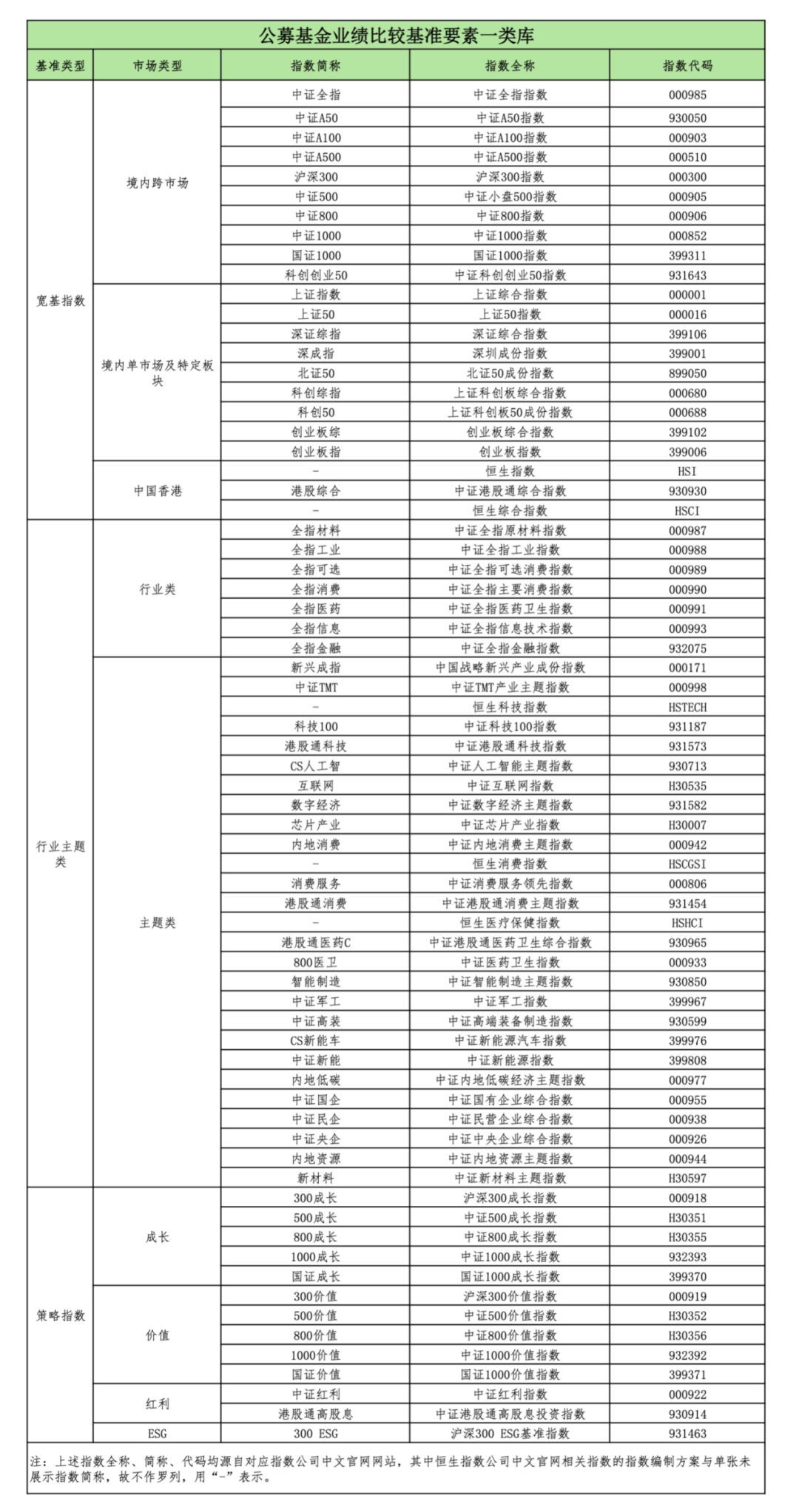
Core Viewpoint - The newly released guidelines for public fund performance benchmarks aim to standardize the evaluation of fund performance, providing a structured framework for fund companies to select appropriate benchmarks and improve transparency in performance assessment [1][14]. Group 1: Benchmark Library Structure - The benchmark library consists of two categories: Category One and Category Two, with Category One including highly recognized indices and Category Two accommodating innovative and differentiated indices [2][5]. - Category One includes 69 indices, while Category Two comprises 72 indices, both categorized into broad-based indices, industry-themed indices, and strategy indices [6][7]. Group 2: Entry Standards for Indices - Category Two indices must meet specific criteria, such as a maximum weight of 20% for any single component in broad-based indices and a minimum of 30 components for non-broad-based indices [3]. - Category One indices require a minimum average free float market capitalization of 10,000 billion yuan over the past year, in addition to meeting Category Two standards [3]. Group 3: Performance Evaluation Metrics - Fund managers are encouraged to use various performance metrics, including information ratio, tracking error, and excess return, to monitor deviations from benchmarks [11][12]. - The calculation of benchmark returns should be based on daily returns and time-weighted principles, ensuring consistency and comparability with fund performance [13]. Group 4: Industry Impact and Future Directions - The standardization of performance benchmarks is expected to reshape the industry ecosystem, enhancing investor experience and promoting high-quality development in public funds [14][15]. - Suggestions for future improvements include the establishment of a benchmark database and educational initiatives to help investors understand the significance of performance benchmarks [15].
重磅来了!已下发
中国基金报· 2025-11-04 14:19
Core Viewpoint - The newly released guidelines for public fund performance benchmarks aim to standardize the evaluation of fund performance, providing a clear framework for fund companies to select appropriate benchmarks and improve transparency in performance assessment [2][16]. Summary by Sections Introduction of Benchmark Libraries - The Asset Management Association of China has issued a draft guideline for public fund performance benchmarks, which includes the establishment of a benchmark element library consisting of two categories: Category One and Category Two [4][5]. - The benchmark library serves as a critical tool for evaluating fund performance, helping to correct issues like "style drift" in fund management [2][4]. Definition and Standards of Benchmark Libraries - Category One includes highly recognized and representative stock indices, while Category Two includes indices that are innovative and differentiated, with a focus on larger market capitalization [5][6]. - Specific criteria for inclusion in Category Two include a maximum weight of 20% for any single security in broad-based indices and a minimum of 30 constituent securities for non-broad indices [5]. Composition of Benchmark Libraries - Category One consists of 69 indices, while Category Two includes 72 indices, both categorized into broad-based indices, industry thematic indices, and strategy indices [7]. - Notable indices in Category One include the CSI All Share Index, CSI 50 Index, and CSI 300 Index, while Category Two includes indices like the CSI 700 Index and CSI 2000 Index [9][10]. Performance Evaluation and Calculation - The guidelines specify that performance benchmarks should be calculated based on daily returns and time-weighted principles, ensuring consistency and comparability with fund performance [14]. - The guidelines also emphasize the importance of various performance indicators, such as tracking error and excess returns, to monitor deviations from benchmarks [13][14]. Impact on the Industry - The standardization of performance benchmarks is expected to reshape the industry ecosystem, enhancing the overall quality of public funds and improving investor experience [16][17]. - The guidelines are seen as a crucial step in promoting transparency and discipline within the fund management industry, aligning with the principle of fiduciary duty [16][17].

基准库要来了!公募基金业绩比较基准将从这里选
Zhong Guo Zheng Quan Bao· 2025-11-04 12:48
Core Viewpoint - The establishment of the performance benchmark element library aims to standardize the selection of benchmark elements for public funds, encouraging equity investment and clarifying investment styles [1][3]. Group 1: Benchmark Library Structure - The benchmark library is divided into two categories: Category One and Category Two, primarily including stock indices to encourage public funds to increase equity investments [2][4]. - Category One includes 69 indices that are highly representative and widely recognized, while Category Two includes 72 indices that provide innovation and differentiation [2]. - The expert group will regularly evaluate the inclusion and exclusion of benchmark elements and adjustments between the two categories, with quarterly assessments for entry and exit and semi-annual evaluations for category adjustments [2][4]. Group 2: Regulatory Framework - The China Securities Regulatory Commission (CSRC) has released guidelines for public fund performance benchmarks, with the Asset Management Association of China responsible for creating operational details and maintaining the benchmark library [3]. - The establishment of the benchmark library is intended to guide industry institutions in the standardized selection of benchmark elements, providing a reference for their choices [3][4]. - The expert working group consists of representatives from various market institutions, ensuring objective and fair evaluations of benchmark elements [4].
锚定基准 回归本源公募行业生态优化进行时
Shang Hai Zheng Quan Bao· 2025-11-03 18:16
Core Viewpoint - The introduction of the new guidelines and operational details for public fund performance benchmarks is a significant step for the industry, aiming to establish a sound ecosystem centered around benchmarks, enhance investor experience, and promote high-quality development in the public fund sector [2][3][6]. Group 1: Guidelines and Operational Details - The guidelines consist of six chapters and twenty-one articles, emphasizing the representation, constraint, and evaluation roles of performance benchmarks, and requiring fund managers to establish internal control mechanisms to ensure investment style stability [3]. - The operational details further clarify the selection, display, information disclosure, risk control, and compliance management related to performance benchmarks, consisting of six chapters and twenty-nine articles [3]. Group 2: Industry Challenges and Responses - The public fund industry has faced long-standing issues with the rough setting of performance benchmarks, with statistics showing that among 2,416 equity funds, there are 211 different benchmarks, with nearly half using the CSI 300 index [4]. - The choice of performance benchmark directly affects the ease with which fund managers can generate excess returns, as demonstrated by the difference in performance when using price indices versus total return indices [4]. Group 3: Impact on the Industry Ecosystem - The standardization of performance benchmarks is expected to reshape the industry ecosystem, benefiting the overall capital market, asset management by fund managers, and the investment experience of investors [6][7]. - The new guidelines will enforce strict supervision over the selection and modification of performance benchmarks, ensuring they accurately reflect product positioning, investment strategies, and performance measurement [7]. Group 4: Future Actions by Fund Companies - Fund companies are planning systematic reviews and evaluations of their performance benchmarks to ensure their rationality, fairness, and clarity, while also enhancing the constraints imposed by these benchmarks [8][9]. - Companies like E Fund are committed to strengthening the selection, monitoring, evaluation, and correction mechanisms for performance benchmarks to better align actual investment behavior with product strategy [9].

【公募基金】央行恢复购债,债市情绪回暖——公募基金泛固收指数跟踪周报(2025.10.27-2025.10.31)
华宝财富魔方· 2025-11-03 08:58
Market Overview - The bond market showed signs of recovery last week (October 27-31, 2025), with the 1-year government bond yield decreasing by 8.90 basis points to 1.38%, the 10-year yield down by 5.32 basis points to 1.80%, and the 30-year yield down by 6.95 basis points to 2.14%. This recovery was supported by the central bank's resumption of open market operations and the successful meeting between the US and Chinese presidents, which boosted market sentiment [3][14]. - Short-term outlook indicates that the benefits of the central bank's bond purchases have largely been priced in. The stock market's slow bullish trend may continue to suppress bond market sentiment, while upcoming fund rate regulations could lead to redemptions and portfolio adjustments, causing temporary disruptions in the bond market [14]. Public Fund Market Dynamics - On October 31, the China Securities Regulatory Commission (CSRC) released a draft guideline for the performance comparison benchmarks of publicly offered securities investment funds, seeking public feedback. This guideline emphasizes the representation, constraint, evaluation, and interaction of performance benchmarks [17][18][19][20]. Fund Index Performance Tracking - The Money Enhanced Index rose by 0.03% last week, with a cumulative return of 4.24% since inception [4]. - The Short-term Bond Fund Index increased by 0.07%, achieving a cumulative return of 4.42% since inception [5]. - The Medium to Long-term Bond Fund Index saw a rise of 0.28%, with a cumulative return of 6.74% since inception [6]. - The Low Volatility Fixed Income + Fund Index increased by 0.37%, with a cumulative return of 4.58% since inception [7]. - The Medium Volatility Fixed Income + Fund Index rose by 0.33%, achieving a cumulative return of 6.04% since inception [8]. - The High Volatility Fixed Income + Fund Index increased by 0.32%, with a cumulative return of 7.90% since inception [9]. - The Convertible Bond Fund Index rose by 0.94%, achieving a cumulative return of 22.94% since inception [10]. - The QDII Bond Fund Index decreased by 0.07%, with a cumulative return of 10.46% since inception [11]. - The REITs Fund Index increased by 0.99%, achieving a cumulative return of 33.23% since inception [12].

早报公募基金业绩比较基准指引征求意见稿发布,两部门发布黄金有关税收政策的公告
Sou Hu Cai Jing· 2025-11-03 04:38
Company News - Anshi China has established sufficient finished and in-process inventory to continuously meet customer order demands [7] - Vanke A announced a framework agreement with Shenzhen Metro Group, stipulating a borrowing limit of up to 22 billion yuan [8] - Taiyuan Heavy Industry reported that its annual report financial indicators contain false records, and its stock abbreviation will change to "ST Tai Heavy" starting November 4 [9] - Li Auto is recalling 11,411 units of the MEGA 2024 electric vehicle due to insufficient corrosion resistance of the coolant [10] - Wens Foodstuff Group signed a strategic cooperation framework agreement with Huawei Technologies on November 1 [11] - Sanqi received an administrative penalty notice from the China Securities Regulatory Commission [12] - Qingyue Technology is under investigation by the China Securities Regulatory Commission for suspected false records in periodic reports [13] Industry News - The China Securities Regulatory Commission released a draft guideline for the performance comparison benchmark of publicly raised securities investment funds, aiming to enhance the stability of public fund investment behavior and improve investor experience [5] - The Ministry of Finance and the State Administration of Taxation announced a tax policy regarding gold, exempting value-added tax for members or clients trading standard gold through the Shanghai Gold Exchange and Shanghai Futures Exchange [6] - According to the latest data from the China Index Academy, the total sales of the top 100 real estate companies from January to October 2025 reached 289.67 billion yuan, a year-on-year decrease of 16.3% [6] - The president of the China Animal Husbandry Association emphasized the need to control pig production capacity and for large enterprises to lead in responding to national regulatory policies [6]
读创财经晨汇|①深圳并购重组行动方案发布后首单公告出炉②商务部将推动尽快恢复中日韩自贸协定谈判
Sou Hu Cai Jing· 2025-11-03 00:10
Group 1 - In the first ten months of the year, Hong Kong Stock Exchange ranked first globally with over 210 billion HKD in fundraising, with 80 companies listed, a 32.5% increase from the previous year [1][1] - Shenzhen had 9 companies listed in Hong Kong, including well-known brands like Guanghetong and Fengcai Technology, contributing to the city's globalization efforts [1][1] - The total fundraising amount of 215.46 billion HKD exceeded the combined IPO fundraising amounts for 2023 and 2024, marking a 202.07% increase year-on-year [1][1] Group 2 - Shahe Co. announced a significant asset restructuring plan to acquire 70% of Jinghua Electronics, marking the first major restructuring case following Shenzhen's new merger and acquisition policies [2][2] - The restructuring aligns with Shenzhen's "Three-Year Action" policy aimed at enhancing the valuation of state-owned enterprises and promoting strategic mergers [2][2] Group 3 - Eleven Shenzhen companies made it to the "Top 100 Foreign-Funded Enterprises in Guangdong" list, showcasing the city's diverse economic landscape and competitive strength [3][3] - Notable companies include Siemens, Walmart, and DuPont, representing key sectors such as manufacturing, retail, and logistics [3][3] Group 4 - In Q3 2025, the net absorption of premium office space in Shenzhen increased by 68.5% year-on-year, driven by growth in technology and trade sectors [4][5] - The market saw a record high of 445,000 square meters of new supply, with half coming from Qianhai [4][5] Group 5 - In October, the retail market for narrow passenger vehicles is expected to reach approximately 2.2 million units, with electric vehicle sales projected at around 1.32 million units, achieving a penetration rate of about 60% [7][7] - Companies like Xpeng and NIO reported significant year-on-year delivery increases, with Xpeng delivering 355,200 units, a 190% increase [7][7] Group 6 - As of October 31, 2023, the quality of information disclosure among A-share listed companies reached an excellent rate of 85.24%, with 1,001 companies rated as A-class [8][9] - The evaluation covered aspects such as disclosure compliance, investor relations, and social responsibility [9][9]