公募基金业绩比较基准

Search documents
公开募集证券投资基金业绩比较基准指引与操作细则解读
Minmetals Securities· 2026-02-02 07:17
Regulatory Framework - The China Securities Regulatory Commission (CSRC) issued the "Guidelines for Performance Comparison Benchmarks of Publicly Raised Securities Investment Funds" on January 23, 2026, which will take effect on March 1, 2026[1] - The guidelines consist of six chapters and twenty-one articles, emphasizing the serious and stable application of performance comparison benchmarks[2] Internal Control and Management - Fund managers are required to establish robust internal control mechanisms and management systems to ensure the stability of fund managers and investment styles[3] - The guidelines mandate that performance benchmarks must align with the core elements of the fund contract and investment style, and cannot be changed arbitrarily once selected[9] External Constraints and Supervision - The guidelines enhance external constraints by clarifying the supervisory responsibilities of fund custodians and regulating the behavior of fund sales and evaluation institutions regarding performance benchmarks[2] - Strict regulatory measures will be enforced by the CSRC against violations by fund managers, custodians, sales institutions, and evaluation agencies[10] Performance Benchmark Standards - The "Operational Guidelines" consist of six chapters and twenty-eight articles, detailing the standards for establishing performance benchmarks, which must be representative and sustainable[11] - Fund managers must regularly assess the rationality and potential risks of deviations from performance benchmarks, ensuring compliance and accountability[11] Industry Development Trends - The public fund industry is expected to focus on equity funds, with a need for repositioning in actively managed equity funds[12] - Future adjustments may include thematic funds covering multiple industries and multi-asset investment funds to diversify risks and enhance performance stability[13] Policy Implications - The guidelines support the high-quality development of public funds, addressing issues such as significant performance deviations from benchmarks in actively managed equity funds[12] - The government aims for publicly raised funds to increase their holdings of A-shares by at least 10% annually over the next three years[12]
从“随意设定”走向“标准化管理”!公募业绩比较基准要素库正式出炉
券商中国· 2026-01-31 04:41
Core Viewpoint - The establishment of the public fund performance benchmark element library marks a significant step in the reform of the public fund industry in China, aiming to standardize the selection and use of performance benchmarks, thereby protecting investors' rights and interests [2][11]. Group 1: Benchmark Element Library Release - The China Securities Investment Fund Association (CSIFA) has officially released the public fund performance benchmark element library, which includes 155 indices, an increase of 14 indices from the previous draft [1][14]. - The release follows the publication of guidelines and operational details for public fund performance benchmarks, indicating a move towards a more standardized management approach [2][11]. Group 2: Structure of the Benchmark Library - The benchmark library consists of two categories: Category One includes 82 indices that are highly representative and widely recognized, while Category Two includes 73 indices that offer innovation and differentiation [12][13]. - The indices in Category One are intended to encourage fund managers to select and use benchmarks in a standardized manner, enhancing comparability among fund performances [12][11]. Group 3: Adjustments and Requirements - Compared to the draft, the final version of the benchmark library has increased the average daily free float market value requirements for indices, with Category One requiring a minimum of 12 trillion yuan and Category Two requiring 8 trillion yuan [15]. - New thematic indices covering sectors such as manufacturing and green low-carbon have been added to Category One, expanding the scope of the benchmarks [16]. Group 4: Future Maintenance and Evaluation - The CSIFA plans to establish an expert group to oversee the dynamic maintenance of the benchmark library, with evaluations conducted quarterly for the entry and exit of benchmark elements [13][14]. - Adjustments between the two categories will be made based on expert evaluations, ensuring that the benchmarks remain relevant and effective [13].


发挥“锚”和“尺”作用 保护投资者合法权益
Xin Lang Cai Jing· 2026-01-29 19:49
Core Viewpoint - The China Securities Regulatory Commission has released the "Guidelines for Performance Benchmarking of Publicly Raised Securities Investment Funds," aiming to standardize the selection and use of performance benchmarks, enhance internal controls, and protect investors' rights [1][2]. Group 1: Guidelines Overview - The guidelines consist of 21 articles addressing benchmark standardization, internal controls for fund managers, external constraints, and supervision [1]. - The guidelines emphasize the importance of performance benchmarks in defining product investment styles, constraining investment behavior, and measuring performance [2]. Group 2: Current Issues in the Industry - Current public funds face issues such as a lack of specific regulations on performance benchmarks, weak internal control mechanisms, and significant deviations from benchmarks by actively managed equity funds [2]. - The guidelines and accompanying "Operational Details" aim to address these issues by providing a structured approach to benchmark management [2]. Group 3: Strengthening Benchmark Constraints - The guidelines stress the serious and stable application of performance benchmarks, requiring them to match the core elements of fund contracts and investment styles [3]. - Changes to benchmarks are strictly regulated, requiring prior notice and adherence to specific procedures to ensure transparency and protect investor interests [3]. Group 4: Performance Measurement - The guidelines link fund performance directly to benchmarks, establishing a core constraint for performance evaluation and management compensation [5]. - Fund managers are required to conduct performance attribution analysis and ensure that long-term performance aligns with benchmarks, with penalties for underperformance [5]. Group 5: Transition Periods - A one-year transition period is provided for existing products to comply with the new benchmark guidelines, ensuring a smooth adjustment process [5]. - A six-month transition period is allocated for custodians to enhance their supervision of fund investment style stability [5].
告别“基金盲盒”!监管又有新动作
Xin Lang Cai Jing· 2026-01-28 02:08
Core Viewpoint - The China Securities Regulatory Commission and the Asset Management Association of China have jointly released new guidelines and operational details for public fund performance benchmarks, establishing a benchmark library to standardize the selection and use of performance comparison benchmarks in the public fund industry [5][19]. Group 1: Benchmark Library Overview - The benchmark library includes operational guidelines and two categories of stock indices, focusing on the selection of stock indices and establishing a tiered benchmark library [14][19]. - The first category includes widely recognized indices such as the CSI 300 Index and the CSI A500 Index, while the second category includes indices like the SSE 180 Index and the CSI 2000 Index [14][19]. Group 2: Objectives and Benefits - The establishment of the benchmark library aims to enhance the comparability of performance among similar products and guide fund managers in adhering to relevant requirements [14][19]. - The indices within the benchmark library are expected to encourage and guide industry institutions in the standardized selection of benchmarks that represent equity assets, effectively regulating investment behavior [14][19]. Group 3: Implementation and Management - The guidelines emphasize the need for self-regulation in the selection and use of performance benchmarks, with the association responsible for maintaining the benchmark library [5][19]. - An expert group has been formed to oversee the establishment and maintenance of the benchmark library, ensuring that the benchmarks are updated and managed in an orderly manner [12][26].
告别“基金盲盒”!监管又有新动作
中国基金报· 2026-01-28 01:41
Core Viewpoint - The China Fund Industry Association has released a benchmark library to standardize the selection and use of performance comparison benchmarks for public funds, aiming to enhance comparability among fund products and guide industry practices [2][6][7]. Summary by Sections Benchmark Library Overview - The benchmark library includes operational guidelines and categorizes stock indices into two tiers, with major indices like the CSI 300 and CSI A500 included in the first tier, while others like the SSE 180 and CSI 2000 are in the second tier [2][7]. Key Regulations - The guidelines aim to address industry issues such as "ambiguous benchmarks," "style drift," and "fund blind boxes," ensuring that fund managers select benchmarks that accurately represent their investment strategies [6][7]. Selection and Categorization of Indices - The first tier of the benchmark library consists of widely recognized indices that reflect market performance, while the second tier includes indices with significant usage and market capitalization, serving as a supplement to the first tier [11][12]. Dynamic Management of the Benchmark Library - The library will be dynamically updated and managed to ensure the objectivity and fairness of the benchmarks, with an expert working group established to evaluate and decide on the inclusion and adjustment of benchmark elements [14][16]. Encouragement of Compliance and Quality - The guidelines also set requirements for index providers to enhance their service quality, including governance, compliance, and transparency in index maintenance [16].

系统规范公募基金业绩比较基准管理
Jin Rong Shi Bao· 2026-01-28 00:46
Core Viewpoint - The release of the "Guidelines for Performance Benchmarking of Publicly Raised Securities Investment Funds" and the "Operational Rules for Performance Benchmarking" marks a new phase of systematic and standardized benchmark management in China's public fund industry, aimed at addressing issues like "style drift" and benchmark abuse, while enhancing product transparency and investment discipline [1][3]. Group 1: Guidelines and Operational Rules - The guidelines will take effect on March 1, 2026, and are designed to prevent "style drift" in public funds by establishing a comprehensive internal control mechanism for fund companies and unified requirements for collaborative supervision among third-party institutions [1][2]. - The guidelines consist of six chapters and 21 articles, covering aspects such as the selection, change, and disclosure of performance benchmarks, as well as internal controls and external constraints [4]. Group 2: Role of Performance Benchmark - Performance benchmarks serve as a "anchor" and "ruler" for fund investments, clarifying product positioning, investment strategies, and measuring performance [2][3]. - The guidelines emphasize the serious and stable application of performance benchmarks, requiring that they reflect product positioning and investment style, and that fund managers appoint experienced fund managers based on these benchmarks [4][5]. Group 3: Investor Protection and Experience - The guidelines and operational rules focus on investor interests, addressing long-standing issues like "style drift" and "fund blind boxes," thereby enhancing the investment experience and satisfaction for investors [3][4]. - By strengthening the constraints on investment behavior through improved internal control mechanisms, the guidelines aim to promote clearer and more stable investment styles and product positioning [5]. Group 4: Link to Compensation and Performance Assessment - The guidelines link performance benchmarks to fund manager compensation, encouraging a focus on long-term returns and aligning the interests of fund managers with those of investors [6]. - Regulatory bodies will further standardize fund evaluation mechanisms, requiring that performance benchmarks be used as a key basis for assessing fund management performance, risk control capabilities, and style stability [6].
陆家嘴财经早餐2026年1月28日星期三
Wind万得· 2026-01-27 23:00
Group 1 - UK Prime Minister Starmer will visit China from January 28 to 31, marking the first visit by a UK Prime Minister in eight years. Discussions will focus on bilateral relations and trade investment cooperation [3][6] - US President Trump stated that he is not concerned about the decline of the US dollar, which has recently dropped over 1% to a nearly four-year low of 95.7905 [3][6] - A new wave of price increases is sweeping the global chip industry, with Samsung and SK Hynix significantly raising prices for LPDDR memory used in iPhones by over 80% and nearly 100%, respectively [3][6] Group 2 - Clawdbot has gained significant attention in the tech industry, seen as a precursor to the future of AI agents. Meanwhile, domestic AI models are also gaining traction, with DeepSeek releasing a new OCR model [4] - The Ministry of Human Resources and Social Security announced plans to enhance labor rights for new employment forms and revise paid leave regulations [5] - The National Bureau of Statistics reported that profits of large industrial enterprises in China reached 7.4 trillion yuan in 2025, a 0.6% year-on-year increase, reversing a three-year decline [5] Group 3 - Anta Sports announced a deal to acquire a 29.06% stake in Puma for 15.06 billion euros (approximately 122.8 billion yuan), making Anta the largest shareholder of Puma [9] - The China Fund Industry Association released a performance benchmark database for public funds, focusing on stock indices [9] - The resource product LOF purchase limit has been upgraded, with major funds suspending large purchases starting January 28 [9] Group 4 - Companies such as Guotai Junan and Shenwan Hongyuan expect significant profit increases in 2025, with projected growth rates ranging from 41.76% to 115% [11] - Aisen Co. plans to invest 20 billion yuan in a semiconductor materials manufacturing base in East China [12] - The central bank reported a decrease in real estate loans, with a total balance of 51.95 trillion yuan at the end of 2025, down 963.6 billion yuan year-on-year [12]

《公募基金业绩比较基准指引》发布【国信金工】
量化藏经阁· 2026-01-27 00:08
Market Review - The A-share market showed a mixed performance among major indices, with the CSI 500, CSI 1000, and Sci-Tech 50 indices leading with returns of 4.34%, 2.89%, and 2.62% respectively, while the CSI 300, ChiNext, and Shanghai Composite indices lagged with returns of -0.62%, -0.34%, and 0.84% respectively [5][11] - The construction materials, oil and petrochemicals, and steel sectors performed well, with returns of 9.18%, 7.76%, and 6.98% respectively, while the banking, telecommunications, and food and beverage sectors underperformed with returns of -2.69%, -1.68%, and -1.57% respectively [17][18] Fund Issuance - A total of 42 new funds were established last week, with a total issuance scale of 444.54 billion yuan, showing an increase compared to the previous week [3] - 58 funds were reported for issuance last week, including 5 FOFs and 17 ETFs, indicating an increase in the number of applications [4][5] Fund Performance - The median returns for active equity, flexible allocation, and balanced mixed funds were 1.51%, 1.37%, and 1.37% respectively last week [29] - Alternative funds have shown the best performance this year, with a median return of 13.14%, while active equity, flexible allocation, and balanced mixed funds had median returns of 7.52%, 6.27%, and 5.09% respectively [29][37] Regulatory Updates - The China Securities Regulatory Commission (CSRC) issued guidelines for the performance comparison benchmarks of public funds, effective from March 1, 2026, to enhance investor protection and ensure the stability of performance benchmarks [7][8] New Market Entrants - Mizuho Securities (China) Co., Ltd. was officially established with a registered capital of 2.3 billion yuan, marking the third Japanese securities firm in China [9]

瑞达期货国债期货日报-20260126
Rui Da Qi Huo· 2026-01-26 09:19
1. Report Industry Investment Rating There is no information about the report industry investment rating in the provided content. 2. Core View of the Report - With the alleviation of some negative factors, the sentiment in the bond market has continued to improve, and ultra - long bonds have continued to recover. In 2025, China's economic structural contradictions still need to be improved. In the next stage, facing greater external uncertainty pressure, the endogenous growth foundation of the economy needs to be further consolidated, and expanding domestic demand will become the policy focus. The issuance rhythm of interest - rate bonds in January is stable, and the market's concerns about the supply pressure of long - term bonds have eased. It is expected that interest rates will fluctuate within a narrow range in the short term, and the market is still waiting for new incremental information for directional selection [2]. 3. Summary According to Relevant Catalogs 3.1 Futures Disk - T主力收盘价为108.180,环比下降0.02%,成交量为59708,环比减少6575;TF主力收盘价为105.850,环比下降0.02%,成交量为47329,环比减少15830;TS主力收盘价为102.392,环比下降0.02%,成交量为29013,环比增加5574;TL主力收盘价为112.510,环比上涨0.2%,成交量为72096,环比减少23480 [2]. 3.2 Futures Spreads - TL2603 - 2606价差为 - 0.17,环比增加0.00;T2603 - 2606价差为0.00,环比减少0.01;TF2603 - 2606价差为 - 0.05,环比减少0.02;TS2603 - 2606价差为 - 0.02,环比增加0.01;T03 - TL03价差为 - 4.33,环比减少0.22;TF03 - T03价差为 - 2.33,环比减少0.02;TS03 - T03价差为 - 5.79,环比减少0.01;TS03 - TF03价差为 - 3.46,环比增加0.00 [2]. 3.3 Futures Positions - T主力持仓量为246340,前20名空头持仓238490,环比减少1394,前20名多头持仓增加861,前20名净空仓223018,环比增加2034;TF主力持仓量146300,环比减少905,前20名多头持仓143934,环比减少414,前20名空头持仓158196,环比减少570,前20名净空仓14262,环比减少156;TS主力持仓量67591,环比减少1505,前20名多头持仓55294,环比减少466,前20名空头持仓62202,环比减少1720,前20名净空仓6908,环比减少1254;TL主力持仓量141712,环比增加1223,前20名多头持仓141637,环比增加1735,前20名空头持仓150442,环比增加1607,前20名净空仓8805,环比减少128 [2]. 3.4 Top Two CTD (Clean Prices) - 250018.IB(6y)净价为100.532,环比下降0.0007;220025.IB(6y)净价为99.0955,环比上涨0.0262;230014.IB(4y)净价为104.7631,环比上涨0.0133;240020.IB(4y)净价为100.8844,环比上涨0.0008;250017.IB(2y)净价为100.0901,环比下降0.0166;250024.IB(2y)净价为99.9298,环比下降0.0166;210005.IB(17y)净价为126.9367,环比上涨0.0489;210014.IB(18y)净价为123.6704,环比上涨0.0165 [2]. 3.5 Active Treasury Bonds - 1y国债收益率为1.2750%,环比下降0.50bp;3y国债收益率为1.4170%,环比下降0.80bp;5y国债收益率为1.5770%,环比下降1.30bp;7y国债收益率为1.6925%,环比下降0.95bp;10y国债收益率为1.8210%,环比下降0.65bp [2]. 3.6 Short - term Interest Rates - 银质押隔夜利率为1.4701%,环比上涨5.35bp;Shibor隔夜利率为1.4200%,环比上涨2.40bp;银质押7天利率为1.4800%,环比下降1.99bp;Shibor7天利率为1.5430%,环比上涨5.20bp;银质押14天利率为1.6172%,环比上涨2.51bp;Shibor14天利率为1.5990%,环比上涨2.20bp [2]. 3.7 LPR Interest Rates - 1y LPR利率为3.00%,环比无变化;5y LPR利率为3.5%,环比无变化 [2]. 3.8 Open Market Operations - 发行规模1505亿,到期规模1583亿,利率1.4%,期限7天,净投放 - 78亿 [2]. 3.9 Industry News - 证监会正式发布公募基金业绩比较基准指引,中国基金业协会同步发布操作细则,自今年3月1日起施行,新规明确存量产品基准调整过渡期一年;外交部发言人就特朗普访华及美国称允许中国购买委内瑞拉石油表态;全国市场运行和消费促进工作会议强调推动商品消费扩容升级等 [2]. 3.10 Key Data to Focus On - 1/27 09:30关注中国2025年12月及全年规模以上工业企业利润同比;1/29 03:00关注美联储FOMC公布利率决议 [3]
债市早报:资金面呈紧平衡态势;债市小幅走强
Sou Hu Cai Jing· 2026-01-26 03:21
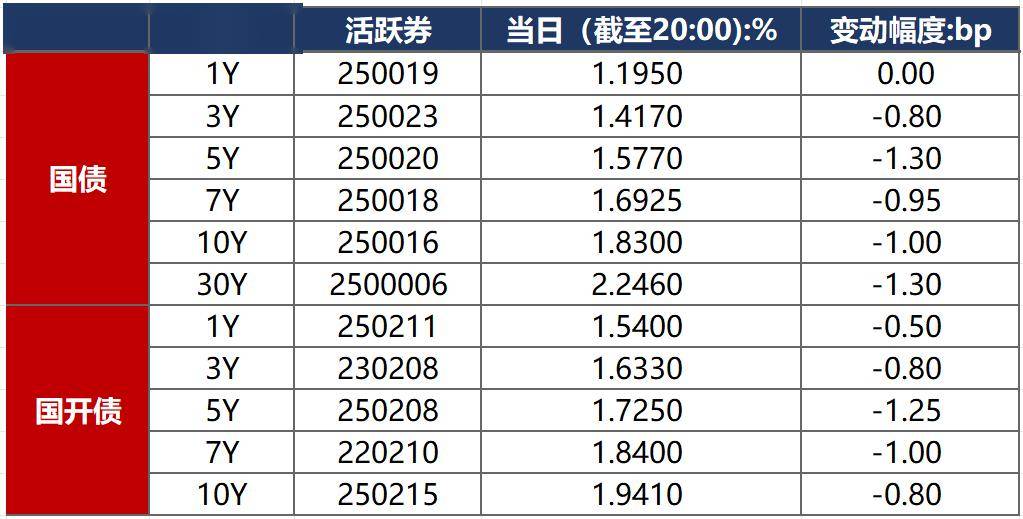
Core Viewpoint - The financial market is experiencing a tight balance in liquidity, with various indicators showing mixed trends in both domestic and international debt markets, alongside significant movements in commodity prices. Group 1: Domestic News - The People's Bank of China (PBOC) Governor Pan Gongsheng stated that by 2025, the "Technology Board" in the bond market is expected to issue a total of 1.8 trillion yuan in technology innovation bonds [2] - The China Securities Regulatory Commission (CSRC) has released guidelines for public fund performance benchmarks, effective from March 1, aimed at addressing issues like "style drift" and enhancing the value investment attributes of public funds [2] Group 2: International News - In January, the S&P Global PMI report indicated that U.S. business activity continues to grow, with the manufacturing PMI at 51.9, slightly below expectations, and the services PMI at 52.5, also below forecast [4] - The Bank of Japan maintained its policy interest rate at 0.75%, aligning with market expectations, while raising its medium- to long-term inflation forecasts, indicating a more optimistic view on price pressures [5] Group 3: Commodity Market - International crude oil prices increased, with WTI crude rising by 2.88% to $61.07 per barrel, and natural gas prices surged over 10% [6] Group 4: Financial Market Operations - On January 23, the PBOC conducted a 125 billion yuan reverse repo operation at a fixed rate of 1.40%, resulting in a net liquidity injection of 38.3 billion yuan for the day [7] - The liquidity in the market remains tight, with the DR001 and DR007 rates slightly declining to 1.398% and 1.494%, respectively [8] Group 5: Bond Market Dynamics - The bond market showed slight strength, with the yield on the 10-year government bond decreasing by 1.00 basis points to 1.8300% [9] - In the secondary market, several corporate bonds saw significant price movements, with some bonds from Vanke rising over 10% [11] Group 6: Convertible Bonds - The convertible bond market followed the equity market's upward trend, with major indices rising by approximately 1.28% to 1.32%, and a total trading volume of 104.1 billion yuan [19] - Notable individual convertible bonds saw substantial increases, with some rising over 19% [19] Group 7: Overseas Bond Market - U.S. Treasury yields generally declined, with the 10-year yield down by 2 basis points to 4.24% [21] - In the European bond market, the 10-year yields showed mixed trends, with Germany's yield rising by 2 basis points to 2.90% while France's yield fell by 2 basis points [24]